
DRY TORTUGAS · MARCH · 70 MILES WEST OF KEY WEST
Seventy miles west of Key West, the Dry Tortugas get a March of 79.6°F afternoons and 69.3°F nights, going by the official normals from the Key West station. The sea off the islands averages 78.6°F at its daily peak. For most swimmers, that is water you walk straight into from the beach on Garden Key.
The trip itself still runs through Key West: you fly or drive there, then cross open water by boat or seaplane. March only adds a date to that plan, so the choices below are about timing, nights and booking. Access, the fort and camping are covered in full in our Dry Tortugas guide.
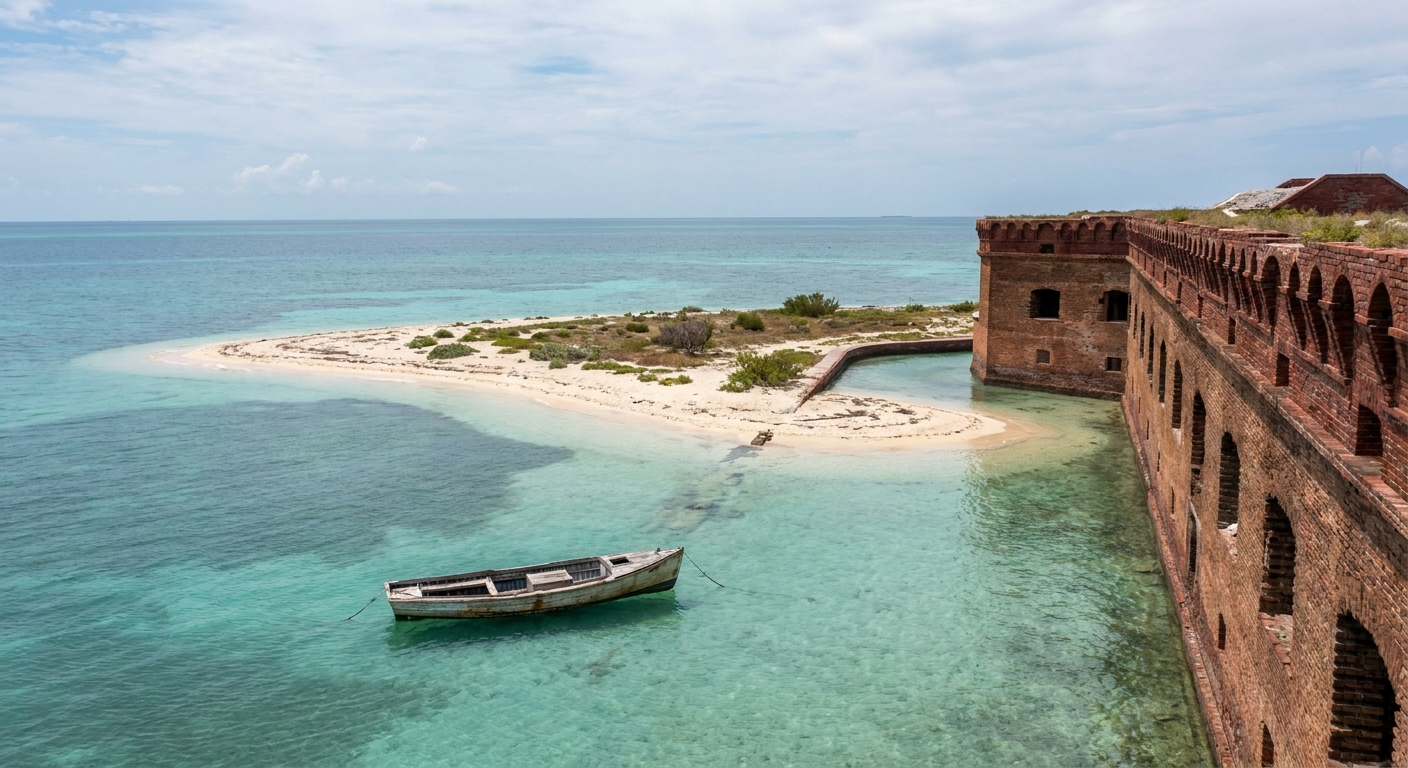
THE MONTH AT A GLANCE · DRY TORTUGAS IN MARCH
March is a warm, mostly dry month for a Dry Tortugas trip, with the sea near 78.6°F and rain on about one day in eleven, but open-water wind can still move your crossing.
KEY WEST NORMALS 1991-2020 · SEA 2015-2024 DAILY-MAX MEAN · 12 H 03 MIN OF DAYLIGHT ON MARCH 15
Go for: snorkeling in water averaging 78.6°F at its daily peak, 79.6°F afternoons on the fort walls, and a sunset after 7:30 p.m. if you camp on the island.
Think twice before: building a trip around a single fixed crossing date. The islands sit alone in open water, windier than Key West.
Air: NOAA NCEI, Key West station USW00012836 · Sea: Open-Meteo Marine API · Light: sunrise-sunset.org · full sources at the end
On this page
- Dry Tortugas weather in March79.6°F highs and 2.9 rain days
- Can you swim in Dry Tortugas in March?Sea at 78.6°F, daily-max mean
- Crowds and prices in MarchBooking the crossing and the lodging tax
- Things to do in MarchFort Jefferson, the moat wall and Loggerhead Key
- Two days in Dry Tortugas in MarchA plan built on a 7:34 a.m. sunrise
- March vs February and AprilHow the three months compare in °F and inches
- Is March a good time to visit?Who should go, and the month to pick instead
Every figure here comes from a named source, and the sources sit in different places. The air normals are NOAA’s official 1991-2020 averages for station USW00012836 at Key West, a real thermometer seventy miles east of the fort. The sea figure is a 2015-2024 mean from the Open-Meteo Marine API for the water off the Tortugas themselves. Out there, with nothing between the islands and the weather, expect more wind than the Key West numbers suggest.
Dry Tortugas weather in March: average highs, lows and rain days
| March measure | Value | Source |
|---|---|---|
| Average high | 79.6°F | NOAA NCEI 1991-2020, Key West |
| Average low | 69.3°F | NOAA NCEI 1991-2020, Key West |
| Precipitation | 1.53 in | NOAA NCEI 1991-2020, Key West |
| Days with 0.10 in or more | 2.9 | NOAA NCEI 1991-2020, Key West |
| Days with 1 in or more | 0.4 | NOAA NCEI 1991-2020, Key West |
| Sea surface, mean of daily maxima | 78.6°F | Open-Meteo Marine, 2015-2024 |
| Daylight on March 15 | 12 h 03 min | sunrise-sunset.org |
| Sunrise and sunset, March 15 | 7:34 a.m. · 7:37 p.m. EDT | sunrise-sunset.org |
NOAA’s National Centers for Environmental Information put the March average high at 79.6°F and the low at 69.3°F, with 1.53 inches of rain across the month. Those are station normals from a real thermometer at USW00012836 in Key West. A reanalysis grid cell would give a smoothed model estimate instead. Read them as the best official guide to March near the islands, taken seventy miles east of where you will stand.
Measurable rain, 0.10 inch or more, falls on 2.9 days in an average March, roughly one day in eleven. A soaking of an inch or more turns up 0.4 times a month, so about two Marches in five see one. Over a four-day trip the odds favor dry weather, and if a crossing day does turn wet, the brick casemates of Fort Jefferson give you cover.
Afternoon and dawn sit 10.3°F apart on the averages. An early crossing starts near the day’s 69.3°F low, and wind over the open deck makes it feel cooler. Pack a light long-sleeve layer for the boat or seaplane, a swimsuit under your clothes, reef-safe sunscreen and a hat for the fort’s upper tier.
On March 15 the sun rises at 7:34 a.m. and sets at 7:37 p.m. Eastern Daylight Time, for 12 hours 03 minutes of daylight. Clocks have already sprung forward by mid-month, so the evening light lasts well into dinner hour in Key West. Campers on Garden Key watch the sun go down over open water, and the light for a walk on the moat wall fades soon after 7:37 p.m.
Can you swim in Dry Tortugas in March? Sea temperature and what it feels like
The Open-Meteo Marine API puts the sea surface off Dry Tortugas at 78.6°F in March, averaged over 2015-2024. That number is a mean of daily maxima, the warmest reading of each day. A 24-hour average of the same water would come out a shade cooler, so tables that average around the clock may show a lower March figure, and both can be right.
For a swimmer, 78.6°F sits one degree below the 79.6°F average afternoon high. Walking in from the beach after lunch feels close to air temperature. Children and anyone planning a long snorkel along the fort’s moat wall may still want a rash guard or a thin shorty wetsuit, since an hour in the water at that temperature cools a small body faster than the air does.
Our sources hold no wind speed or wave height series for Dry Tortugas in March, so we give no numbers. We can say where the islands sit: alone in open water, windier than Key West, with nothing to break the weather on its way in. Check the marine forecast the evening before you cross and again at breakfast.
How busy is Dry Tortugas in March? Crowds and prices
March falls inside Florida’s dry season, November through April, which our Florida timing guide covers month by month. We found no visitor counts or fare series for Dry Tortugas by month, so we rank March neither cheap nor expensive. Treat it as a dry-season month and plan accordingly.
We could not verify how far ahead the crossings sell out in March, so we give no number of weeks. Book the boat or seaplane first, because it fixes the date, then build your Key West nights around it. Flights into the Keys are laid out in our Florida flights guide, and the Key West guide handles where to sleep before and after.
We could not verify the lodging-tax rate for a Key West hotel stay, so we give no percentage. Ask for the all-in nightly total, taxes and any resort fee included, before you pay a deposit.
Spend any extra money on flexibility in the crossing ticket. With no wind data to offer you, a fare that lets you move to another day, paired with one spare Key West night, protects a March trip better than a pricier room. Our Florida trip-cost guide sets out the rest of the budget.
Things to do in Dry Tortugas in March
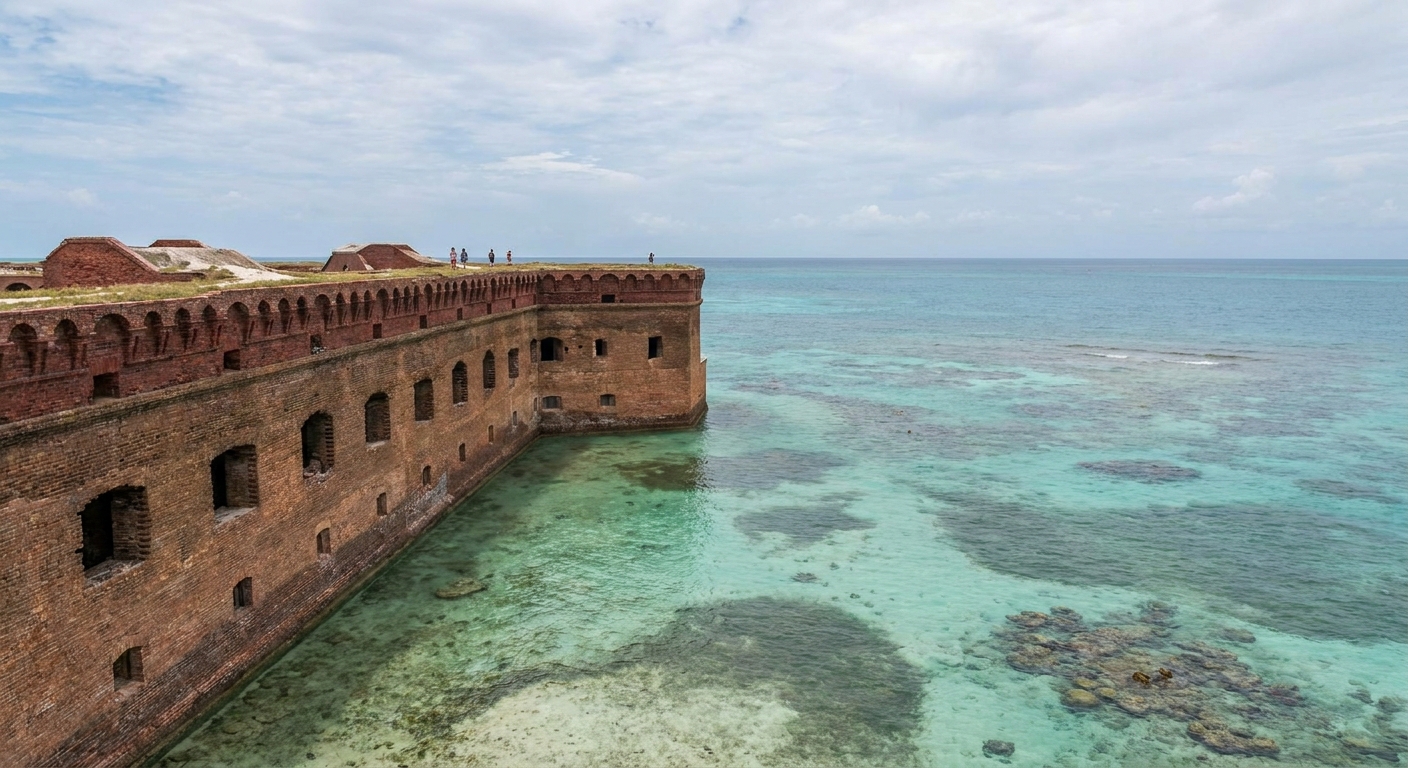
March pairs the two conditions a Tortugas day depends on: sea near 78.6°F for snorkeling, and measurable rain on only 2.9 days. February’s water averages 76.3°F by the same marine source, 2.3 degrees cooler. April runs warmer at sea but brings 2.07 inches of rain against March’s 1.53.
Fort Jefferson fills most of Garden Key, and the moat wall around it is where snorkelers follow the outside edge. The beaches beside the fort are the swim entry for day visitors. Loggerhead Key, with its lighthouse, lies farther west. We could not verify entrance fees or opening hours, so we quote none. The park and its operators publish both, and our Florida national parks guide sets Dry Tortugas beside the others.
The fort’s brick stays the same all year. The air around it moves. At a 79.6°F average afternoon, a walk along the upper tier in full sun is comfortable in a hat. By April’s 82.6°F average high, the same walk runs three degrees hotter. The sea shifts less over those four weeks: 78.6°F to 79.8°F, a 1.2-degree step against the air’s 3.0.
Our sources carry nothing on free-entry days in March, so we name none. Once you are ashore, walking the moat wall and watching sunset from the beach carry no extra charge that we know of.
Dry Tortugas in March: a two-day itinerary
Day one, the crossing. Sunrise is at 7:34 a.m., so first light is up before you reach the Key West departure point. Your operator sets the boat or seaplane time, and we did not verify schedules. On Garden Key, tour Fort Jefferson first while the air sits below its 79.6°F afternoon average. Snorkel the moat wall in early afternoon, when the water is closer to its daily peak, then climb to the upper tier before the return. Campers stay on for the 7:37 p.m. sunset.
Day two, Key West. Keep this day as your weather buffer. If the marine forecast turns and your crossing moves, day two becomes the Tortugas day and the plan above runs one day later. Hold the ticket changeable until you have seen the forecast, and let our Key West guide fill the spare hours on the island.
Dry Tortugas in March vs February and April
| Measure | February | March | April |
|---|---|---|---|
| Average high | 77.4°F | 79.6°F | 82.6°F |
| Average low | 67.1°F | 69.3°F | 73.1°F |
| Precipitation | 1.54 in | 1.53 in | 2.07 in |
| Days with 0.10 in or more | 2.4 | 2.9 | 2.8 |
| Sea surface, daily-max mean (2015-2024) | 76.3°F | 78.6°F | 79.8°F |
Air normals from the Key West station climb 2.2°F from February to March on both the high and the low. Into April they rise 3.0°F on the high and 3.8°F on the low. Rain barely moves between February’s 1.54 inches and March’s 1.53, then jumps to 2.07 in April. March counts the most measurable-rain days of the three at 2.9, a hair above April’s 2.8 and February’s 2.4. On the Open-Meteo sea figures, March gains 2.3 degrees on February and gives up 1.2 to April.
Going four weeks earlier into February buys half a rain day fewer and 2.2°F cooler afternoons for the fort walk, at the cost of water averaging 76.3°F. Going to April adds 1.2 degrees of sea and warmer nights at 73.1°F, but also 0.54 inch more rain and an 82.6°F afternoon on sunlit brick.
Is March a good time to visit Dry Tortugas?
Yes, for snorkelers and day-trippers who want warm water and a low rain count: a 78.6°F sea and 2.9 wet days make March a sound month. It suits less well anyone with one fixed date and no buffer night, since the crossing depends on open-water weather our sources cannot chart.
If warm water is the priority, April edges March by 1.2 degrees at sea. If a cooler walk around the fort matters more than the swim, February’s 77.4°F average high and 2.4 rain days suit better. Our Florida best-time guide places both in the wider calendar.
Of the three months, March brings sea and air closest together: 78.6°F water against a 79.6°F afternoon, one degree apart.
The last word
Settle the crossing date first and keep it movable, then plan the Key West nights around it. If you camp on Garden Key, take your first swim at dawn: on these averages the sea runs about nine degrees above the 69.3°F morning air, so stepping into the water warms you up.
Sources & data for this guide
- March air normals (79.6°F high, 69.3°F low, 1.53 in, 2.9 and 0.4 rain days) · NOAA NCEI monthly normals 1991-2020, station USW00012836, Key West, seventy miles east of the fort · checked Sep 24, 2026
- February and April air normals · NOAA NCEI, same station and period · checked Sep 24, 2026
- Sea surface, mean of daily maxima (76.3°F, 78.6°F, 79.8°F) · Open-Meteo Marine API, 2015-2024 · checked Sep 24, 2026
- Sunrise, sunset and daylight on March 15 · sunrise-sunset.org, converted from UTC to Eastern Daylight Time · checked Sep 24, 2026
- What we could not verify: crossing fares and schedules, park entrance fees and hours, the lodging-tax rate, visitor counts by month, and wind or wave data for the islands. We give no figure for any of them, so check operators when you book.