
ALENTEJO · JANUARY · IPMA NORMALS 1991-2020
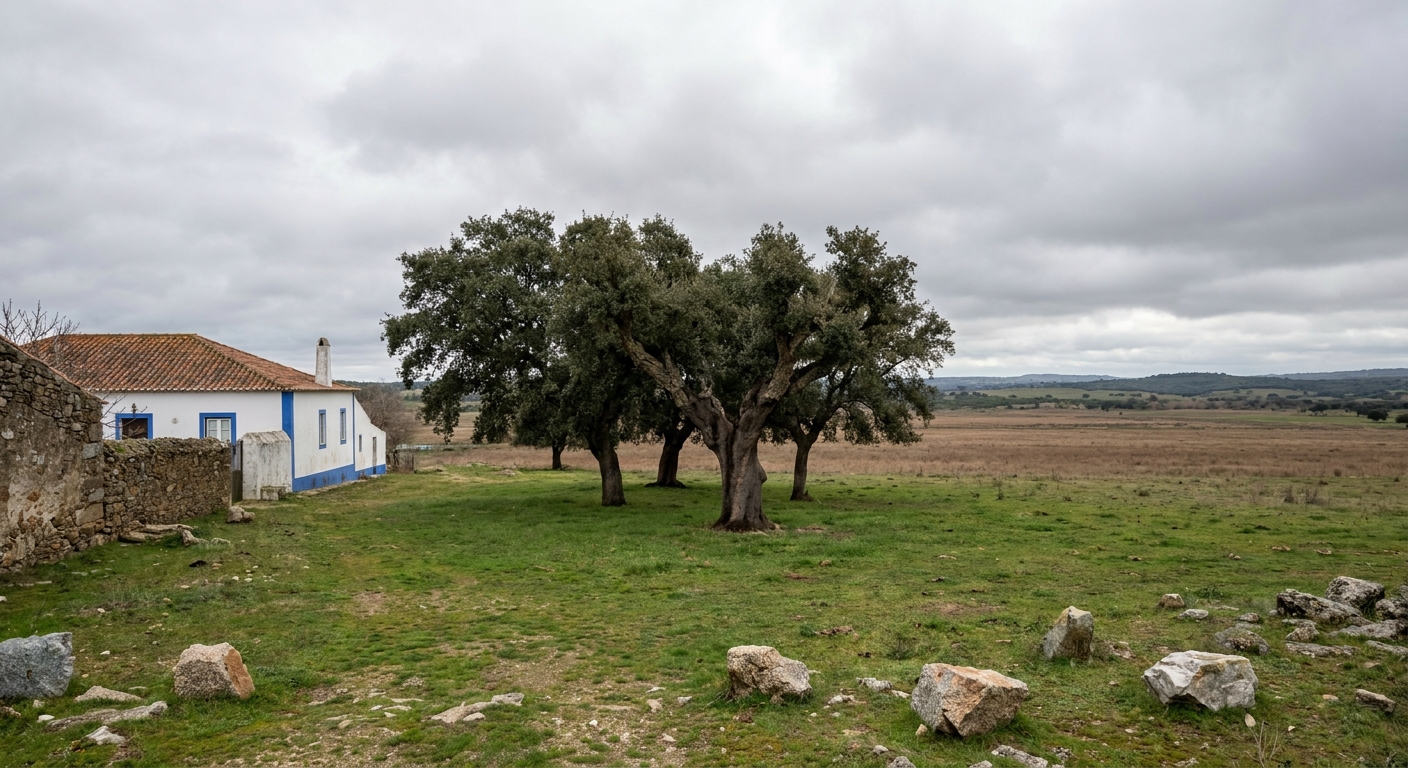
January is the Alentejo’s own month. The plain is green rather than gold, the cork oaks stand in wet grass, and the marble towns east of Évora run on locals and lunch. Nothing about the landscape is hiding from you, but the pace changes and so does what an afternoon outdoors feels like. This is the Alentejo without the heat.
Numbers first. At Évora, the average January afternoon reaches 57.4°F and the average night falls to 40.1°F, with 2.70 inches of rain spread across roughly nine days. That is sweater weather with a real coat for the mornings, and it is nobody’s beach week. The question worth settling before you book the flight is whether shifting four weeks buys a better trip, and the December and February figures below answer it.
THE MONTH AT A GLANCE · ALENTEJO · JANUARY
January gives you 57.4°F afternoons, 40.1°F nights and about nine rain days at Évora: right for walled towns, megaliths and long lunches, wrong for anyone who came to swim.
EVORA NORMALS 1991-2020 · 9H 49M OF DAYLIGHT ON JAN 15 · A HEATED ROOM IS NON-NEGOTIABLE
Go for: empty roads between Évora, Monsaraz and the marble towns, midday walking that August makes impossible, and a long lunch that fills the coldest hours.
Think twice before: booking an unheated stone house, or planning the coast around swimming: we verified no January sea temperature for the Alentejo shore.
Climate: IPMA station 558, Évora, 1991-2020 · Daylight: sunrise-sunset.org · full sources at the end
On this page
- January weather in the AlentejoHighs of 57.4°F and 8.6 rain days
- How cold the nights get, and what to wearThe 17.3°F day-night gap
- Booking and costs in low seasonWhat we can and cannot price
- Things to do in JanuaryÉvora, Almendres, Monsaraz, the marble towns
- A two-day plan around 9h 49m of lightSunrise 7:46 am to sunset 5:35 pm
- January vs December and FebruaryHow the three months compare
- Is January a good time to go?Who should go and who should wait
Everything below is tied to the date. For what the region is across the other eleven months, our Alentejo guide does that work, and the country’s month-by-month verdict sorts the wider calendar.
Alentejo weather in January: average highs, lows and rain days
| January at Évora, 1991-2020 | Value |
|---|---|
| Average high | 57.4°F (14.1°C) |
| Average low | 40.1°F (4.5°C) |
| Day-night gap | 17.3°F |
| Precipitation | 2.70 in (68.6 mm) |
| Days with 1 mm (0.04 in) or more | 8.6 |
| Days with 10 mm (0.39 in) or more | 2.4 |
| Daylight on January 15 | 9h 49m |
| Sunrise / sunset, January 15 | 7:46 am / 5:35 pm |
These come from IPMA, Portugal’s national weather service, and from a real thermometer: station 558 at Évora, 247.6 m up, 1991-2020 normals. Where the instrument stands matters for where you point the car. Évora sits in the middle of the plain, so the normals here describe the plain. High ground such as the Serra de São Mamede runs colder and far wetter, and the coast keeps its own weather. Pack for these figures and you have packed for most of an Alentejo trip, though not for a January walk on the heights.
Rain falls on 8.6 days in an average January, counting every day that records 1 mm (0.04 inch) or more. Call it two days in seven with something in the air, and 2.4 days with 10 mm (0.39 inch) or more, the kind that keeps you under an arcade for an hour. One caution before you set that beside a US table: IPMA counts from 1 mm, while American summaries usually start at 0.10 inch. The two day-counts are not interchangeable.
The 17.3°F between the average high and the average low lands on your luggage rather than your plan. A waterproof shell you can walk in beats an umbrella on the Alqueva shore, one warm mid-layer covers the first hours after sunrise, and shoes that handle wet cobbles in Évora and soft ground under the cork oaks matter more than anything else in the bag. Our packing guide has the full winter list.
Daylight on January 15 runs 9 hours 49 minutes: sunrise at 7:46 am, sunset at 5:35 pm, and Portugal keeps UTC through the winter, so those are clock times. The consequence is a civilized start. You can sleep until seven and still be out at first light, and the hour of low sun over Monsaraz and the reservoir arrives before five. Dinner here rarely begins early, so plan something indoors between sunset and the table.
How warm is Alentejo in January?
Average high 57.4°F, average low 40.1°F, 17.3°F between them. Those are thirty-year means rather than a forecast: a still, sunny afternoon on the plain and a gray, windy one share the same number, and individual January days at Évora land on both sides of it. Treat 57°F as the middle of the range you will actually get.
In practice the day splits in two. Before ten the air sits close to that 40.1°F low and you want a proper coat. From early afternoon, the high fifties on the sunny side of a street is genuine walking weather, the kind that gets a jacket carried rather than worn, and it holds until the light goes at half past five.
We found no frost-night count in the IPMA normals we read, so we give no number of nights below freezing; a 40.1°F monthly mean low, inland at 247.6 m, plainly includes colder ones. Two notes for the coast at Vila Nova de Milfontes or Comporta. We could not verify a January sea temperature for the Alentejo shore, so no water figure appears here. And sea readings published elsewhere are generally averages of daily maxima, a little warmer than a true 24-hour mean.
How busy is Alentejo in January? Crowds, prices and the demand peak
January falls outside every peak the region has: not the summer coast season, not Easter week, not the September vineyard rush. That much is calendar, and it shows on the road between Évora and Monsaraz. What we do not have is a price series. We found no monthly occupancy or room-rate data for the Alentejo, so we crown no month cheapest and quote no nightly figure. For what a week in the country costs, our trip-cost guide does that arithmetic.
Booking behaves accordingly. Two to three weeks of lead time is usually enough for a rural hotel or a herdade room in midwinter (est.), and the car matters more than the room: distances between towns are the trip itself, and our car guide covers the toll and insurance layer. One thing to settle by phone rather than assume, since our sources could not confirm it: winter opening at small rural properties.
On the tourist tax, we give no percentage. We could not verify whether the municipalities you would sleep in charge one, or at what rate, so nothing is quoted. Ask when you book, so the line is not a surprise at checkout. Entry paperwork, which does carry firm dates, sits in our know-before-you-go guide.
If you spend more on one thing this month, spend it on heat. Alentejo houses are built of thick stone and whitewash to survive August, and on a 40.1°F night that construction works against you. Confirm there is real heating in the room, not a heated towel rail, and confirm it in writing before you pay. That single question changes January in an old farmhouse more than the address does.
Things to do in Alentejo in January
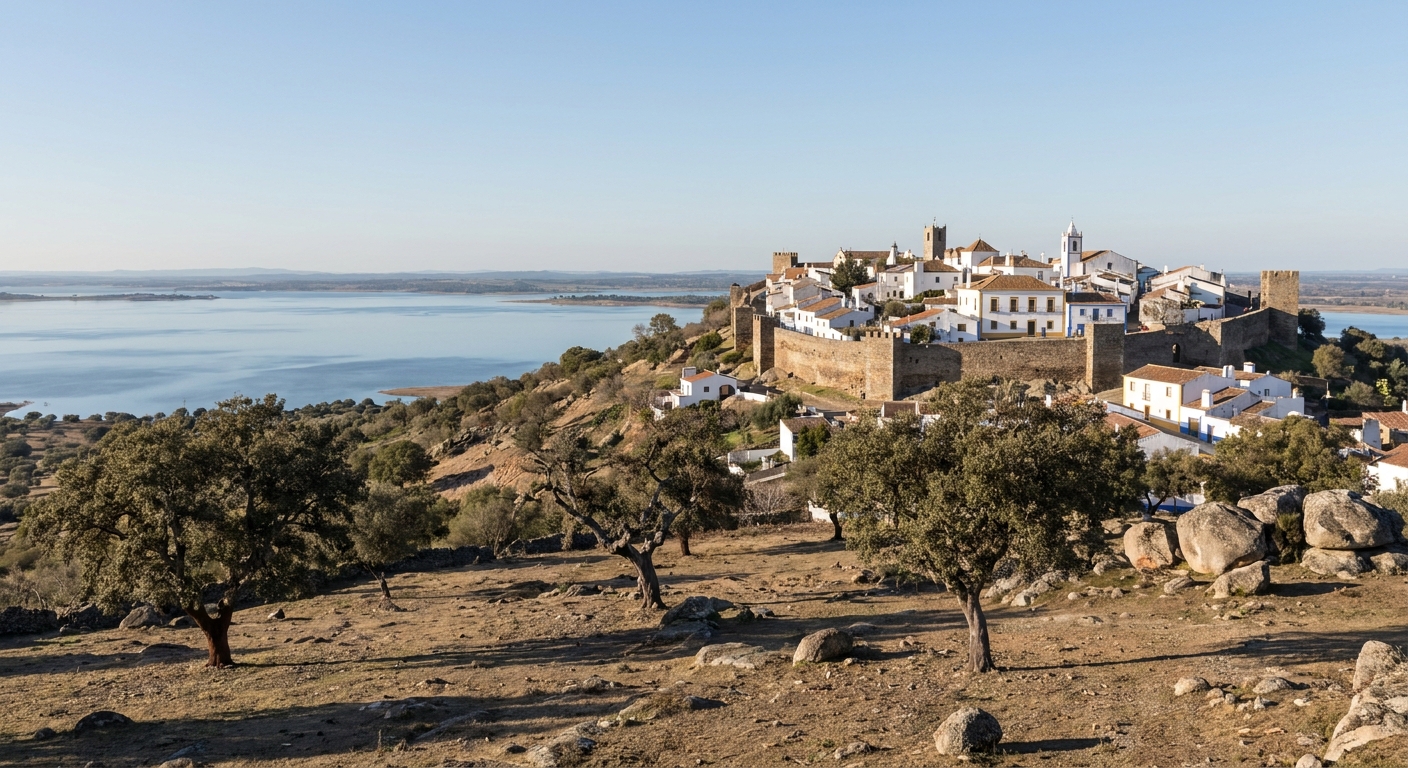
What January hands you is the middle of the day. Between noon and four the plain is at its warmest, and that is precisely the stretch a summer visit spends indoors. Walking a megalithic circle at 57°F, or a hilltop rampart with the wind coming off the reservoir, is a different activity from doing either in August. Wet ground is the trade: 2.70 inches falls across the month and the tracks under the cork oaks hold it.
Évora carries the headline sights, the Roman temple, the cathedral with its roof terrace, the bone chapel at São Francisco, and our Évora guide has the detail. West of town the Cromeleque dos Almendres stands in a clearing of cork oaks. East, Monsaraz sits walled and white above the Alqueva reservoir, and the marble towns of Estremoz, Borba and Vila Viçosa line the road north. Arraiolos makes rugs, Mértola holds the Guadiana. We verified no January hours or ticket prices for any of them, so we quote none: check each operator before you drive.
The stones do not move with the season, the air does. Almendres is walkable at noon in January, which August does not allow. The interiors run the other way: granite and marble churches hold the night temperature well past lunchtime, and the bone chapel is not a warm room. Sunset at 5:35 pm rearranges the rest. Monsaraz under low sun is the photograph of the trip, and it puts you back on unlit country roads in the dark.
We verified no January-only free admission anywhere in the region, so we promise none. What costs nothing is the daylight, 9 hours 49 minutes of it on the 15th. Spend it on foot: the lanes inside Évora’s walls, the track out to the stone circle, the lay-bys along the Alqueva shore where the water reaches the road.
Alentejo in January: a two-day itinerary
Day one is Évora. Sunrise is at 7:46 am, so nine o’clock counts as an early start. Take the cathedral and the Roman temple while the streets are still cold, sit down at one for the long Alentejo lunch, because the middle of a winter day is what lunch is for, then drive west to Almendres for two in the afternoon, when the plain is at its warmest. Back inside the walls by four leaves an hour and a half of light.
Day two runs east. Estremoz and Vila Viçosa in the morning for marble, the ducal palace and a café on the square, then Monsaraz for the last hour of sun over Alqueva and the drive home in the dark. If the sky turns, and 2.4 days in an average January deliver 10 mm or more, flip the order: the museums and wine cellars of the marble towns are indoor hours, and nothing in Évora’s bone chapel cares what is falling outside. Two nights is the minimum this plan needs.
Alentejo in January vs December and February
| Measure (Évora, 1991-2020) | December | January | February |
|---|---|---|---|
| Average high | 58.3°F | 57.4°F | 60.3°F |
| Average low | 41.5°F | 40.1°F | 41.0°F |
| Precipitation | 3.35 in | 2.70 in | 2.06 in |
| Days with 1 mm or more | 8.7 | 8.6 | 7.0 |
| Sea temperature | no reading we could verify | no reading we could verify | no reading we could verify |
Across the three months the plain barely moves in temperature and moves a great deal in rain. December averages 58.3°F by day and 41.5°F at night, January 57.4 and 40.1, February 60.3 and 41.0, so under 3°F separates the warmest afternoon from the coldest. The water column is the real spread: 3.35 inches over 8.7 wet days in December, 2.70 over 8.6 in January, 2.06 over 7.0 in February. No verified sea temperature exists for any of the three, so swimming stays out of the comparison entirely.
Shift four weeks forward and you gain 2.9°F on the afternoon high and 1.6 fewer wet days, and that is the strongest argument February has. Shift four weeks back and December gives 0.9°F more by day, 0.65 inch more rain and less daylight to use it in. Nights improve barely either way. For a trip built on walking, February wins on paper. For one built on empty roads and three-hour lunches, the gap is small enough to ignore.
Is January a good time to visit Alentejo?
Yes, if your Alentejo is towns, food, wine and megaliths, and if you own a coat. Afternoons at 57.4°F with 9 hours 49 minutes of light are good conditions for walking a walled town and driving between them, and the roads belong to you. No, if you pictured the coast: with 40.1°F nights and no January water temperature we could verify, this is not the swimming trip anyone is selling you.
For the swimmers, the nearest upgrade is not next month. February moves the afternoon to 60.3°F and cuts rain to 2.06 inches over 7.0 days, a measurable but modest winter improvement, and the sea is still unverified. Anyone whose trip depends on warm water should read the twelve-month verdict before booking flights, and the transatlantic options after.
What January has to itself is the green. The plain wears that color only in the wet months, the reservoirs stand full, and the cork oaks rise out of grass instead of dust.
The last word
Book the room with real heating, then stop fiddling with the dates. One number closes the case on waiting: February’s average low is 41.0°F against January’s 40.1°F, so a month of patience buys warmer afternoons and essentially the same cold night. Pack for the night, plan around the afternoon, and give the region two days at least, Évora on one, Monsaraz and the marble towns on the other, with the last hour of sun over the reservoir on both if the drive allows it.
Sources & data for this guide
- January normals: high 57.4°F, low 40.1°F, 2.70 in, 8.6 days at 1 mm or more, 2.4 days at 10 mm or more · IPMA (Instituto Português do Mar e da Atmosfera), climate normals 1991-2020, station 558 Évora, 247.6 m · checked Sep 24, 2026
- December and February normals used in the comparison · same IPMA series, station 558 Évora · checked Sep 24, 2026
- Daylight of 9h 49m, sunrise 07:46 and sunset 17:35 on January 15, read in local time (Portugal keeps UTC in winter) · sunrise-sunset.org · checked Sep 24, 2026
- Scope caveat: the normals describe Évora and the plain around it. Higher ground runs colder and far wetter, and the Alentejo coast has its own weather.
- We found no occupancy or room-rate series for the region and could not confirm a municipal lodging-tax rate, so we rank no month on price and quote no percentage.
- We verified no January sea temperature for the Alentejo coast; sea figures published elsewhere are generally averages of daily maxima rather than 24-hour means.
- Monument hours and ticket prices change through the winter and were not verified for January · check each operator before you drive.
To plan your stay
- Things to Do in the Alentejo: Évora, the Almendres Stones, Alqueva's Dark Sky and the Wine Towns
- Best Time to Visit the Alentejo: Weather Month by Month, Summer Heat and the Quiet Season
- Alentejo in February: Weather, Rain Days, Crowds and How It Compares to January and March
- Alentejo in December: Weather, Rain Days and a Two-Day Plan