
SAGRES · MARCH · 37.0° N
The southwest corner of Europe gets its light back in March. Afternoons at Sagres average 64.0°F, the sun stays up for a clean twelve hours by mid-month, and the cliffs that spend winter under cloud start handing out the evenings people drive the coast road to see. The catch is in the water: 60.2°F, colder than the air, and colder than most people’s idea of a swim.
The rest is arithmetic you can plan around. Rain totals 1.92 inches spread over about six days, nights drop to 51.1°F, and April waits four weeks off with a drier sky. Whether that trade is worth the wait gets answered country-wide in our 12-month verdict. For one exposed cape, the normals below answer it.
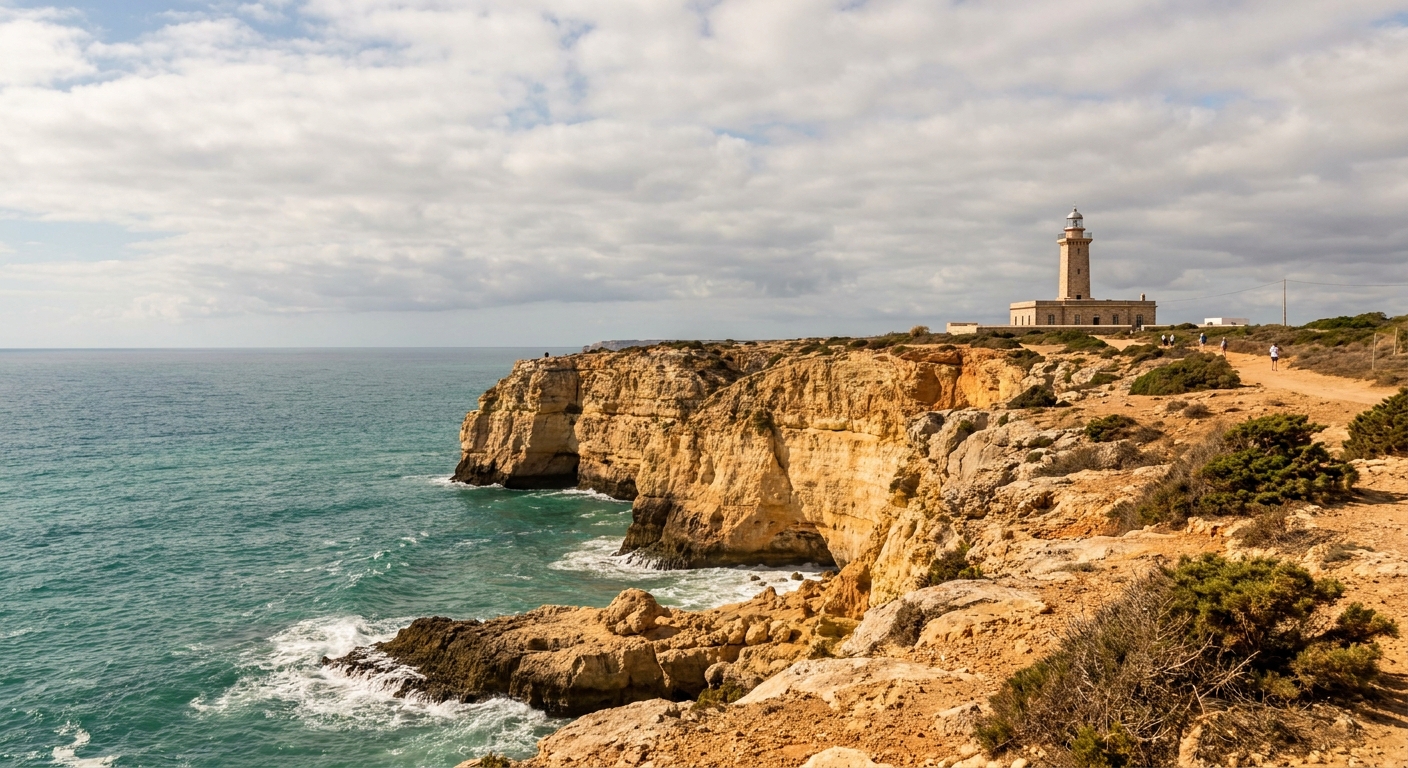
THE MONTH AT A GLANCE · SAGRES · MARCH
March gives Sagres 64.0°F afternoons, twelve hours of daylight and a cape you can walk all day, but the sea holds at 60.2°F and six days of the month record rain: come for cliffs, not for swimming.
AVG HIGH 64.0°F · SEA 60.2°F · 6.3 RAIN DAYS · 12 HOURS OF DAYLIGHT
Go for: clifftop walking between the fort and Cabo de São Vicente, empty sand at Tonel and Mareta, and afternoons that reach 64.0°F without a queue at the point.
Think twice before: booking March for swimming or for guaranteed beach weather: the sea averages 60.2°F and 1.7 days of the month deliver 0.39 inch of rain or more.
Normals: IPMA station 533, 1991–2020 · Sea: Open-Meteo Marine, 2015–2024 · full sources at the end
On this page
- Sagres weather in MarchHighs of 64.0°F, lows of 51.1°F, 6.3 rain days
- Can you swim in Sagres in March?The Atlantic at 60.2°F, and what that means in the water
- Crowds, booking and costs in MarchWhere March sits before the summer season, and what we could not verify
- Things to do in Sagres in MarchThe fort headland, Cabo de São Vicente, Tonel, Beliche and Mareta
- A two-day plan for SagresTwo days keyed to a 6:44 p.m. sunset
- March vs February and AprilHow the three months compare on heat, rain and water
- Is March a good time to visit Sagres?Who it suits, and who should wait four weeks
Every figure here comes from one instrument: IPMA’s station 533, standing 75 feet (22.9 m) above the sea on the cape at Sagres itself. Those readings describe the exposed southwest point and nothing more. Inland, the high ground runs colder and a great deal wetter, and the far end of the coast keeps its own weather, so pack for the walk you are actually doing. For the towns either side, the Algarve guide has the rest.
Sagres weather in March: average highs, lows and rain days
| Measure | Sagres in March |
|---|---|
| Average high | 64.0°F |
| Average low | 51.1°F |
| Precipitation | 1.92 in |
| Days with 0.04 in or more | 6.3 |
| Days with 0.39 in or more | 1.7 |
| Daylight, March 15 | 12h 00m · 6:44 a.m. to 6:44 p.m. |
| Sea surface | 60.2°F |
These are IPMA normals, from the Instituto Português do Mar e da Atmosfera, Portugal’s national weather service, averaged over 1991 to 2020 at station 533. Average high 64.0°F, average low 51.1°F, 1.92 inches of rain across the month. A real thermometer at a real address on the headland, not a model grid cell smeared across ocean and clifftop, and on a coast this exposed that distinction is worth a reader’s attention.
Measurable rain falls on 6.3 days of an average March, roughly one day in five, and 1.7 of those days bring 0.39 inch or more. Two dozen days record nothing at all. One caution about the counts: IPMA tallies a rain day at 1 mm (0.04 inch), while American tables usually start at 0.10 inch, so the two sets of numbers are not interchangeable. Budget one soaked afternoon a week and have somewhere to put it.
Between the 64.0°F afternoon and the 51.1°F hour before dawn sits a spread of 12.9 degrees, and Sagres is a headland with water on three sides, so the evening reads cooler than the number suggests. A fleece, a windproof shell and long pants for dinner cover the month. Swim gear is optional and a beach towel is mostly for sitting on. Our packing guide handles the rest of the suitcase.
On March 15 the sun rises at 6:44 a.m. and sets at 6:44 p.m. local time, twelve hours to the minute. That is enough to walk the cliffs in the morning, take a long lunch, drive west, and still be at the point with light to spare. Dinner starts after dark, which in a village this small means a short walk in a jacket.
Can you swim in Sagres in March? Sea temperature and what it feels like
The sea surface off Sagres averages 60.2°F in March, from ten years of Open-Meteo Marine data covering 2015 to 2024. Read the fine print on that figure: it is the mean of daily maxima, so it runs a shade warmer than a full 24-hour average would. The all-day number sits a touch under the 60.2 quoted here, and neither version is a swimming temperature for most visitors.
In practice, 60.2°F is a dip counted in minutes. Anyone planning to stay in longer wears a full wetsuit, which is why the surf crowd treats this month as ordinary and the beach crowd does not. With the afternoon air at 64.0°F, only 3.8 degrees warmer than the water, there is no warm towel-dry moment waiting for you on the sand either. Children paddle ankle-deep and are delighted; adults commit once and remember it.
March water is the coldest of the three months around it, 60.2°F against February’s 61.1 and April’s 61.8, because the Atlantic lags the sky by weeks. We could not verify March wind speeds or swell heights for Sagres, so we publish no figures for either. What the geography does guarantee is a choice of aspect: Tonel and Beliche take the west-coast swell, while Mareta faces south across the bay and sits in the lee when the wind comes out of the northwest.
How busy is Sagres in March? Crowds, prices and the demand peak
March falls before the coast’s summer season and after the deep winter quiet, which is a fact of the calendar rather than a price signal. We found no occupancy series and no monthly room-rate data for Sagres, so we crown no month the cheapest and none the busiest. What we can say is that the demand curve on this coast follows the weather curve, and in March that curve is still climbing.
We could not verify booking-window data either, so we give no lead time in weeks. The numbers we do have argue for flexibility rather than speed: with 6.3 wet days in 31, a refundable room is worth more in March than a saved dollar. Sagres is a small village at the end of the land, not a resort strip, so if it fills, Lagos is the usual fallback base within easy driving distance.
On the nightly tourist tax: we could not verify whether one applies to stays in Sagres, or at what rate, so no amount per night appears here. Ask the property when you book, so the figure does not turn up as a surprise at check-in. Our know-before-you-go guide covers the paperwork side of a Portugal trip.
A car is the spend that genuinely changes this month. It converts a wet morning into a drive along the coast, puts Cabo de São Vicente twenty minutes from breakfast instead of an errand, and lets you chase the sheltered beach when the wind picks the wrong side of the cape. Our rental guide covers tolls and insurance, and getting around handles the alternatives.
Things to do in Sagres in March
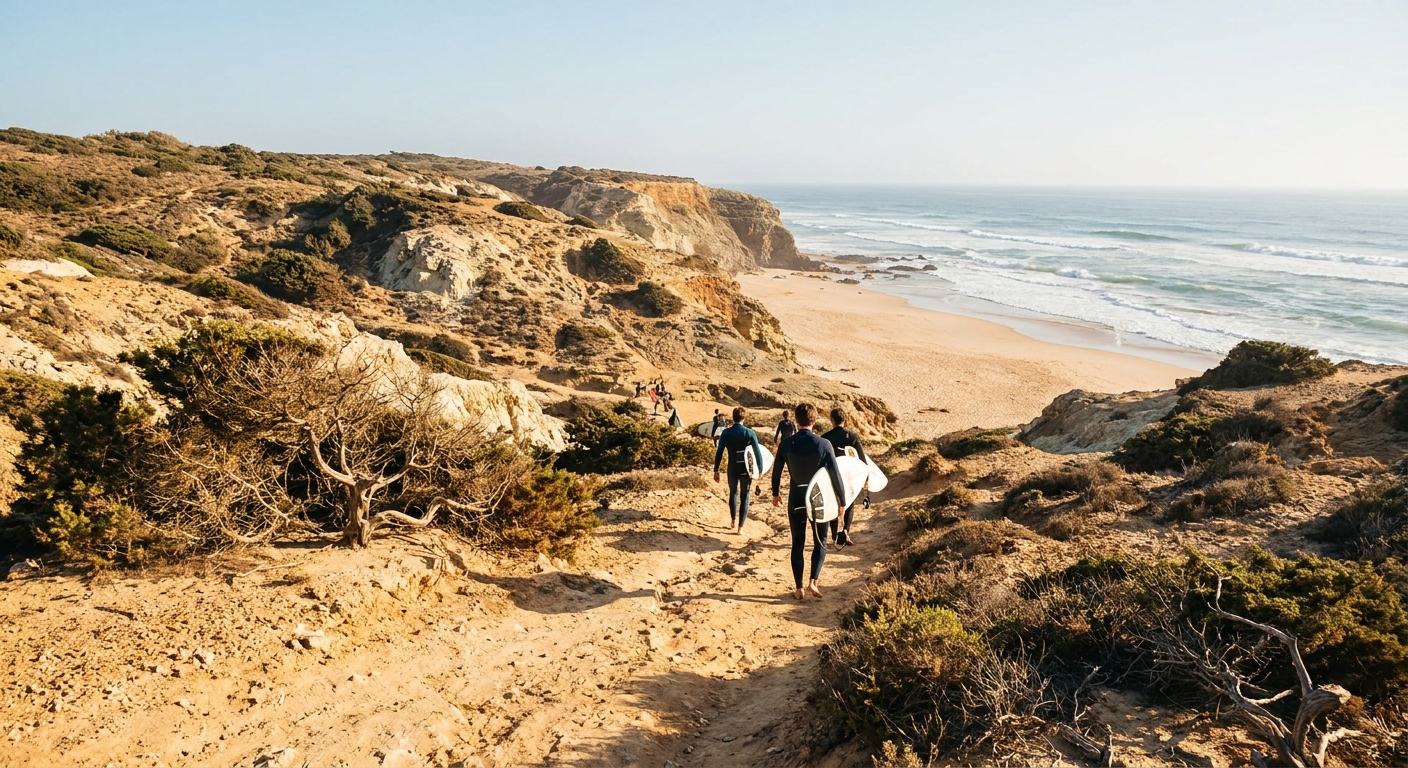
March opens the cape for walking. At 64.0°F the clifftop miles are comfortable in a fleece, and the twelve hours of daylight give you room to walk in the morning and still be out at the point for the light. This is the month’s real gift, and it does not depend on the water behaving.
The Fortaleza de Sagres takes up the whole of Ponta de Sagres, the flat headland south of the village, with its great stone wind rose and a walking circuit around the cliff edge. We could not verify its March hours or admission price, so check before you drive out. West along the road, Cabo de São Vicente carries the lighthouse at the southwest tip of mainland Europe. The beaches sit between them: Tonel below the fort facing west, Beliche down its cliff stairs, Mareta facing south across the bay.
Here is what the season does to those places. Across February, March and April the sea moves 1.6 degrees, from 60.2°F to 61.8. The afternoon air moves 5.1, from 61.3°F to 66.4. The water is essentially a constant and the sky is the variable, so in March Tonel and Mareta become places you walk, photograph and sit above, rather than places you swim.
Nothing on the clifftops needs a ticket. The viewpoints west of the village, the sand at Mareta, and sunset from the cape at 6:44 p.m. on the 15th cost nothing at all, and a twelve-hour day fits two of the three into one afternoon with a lunch in between.
Sagres in March: a two-day itinerary
Day one: breakfast in the village, then out to Ponta de Sagres around nine, while the light is still low across the cliffs. Walk the headland circuit, drop down to Tonel for the middle of the day when the 64.0°F high arrives, and take a late lunch back in town. Save the drive west for four o’clock, reach Cabo de São Vicente by six, and give the sunset at 6:44 p.m. the full half hour. Bring the jacket for the walk back: the night is heading for 51.1°F.
Day two belongs to the beaches. Mareta for a sheltered morning, Beliche and its cliff stairs for the west-coast water at 60.2°F if anyone is game, then the clifftop tracks running north of Tonel for the afternoon. If the day turns out to be one of the 1.7 that bring 0.39 inch or more, drive rather than walk: Lagos is the nearest town with an indoor afternoon in it, and the coast road back holds up under cloud.
Sagres in March vs February and April
| Measure | February | March | April |
|---|---|---|---|
| Average high | 61.3°F | 64.0°F | 66.4°F |
| Average low | 47.8°F | 51.1°F | 53.6°F |
| Precipitation | 1.91 in | 1.92 in | 1.37 in |
| Days with 0.04 in or more | 6.3 | 6.3 | 5.7 |
| Sea surface | 61.1°F | 60.2°F | 61.8°F |
February and March are the same month for rain: 1.91 inches against 1.92, with 6.3 wet days each. What March adds is 2.7 degrees on the afternoon and 3.3 on the night. April is the month that changes the rain, dropping to 1.37 inches over 5.7 days with highs of 66.4°F. Sea temperatures barely register the difference, running 61.1, 60.2 and 61.8°F across the three.
Push the trip four weeks later and you gain half an inch of dryness, a warmer sky and 1.6 degrees of water, none of which turns the Atlantic into a swimming pool. Pull it four weeks earlier and you keep the same rain, lose 2.7 degrees off the afternoon, and collect the odd consolation of a sea 0.9 degrees warmer than March’s. Our February page makes that case with its own numbers.
Is March a good time to visit Sagres?
For walkers, surfers, photographers and anyone who came for the cliffs, yes without hesitation. An average high of 64.0°F and twelve hours of daylight is walking weather of the best kind, and the cape rewards it hour by hour. For a family whose whole plan is a beach day with swimming in it, no: water at 60.2°F and one wet day in five will not deliver that vacation, whatever the photographs promised.
If the answer for you is no, April is the nearest fix and the reason is rain rather than heat. Precipitation falls to 1.37 inches over 5.7 days, afternoons reach 66.4°F, and the sea nudges up to 61.8. That is a better beach month by every measure in the table above, though a wetsuit still settles the swimming argument.
What March alone hands you is a full twelve-hour day of light on the cape before the summer season starts, with afternoons at 64.0°F and no hour of the day too hot to walk the clifftop between the fort and the lighthouse.
The last word
Book March for the cliffs and treat the Atlantic as scenery. If the trip stands or falls on swimming, wait: April’s water reaches 61.8°F, warmer by 1.6 degrees and still not warm, while the nights you would be waiting for gain only 2.5 degrees, from 51.1°F to 53.6. Everything else is packing and timing. Take the fleece, aim for the cape at 6:44 p.m., and call ahead about the fort’s hours, because we could not verify them.
Sources & data for this guide
- March normals (high 64.0°F, low 51.1°F, 1.92 in) · IPMA, normais climatológicas 1991–2020, station 533 Sagres, altitude 22.9 m · checked Sep 23, 2026
- Rain-day counts (6.3 days at 0.04 in or more, 1.7 days at 0.39 in or more), IPMA thresholds, not the 0.10-inch US threshold · IPMA station 533, 1991–2020 · checked Sep 23, 2026
- February and April normals used in the comparison · same IPMA station and same 1991–2020 period, not estimates · checked Sep 23, 2026
- Sea surface 60.2°F, mean of daily maxima 2015–2024 · Open-Meteo Marine API · checked Sep 23, 2026
- Daylight and clock times (sunrise 06:44 UTC, sunset 18:44 UTC on March 15, converted to Europe/Lisbon) · sunrise-sunset.org · checked Sep 23, 2026
- We could not verify Fortaleza de Sagres hours or admission, any nightly tourist tax in Sagres, March wind and swell statistics, or monthly lodging rates, so we give no figure for any of them. Beaches, trails and viewpoints are described from general knowledge; hours and prices change, so check operators when you book.