
SAGRES · FEBRUARY · IPMA STATION 533
Sagres sits at the corner where the Algarve stops being a beach resort and becomes weather. February hands you afternoons averaging 61.3°F, nights near 47.8°F, and a sea that has barely cooled since Christmas. The cliff paths above the Atlantic are yours. Lunch outdoors is a reasonable bet roughly three days in four, and the walk out to the lighthouse happens without a single tour bus in the way.
What the month takes away is simple enough to name: bare-skin swimming, long beach afternoons in swimwear, and the certainty that every kitchen in town is open. What it gives back is space, low gold light and a coast you can drive in twenty minutes. For the town itself, our Sagres guide has the year-round picture, and the 12-month verdict for Portugal puts February in national context.
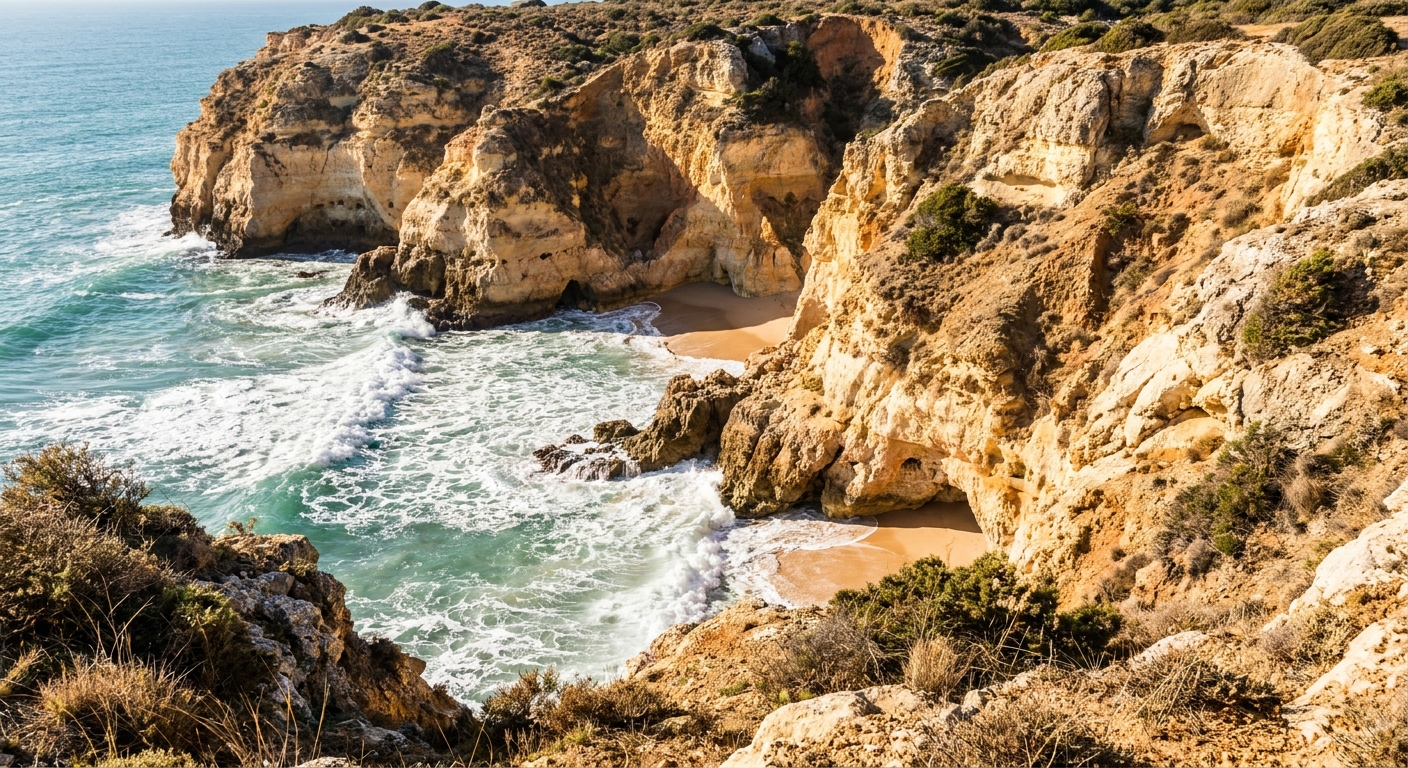
THE MONTH AT A GLANCE · SAGRES · FEBRUARY
February is a walking, driving and wetsuit month at Sagres: mild by day, quiet everywhere, and only three days in twenty-eight bring real rain.
OFF-SEASON WEEKS · WETSUIT WATER · 1.91 IN OF RAIN · CAR STRONGLY RECOMMENDED
Go for: empty cliff walks at 61°F, surf without a lineup, a rental car that parks anywhere, and sunsets at the cape with a handful of people beside you.
Think twice before: planning a swimming trip. A 61.1°F sea is neoprene water, and some kitchens and rental shops take a winter break we could not map.
Air: IPMA normals 1991-2020, station 533 · Sea: Open-Meteo Marine 2015-2024 · full sources at the end
On this page
- Sagres weather in February61.3°F days, 47.8°F nights, 6.3 rain days
- Sea temperature and swimming61.1°F water, and what that means without a wetsuit
- Crowds, booking and winter closuresOff-season weeks, and the prices we could not verify
- Things to do in Sagres in FebruaryCabo de São Vicente, the fortress, Tonel and Mareta
- Two days in Sagres, hour by hourA plan built around 10 h 53 min of daylight
- January vs February vs MarchHow the three months compare, in numbers
- Is February a good time to visit Sagres?Who should come, and who should shift to March
Every figure here for air and rain comes from one real thermometer: IPMA station 533, on the cape at 22.9 m, 1991-2020 normals. The sea number comes from a marine model rather than a buoy, and it is flagged as such below. These normals describe Sagres, not the whole southwest: ground inland runs colder and a good deal wetter, and the eastern Algarve keeps its own weather.
Sagres weather in February: average highs, lows and rain days
| February at Sagres | Figure |
|---|---|
| Average high | 61.3°F (16.3°C) |
| Average low | 47.8°F (8.8°C) |
| Precipitation, monthly total | 1.91 in |
| Days with 0.04 in (1 mm) or more | 6.3 |
| Days with 0.39 in (10 mm) or more | 1.5 |
| Sea surface | 61.1°F, mean of daily maxima |
| Daylight, February 15 | 10 h 53 min · sunset 6:16 pm |
IPMA, the Portuguese weather and sea institute, gives Sagres an average February high of 61.3°F and an average low of 47.8°F across the 1991-2020 period. That comes from station 533, a physical instrument on the cape at 22.9 m of altitude, not a reanalysis grid cell averaged over a chunk of ocean and hillside. It matters when you pack: drive an hour north into the Alentejo hills and the same day can be several degrees colder and a lot wetter.
Rain totals 1.91 inches for the month, spread over 6.3 days that record at least 0.04 inch. That leaves close to twenty-two days of the month with nothing measurable falling at all. Only 1.5 days bring 0.39 inch or more, the kind of soaking that cancels a cliff walk rather than interrupting it. One caution on the counting: these are IPMA’s thresholds of 1 mm and 10 mm, and US monthly tables usually count days at 0.10 inch, so the two sets of numbers are not interchangeable.
Day to night, the spread runs 13.5°F, modest for a winter month and typical of a cape surrounded by water. It lands awkwardly all the same: you feel the mild part between late morning and four, and the cool part exactly when you are standing on a headland watching the sun go. Pack a fleece, a genuinely windproof shell and long pants for evenings, plus one warm layer more than the average high suggests. Our packing guide covers the rest of the suitcase.
February 15 brings 10 hours 53 minutes of daylight, with last light at 6:16 pm local time. That is an hour of usable evening more than the solstice gave, and enough to put a cape sunset and dinner in town on the same day without rushing either. Plan any cliff-edge walking to finish by six: the coast road is unlit in stretches and the paths run close to the drop. If you are driving in from Faro airport, the car guide covers tolls and fuel.
Can you swim in Sagres in February? Sea temperature and what it feels like
Sea surface off Sagres averages 61.1°F in February, taken from Open-Meteo’s marine model as the mean of daily maxima over 2015-2024. Read that qualifier properly: it is the warm end of each day rather than a 24-hour average, so a shade cooler is what most of the day actually delivers. Tables built on 24-hour means will show a slightly lower number for the same month, and neither is wrong.
In practice, 61°F is neoprene water. A bare-skin dip is possible and lasts about as long as your nerve does, which for most people is a couple of minutes of shouting. A 4/3 wetsuit with boots turns the same sea into a comfortable two-hour session, and Sagres is a surf town in winter as much as in August. We could not verify which board and wetsuit shops keep February hours or what they charge, so ask your hotel on arrival rather than planning around a website.
On wind and swell we have no February series for Sagres, so we publish no figures. What the station siting does tell you is real: this is an exposed southwest cape, open to the Atlantic on two sides. The practical response is geographic. Tonel and Beliche face the open ocean and take the weather first, while Mareta and Martinhal sit around the southern side and stay usable when the northwest is up. Check both sides before choosing a beach.
How busy is Sagres in February? Crowds, prices and the demand peak
February sits well outside the summer weeks that fill the Algarve, and Sagres is a small cape town rather than a resort strip, so the difference is stark: parking near the fortress, tables without a reservation, cliff paths where you pass four people in an hour. On money we stay quiet on purpose. We found no monthly occupancy series and no room-rate series for Sagres, so we crown no month cheapest and quote no nightly figure. Our Portugal cost guide handles budgets at national level.
Booking behaves differently from August. The scheduling risk in February is not availability, it is winter closures: some kitchens, guesthouses and rental shops take a break, and we could not verify which ones do so in 2026. Confirm by phone the week you travel, and book the rental car before the room if you are flying into Faro, since a cape trip without wheels is a short trip. Two nights is our minimum here, three if you want one spare day for weather.
On tourist tax, we could not verify whether a municipal per-night charge applies at Sagres for 2026 or what it would be, so we give no amount. Ask at the time of booking and check the final invoice, since these charges are usually collected at the property rather than shown in the online rate. Portugal’s wider entry and paperwork rules sit in our entry guide.
Spend the money on the car. Cabo de São Vicente, the fortress promontory, four beaches and the road east toward Lagos are spread along a coast with thin winter bus service, and with 10 hours 53 minutes of daylight you want every one of them usable on demand. After that, pay for a room with proper heating and a view out of the wind. Those two lines change a February trip more than any restaurant upgrade will. Getting around Portugal covers the alternatives.
Things to do in Sagres in February
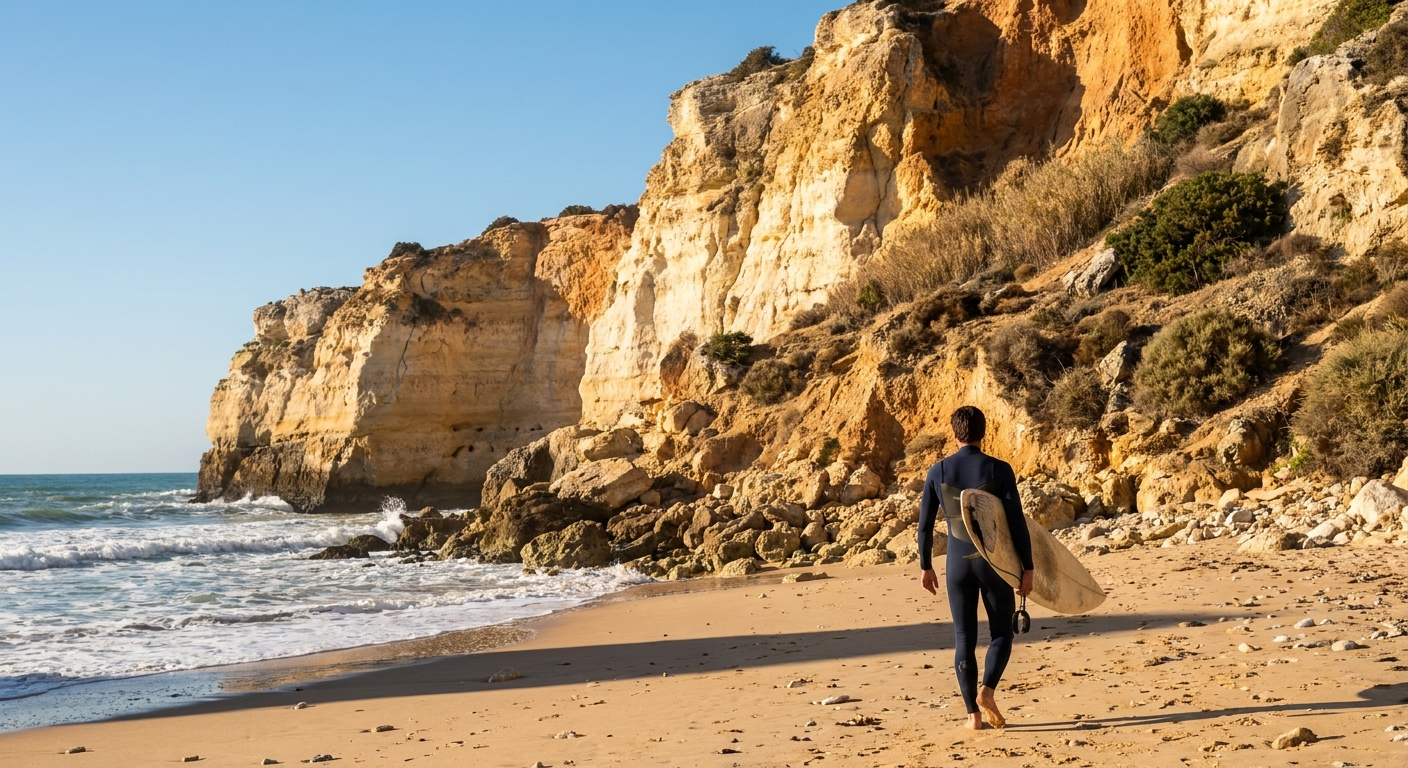
The month’s real gift is walking. At an average high of 61.3°F you can do the headland circuits at midday, the hour that summer forces you to avoid, and the low winter sun puts the cliffs in relief from morning to late afternoon. Add the surf, which is the reason a good share of Sagres stays open all winter, and a February day divides neatly: paths and viewpoints while the light is good, the water when the forecast lines up.
The named stops are close together. Cabo de São Vicente is the point itself, with its lighthouse on the last headland in Europe before the Atlantic. Back toward town, the Fortaleza de Sagres spreads across its own promontory above the sea. Praia do Tonel and Praia do Beliche face the open ocean, Praia da Mareta and Praia do Martinhal sit on the sheltered southern side, and all of them meet the same 61.1°F water. We could not verify February opening hours or admission at the fortress or the lighthouse, so check before you drive out.
What February changes at these places is the air, not the sea. Across January, February and March the water moves only 1.2°F, from 61.4°F down to 60.2°F, while the air climbs 2.7°F between February and March alone. So the beaches feel identical underfoot in any of the three months, and the difference you actually notice is how long you can stand on the sand afterward in a wet swimsuit. In February, not long. Bring a towel with ambitions and a thermos.
Plenty of the month costs nothing. The cliff-top paths, the headland approach to the lighthouse, the beaches and the sunset are all free, and at 6:16 pm on February 15 that sunset happens at a civilized hour rather than after dinner. The coastal trail sections around the cape are walkable year-round and busiest in spring. If you want a paid day out with more indoor options, Lagos is the nearest town with a full winter program.
Sagres in February: a two-day itinerary
Day one, start slow and follow the warmth. Coffee in town by nine, then the fortress promontory while the light is still low and raking. Drive out to Cabo de São Vicente for late morning, walk the headland, and be back for lunch around one, when the day is closest to its 61.3°F average. Afternoon on Praia da Mareta, out of the northwest wind. Return to the cape by five for the sunset, with the fleece and shell you packed, then dinner in town.
Day two belongs to the water and the road. Check the swell at Tonel first thing, take a lesson or a session in a full wetsuit if it looks kind, then drive east along the coast in the afternoon. If one of the month’s 1.5 heavy rain days lands on you instead, flip the plan: make the drive the day, aim at Lagos or Faro for indoor hours, and keep the cape walk for the following morning. Confirm winter hours anywhere you count on.
Sagres in February vs January and March
| Measure | January | February | March |
|---|---|---|---|
| Average high | 61.0°F | 61.3°F | 64.0°F |
| Average low | 47.3°F | 47.8°F | 51.1°F |
| Precipitation | 2.10 in | 1.91 in | 1.92 in |
| Days with 0.04 in or more | 7.4 | 6.3 | 6.3 |
| Sea surface (daily maxima) | 61.4°F | 61.1°F | 60.2°F |
The three months are closer than a calendar suggests. January and February are separated by 0.3°F in the daytime average and by one wet day in twenty-eight, with February the drier of the two by 0.19 inch. March is where the air finally moves: 64.0°F by day, 51.1°F at night, a full 3.3°F warmer after dark. The sea runs the other way and reaches its coldest of the three in March, at 60.2°F. Our January page has the same figures from the winter side.
Shift four weeks forward and you gain evenings worth sitting outside in, plus longer days for the same 6.3 wet days. You lose a degree of water and you start sharing the cape, since spring walking season builds through March on the coastal trail. Shift four weeks back into January and you trade 1.1 extra wet days and 0.19 inch more rain for the warmest sea of the winter. Neither swap is dramatic, and that is the useful finding.
Is February a good time to visit Sagres?
Yes, if you came for the coast rather than the beach towel. Walkers, surfers, photographers, drivers doing a slow Algarve loop and anyone who wants Cabo de São Vicente to themselves will get a strong month at 61.3°F with three dry days in four. No, if the trip’s centerpiece is swimming without neoprene, sunbathing until four, or a town with every restaurant lit up. Sagres in February is a working cape village with visitors, not a season in full swing.
If that second description is you, March is the smallest sensible shift: the same 6.3 wet days, 2.7°F more by day, 3.3°F more at night, and evenings you can spend outdoors. Push to late spring and the air keeps climbing while the sea catches up later in the year, which is the trade our best-time-to-visit guide lays out month by month for the whole country. For a warmer regional base in any season, the Algarve guide is the place to start.
One thing February alone offers: water within 0.3°F of January’s, with a full wet day fewer and an hour more daylight, on a cape where nobody is waiting for your parking space.
The last word
Book the car, book two nights minimum, and let the forecast pick which beach faces the weather. The one detail worth setting an alarm for: on February 15 the sun comes up at 7:23 am local time, so first light at the lighthouse costs you an early coffee rather than a sleepless night, and you can still be back in town for breakfast before nine. Bring the windproof layer. You will use it at the cape twice a day.
Sources & data for this guide
- February air normals (61.3°F high, 47.8°F low, 1.91 in, 6.3 days at 1 mm, 1.5 days at 10 mm) · IPMA climatological normals 1991-2020, station 533 Sagres, 22.9 m · checked Sep 23, 2026
- January and March figures, same station and same 1991-2020 period · IPMA · checked Sep 23, 2026
- Sea surface 61.1°F, mean of daily maxima 2015-2024 · Open-Meteo Marine API (model, not a buoy) · checked Sep 23, 2026
- Daylight 10 h 53 min, sunrise 7:23 and sunset 18:16 on February 15, converted to Europe/Lisbon · sunrise-sunset.org · checked Sep 23, 2026
- Rain-day counts use IPMA thresholds of 1 mm and 10 mm, not the 0.10-inch threshold common in US tables · checked Sep 23, 2026
- We could not verify February opening hours or admission at the Fortaleza de Sagres and Cabo de São Vicente, any municipal tourist tax, winter restaurant and rental-shop closures, or any monthly occupancy or room-rate series · confirm with operators when you book