
ÓBIDOS · PORTUGAL · JANUARY
January leaves Óbidos mild and wet. The 1991-2020 normals put the average afternoon at 58.1°F (14.5°C) and the average night at 49.8°F (9.9°C), so the cobbles inside the walls are cool rather than cold, and a fleece under a waterproof shell covers a full day of walking. What the month asks in return is 2.98 inches of rain, spread over ten or eleven days.
The other thing January takes is light. On the 15th the sun is up for 9 hours 45 minutes and gone by 5:39 pm, which turns the golden half hour on the whitewash into a late-afternoon appointment rather than an evening one. For the town in every other month, see our Óbidos guide, and for the national calendar, the 12-month verdict.
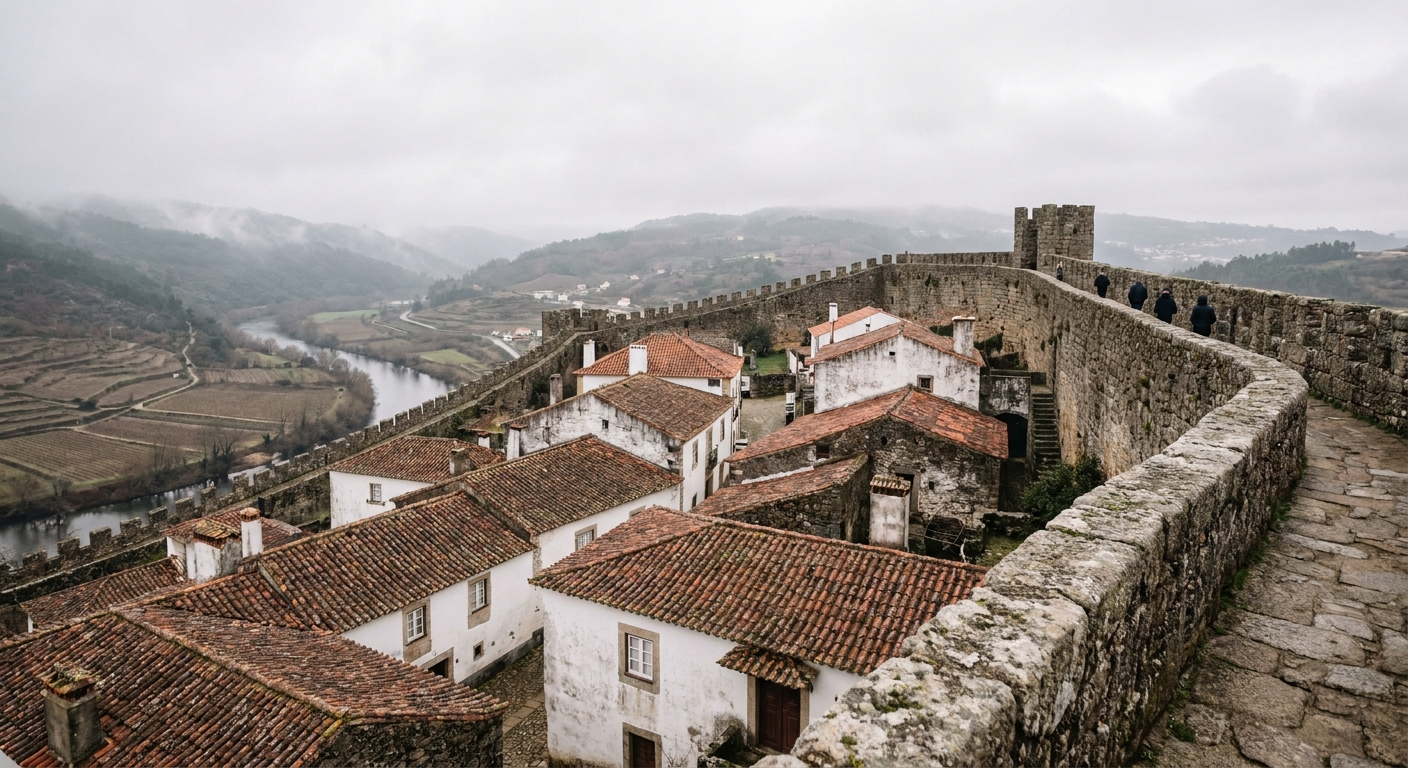
THE MONTH AT A GLANCE · ÓBIDOS · JANUARY
January gives Óbidos 58.1°F afternoons, 10.4 wet days and a 5:39 pm sunset: a fine two-day walled-town break for anyone who packs a shell and plans one indoor afternoon.
IPMA 1991-2020 NORMALS · STATION 531, CABO CARVOEIRO · WINTER LOW SEASON
Go for: mild winter walking at 58.1°F, long lunches indoors, and an amber half hour on the walls that lands before 5:39 pm.
Think twice before: banking on dry stone: 10.4 days in an average January record measurable rain, and 2.4 of them bring 0.39 inch or more.
Normals: IPMA station 531 · Daylight: sunrise-sunset.org · full sources at the end
On this page
- Average highs, lows and rain daysÓbidos weather in January
- How cold does it get at night?The 58.1°F / 49.8°F day-night band
- Crowds and prices in the low seasonWhat we can and cannot tell you about cost
- Things to do in JanuaryThe walls, Rua Direita and Santa Maria
- A two-day itineraryBoth days, hour by hour
- January vs December and FebruaryHow the three months compare
- Should I go in January or wait?Our verdict, and the month we would move to
One caveat before any of it. Every figure here comes from IPMA station 531 at Cabo Carvoeiro, on the coast at Peniche, 32.0 m above the sea. Óbidos sits slightly inland behind its walls, so town readings can run a little differently, and high ground anywhere in Portugal is colder and far wetter than a coastal gauge. Pack for a hill walk on hill data, not on these numbers.
Óbidos weather in January: average highs, lows and rain days
| Measure | January | What it means on the ground |
|---|---|---|
| Average high | 58.1°F (14.5°C) | Fleece weather at midday, not parka weather |
| Average low | 49.8°F (9.9°C) | Cool evenings on an unheated terrace |
| Rainfall | 2.98 in | Spread across the month, not dumped in one week |
| Days with 0.04 in+ | 10.4 | Measurable rain about one day in three |
| Days with 0.39 in+ | 2.4 | Two or three soakings in an average January |
| Daylight, Jan 15 | 9h45 · 7:54am to 5:39pm | Dark well before dinner |
Portugal’s national weather service, IPMA, puts January’s average high at 58.1°F and its average low at 49.8°F, with 2.98 inches of rain over the month. Those are 1991-2020 normals from a real thermometer, station 531 at Cabo Carvoeiro, rather than a reanalysis grid cell smoothed over a stretch of coast. The two methods do not always agree, so if another site quotes you a different January for Óbidos, check which kind of number it is serving before you repack.
Rain turns up on 10.4 days in an average January, roughly one day in three, and 2.4 of those days deliver 0.39 inch or more. IPMA counts a wet day from 1 mm, 0.04 inch, while American tables usually start counting at 0.10 inch, so the two totals are not interchangeable and the month looks wetter here than it would on a US-threshold chart. Read it as a run of grey mornings that clear by lunch, plus two or three genuinely soaked afternoons when the sensible move is a table indoors.
Between the average day and the average night sits a gap of just 8.3°F. That narrow band means one layer rather than three: a fleece under a waterproof shell handles the whole day, with a hat for the exposed stretch on top of the walls. Footwear matters more than the coat. Óbidos is paved in cobble polished by several centuries of feet, and on the wet days it is slick. Our packing guide has the rest of the list.
On January 15 the sun rises at 7:54 am and sets at 5:39 pm, for 9 hours 45 minutes of daylight. Portugal runs on UTC in January, so those are clock times in town with no conversion needed. The consequence is an early golden hour: by half past four the light is going amber on the whitewash, and by six it is dark enough that dinner feels like a night out. Anything you want to photograph from the ramparts belongs in the first or last hour of the day.
How warm is Óbidos in January?
Neither end of the January day goes to extremes. The afternoon normal of 58.1°F is sweater weather, and the night normal of 49.8°F would pass for a cool spring evening across much of the US. Everything in between happens inside that band of a little over eight degrees, so the difference between noon and dusk is smaller than the difference between standing in the sun and standing in the shadow of a thirty-foot wall.
Mornings are the moment for the shell. Stone streets hold the night’s cool until the sun clears the ramparts, and the first hour after 7:54 is the coldest part of the visit. By early afternoon most people are carrying the jacket instead of wearing it. Then the swing runs in reverse: once the sun drops at 5:39 pm the air heads back toward that night figure quickly, and outdoor tables get cold long before the restaurants fill up.
The IPMA normals we read carry no count of nights at or below freezing for this station, so we give no frost number. What they do give is that average low of 49.8°F, roughly 18 degrees clear of freezing, measured on the coast at 32.0 m. We also found no sea-surface series for this stretch of shoreline, so we name no water temperature and make no swimming call. Where sea figures do exist, they are usually averages of daily maxima rather than 24-hour means, and they read warmer than the water feels.
How busy is Óbidos in January?
January falls in the winter low season, and that is a calendar fact rather than a price quote. We found no occupancy series and no monthly room-rate series for Óbidos, so we crown no month the cheapest and we hand you no percentage off anything. For what a Portuguese trip costs in the round, our cost guide does the arithmetic, and the country-wide month-by-month picture sits in the best-time verdict.
No booking-window data reached us either, so we will not invent a number of weeks. The editorial call is simpler than the data anyway: the stock of rooms inside the walls is small, most of it in converted houses and one castle, and a January weekend with a clear forecast can take those first. Lock the inside-the-gate room as soon as your dates hold and leave the flexible night to a place below the walls. Our where-to-stay guide frames the national choice.
We could not verify whether Óbidos levies a municipal tourist tax, or at what rate, so no percentage and no per-night figure comes from us. Plenty of Portuguese municipalities do charge one and collect it at check-in, on top of the rate you booked. Ask the property when you reserve, and budget for the possibility rather than for a number we cannot stand behind. The know-before-you-go guide covers the rest of the paperwork.
One upgrade changes this month more than any other: a heated room inside the walls. Houses of this vintage are built of thick stone and were never built for insulation, and against a 49.8°F night normal the gap between a warm room and a charming cold one is the gap between two good days and one. Everything else, the meals, the ginjinha, the walk itself, costs what it costs no matter what you spend on the bed.
Things to do in Óbidos in January
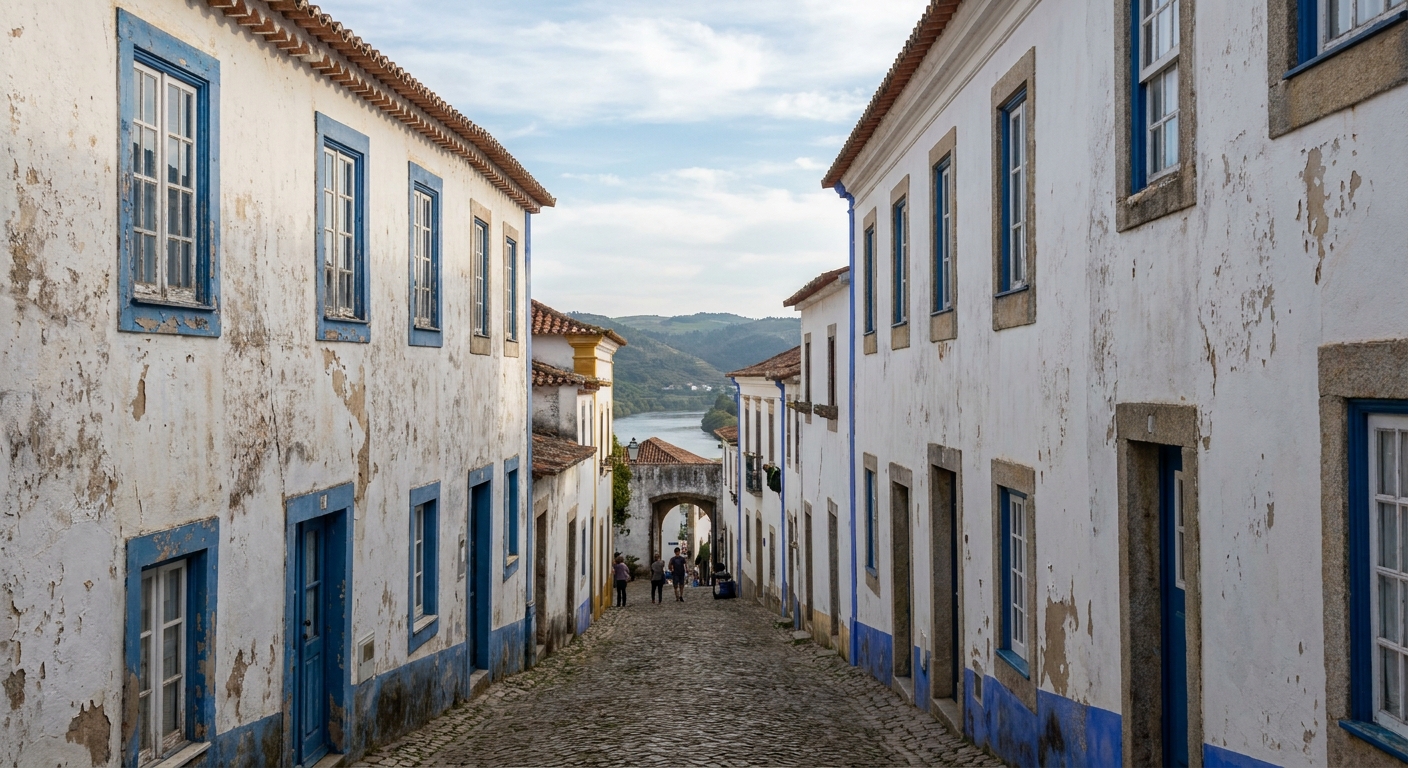
Short days turn out to suit a town this compact. Sunset at 5:39 pm puts the best light of the day at an hour when you are still out walking, and the whole circuit of the walls fits inside 9 hours 45 minutes with room for two sit-down meals on either side of it. Add 58.1°F afternoons, mild enough to walk in a fleece and cool enough that the climb toward the castle end costs nothing in sweat.
The names, in walking order: the Porta da Vila and its tiled vestibule, the Rua Direita running the length of the town from gate to castle, the Igreja de Santa Maria on the main square, the castle keep at the top end, now a pousada, and the ring of walls above all of it. The aqueduct stands outside the main gate, across the road. We could not verify winter hours or admission for the church, the town’s museums or the wall walk, so we quote no times and no fees: confirm with the operator before you build a day around one.
The buildings are identical in January and in July. The air around them is not. Those 2.98 inches mean wet cobbles for long stretches, and polished stone on a slope is genuinely slippery underfoot. On the 2.4 days that bring 0.39 inch or more, the wall walk is the first thing to drop from the plan, being narrow and fully exposed with nowhere to shelter. Save it for a clear morning and hold the church, the shops and a long lunch for the wet afternoon.
The streets themselves cost nothing, and in a town this size that covers most of a visit: the walk from the Porta da Vila to the castle end, the view out over the fields below, the square in front of Santa Maria. Ginjinha served in a small chocolate cup is the local ritual, sold from doorways along Rua Direita. We could not confirm whether the wall walk is ticketed in winter, so ask at the gate rather than taking our word for it. The national shortlist covers the rest of the country.
Óbidos in January: a two-day itinerary
Day one runs on the light. Coffee at eight, just after the 7:54 sunrise, then the walls while the stone is still dry and the lanes are quiet. Down into Rua Direita by ten for the shops and Santa Maria, lunch indoors at one and taken slowly, then the castle end and the aqueduct through the early afternoon. Be back on high ground by half past four: the last half hour before the 5:39 pm sunset is when the amber lands on the whitewash. Dinner at half past seven, by which point it has been dark for two hours.
Day two can afford to be slower, because there is less of it than you think. Give the morning to the lanes running parallel to Rua Direita, then leave after lunch for Lisbon, Nazaré or the coast. If the weather turns, and one January day in three brings measurable rain, invert the whole sequence: long breakfast, church and whatever museum is open, lunch at length, and the walls at the first break in the cloud. Our getting-around guide has the road and bus options.
Óbidos in January vs December and February
| Measure | December | January | February |
|---|---|---|---|
| Average high | 59.5°F | 58.1°F | 58.5°F |
| Average low | 51.4°F | 49.8°F | 50.5°F |
| Rainfall | 2.70 in | 2.98 in | 2.17 in |
| Days with 0.04 in+ | 9.4 | 10.4 | 7.6 |
| Sea temperature | Not verified | Not verified | Not verified |
Set the three beside each other and December is the mildest on paper, 59.5°F by day and 51.4°F at night against January’s 58.1 and 49.8. January takes the rain: 2.98 inches over 10.4 wet days, ahead of December’s 2.70 inches over 9.4 days and well ahead of February’s 2.17 inches over 7.6. February warms back up a touch, to 58.5°F and 50.5°F, and sheds nearly three wet days in the process.
Shift four weeks and the trade is plain arithmetic. Going back to December buys 1.4°F on the afternoon, 1.6°F on the night and one fewer wet day. Going forward to February buys 0.4°F on the afternoon, 0.81 inch less rain and 2.8 fewer wet days, the largest single improvement among the three. And every day after the solstice is longer than the one before it, so a January visit is walking back toward the light rather than away from it.
Is January a good time to visit Óbidos?
Yes, if you have come for the town itself: the walls, the lanes, the long lunches, a 58.1°F afternoon that needs no planning around heat, and a walled circuit you can do twice in a day without tiring. No, if the trip leans on beach days, boat trips or a guaranteed dry week, because 10.4 wet days out of 31 is a real share of the month and two or three of them will be properly wet.
When the answer is no, February is where we would move it: 2.17 inches instead of 2.98, 7.6 wet days instead of 10.4, and an afternoon 0.4°F warmer for the trouble. December runs milder still at 59.5°F by day, but it is half an inch wetter than February and it carries the holiday calendar with it, which is a different kind of trip from a quiet walled-town weekend.
What January gives that neither neighbor does is the wet version of the place: 2.98 inches falling on the ramparts, water running down Rua Direita, and a town that photographs better soaked than dry in the twenty minutes after the cloud breaks.
The last word
Settle the bed first, heated and inside the gate, booked as soon as the dates hold. Then give Óbidos two days rather than one and let the forecast decide which order you take them in. And note what the month hands you after hours: between the 5:39 pm sunset and the next sunrise there are 14 hours and 15 minutes of dark, so pick a dinner table you would happily sit at for two of them.
Sources & data for this guide
- January normals, 58.1°F high / 49.8°F low / 2.98 in · IPMA, 1991-2020 climate normals, station 531 Cabo Carvoeiro, 32.0 m · checked Sep 24, 2026
- Wet-day counts, 10.4 days at 1 mm (0.04 in) and 2.4 days at 10 mm (0.39 in) · IPMA, same station and period · checked Sep 24, 2026
- December and February normals used in the comparison · IPMA, same station and period · checked Sep 24, 2026
- Sunrise 7:54 am, sunset 5:39 pm and 9h45 of daylight on January 15 · sunrise-sunset.org · checked Sep 24, 2026
- Editorial note: the thermometer is on the coast at Peniche and Óbidos sits inland behind its walls. We flagged that gap rather than modeling around it.
- We could not verify a sea-surface temperature for this coast, a municipal tourist-tax rate, or winter hours and admission for the church, the museums and the wall walk, so we quote none of them. Check with the operators when you book.