
SINTRA · PENA PALACE · THE 12-MONTH VERDICT
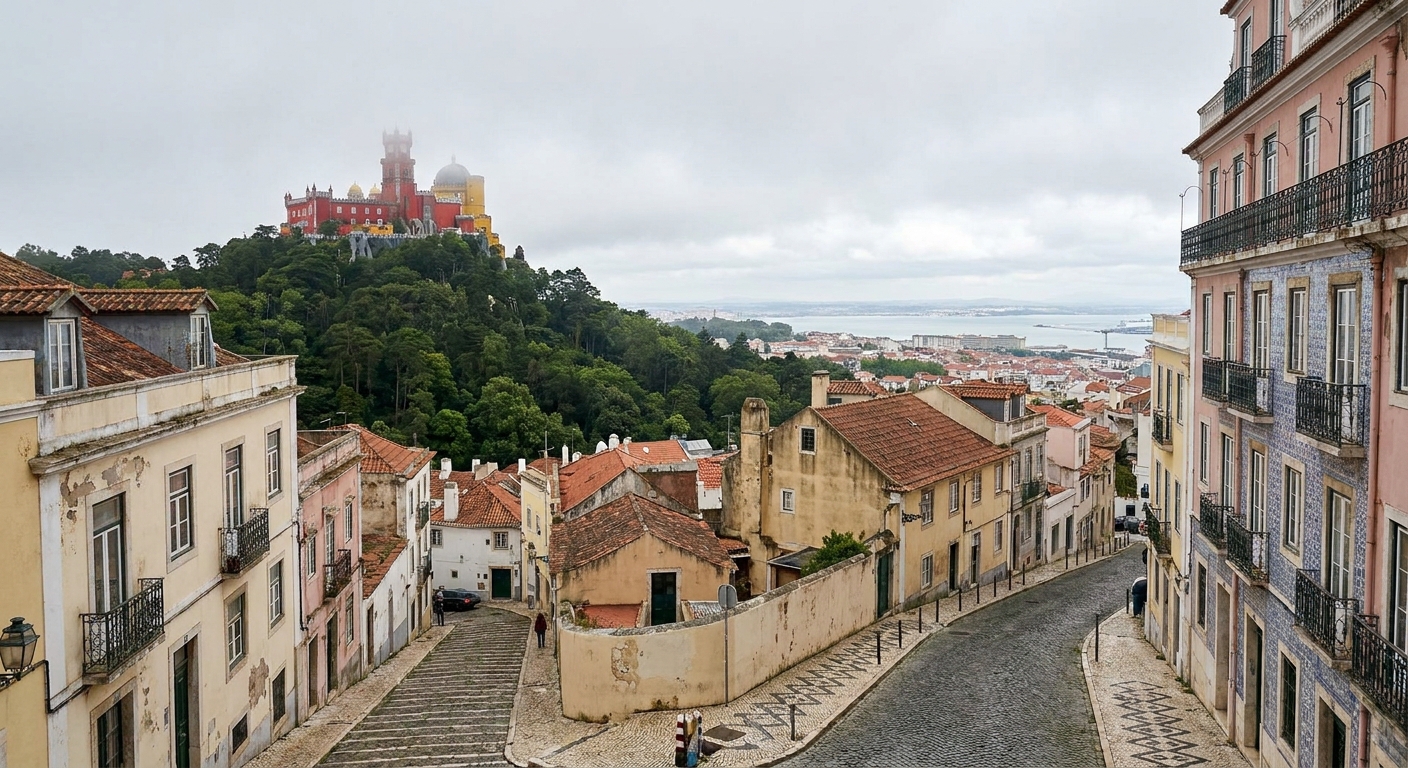
Pena sits on a hilltop that makes its own weather. The palace stands about 15 miles from Lisbon’s airport and roughly 1,300 feet above it, high enough that Atlantic air condenses on the way up, which is why the red and yellow towers spend so many mornings appearing and disappearing. People come for those colors and for the terrace views across the Sintra hills. What they get depends far less on the temperature than on whether the cloud is sitting on the building that day.
Rain and mist decide Pena’s outdoor half: the terraces, the ramparts, the walk down through the park. The short version, before the figures: May, with 73.0°F average highs, 2.00 inches of rain and 5.7 days across the month that record measurable rain.
THE YEAR AT A GLANCE · PENA PALACE
May is the pick: 73.0°F highs, 2.00 inches of rain and 5.7 wet days, with hilltop mist likelier than an airport thermometer 1,300 feet lower will admit.
BEST: MAY · DRIEST: JULY, 0.11 IN · WETTEST: NOVEMBER, 4.51 IN · NORMALS MEASURED AT LISBON’S AIRPORT
Go for: May and September, when the rain column is low (2.00 and 1.41 inches) and the light still runs past 7:45 pm local.
Think twice before: booking November for an outdoor day: 4.51 inches, 9.3 wet days and 3.9 days above 10 mm, the year’s heaviest tally.
IPMA 1991-2020 normals, station 579 Lisboa Gago Coutinho · sunrise-sunset.org · full sources at the end
On this page
- Month by month highs, lows and rainfallThe twelve-month table
- The single best month to goWhy May, with 2.00 inches
- How hot it gets in July and August82.9°F, 84.2°F and warm nights
- The quietest months on the hillNovember to February, and the daylight cost
- The month to avoidNovember, and who it hurts
- Whether the shoulder months pay offWhat April, May, September and October give
Most American visitors meet Pena on a day trip: a train out of Lisbon, a morning on the hill, dinner back in the city. The month you pick for the trip is therefore the month you get at the palace, so the two decisions travel together. Our Sintra guide handles the half-day logistics and the country-wide twelve-month view puts these figures beside the Algarve and the Douro. Check entry times on the palace’s own site before you lock a date.
Pena Palace weather month by month: highs, lows and rainfall
| Month | Avg high | Avg low | Rain | Days ≥ 1 mm | Daylight on the 15th |
|---|---|---|---|---|---|
| January | 57.9°F | 46.0°F | 3.78 in | 9.9 | 9h48 |
| February | 60.3°F | 47.1°F | 2.80 in | 7.8 | 10h48 |
| March | 65.1°F | 50.5°F | 2.63 in | 7.2 | 12h00 |
| April | 67.8°F | 53.2°F | 2.50 in | 7.7 | 13h17 |
| May | 73.0°F | 57.4°F | 2.00 in | 5.7 | 14h21 |
| June | 79.0°F | 61.7°F | 0.53 in | 2.0 | 14h55 |
| July | 82.9°F | 64.4°F | 0.11 in | 0.4 | 14h39 |
| August | 84.2°F | 65.3°F | 0.20 in | 1.0 | 13h43 |
| September | 80.2°F | 63.3°F | 1.41 in | 3.7 | 12h29 |
| October | 72.7°F | 58.8°F | 4.05 in | 8.3 | 11h14 |
| November | 63.7°F | 52.2°F | 4.51 in | 9.3 | 10h06 |
| December | 58.8°F | 47.7°F | 3.94 in | 9.7 | 9h31 |
June, July and August bring 0.53, 0.11 and 0.20 inches of rain. Then the wet half arrives: October through January each deliver between 3.78 and 4.51 inches, with eight to ten days of measurable rain apiece. Temperature moves much less. August’s 84.2°F average high and January’s 57.9°F sit 26 degrees apart, while the wettest month carries roughly forty times the rain of the driest.
Between May and June the rain drops from 2.00 inches to 0.53 and wet days from 5.7 to 2.0, and summer is installed inside four weeks. The reverse swing hits harder. September’s 1.41 inches become October’s 4.05, 3.7 wet days become 8.3, and the average high falls 7.5 degrees to 72.7°F. Those two steps, not the slow slide of the thermometer, are what a date change on either side of them buys or costs you.
November punishes the outdoor half of the visit: 4.51 inches of rain, the wettest total of the twelve months, spread over 9.3 days above 1 mm, of which 3.9 days pass 10 mm, the heaviest tally of the year. Daylight on November 15 runs 10 hours 6 minutes, sunrise 7:18 am, sunset 5:24 pm local. A visitor booked for the interior rooms loses little to that. A visitor who came to walk the park and photograph the terraces loses the reason for the trip.
Every figure here comes from the national weather service’s 1991 to 2020 normals for station 579, Lisboa Gago Coutinho, a real thermometer at 103.9 m (341 feet). That station stands at Lisbon’s airport, about 15 miles away and roughly 1,300 feet below the palace, and Pena stands in the cloud the Sintra hill makes: colder, wetter and mistier than these lines. The rain-day counts use the Portuguese thresholds of 1 mm (0.04 inch) and 10 mm (0.39 inch), while American tables count days above 0.10 inch, so the two sets do not compare.
When is the best time to visit Pena Palace?
May is the answer for the ordinary visitor: 73.0°F average highs, 57.4°F lows, 2.00 inches of rain and 5.7 days recording at least 1 mm. It is the first month of the year with fewer than six wet days, and the last before the summer calendar takes the hill. A plan built on the terraces and a walk down through the park has its best odds here.
April costs two more wet days, 7.7 against 5.7, a quarter more rain (2.50 inches against 2.00) and 5.2 degrees off the afternoon at 67.8°F. June is genuinely drier at 0.53 inches and 2.0 wet days, and that argument has weight, but it comes with 79.0°F afternoons on an exposed hilltop and the whole summer season behind it.
May 15 carries 14 hours 21 minutes of daylight, sunrise 6:22 am, sunset 8:43 pm local, so a late-afternoon entry still finds the terraces lit. For the layer this hill asks for even in May, our packing guide covers it, and the Lisbon guide covers the base most visitors sleep in between trains.
How hot does Pena Palace get in summer?
July and August are the hot, dry end of the year: average highs of 82.9°F and 84.2°F, with 0.11 and 0.20 inches of rain and 0.4 and 1.0 wet days between them. The nights do not drop far either, averaging 64.4°F in July and 65.3°F in August at the airport station. August 15 still holds 13 hours 43 minutes of daylight, with the sun down at 8:32 pm local, which leaves a long, bright, shadeless afternoon on the ramparts.
One thing the normals do not carry: humidity. The series we read gives temperature, precipitation and rain-day counts, and we could not read a published humidity or fog-frequency figure for the Sintra hill, so no number for the mist appears here. What the station’s position does tell you is that a July afternoon on the hill can run cooler and grayer than 82.9°F suggests, because the reading was taken 15 miles away and about 1,300 feet down.
When is Pena Palace quietest?
The quiet stretch is a calendar fact rather than a discount: November through February, outside the school holidays, when the day is short and the hill is wet. December 15 gives 9 hours 31 minutes of daylight, sunrise 7:46 am, sunset 5:17 pm local. The two weeks around Christmas and New Year are the exception inside the exception, and they refill everything.
What the wet months hand over is Pena at its most theatrical, since the peak that manufactures the cloud is the peak the palace was built on. February already trims the rain to 2.80 inches across 7.8 wet days, down from January’s 3.78 inches and 9.9 days, and daylight climbs a full hour between the two months, 9 hours 48 minutes on January 15 against 10 hours 48 on February 15.
January averages a 46.0°F low and 3.3 days of 10 mm or more, and the park paths hold the water after each one. Cloud takes the view over the Sintra hills on a fair share of winter days, and no figure we could read attaches a percentage to that. Daylight is the plainest loss: 9 hours 31 minutes on December 15 is more than five hours short of June 15’s 14 hours 55 minutes, which is one palace and no second stop.
Which month should you avoid in Pena Palace?
November’s 4.51 inches fall across 9.3 wet days, and 3.9 of those pass 10 mm, the heaviest count of the twelve months. Average high 63.7°F, average low 52.2°F. For someone whose day is the interior rooms, the chapel and the cloister, that means a coat and an umbrella. For a photographer after the terrace colors, or a family planning the walk down through the park into town, it is the month most likely to cancel the plan outright.
Even so, about seven days in ten stay under the 1 mm mark, since 9.3 wet days out of thirty leaves close to twenty-one that record nothing, and heavy rain lands on roughly one day in eight. November afternoons also run warmer than February’s, 63.7°F against 60.3°F. Book it with a flexible date, keep the palace interior as the fallback, and the month is workable.
Is the shoulder season worth it in Pena Palace?
April, May, September and October are the shoulder here, measured against a June to August core that averages 0.28 inches of rain a month. April brings 2.50 inches and 7.7 wet days, May 2.00 and 5.7, September 1.41 and 3.7, October 4.05 and 8.3. September sits closest to summer of the four: 80.2°F highs against July’s 82.9°F, with 3.7 wet days against 0.4.
September keeps the evening that October has already lost: 12 hours 29 minutes of daylight on the 15th, sun down at 7:45 pm local, which leaves the terraces lit long after the busiest hours of the morning. April offers the other kind of value, a hillside still carrying the green that 2.50 inches of spring rain paid for, and afternoons at 67.8°F that make the climb from the town gate bearable.
October then takes it back. Its 4.05 inches beat January’s 3.78, so the rain column reads like midwinter while the thermometer still shows 72.7°F, and its 8.3 wet days more than double September’s 3.7. April runs 7.7 wet days against July’s 0.4, and its 67.8°F high falls 16 degrees short of August’s 84.2°F.
September is the pick of the four on the figures alone, 1.41 inches, 3.7 wet days, 80.2°F highs, and it is the month to book when May is gone. April is the gamble at 7.7 wet days, and it pays off on a trip that pairs Sintra with Lisbon, where an indoor day has somewhere to go. October deserves a refundable booking, because 8.3 wet days and 2.8 days above 10 mm belong to the wet half of the year.
The last word
March is the quiet candidate nobody puts on the shortlist: 7.2 wet days, fewer than February’s 7.8 and April’s 7.7, with 2.63 inches of rain and a clean 12 hours of daylight on the 15th, sunrise 6:45 am. Book May if the dates are open, September if they are not, and carry a rain layer for the hill in either case, because the terraces at Pena run colder and mistier than the airport thermometer 1,300 feet below them ever records.
Sources & data for this guide
- Monthly normals 1991-2020, highs, lows, precipitation and rain-day counts · IPMA, station 579 Lisboa Gago Coutinho, altitude 103.9 m · checked Sep 12, 2026
- Rain-day thresholds of 1 mm (0.04 inch) and 10 mm (0.39 inch) are the Portuguese service’s own; US tables count days above 0.10 inch · IPMA · checked Sep 12, 2026
- Daylight, sunrise and sunset on the 15th of each month · sunrise-sunset.org, converted to Lisbon local time · checked Sep 12, 2026
- Position of the thermometer: the station stands at Lisbon’s airport, about 15 miles from Sintra and roughly 1,300 feet below the palace · IPMA station metadata · checked Sep 12, 2026
- Humidity and fog frequency on the Sintra hill: we could not read a published figure, so none is given above
- Quiet and busy months are editorial, read off the calendar and the daylight; no visitor-count or price series was available to us · opening hours and ticket rules change, check the palace before you book