
Naxos greets you with a marble gate at the harbor. Beyond it are sandy beaches along the west coast and stone villages in the green hills. Base yourself in Chora (Naxos Town), where the ferry docks, and rent a car for a day or two. Give the island about a week if you can spare it.
What should you do in Chora?
Walk out to the Portara
It is a huge marble doorway on the little islet of Palatia, all that remains of a temple to Apollo abandoned mid-build in the 6th century BC. A short causeway links the islet to town, and the walk from the port takes about five minutes.
Sunset at the Portara is a favorite moment for many visitors. Expect photographers, drones and hundreds of people jostling for the gap where the sun drops. It's still beautiful. For a quieter visit, go at sunrise, when you'll have the marble almost to yourself. The walk is easy enough to do both.
Get lost in the old town
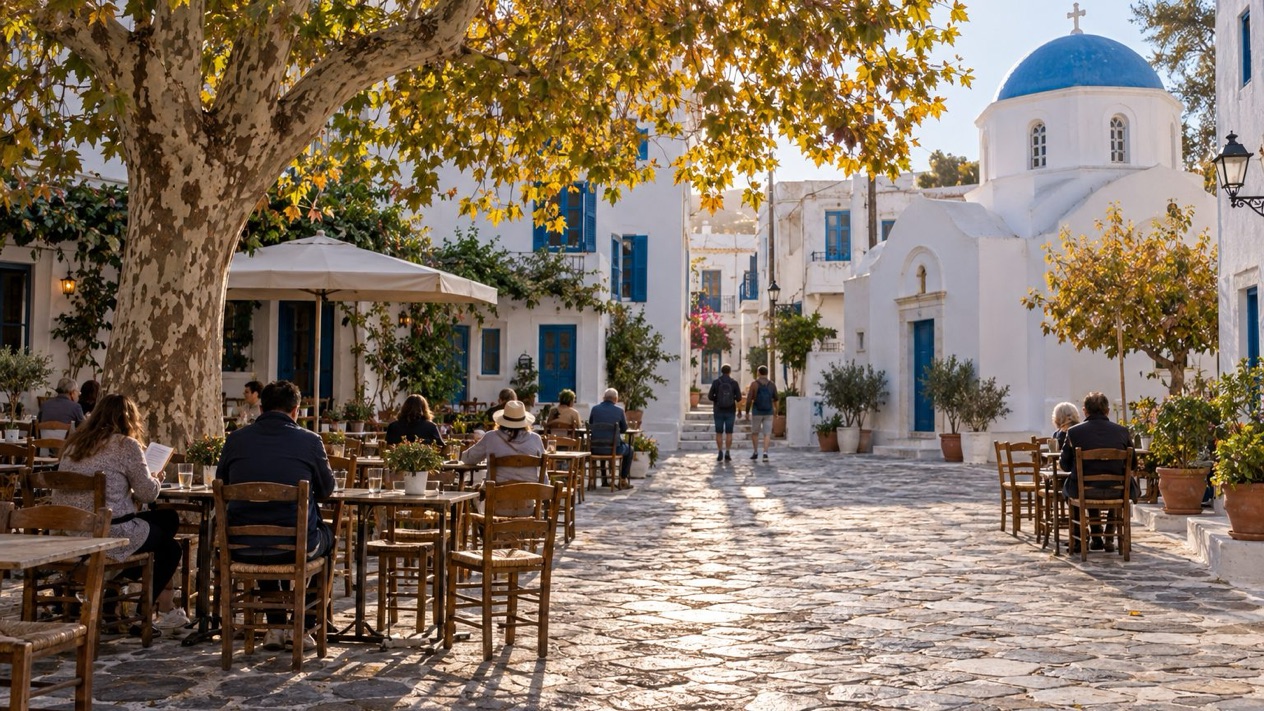
The old town is a pedestrian maze of narrow lanes, arches, whitewashed walls, flower pots and blue doors. It was laid out to confuse pirates, and it still confuses visitors. Leave the map in your pocket. Cats sun themselves on the steps, something delicious drifts out of a kitchen you can't find, and every few turns another tiny square appears. The lanes are sheltered, too, which helps when the wind is up.
Much of the old town shuts for siesta in the midsummer heat, so come early or after 5 p.m.
Climb to the Venetian castle
The Venetian castle at the top was built in 1207 and has been lived in ever since. Families still have homes inside its walls. Its lanes lead past churches, small museums and cafés to wide views over the harbor. Avaton 1739, up here, is a favorite for a pre-dinner drink with that view.
The castle's Glezos Tower is closed for restoration. The Archaeological Museum of Naxos, housed in the castle, is also closed while works on a museum project there continue. Call 22850 23997 to check whether it has reopened.
Shop and eat in the old market
Below the castle, the old market winds through narrow, meandering streets, and Chora's best shops are here. Look for ceramics, local honey, olive oil, nuts and Naxian cheeses. Stop at Koufopoulos for a cheese tasting. Then find Padelis Coffee Shop for loukoumades, crisp outside, soft inside and topped with local honey. For a meal, Metaxi Mas sits right on a market walkway and serves good Greek food at slightly lower prices than elsewhere. You can usually walk into restaurants and get a table. If town looks full, stop by the day before or that morning to reserve.
Which beaches in Naxos are worth the trip?
Plaka for a full beach day
Plaka is a little under 20 minutes' drive from Chora. It's a long stretch of soft white sand backed by dunes, with clear water and laid-back beach bars. Swim the southern stretch in the morning, when you may see turtles, then settle into a beach club for the afternoon. Tortuga, in the middle of the beach, rents sunbeds as sets with towels and water. Plaka also has a few other beach bars, including Nomad Naxos, Tohu Beach Bar next door, and the mellower Cedar Cafe.
Agios Prokopios for sunbeds and watersports
Agios Prokopios is the island's most popular beach, a short drive south of Chora. It has turquoise water, organized sunbeds and umbrellas, and beach clubs. Watersports run from banana tubing to windsurfing. It fills up in summer, so arrive in the morning. Agia Anna sits a short walk along the sand and has shallow water.
Agios Georgios for kids and first-time windsurfers
Agios Georgios runs right alongside Chora, so you can walk there from town. Shallow water stretches far out from the shore here, so it works well for little kids. Beginners learn windsurfing and paddleboarding in the same shallow lagoon. Flisvos Sports Club runs beginner windsurfing courses with patient instructors. Contact the club for current prices and availability.
Mikri Vigla and Hawaii Beach for something wilder
Mikri Vigla has two sides. The southern side is sheltered and better for families. Hawaii Beach, about half an hour from Chora, is rugged and undeveloped, backed by reddish cliffs and a cedar forest. Hawaii Beach has no facilities, so it helps to pack your own supplies before you go. It's worth the effort.
The meltemi, a strong north wind, peaks in July and August. Windsurfers love it, but swimmers looking for flat water won't. On blowy days, pick sheltered spots like the southern side of Mikri Vigla. Your hotel can give you the Naxos Hoteliers Association map, which marks beaches and the windsurfing spots. Most of the calmer sunbathing beaches are on the east side, a longer drive from Chora.
Which mountain villages in Naxos should you visit?
The villages of the center and north show the island's farming side. Expect marble lanes, long taverna lunches and views to Mt Zas. A rental car for a day lets you loop through them, so book one ahead in summer.
A good full-day route runs:
- North from Chora to Melanes
- Up through Kinidaros to Koronas
- On to Apeiranthos, Filoti and Halki
- Back down to end with a swim at Plaka
The roads twist constantly, and views of Mt Zas and the Aegean open up as you climb. Without a car, public buses from Chora reach Halki and Apeiranthos. Full-day bus tours also cover both villages, along with other sights around the island.
Halki
Halki sits among citrus orchards and olive groves. It was once the island's capital, and its neoclassical buildings and marble lanes still show it. Settle into the shaded main square for a long lunch, and go early, because the restaurants close in the afternoon heat.
The Vallindras Distillery and Museum has stood here since 1896, still run by the same family. It's the place to taste kitron, the local citron liqueur, which comes in three versions:
- Green is the sweetest and lowest in alcohol.
- Yellow is the strongest.
- Clear falls somewhere between.
Filoti
Filoti feels like a working village that happens to get visitors. Locals sit at café tables along the leafy main street while farm trucks stacked with Naxian potatoes roll past. Ambrosia sits on the main square and is a good choice for a meal. The produce stall on the square is worth a look even if you're not buying.
About 328 feet (100 m) from the square along the road, the Theonas Traditional Shop is part museum, part shop. It sells baskets and pots, and the owner enjoys a chat. A hiking trail also begins just outside the village.
Apeiranthos
This is the marble village. Its stone-paved lanes run under arches, past old defense towers, with fig trees growing from cracks in the walls. Several small museums cluster here, including the archaeological collection, which costs €5 (€3 reduced). It's open 8:30 a.m. to 3:30 p.m. and closed Tuesdays. Arrive before the fierce midday heat. The tavernas serve traditional food at reasonable prices, with views over the hills toward Mt Zas. Taverna Platanos is known for its moussaka.
Koronas
Koronas is the sleepiest village of the lot. There's little to do beyond wandering the narrow lanes, sitting in the leafy square and eating. Fewer tourists make it this far, and the views north over the Aegean are dramatic. Martina and Stavros' Taverna on the square has no menu. You eat whatever Martina has cooked that day, at gentle prices. Make sure it's open, then go hungry and stay a while.
What are the best ancient sites and hikes on Naxos?
See the Temple of Demeter
The Temple of Demeter near Sangri is one of the few buildings of the ancient world to survive this complete. It went up around 530 BC as part of the building program of the tyrant Lygdamis. It shows early forms of the Ionic order and refined curves like those of the Parthenon, built a century later. In the mid-6th century AD it became a Christian basilica.
Unlike the island's other ancient sites, it has a fence, a museum and a ticket booth. The temple is a long way from Chora, so plan the day around it.
Find an unfinished kouros
Huge marble statues, abandoned before they were finished, lie around the island. The Kouros of Apollonas rests in an ancient quarry above the seaside village, a short walk from the road. You can park nearly anywhere. Another lies in the olive groves near Melanes. You can usually get close with few or no other visitors around. Apollonas is a pleasant stop for a swim after the kouros, and it fits nicely into a drive along the lovely northern coast road.
Hike Mt Zas
Mt Zas rises above the whole island and is the highest peak in the Cyclades. In myth, it's where Zeus was raised. One popular way up begins at Agia Marina Chapel, which is considered the easiest route, and another begins at Aria Spring. Allow about four hours return.
Time the hike for sunset and you'll watch the islands turn golden from the summit. You'll also walk the last stretch down in the dark, so pack:
- A flashlight
- At least 2 liters of water
- Sun protection
- Sturdy shoes for the loose rock on the summit section
Visit the Cave of Zas
For a shorter climb, take the trail from Filoti to the Cave of Zas on the mountain's western flank. In myth, Zeus hid here from his father Cronus. The cave is larger than you'd expect and noticeably cool inside. Allow about two hours return, finishing at Aria Spring, where cold water flows straight from the ground beneath a big plane tree. The path is rocky and has almost no shade, so start as early as you can.
Which day trips and boat tours from Naxos are worth it?
Paros by ferry
Paros is roughly 30 to 45 minutes away by ferry, which lands at Parikia. The town has excellent shopping and good lunch spots such as Taverna Mouragio. Good morning and afternoon sailings for a day trip are limited, so in summer it pays to book early. Keep an eye on the meltemi, which can delay crossings.
Sailing the Small Cyclades
A sailing day around the Small Cyclades, taking in Koufonisia, Iraklia and Schinoussa, is the classic boat trip from Naxos. Reserve it well in advance. Catamaran day cruises include snorkeling gear, lunch and drinks, and they visit coves that are hard to reach on your own.
How many days do you need in Naxos?
- One day: Chora, the Portara and an afternoon at Agios Georgios or Plaka.
- Two or three days: add the village loop by car, with lunch in Koronas if Martina and Stavros are cooking.
- A full week: room for Mt Zas, a sailing day, a windsurf lesson and at least one long, lazy beach afternoon.
If time is tight, skip the northern beach villages such as Lionas. Apollonas earns its place mainly for the kouros. Many museums and collections on the island are closed on Tuesdays, so that can be a good day to spend at the beach.
When is the best time to visit Naxos?
May and September are the sweet spots, with warm sea, manageable crowds and lower prices. June and October work well too. July and August are hot and busy, with higher room rates. April is cool and good for hiking, though too chilly for most people to enjoy the beach, so pack a warm jacket if you go then.
Sources
- travelbabbo.com (https://travelbabbo.com/naxos-greece/), checked October 18, 2026
- thecommonwanderer.com (https://www.thecommonwanderer.com/blog/things-to-do-on-naxos-greece), checked October 18, 2026
- packthesuitcases.com (https://www.packthesuitcases.com/things-to-do-in-naxos-greece/), checked October 18, 2026
- awinterescape.com (https://awinterescape.com/naxos-greece/), checked October 18, 2026
- kellystilwell.com (https://kellystilwell.com/things-to-do-in-naxos-greece/), checked October 18, 2026
- archaeologicalmuseums.gr (https://archaeologicalmuseums.gr/en/museum/5df34af3deca5e2d79e8c19a), checked October 15, 2026
- cyclades.culture.gov.gr (https://cyclades.culture.gov.gr/en/hours-prices/), checked October 15, 2026
- Hellenic Ministry of Culture, Odysseus (http://odysseus.culture.gr/h/1/eh155.jsp?obj_id=3302), checked October 15, 2026
- cyclades.culture.gov.gr (https://cyclades.culture.gov.gr/en/location/the-archaeological-collection-and-the-archaeological-site-of-sangri-naxos/), checked October 15, 2026
- hellenicseaways.gr (https://www.hellenicseaways.gr/en-gb/hellenic-highspeed/ferry-tickets-to-naxos), checked October 15, 2026
- cyclades.culture.gov.gr (https://cyclades.culture.gov.gr/en/location/the-archaeological-museum-of-naxos/), checked October 15, 2026