
FLORIDA · GILCHRIST BLUE SPRINGS · STATE PARK
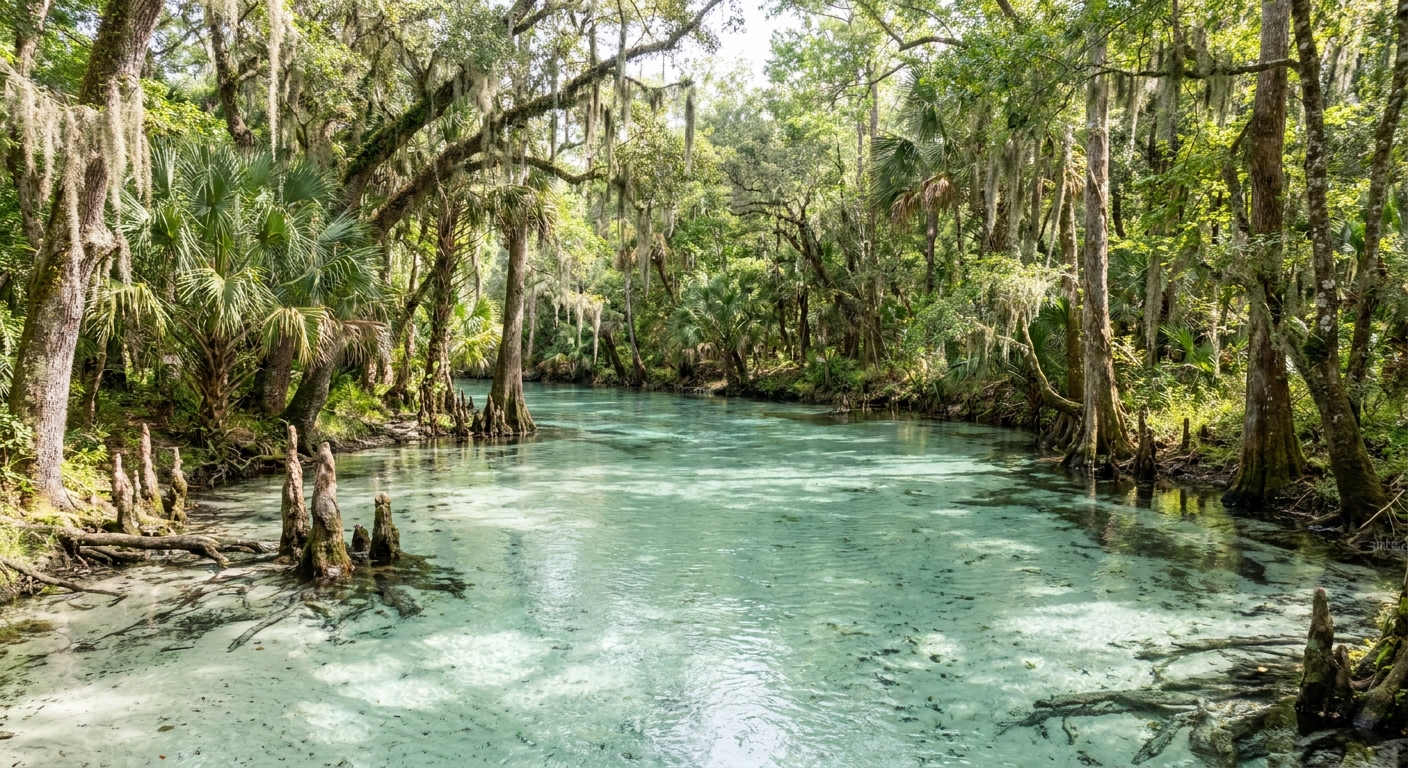
The water at Blue Spring does one thing extremely well: it holds its clarity. Sand grains on the bottom keep their edges, a small fish two feet down looks close enough to touch, and the color runs from pale blue over the vent to green where the run narrows under the trees. North Florida has a great deal of clear water. This is a small park built around one piece of it.
The state’s facilities inventory counts what is here in single digits: 1 designated swimming area, 1 launch for canoes, kayaks and tubes, and 0.5 miles of hiking trail. Then comes the number that runs your Saturday, 100 parking spaces. When they are gone the gate closes, and no arrival time posted on a website gets you around that.
THE SPRING AT A GLANCE · GILCHRIST BLUE SPRINGS
Come for one clear swimming area and a short float, arrive early enough to land one of 100 parking spaces, and look up the fee and the hours on the park’s own listing, because our sources could not supply either.
1 SWIMMING AREA · 100 PARKING SPACES · 0.5 MILES OF TRAIL
Go for: water clear enough to read a coin through by 9am, one launch that takes tubes and kayaks, and a park you can see before lunch.
Think twice before: driving out on a summer Saturday afternoon: 100 spaces is the ceiling, and the gate closes once the lot fills.
Facilities: Florida DEP inventory, 2024 · Legal category: Fla. Stat. 373.802(5) · full sources at the end
On this page
- Water temperature before you get inHow cold the spring runs, and what we could not measure
- Swimming with kidsThe 1 designated swimming area
- Tubing, kayaking and a short walk1 launch and 0.5 miles of trail
- A Saturday without a closed gate100 parking spaces, and when they run out
- Whether this beats the bigger spring parksThe verdict, facility by facility
- Other Florida springsThe statewide springs guide
Florida law keeps a category for springs of this kind. Under Florida Statutes 373.802(5), an Outstanding Florida Spring means every historic first-magnitude spring as the Florida Geological Survey determines them, plus six more named by hand in the statute. Which side of that line Blue Spring sits on is the Survey’s determination to make, and a single day’s flow reading would not settle it here. Where this vent stands among the state’s others is laid out in our Florida springs guide.
How cold is Gilchrist Blue Springs?
We cannot put a decimal on this vent. The park’s own site answers automated reads with a 403, and no measured water temperature for Blue Spring appears in the sources listed below. Florida spring water generally sits near 72°F (22°C) (est.), and what that does is easier to describe than the figure itself. In July it stings at the knees for about ten seconds and then stops registering entirely. On a January morning the same water feels warm, mist drifts over the run, and it is the air, not the water, that makes you flinch on the way out.
Can you swim at Gilchrist Blue Springs?
One designated swimming area: that is the state’s count, and it shapes the day more than any sign at the entrance. Swimmers, floaters, toddlers on noodles and teenagers with a running start all share the same bank and the same steps into the blue. A group of eight will not spread out along a beach here, because there is no beach to spread along. Claim a patch of bank on arrival and use it as the base for everything else.
Whether manatees come up this run in winter is something our reading could not settle: the state wildlife pages that would carry a count render only in a browser and gave us no figure to quote. Treat a sighting as luck rather than a plan. If manatees are the point of the trip, start with our manatee guide instead, and for the shade-and-shallow-entry question that decides a day with small children, the family guide goes into it.
What is there to do at Gilchrist Blue Springs?
| What you came for | What the state counts | What that means on the ground |
|---|---|---|
| Swimming | 1 designated swimming area | Everyone in the water shares one bank |
| Tubing and paddling | 1 canoe, kayak and tube launch | One place to put in, one line to join |
| Walking | 0.5 miles of hiking trail | Twenty minutes at a stroll (est.) |
| Parking | 100 spaces | The gate closes once they are taken |
| Entrance fee | Not in our sources | Check the park’s own listing before you drive |
The launch is a single point of entry for canoes, kayaks and tubes, so the float and the paddle both start in the same place and the same line. Tubes move at the speed of the water and not much faster, which makes a run that looks short from the bank take longer than the map suggests. Find out where the park wants you to take out before you get in, since one launch does not automatically mean one return.
Half a mile of hiking trail is a leg-stretch between swims, twenty minutes at a stroll (est.), on ground that asks nothing of your shoes when it is dry. Save it for the middle of the day, when the swimming area is at its fullest, and come back down to the bank as the first cars start pulling out.
There is no second swimming area, no trail network beyond that half mile, and no third launch to spread the crowd. That makes this a two-hour park with a picnic attached rather than a day’s destination, and it works better paired with a second stop than with a long drive home. The tubing rivers and the bigger spring parks are sorted in the Florida springs guide, and the road-trip planner handles the stringing together.
How busy does Gilchrist Blue Springs get?
One hundred spaces, counted by the state in its 2024 facilities inventory, is the hard ceiling on how many people stand in that water at once. When the lot fills, the gate closes and cars are turned back at the entrance. Three families arriving in two cars each is six of those hundred, and a holiday weekend does that arithmetic on the way in.
Our reading could not produce an opening hour for this park, so the plan has to be built on daylight and on the park’s own listing checked the night before. Summer Saturdays and holiday weekends are when the hundred run out. A Tuesday in October is a different park with the same water in it.
No entrance fee appears in our sources either, and we will not borrow one from a neighbor. Florida’s parks charge differently, and by season, so a figure you saw for a spring an hour up the road does not transfer here. Look the current fee up on the park’s own listing, and carry a card as well as bills.
That same ceiling has an upside on the calendar. An off-season weekday morning rarely tests 100 spaces, and that is when a single swimming area feels like generous water per person. Which weeks are quiet statewide is set out in our month-by-month Florida verdict, and the driving guide covers the rental-car questions a spring day trip raises.
When to go. The month-by-month case for Gilchrist Blue Springs — what the normals say, when the sea is warm enough to swim and which weeks fill up — sits on the best time to visit Gilchrist Blue Springs.
Is Gilchrist Blue Springs worth visiting?
Sources & data for this guide
- Facility counts: 1 designated swimming area, 1 canoe, kayak and tube launch, 0.5 miles of hiking trail, 100 parking spaces · Florida Department of Environmental Protection, Recreational Facilities Inventory, 2024 annual report (PDF, 374 pages) · checked Sep 11, 2026
- Legal definition of an Outstanding Florida Spring, including the six springs named in the text · Florida Statutes 373.802(5) · checked Sep 11, 2026
- Entrance fee, opening hour and any manatee count: not readable · floridastateparks.org answered our automated reads with a 403, and the FWC manatee pages render client-side · checked Sep 11, 2026
- Water temperature near 72°F (22°C) is an editorial estimate for Florida spring water, not a reading taken at this vent.
- Facility counts describe the 2024 report; parks add and close facilities between editions · check the park’s listing before you drive.
Worth it depends on what you are measuring. Measured in facilities, this park holds one swimming area, one launch and half a mile of trail, and you will have seen all of it before lunch. Measured in water, it delivers what people drive for: clarity you could read a coin through, at a temperature the season barely touches.
The comparison that counts is with the bigger spring parks. They offer more trail, more boardwalk and more parking, and they bring more people with them. Trading 100 spaces for several hundred means trading a quiet bank for a busier one, so check the lot size of whichever spring you pick.
For families, one swimming area does two jobs at once: everyone stays visible from a single spot, and nobody wanders off to a second beach out of sight. For paddlers, one launch is plenty for a morning and thin for a full afternoon. For hikers, half a mile is a walk to the car and back, and the trail should not be the reason for the drive.
Facility counts carry a year, and these carry 2024. Parks restripe lots, add a boardwalk or close a launch between reports, so the 100 spaces and the half mile describe the inventory rather than the morning you show up. A swimming area and a launch change slowly. Parking is the line item that moves.
Pack for a small park: a towel you can sit on, shoes for the steps into the vent, a card for the fee our sources could not name, and an arrival early enough to be one of the hundred cars. Get in, float down to where the run narrows under the trees, walk the half mile while the bank is at its busiest, then swim again before the afternoon arrivals. For the rest of north Florida’s water, tubing rivers and winter manatee runs included, start with the springs guide.