
FLORIDA · GILCHRIST BLUE SPRINGS · JUNE
June turns this stretch of the Santa Fe River into a two-temperature place. The air climbs to a normal high of 90.3°F, the nights stop at 69.5°F, and 7.56 inches of rain fall across the month, well over double what May delivers. Florida springs run cool and steady all year, so the swim that felt pleasant in April becomes the reason you set an alarm.
Four weeks in either direction move the numbers more than most people expect. May runs 3.08 inches of rain across 4.5 wet days. July adds less than a degree to the afternoon and rains slightly less than June. If the dates are still open, compare the May normals or start from Florida’s twelve-month view.
THE MONTH AT A GLANCE · GILCHRIST BLUE SPRINGS · JUNE
Come in June for water and long evenings, build the day around a 6:28 a.m. sunrise, and treat 90.3°F afternoons and eleven wet days as the price of admission.
NOAA 1991-2020 NORMALS · STATION AT GAINESVILLE REGIONAL · HURRICANE SEASON OPENS JUNE 1
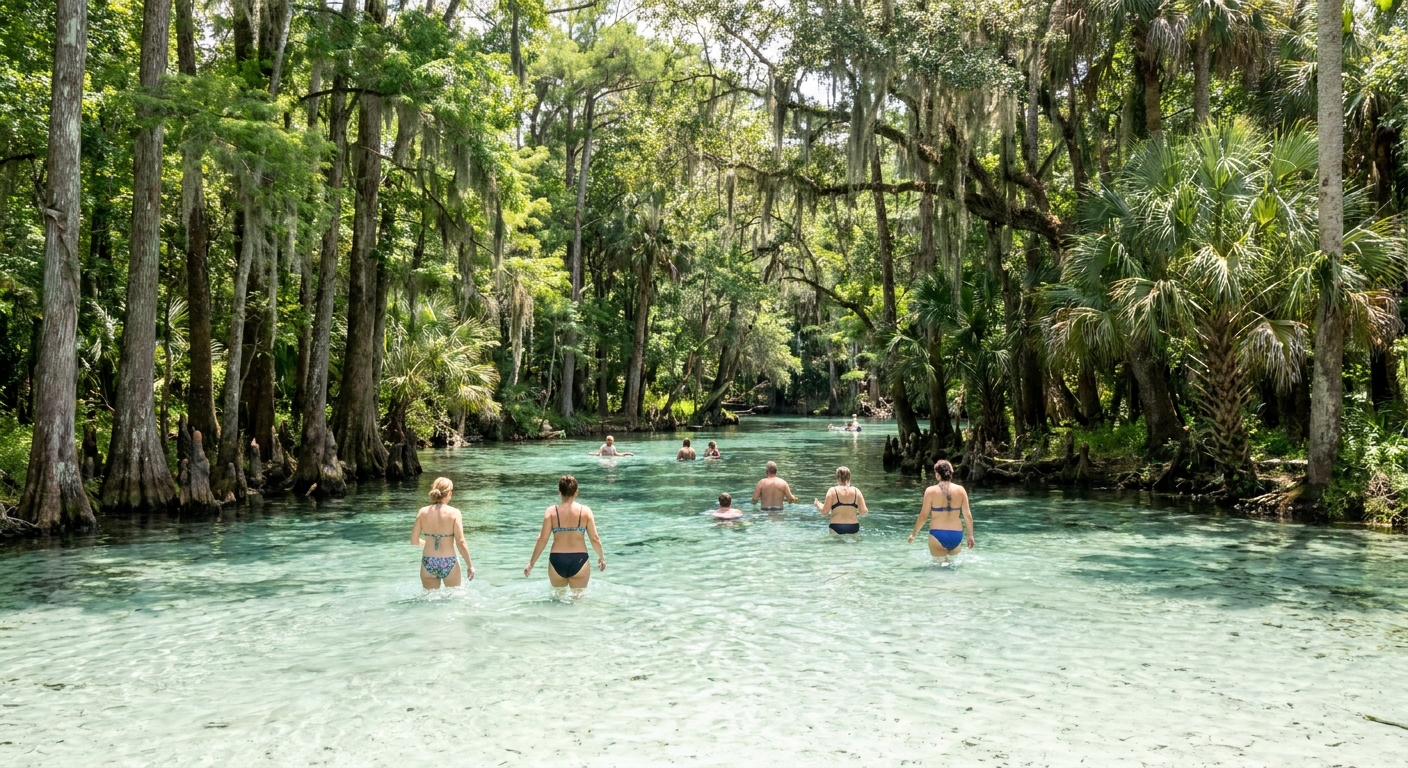
Go for: water you can stay in all morning, the longest evenings of the year, and a swim that beats the heat instead of fighting it.
Think twice before: planning long midday walks or a dry weekend. Eleven days in an average June bring measurable rain and 2.1 bring an inch or more.
Normals: NOAA NCEI 1991-2020, station USW00012816 · Light: sunrise-sunset.org · full sources at the end
On this page
- June weather at Gilchrist Blue SpringsThe 1991-2020 normals: 90.3°F and 7.56 inches
- Highs, lows and the day-to-night swing20.8°F between afternoon and dawn
- Crowds, fees and booking in JuneWhat we could verify, and what we could not
- Things to do at the springs in JuneThe spring run, the Santa Fe River and Ginnie Springs
- A two-day plan built around the heatIn the water by 7:30, indoors by 1
- June against May and JulyHow the three months compare on rain and heat
- Is June a good month to go?Who should book it, and who should wait for fall
One caveat belongs up front, because it shapes every number that follows the table below. The thermometer is not at the spring. It sits at Gainesville Regional, up the road, and it serves Ginnie Springs on the same stretch of river just as it serves this park.
Gilchrist Blue Springs weather in June: average highs, lows and rain days
| June normal | Value |
|---|---|
| Average high | 90.3°F |
| Average low | 69.5°F |
| Precipitation | 7.56 in |
| Days with 0.10 in or more | 11.0 |
| Days with 1.00 in or more | 2.1 |
| Daylight on June 15 | 14 h 06 min |
Every figure here comes from NOAA NCEI’s 1991-2020 monthly normals for station USW00012816, a real instrument at Gainesville Regional rather than a reanalysis grid cell. That distinction matters when you are reading tenths of a degree. It also means 90.3°F describes the regional air, not the shaded microclimate over the spring run, and we hold no measurements taken inside the park itself.
Eleven days in an average June record at least a tenth of an inch, better than one day in three. Of those, 2.1 deliver an inch or more, so call it two proper soakings a month. Florida’s wet season works on a near-daily afternoon rhythm, not on gray all-day drizzle, and the storms tend to arrive after the morning has already been spent.
Between the 90.3°F afternoon and the 69.5°F dawn sits 20.8°F of swing, and none of it calls for a sweater. Pack for wet and for sun instead: two towels, water shoes for limestone, a brimmed hat, and a light rain shell that lives in the day bag for those 2.1 inch-plus days. Sunscreen goes on before the first swim, because reapplying it wet is a losing argument.
Light is the month’s real gift. On June 15, sunrise-sunset.org puts sunrise at 6:28 a.m. and sunset at 8:34 p.m. Eastern Daylight Time, a stretch of 14 hours and 6 minutes. You can swim before breakfast, sit out the worst of the afternoon, and still get two unhurried hours on the water after five o’clock.
How warm is Gilchrist Blue Springs in June?
The normal June afternoon peaks at 90.3°F and the normal night bottoms out at 69.5°F. That 20.8°F spread is narrower than it sounds in practice, because humidity keeps the early hours heavy. The coolest air of the whole day arrives around that 6:28 a.m. sunrise, and it is gone by mid-morning.
Dress for it in one layer. A T-shirt and a swimsuit cover the 7 a.m. hour comfortably, and by two in the afternoon the only comfortable options are shade, water or air conditioning. Families who want the shape of a Florida summer day without the guesswork will find the same logic in our family guide.
Frost plays no part in a north Florida June. The NOAA normals we read carry no count of freezing nights for the month, and with an average low of 69.5°F there is nothing to plan around. We could not verify the water temperature at the vent itself, so no figure for the spring appears from us. What is safe to say is that a Florida spring runs cool and near-constant while the air above it does all the seasonal moving.
How busy is Gilchrist Blue Springs in June? Crowds, prices and the demand peak
We found no occupancy series and no monthly room-rate series for this corner of Gilchrist County, so we crown no month expensive and none cheap. What we can date is the calendar. The Atlantic hurricane season opens June 1 and runs to November 30, with a statistical peak around September 10, which puts June at the quiet end of that curve while still being the first full month of the wet season.
Campsite rates and the reservation window at the park are things we could not verify, so we name no lead time in weeks and no amount. Book refundable where you can, given the season, and check the park’s own page for capacity before you drive. Broader budgeting sits in what a Florida trip costs and where to base yourself.
On lodging tax, our cards are on the table: we could not verify a rate for Gilchrist County, so we give no percentage and no nightly add-on. Treat any figure you see quoted elsewhere as something to confirm at the desk when you check in.
Money moves this month less than the clock does. Arriving at 6:30 in the morning costs nothing and buys three hours before the air reaches its 90.3°F normal, while the best paid upgrade is simply a bed with air conditioning close enough that the midday retreat is short. Everything else, shade and a cooler included, comes out of the trunk.
Things to do in Gilchrist Blue Springs in June
June holds the solstice, and 14 hours 6 minutes of daylight on the 15th is the longest working day the calendar offers here. That changes the shape of a visit. An evening swim that would be a race against dusk in October runs comfortably to 8 p.m., with the sun down at 8:34 and the parking lot still light.
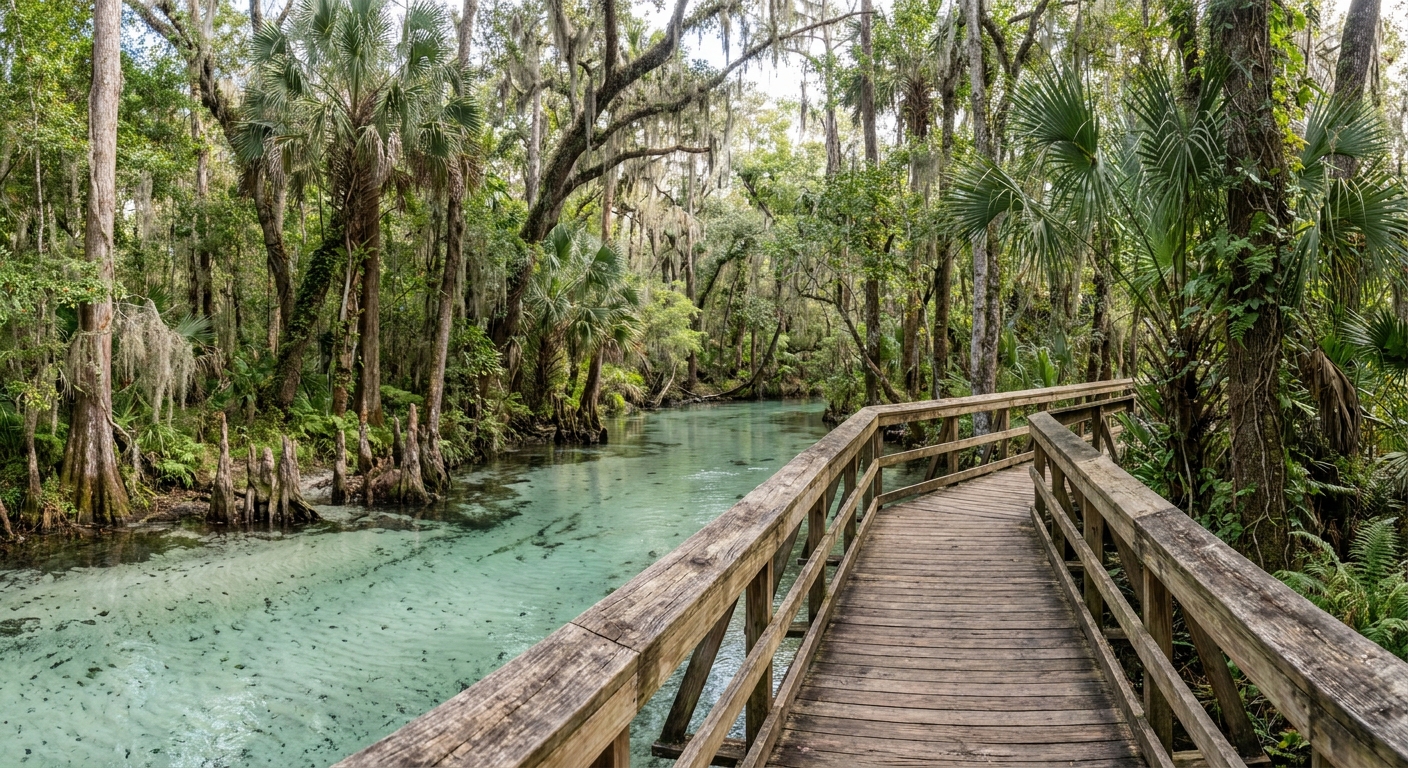
The spring run and its short walk down to the Santa Fe River are the reason to come, and a few miles up the same stretch of river sits Ginnie Springs, close enough to share the weather station that produced every normal above. Gainesville is the wet-afternoon fallback within easy reach. We could not verify entry fees, opening hours or tube rentals at either spring, so no price appears from us. Call before you commit a morning.
What June changes is the air, not the water. A spring that behaves the same way in February meets afternoons at 90.3°F instead of May’s 87.4°F, and that widening gap is what makes the first step in feel dramatic. Manatees are a different season entirely and a different river, as our Crystal River guide explains.
On free days, we could not verify any fee-free date at the park for June, so we list none. The month does hand over something at no charge anyway: the window from 6:28 a.m. to 8:34 p.m., which is two hours longer than a December visitor gets.
Gilchrist Blue Springs in June: a two-day itinerary
Day one starts at the 6:28 sunrise. Be parked by seven and in the water by 7:30, when the air is closer to 69.5°F than to anything uncomfortable. Swim and float until eleven, eat under trees, then leave for an air-conditioned Gainesville afternoon while the thermometer works toward 90.3°F. Come back at five for the long evening stretch and dry off in light that lasts past 8:30.
Day two goes to the Santa Fe River, paddling early for the same reason. Watch the sky from noon onward, since eleven days in an average June bring measurable rain and 2.1 bring an inch or more. If a cell builds, drive out rather than wait it out, take the indoor afternoon, and plan on the sky clearing for the evening swim. Florida’s wet-season storms are an afternoon event, not a washed-out day.
Gilchrist Blue Springs in June vs May and July
| Normal (1991-2020) | May | June | July |
|---|---|---|---|
| Average high | 87.4°F | 90.3°F | 91.1°F |
| Average low | 62.6°F | 69.5°F | 71.6°F |
| Precipitation | 3.08 in | 7.56 in | 6.68 in |
| Days with 0.10 in or more | 4.5 | 11.0 | 10.5 |
The step from May to June is the big one. Afternoons gain 2.9°F, nights gain 6.9°F, rainfall jumps from 3.08 to 7.56 inches, and wet days go from 4.5 to 11.0. July then barely moves the heat, adding 0.8°F to the high and 2.1°F to the low, and it is marginally drier than June at 6.68 inches across 10.5 wet days. June out-rains July by 0.88 inch.
Shifting four weeks back to May buys the driest of the three months and nights that fall to 62.6°F, at the cost of afternoons that never quite justify a dawn swim. Shifting forward to July gains almost nothing and loses the solstice light. The real decision is May or June, and it comes down to whether you want dry ground or a genuine reason to stay in the water all morning.
Is June a good time to visit Gilchrist Blue Springs?
Yes, for swimmers, paddlers and early risers with a car and a flexible afternoon. The month’s whole case is the contrast between 90.3°F air and cool spring water, and it pays out every morning. No, for anyone planning long midday hiking, a camera-heavy schedule that cannot absorb a storm, or a trip where eleven wet days in thirty would spoil the mood.
If that second description fits, take May instead. It runs 3.08 inches of rain across 4.5 wet days, nights drop to 62.6°F, and afternoons at 87.4°F still make the water welcome. The May page lays out what that trade looks like day by day. Late fall is the other answer, once the wet season closes at the end of October.
What no other month gives you is the solstice: 14 hours 6 minutes of daylight, a sunset at 8:34 p.m., and water that has not noticed the season at all.
The last word
Book June if you can reach the water by half past seven, and skip it if you cannot. Spread the month’s 7.56 inches across its 11.0 wet days and the average rainy day delivers about seven tenths of an inch, which is a loud hour rather than a lost day. Pack the shell, set the alarm for 6:28, and let the afternoon belong to the air conditioning.
Sources & data for this guide
- June normals: high 90.3°F, low 69.5°F, 7.56 in, 11.0 days at 0.10 in, 2.1 days at 1.00 in · NOAA NCEI monthly normals 1991-2020, station USW00012816 (Gainesville Regional) · checked Sep 24, 2026
- May and July normals used in the comparison · same NOAA NCEI 1991-2020 series · checked Sep 24, 2026
- Daylight, sunrise 6:28 a.m. and sunset 8:34 p.m. on June 15, converted from UTC · sunrise-sunset.org · checked Sep 24, 2026
- Hurricane season dates and the September 10 peak, wet-season storm rhythm · NOAA National Hurricane Center and the National Weather Service, as cited in our Florida orientation · checked Sep 24, 2026
- Station caveat: the normals are measured at Gainesville Regional, the same station that serves Ginnie Springs on this stretch of the Santa Fe River, not inside the park.
- We could not verify park entry fees, opening hours, campsite rates, the reservation window, the spring’s water temperature, or a Gilchrist County lodging-tax rate, so no such amount appears above.
To plan your stay
- Best Time to Visit Gilchrist Blue Springs: Month-by-Month Highs, Rain and the Quietest Weeks
- Gilchrist Blue Springs in May: Weather, Crowds and How It Compares to April and June
- Gilchrist Blue Springs in July: Weather, Rain Days, Daylight and How June and August Compare
- Gilchrist Blue Springs in April: Weather, Rain Days and a Two-Day Plan