
FLORIDA · GILCHRIST BLUE SPRINGS · MARCH
By March the Santa Fe River country has shaken off winter without turning into summer. The 1991-2020 normals put the afternoon at 75.8°F and the dawn at 49.7°F, and on the 15th the sun rises at 7:38 am and sets at 7:40 pm local time, 12 hours and 2 minutes apart. Warm enough after lunch to want to be in the water, cool enough at breakfast to want a fleece.
March also carries the wettest total of the three months around it, 3.49 inches, and it carries the spring-break weeks that our Florida orientation warns about. If you are still choosing a state-wide window rather than a date at one spring, the 12-month verdict does that job. The narrower question is what these four weeks give you, and whether February or April would serve you better.
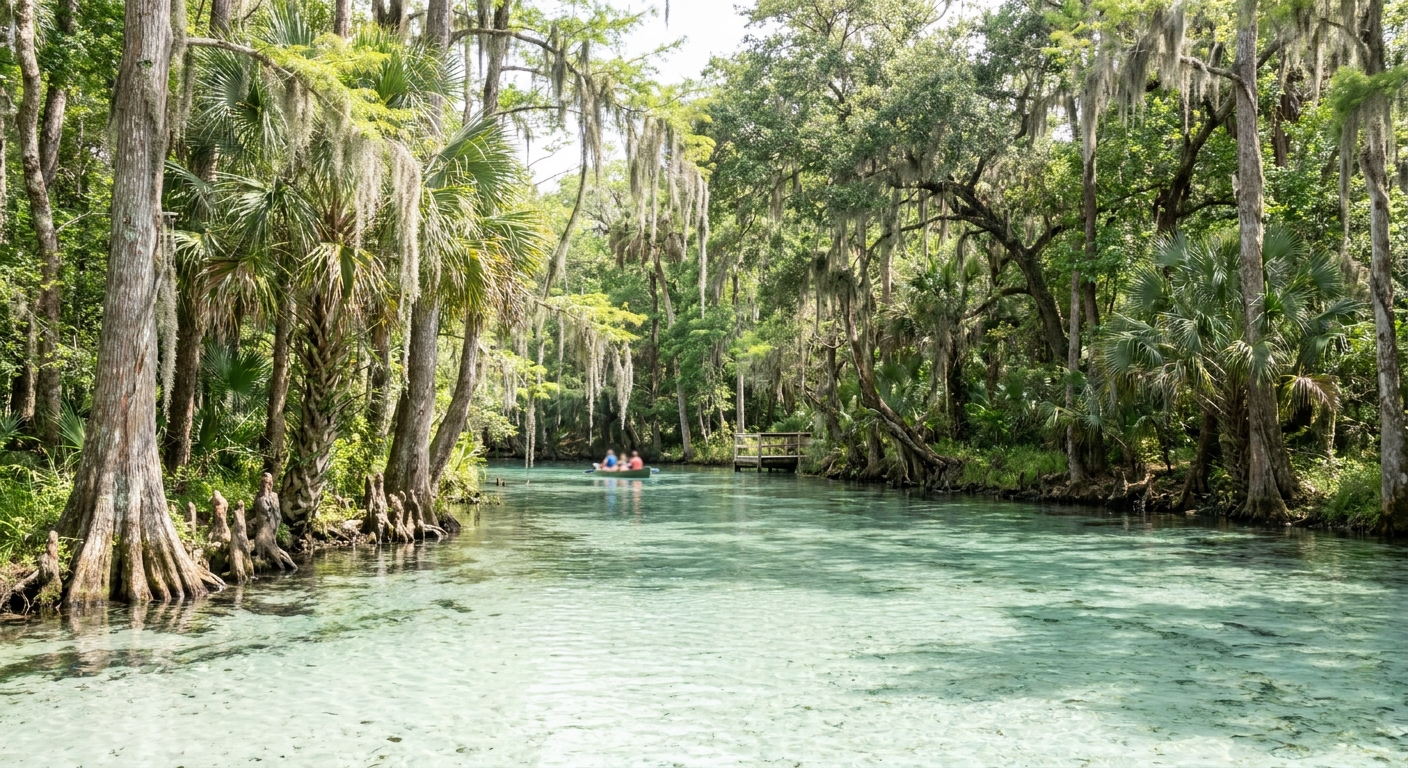
MARCH AT A GLANCE · GILCHRIST BLUE SPRINGS
March buys you 75.8°F afternoons and just over twelve hours of daylight for a spring swim, at the price of the year’s spring-break weeks and 3.49 inches of rain.
NORMALS 1991-2020 · GAINESVILLE REGIONAL STATION · SPRING BREAK MONTH
Go for: afternoons nearly 5 degrees warmer than February’s, a spring run that barely notices the calendar, and enough evening light to swim at five and still drive out dry.
Think twice before: locking a Saturday. March is spring break across Florida, and we could not verify the park’s parking capacity or any visitor count.
Air normals: NOAA NCEI 1991-2020, station USW00012816 · Daylight: sunrise-sunset.org · full sources at the end
On this page
- Gilchrist Blue Springs weather in March75.8°F highs, 3.49 inches, 5.3 rain days
- March temperatures, dawn and afternoon49.7°F at sunrise, 75.8°F by mid-afternoon
- Crowds and prices in MarchSpring-break weeks, and the numbers we could not verify
- Things to do in MarchThe spring run, the Santa Fe River, Ginnie Springs
- A two-day plan timed to the lightTwo days between a 7:38 am sunrise and a 7:40 pm sunset
- March or February or April?How the three months compare, degree by degree
- Is March a good time to go?Our verdict, and who should shift four weeks
Every figure here comes from the NOAA NCEI 1991-2020 monthly normals for station USW00012816 at Gainesville Regional, the same official thermometer that serves Ginnie Springs a few miles up the Santa Fe River. Read them as the regional air, not as a reading taken at the spring lip.
Gilchrist Blue Springs weather in March: average highs, lows and rain days
| Measure | March normal |
|---|---|
| Average high | 75.8°F |
| Average low | 49.7°F |
| Precipitation | 3.49 in |
| Days with 0.10 in or more | 5.3 |
| Days with 1.00 in or more | 1.0 |
| Nights at 32°F or below | 1.2 |
| Daylight on March 15 | 12h 02m |
NOAA NCEI publishes the 1991-2020 normals for Gainesville Regional at 75.8°F by afternoon, 49.7°F before sunrise and 3.49 inches of rain over the month. Those come off a real thermometer and a real gauge, not a reanalysis cell averaged over a grid square, and the difference matters on the low end, where models and stations disagree most. The rainfall total is the highest of the three months around March.
Measurable rain falls on 5.3 days, roughly one day in six, and 1.0 of them delivers an inch or more. A one-week trip therefore budgets for a single wet day, occasionally a properly heavy one, and five days when the sky does nothing to your plans. North Florida rain this month travels with passing fronts rather than on the daily summer schedule, so a gray start often clears while the air is still climbing.
Twenty-six degrees separate the dawn from the afternoon, and all of it happens inside one day. Pack for two climates in the same duffel: long pants and a fleece for the seven o’clock start, a swimsuit and a rash guard for anything after noon. Bring a towel that dries fast rather than a big one, because you climb out of cool water into air that has not yet reached its 75.8°F afternoon.
On March 15 the sun is up at 7:38 am and gone at 7:40 pm local time, 12 hours and 2 minutes of daylight, the equinox week levelling day and night. That evening end leaves room for a late swim and a dry walk back to the car before dusk, and it is why a March day trip works from a bed an hour or two away when a January one does not.
How warm is Gilchrist Blue Springs in March?
The month runs from a 49.7°F normal low to a 75.8°F normal high, a spread of 26.1 degrees. That is a hair wider than April’s 26.0 and more than a degree wider than February’s 25.0, so March is the month whose single day covers the most ground. Neither end is extreme. Both ends are real, and a trip planned around only one of them gets half of it wrong.
Arrive at first light and you are standing in air near 50°F with the water steaming. Wait until early afternoon and you are in the mid-70s, which is when swimming stops being a dare. The practical shape of a March day is a jacket until ten, sleeves until noon, and a swimsuit from noon to five, with the fleece going back on while your hair is still wet.
Frost is a minority event but not a rumor: 1.2 nights in an average March fall to 32°F or below. If you are sleeping outdoors, that night exists somewhere in the month, almost always in the first half. A 20°F bag and a hat cost nothing to bring and turn the one cold night from a story into a footnote.
How busy is Gilchrist Blue Springs in March? Crowds, prices and the demand peak
March sits in the back half of Florida’s dry season, November through April, which is the state’s high season for visitors. That much is calendar. We found no occupancy series and no monthly room-rate series for Gilchrist County, so we crown no month the most expensive and quote no seasonal premium.
What we can say about timing is a matter of the school year. Spring-break weeks land in March across much of Florida and much of the country, and they stack onto weekends that were already the busiest days at a swimming spring. Book a weekday if your dates flex at all, and get there in the morning either way. We could not verify the park’s parking capacity or any closure-at-capacity policy, so an early arrival is the cheap insurance.
We could not verify the Gilchrist County tourist development tax rate, so we give no percentage. For what a Florida week actually costs once rooms, the rental car and the toll layer are added up, our trip cost guide carries the statewide arithmetic, and the getting-around guide covers the electronic tolls you will meet on the drive up.
One upgrade genuinely changes this month, and it is the bed. A room with a heater instead of a tent on the one night an average March drops to 32°F buys a better second day. Every other extra dollar buys the same 75.8°F afternoon that the campground next door is getting for free.
Things to do in Gilchrist Blue Springs in March
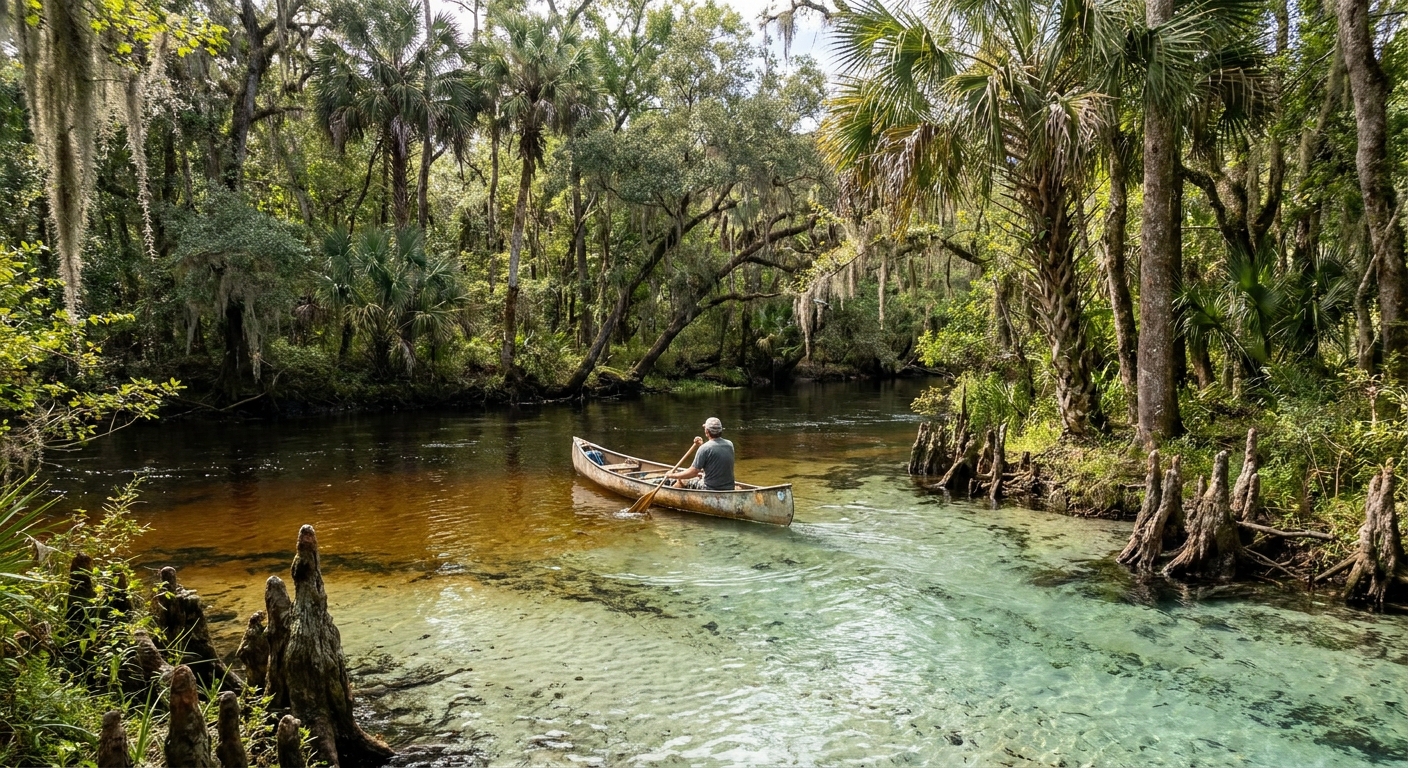
March is the crossing point. Afternoons reach 75.8°F, nearly five degrees above February’s 70.9°F, which is the difference between water you admire and water you get into. Dawns are still near 49.7°F, the dry season still has six weeks to run, and the mosquito pressure that decides a July evening has not arrived. Summer gives warmer swimming and takes the whole morning back in heat and afternoon storms.
The spring run empties into the Santa Fe River, and Ginnie Springs sits a few miles up the same stretch of water, close enough that both are covered by the same official weather station at Gainesville Regional. We could not verify entrance fees, gate hours, parking counts or a measured water temperature for either of them, so we publish none of those numbers and leave the booking desk to confirm them.
A Florida spring run holds close to the same temperature all year. The water does not read the calendar. The air does, and that is the whole seasonal story: between a February visit and a March one you gain 4.9 degrees on the afternoon and 3.8 on the dawn, while the pool you swim in is identical. The shock of getting in shrinks even though nothing in the water changed.
What March gives away free is daylight: 12 hours and 2 minutes on the 15th, with the last of it at 7:40 pm. Manatees winter in Florida’s spring runs and March is the back end of that window, so if wildlife is the reason for the drive, our manatee guide names the rivers where sightings are reliable and the weeks they thin out.
Gilchrist Blue Springs in March: a two-day itinerary
Day one runs on the light. Leave your bed by seven, because sunrise is 7:38 am and the first hour belongs to walking, photographs and empty water while the air sits near 49.7°F. Hold the swim until the thermometer catches up, roughly noon to four, when the afternoon is closest to its 75.8°F normal. Eat late, get back in around five, and you are dry with daylight to spare before the 7:40 pm sunset.
Day two goes to the river: put in on the Santa Fe and let the current carry the work, or drive the few miles to Ginnie Springs for a second clear-water morning. If a front arrives, it is most likely the one day in six that registers 0.10 inch, and one day in an average March brings a full inch. Take an indoor morning in Gainesville and swim at two, because March fronts move through rather than settle in.
Gilchrist Blue Springs in March vs February and April
| Normal, 1991-2020 | February | March | April |
|---|---|---|---|
| Average high | 70.9°F | 75.8°F | 81.5°F |
| Average low | 45.9°F | 49.7°F | 55.5°F |
| Precipitation | 2.67 in | 3.49 in | 2.74 in |
| Days with 0.10 in or more | 4.1 | 5.3 | 3.8 |
February runs 70.9°F by day and 45.9°F at night on 2.67 inches of rain across 4.1 wet days. April jumps to 81.5°F and 55.5°F on 2.74 inches across 3.8 wet days. March lands between them on temperature and above both on rain, 3.49 inches over 5.3 days. None of the three moves the spring itself, and since we could not verify a measured water temperature, the comparison is a comparison of air.
Shift four weeks earlier and you save 0.82 inch of rain and the spring-break calendar, and you pay 4.9 degrees off the afternoon plus dawns near 45.9°F: February has the full picture. Shift four weeks later and April hands you 5.7 more degrees at midday and the fewest wet days of the three, while the cool half of the day disappears, dawns starting at 55.5°F.
Is March a good time to visit Gilchrist Blue Springs?
Yes for most travelers, and the normals say why: 75.8°F afternoons, 5.3 days of measurable rain out of thirty-one, and more than twelve hours of daylight by mid-month. Say no if your only possible day is a Saturday and quiet matters more than warmth, because spring break lands in this month and we have no visitor count to reassure you. Anyone counting on a warm dawn should pack for the 49.7°F low.
If the answer is no, April is the month to buy: 81.5°F afternoons, 55.5°F dawns and 3.8 wet days, the driest count of the three. You trade the cold start for a mild one and the school holidays for the run-up to summer heat, and the run itself gives you exactly what it gave you in March.
What March holds that its neighbors do not is the combination: an afternoon within six degrees of April’s, dawns still cool enough to justify a jacket, and a 15th of the month already past the twelve-hour daylight mark.
The last word
Book a Tuesday if your week bends at all, arrive before eight, and let the day warm into the swim rather than fighting it at ten in the morning. And if you are weighing March against April, keep the rain gap in proportion: 0.82 inch and about one and a half extra wet days, spread across a month whose afternoons already normal out at 75.8°F.
Sources & data for this guide
- March normals, rain days and frost nights (75.8°F, 49.7°F, 3.49 in, 5.3 days, 1.2 nights) · NOAA NCEI monthly normals 1991-2020, station USW00012816, Gainesville Regional · checked Sep 24, 2026
- February and April normals used in the comparison · same NOAA NCEI 1991-2020 series and station · checked Sep 24, 2026
- Daylight, sunrise and sunset for March 15 (12h 02m, 7:38 am, 7:40 pm) · sunrise-sunset.org, converted from UTC to local time · checked Sep 24, 2026
- Station caveat: the thermometer sits at Gainesville Regional, the station that also serves Ginnie Springs a few miles up the Santa Fe River, not at the spring itself.
- We could not verify the park’s entrance fee, gate hours, parking capacity or a measured water temperature, and we found no occupancy or room-rate series for Gilchrist County, so we quote none of them. Fees and hours change: confirm with the park before you drive.
To plan your stay
- Best Time to Visit Gilchrist Blue Springs: Month-by-Month Highs, Rain and the Quietest Weeks
- Gilchrist Blue Springs in February: Weather, Crowds and How It Compares to January and March
- Gilchrist Blue Springs in April: Weather, Rain Days and a Two-Day Plan
- Gilchrist Blue Springs in January: Weather, Freeze Nights and a Two-Day Plan