
GILCHRIST BLUE SPRINGS · JANUARY · NORTH FLORIDA
North Florida in January is not the Florida of the poster. At the nearest official thermometer, the month averages a 67.1°F high and a 42.6°F low, and 6.2 nights in a normal January fall to 32°F or below. That is a coat at breakfast and shirtsleeves by two o’clock, repeated most days of the month.
A Florida spring changes far less across the year than the air above it, and that contrast is what January sells here. We could not verify a published water temperature for the Gilchrist Blue vent, so we give no figure for it. What we can give is the air, the rain, the light, and how all three stack up against December and February.
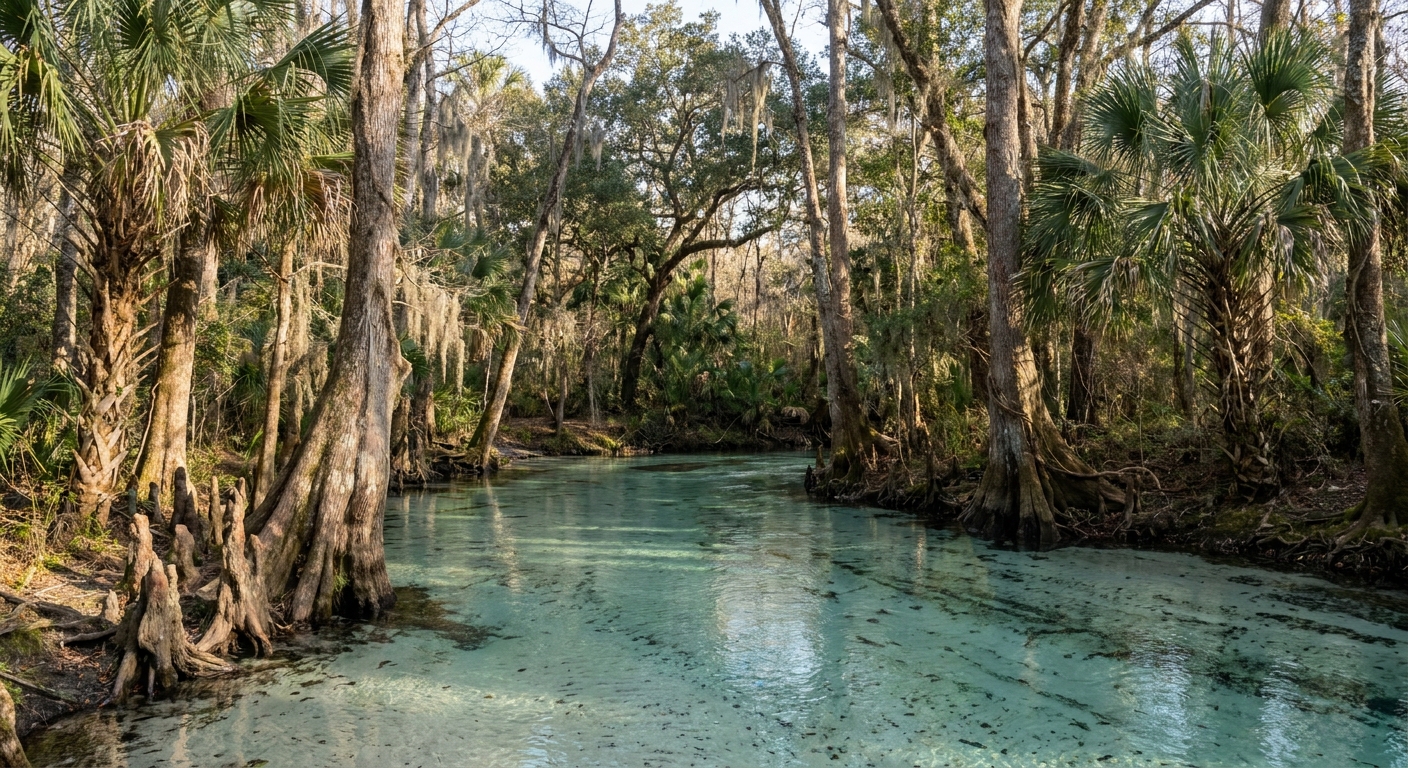
THE MONTH AT A GLANCE · JANUARY
January gives you the coolest, driest air of the winter over a spring that barely notices the season, with frost most weeks and the shortest afternoons of the trio.
AVERAGE HIGH 67.1°F · 42.6°F NIGHTS · 3.29 INCHES OF RAIN · DRY SEASON
Go for: cool dry air, the widest gap of the winter between a cold dawn and a mild afternoon, and a spring that does not follow the thermometer down.
Think twice before: booking a tent for a week, since 6.2 nights in a normal January reach 32°F or below and the sun is gone by 5:54 p.m.
Normals: NOAA NCEI 1991-2020, Gainesville Regional · Daylight: sunrise-sunset.org · full sources at the end
On this page
- January weather in numbers67.1°F days, 42.6°F nights, 3.29 inches
- How cold January nights get6.2 nights at or below 32°F
- Crowds and prices in JanuaryThe dry season, and the figures we could not verify
- Things to do at the springs in JanuaryThe Santa Fe River and Ginnie Springs upstream
- A two-day plan built around the daylightFrom a 7:25 a.m. sunrise to a 5:54 p.m. sunset
- January, December or FebruaryHow the three months compare, degree by degree
- Is January worth the trip?Who should go and who should wait
Every figure here comes from one place, and it is worth knowing which: NOAA’s 1991-2020 monthly normals for the airport station at Gainesville Regional, the closest official thermometer to the springs.
Gilchrist Blue Springs weather in January: average highs, lows and rain days
| January at Gainesville Regional | Normal, 1991-2020 |
|---|---|
| Average high | 67.1°F |
| Average low | 42.6°F |
| Precipitation | 3.29 in |
| Days with 0.10 in or more | 5.2 |
| Days with 1.00 in or more | 1.1 |
| Nights at 32°F or below | 6.2 |
| Daylight on January 15 | 10 h 29 min |
NOAA’s National Centers for Environmental Information publishes these normals for station USW00012816 at Gainesville Regional. That is a real instrument at an airport, not a reanalysis grid cell, and the distinction matters when you are reading a number to the tenth of a degree. The same station also serves Ginnie Springs, a few miles up the same stretch of the Santa Fe River. Read the normals here as the regional picture rather than a measurement taken at the vent, where a wooded riverbank runs its own cool morning.
Rain arrives on 5.2 days of a normal January at a tenth of an inch or more, so about one day in six gets measurably wet. Only 1.1 day reaches a full inch, roughly one real soaking per January. In practice that is a gray morning you wait out over a second coffee, not a canceled trip, and the 3.29 inches total is spread thin enough that most of your days stay dry from sunrise to sunset.
The spread between the average low and the average high is 24.5°F, and you will feel every degree of it. Pack for two climates in the same duffel: a warm layer and something on your head for the first hours, a T-shirt for the middle of the day, and a towel plus dry clothes that are genuinely dry, since changing at 45°F with a damp shirt is the part people remember for the wrong reason.
Light is the other constraint. On January 15 the sun rises at 7:25 a.m. and sets at 5:54 p.m. local, giving 10 hours 29 minutes of daylight. The warm slice of that is narrower still, since the air needs the morning to climb. Anything you want to do outside belongs between about 10 a.m. and 4 p.m., and any drive home is done in the dark.
How warm is Gilchrist Blue Springs in January?
Averaged over the month, afternoons reach 67.1°F and nights bottom out near 42.6°F. Those 24.5 degrees are not distributed evenly across the clock: the low lands close to sunrise, the high shows up mid-afternoon, and the drop after 4 p.m. is brisk. A January day here is less a temperature than a schedule.
Dress for the 42.6 and strip toward the 67. Fleece or a light jacket, long pants and closed shoes get you through breakfast and the first walk. By one o’clock most visitors are down to a single layer in the sun and back into the jacket the moment they step under trees. Keep the jacket with you rather than in the car, because the car will be several hundred yards away when you want it.
Frost is normal, not exceptional: 6.2 nights in an average January reach 32°F or below at the Gainesville station, close to one night in five. If you are sleeping outdoors anywhere in this part of Gilchrist County, rate your bag for freezing rather than for a Florida brochure, and expect a windshield that needs scraping at least once in a week-long stay.
How busy is Gilchrist Blue Springs in January? Crowds, prices and the demand peak
January sits inside Florida’s dry season, the November through April stretch that the National Weather Service marks off and that our month-by-month verdict uses as its spine. That is a calendar fact. It is not a price fact: we found no occupancy series and no monthly room-rate series for this corner of north Florida, so we crown no month cheap and no month expensive.
Which leaves booking advice we can stand behind and no more. Statewide, the holiday weeks and spring break are Florida’s loudest and priciest stretches, and January mostly falls between them. How many weeks ahead you should move on a campsite or a cabin here, we could not verify, so we will not invent a number. Our lodging guide carries the state-level pattern, and the park’s own reservation system carries the real availability.
On taxes, the same discipline applies. We could not verify the county tourist development tax rate that applies to short stays around Gilchrist County, so we quote no percentage. Assume a county add-on stacked on top of state sales tax, read the total line before you confirm, and budget from the total rather than from the nightly rate. Our cost guide handles the wider arithmetic of a Florida week.
There is one line item where spending more genuinely changes January, and it is heat. With 6.2 freezing nights in a normal month, the difference between a tent and a walled room with a thermostat is the difference between a trip you enjoy and a trip you endure. Spend there first. Gear, rentals and restaurant meals can all be trimmed instead.
Things to do in Gilchrist Blue Springs in January
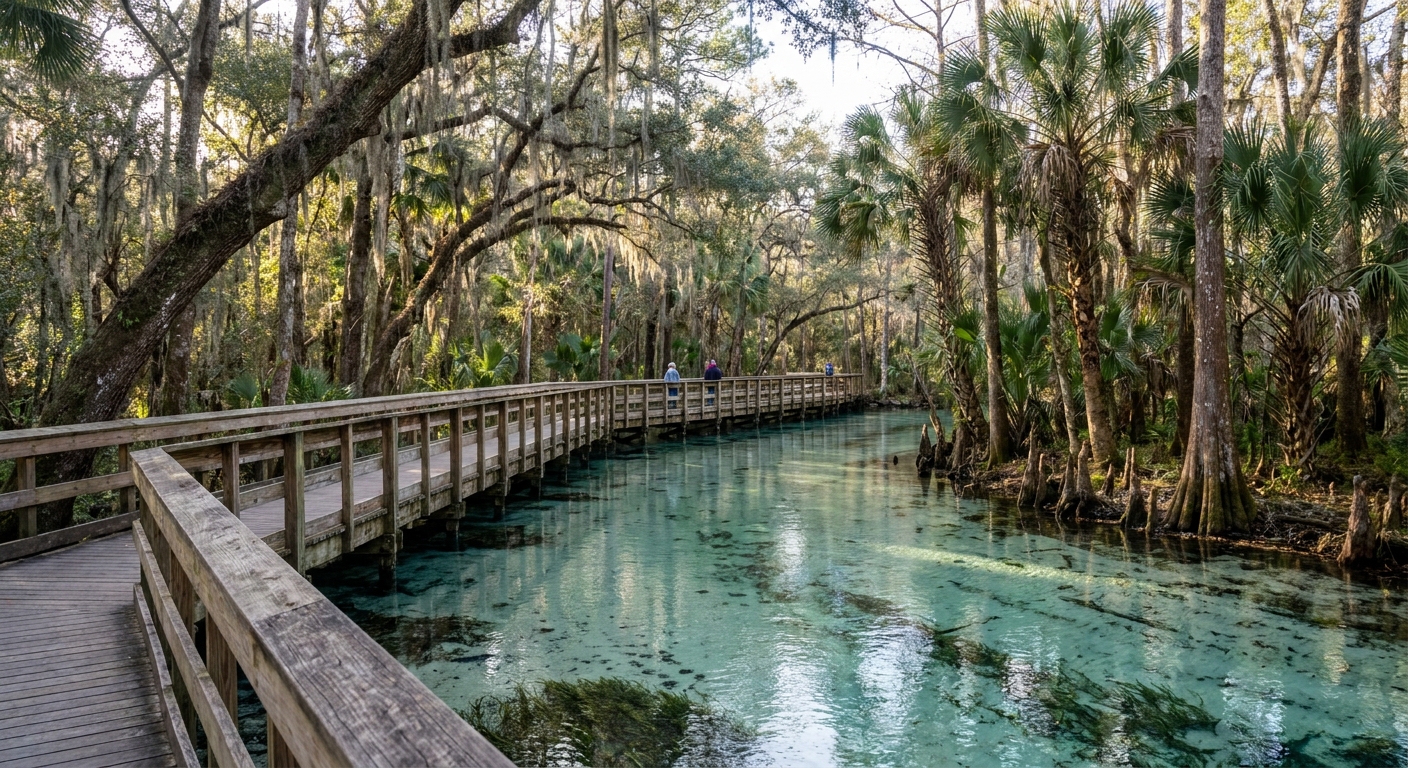
The month buys comfort on land. Walking a riverbank at 67°F with low humidity is an entirely different activity from doing it in August, and the dry season keeps mosquitoes in retreat across the state, as our Florida orientation sets out. The cost of that comfort is time: 10 hours 29 minutes of daylight means the outdoor day is effectively six good hours long, so pick two things and do them properly.
Gilchrist Blue Springs State Park is the anchor, on the Santa Fe River, and Ginnie Springs sits a few miles up the same stretch of water, close enough to share the weather station whose normals you have been reading. We could not verify the park’s entry fee, its opening hours, its camping rates, its tube rentals or the temperature at the vent, so none of those numbers is given here. Check the park directly before you drive.
What January changes is the air around the water, not the water. A spring run holds its temperature through the year while the thermometer above it swings 24.5 degrees between dawn and mid-afternoon, so swimming in January becomes a decision about the exit rather than the entry. Get in when the air is at its warmest, plan how you will get dry, and the cold half of the equation disappears. Manatees winter in Florida’s warm springs generally, and our manatee guide names where you can actually swim with them.
On free entry, we found no fee-free day published for January at this park, so plan on paying at the gate. What costs nothing is the river corridor itself and the light: the sun clears the trees after a 7:25 a.m. rise, and the two hours before it drops at 5:54 p.m. are the best walking of the day. Our statewide list covers the paid attractions further afield.
Gilchrist Blue Springs in January: a two-day itinerary
Day one runs on the thermometer. Sunrise on January 15 is 7:25 a.m. and the air is at its coldest right then, near 42.6°F, so give the first hours to the drive and breakfast. Arrive around 10, when the climb toward 67°F is under way, and walk first. Swim between 1 and 3 p.m., the warmest block of the day. Be dry and changed by 4, an hour and a half before the 5:54 p.m. sunset, with the jacket back on.
Day two is the one you adjust. A normal January brings 5.2 measurably wet days and 1.1 day of an inch or more, so build an alternative for roughly one day in six. Rain at 67°F is unpleasant rather than risky, and the sensible swap is a driving day along the Santa Fe corridor and east toward Gainesville, with our road-trip routes for the longer version. Clear weather, and you simply repeat day one an hour earlier.
Gilchrist Blue Springs in January vs December and February
| Normal, 1991-2020 | December | January | February |
|---|---|---|---|
| Average high | 69.3°F | 67.1°F | 70.9°F |
| Average low | 45.2°F | 42.6°F | 45.9°F |
| Precipitation | 2.88 in | 3.29 in | 2.67 in |
| Days with 0.10 in or more | 4.5 | 5.2 | 4.1 |
All three columns come from the same NOAA station and the same 1991-2020 period, so the gaps are real rather than artifacts. January is the coldest of the trio by 2.2°F on the afternoon high against December and 3.8°F against February, and by 2.6 and 3.3 degrees on the nights. It is also the wettest: 3.29 inches against 2.88 and 2.67, spread over 5.2 wet days rather than 4.5 or 4.1. The spring water, unchanged across all three, is the one line we could not put a number on.
Shift four weeks forward and you gain 3.8°F of afternoon, one fewer wet day and 0.62 inch less rain, which makes February the easier month for tent camping. Shift four weeks back and December buys 2.2°F over January while dropping you into the holiday weeks, Florida’s busiest and priciest stretch. Stay put in January and you keep the quietest school calendar of the three, at the price of the coldest dawns.
Is January a good time to visit Gilchrist Blue Springs?
Yes, for anyone whose day is built around walking, paddling, photographing and a short swim, and who owns a warm layer. A 67.1°F afternoon with low humidity is close to perfect for everything that happens beside the water. No, for a family expecting a long lazy day in and out of the water with small children, and no for anyone hoping to sleep under nylon without a real sleeping bag.
If that second description fits, wait for February: 70.9°F afternoons, 45.9°F nights, 4.1 wet days and 2.67 inches of rain, all of it measurably milder and drier for the sake of four weeks. March and April sit further into the dry season still, with the spring-break crowds as the trade, and our family guide works through that calculation.
What no other month of the winter offers is the size of the daily swing at its widest here, 24.5 degrees between a 42.6°F dawn and a 67.1°F mid-afternoon, over water that does not move with it.
The last word
Book the heated room, not the tent, and let the clock do the rest of the planning: in at 10, in the water at 1, dry by 4. One number worth carrying with you, since 3.29 inches falls across 5.2 measurable days, the average wet January day here delivers around six tenths of an inch (est.), which is a slow breakfast rather than a lost day. Check the park’s own fees and hours before you set out, then go see what a spring looks like in a cold snap.
Sources & data for this guide
- January highs, lows, precipitation, wet days and freeze nights · NOAA NCEI monthly normals 1991-2020, station USW00012816, Gainesville Regional · checked Sep 24, 2026
- December and February normals used in the comparison · same NOAA NCEI 1991-2020 series, same station · checked Sep 24, 2026
- Daylight, sunrise and sunset for January 15 · sunrise-sunset.org, converted from UTC to local time · checked Sep 24, 2026
- Scope caveat · the station sits at Gainesville Regional, not at the spring, and it also serves Ginnie Springs a few miles up the Santa Fe River · readings at the riverbank can run cooler in the morning
- We could not verify the park’s entry fee, hours, camping rates, tube rentals or the water temperature at the vent, and we found no occupancy series and no county lodging-tax rate, so we give none of those numbers · confirm with the park and the county when you book
To plan your stay
- Best Time to Visit Gilchrist Blue Springs: Month-by-Month Highs, Rain and the Quietest Weeks
- Gilchrist Blue Springs in February: Weather, Crowds and How It Compares to January and March
- Gilchrist Blue Springs in December: Weather, Frost Nights, Crowds and a Day Plan
- Gilchrist Blue Springs in March: Weather, Crowds and How It Compares to February and April