
FLORIDA · AUGUST · GILCHRIST BLUE SPRINGS
Gilchrist Blue Springs in August means an average high of 90.5°F and a spring you can be standing in before that heat arrives. The month averages 6.40 inches of rain at the nearest official station. Most of it falls in afternoon thunderstorms, so a morning swim usually stays dry.
You have already picked the spring. What remains is the date: long days of 13 hours 15 minutes, nights that stay near 72.0°F, and a Florida school calendar that sends many families home before the month ends. For the park, the roads in and the overall trip, start with our Gilchrist Blue Springs guide.
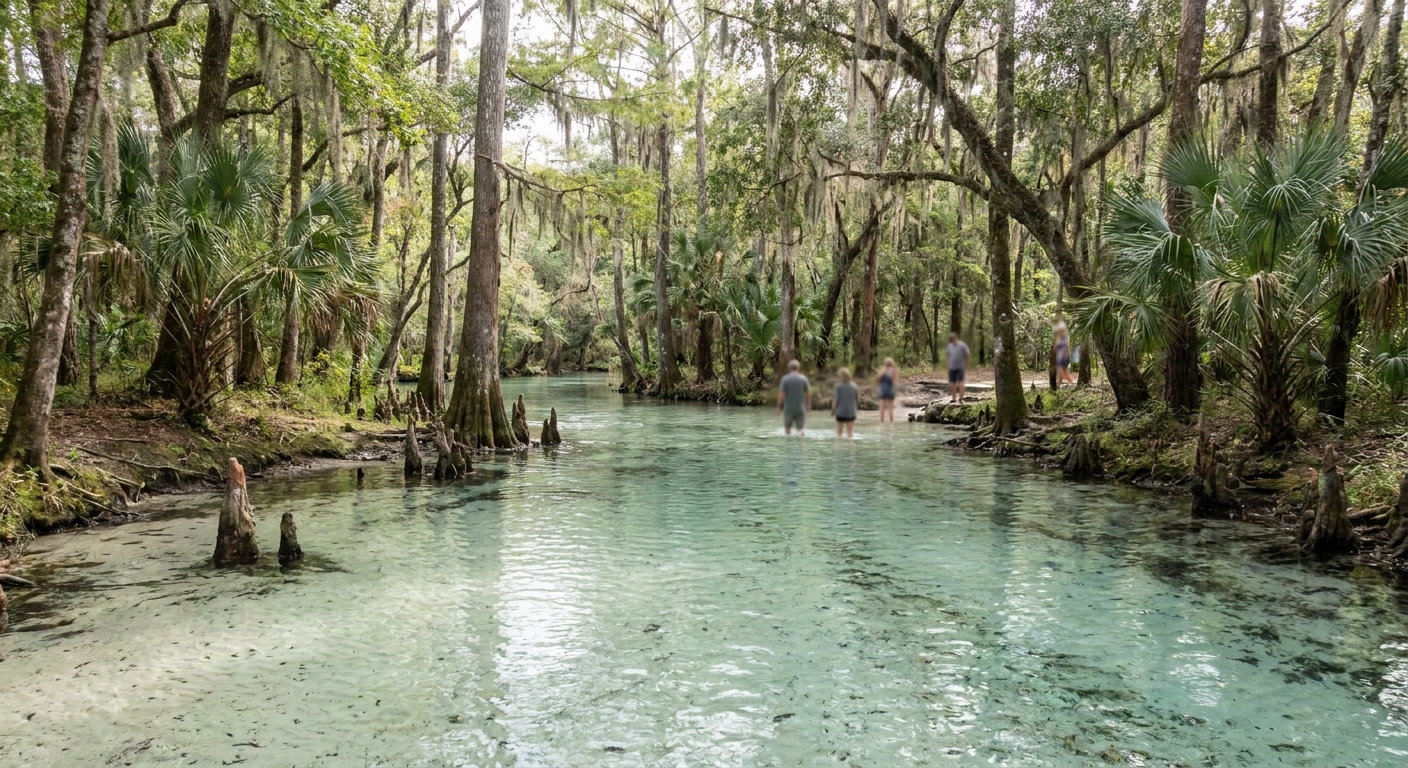
AUGUST AT A GLANCE · GILCHRIST BLUE SPRINGS
August works for a morning-swim trip of two nights: hot afternoons, frequent storms, and more daylight than you will use.
HOT & WET · SWIM EARLY · 2 NIGHTS · BOOK REFUNDABLE
Go for: a cold plunge on a 90°F day, swims in the early morning, and evening light that lasts past 8 pm.
Think twice before: planning long afternoons outdoors or booking non-refundable in hurricane season.
Climate: NOAA NCEI 1991–2020, Gainesville Regional station · Light: sunrise-sunset.org · full sources at the end
On this page
- Gilchrist Blue Springs weather in August90.5°F highs, 72.0°F lows, 10.4 rain days
- How hot it gets from morning to afternoonAn 18.5-degree swing between dawn and mid-afternoon
- Crowds and prices in AugustSchool calendar, booking and lodging tax
- Things to do in AugustThe spring basin, the Santa Fe River and Ginnie Springs
- A two-day August itineraryTwo days that start at the 6:57 am sunrise
- August vs July or SeptemberSeptember runs 2.4°F cooler with 3.5 fewer rain days
- Is August a good time to go?Who should go now and who should wait for September
Two nights cover it. That gives you one full morning in the spring and a second for the river. If you fly in, check routes into Gainesville in our Florida flights guide. Rental cars and drive times from the bigger airports are in getting around Florida.
Gilchrist Blue Springs weather in August: average highs, lows and rain days
| August normal | Value | In practice |
|---|---|---|
| Average high | 90.5°F | Swim before noon |
| Average low | 72.0°F | Warm nights, no layers |
| Precipitation | 6.40 in | Pack a rain shell |
| Days with 0.10 in or more | 10.4 | About one day in three |
| Days with 1 in or more | 2.1 | Two soakers a month |
| Daylight on Aug 15 | 13 h 15 min | 6:57 am to 8:12 pm EDT |
Every figure here is a 1991–2020 official normal from NOAA’s National Centers for Environmental Information, measured at station USW00012816, Gainesville Regional. It is a real thermometer, not a grid-cell reanalysis. It is also not at the spring. The same station serves Ginnie Springs, a few miles up the same stretch of the Santa Fe River, so read 90.5°F by day and 72.0°F by night as the local reference, not a reading taken under the trees.
An average August brings 10.4 days with at least a tenth of an inch of rain, roughly one day in three. On 2.1 of those days, more than an inch falls. In north-central Florida summer rain mostly comes as afternoon thunderstorms, so a wet day can still give you a dry, bright morning. Build the swim into the first half of the day and keep the afternoon loose.
From the 72.0°F low to the 90.5°F high the day climbs 18.5 degrees. Neither end calls for a sweater. Pack quick-dry clothes, a light rain shell for the storms, a towel you are happy to get muddy, and sandals or water shoes for limestone edges and wet steps. A dry bag keeps phones and car keys safe when a storm arrives while you are still in the water.
On August 15 the sun rises at 6:57 am and sets at 8:12 pm Eastern Daylight Time, giving 13 hours 15 minutes of daylight. The park gate probably does not stay open for all of that. We could not verify its August opening and closing times, so check them with the park before you plan an evening swim.
How warm is Gilchrist Blue Springs in August?
The warmest part of an average August day at Gainesville Regional is 90.5°F, and the coolest is 72.0°F. That 18.5-degree gap is the whole temperature story of the month. Early mornings are warm and pleasant, and early afternoons are hot.
Arrive in a swimsuit under shorts and a T-shirt, and you will not add anything before dinner. By early afternoon a wide-brimmed hat, reef-safe sunscreen and a refillable water bottle matter more than any clothing choice. Shade at the spring comes from the tree canopy, so claim a spot early if you plan to stay past lunch.
Frost is not an August issue. Our NOAA source gives no freeze count for the month, and with an average low of 72.0°F there is nothing to plan for. The concern at night is humidity and mosquitoes, so bring repellent for the evening.
How busy is Gilchrist Blue Springs in August: crowds and prices
August is summer vacation for Florida families until schools reopen during the month, and that calendar sets the crowd pattern here. We found no occupancy series or monthly room-rate data for the area, so we will not call August the priciest or the cheapest month. Expect the weekend swimming crowd to be local and to fade once classes restart.
Weekends see the most pressure, both at the spring and on nearby beds. Book lodging as soon as your dates are firm, and choose refundable rates. Atlantic hurricane season runs June 1 to November 30, as our Florida orientation sets out, and a late-summer storm can close roads or the park with little notice.
We could not verify the lodging-tax rate for Gilchrist County or the neighboring towns, so we give no percentage. Ask for the full nightly price, taxes and fees included, before you confirm. For typical costs across the state, see what a Florida trip costs.
If you pay extra for one thing, pay for location. A room close enough to reach the gate at opening gives you the cool, quiet morning August rewards, and it means you are indoors when the afternoon storms arrive. Our where-to-stay guide covers how to choose a base.
Things to do in Gilchrist Blue Springs in August
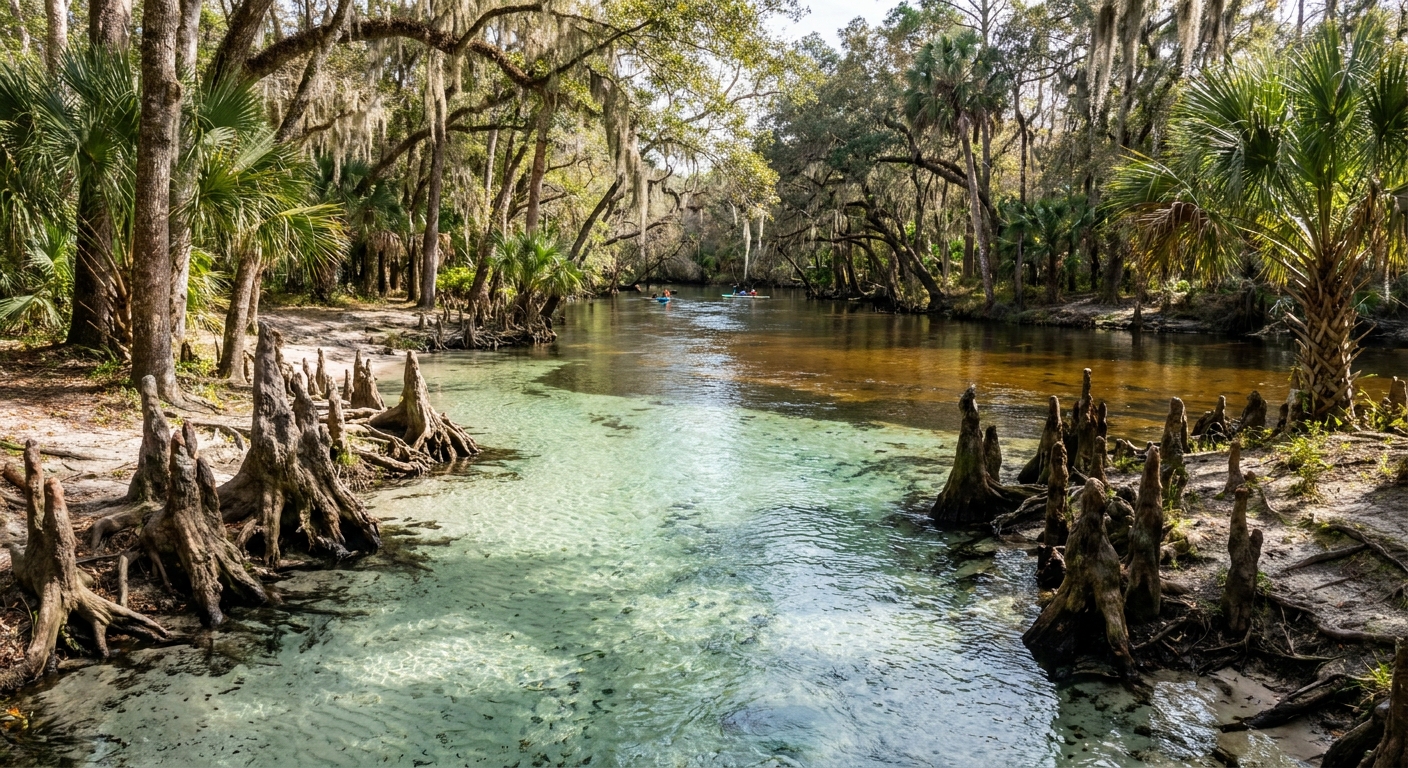
August’s main appeal is contrast. Stepping into spring water on a 90.5°F morning is a sharp shock and then a relief. In the cooler months that same water feels closer to the air, and the plunge loses its edge. Swimming is the reason to come, and August is when it feels best.
The main attraction is the spring basin and its swimming area. The spring run carries that water out to the Santa Fe River, so a paddle or float can follow the clear water into the darker river. Ginnie Springs sits a few miles up the same stretch of the Santa Fe and makes an easy second swim. We could not verify current entry fees, capacity rules or rental prices at either spring, so confirm them before you drive. Our Florida things-to-do guide lists more springs across the state.
Spring water holds a nearly steady temperature all year. The air is what changes with the season. We could not verify a water-temperature reading for Gilchrist Blue Springs, so we give no number. What we can say is that the air averages 90.5°F in August against 88.1°F in September, and that difference is why the water feels coldest now.
We found nothing verified as free at the springs in August, and no free-entry days. The Santa Fe River itself is free to look at from public access points, but check parking rules at each one before you leave the car.
Gilchrist Blue Springs itinerary: two days in August
Day one. The sun is up at 6:57 am, so have breakfast early and be at the gate when it opens. Swim, snorkel the basin and float the spring run while the air is still in the 70s. Leave by early afternoon, before the 90.5°F peak and the likeliest storm window, and spend the heat of the day indoors over a long lunch and a rest. Go back out around 5 pm for the long evening light, which lasts until the 8:12 pm sunset.
Day two. Head up the Santa Fe to Ginnie Springs for a second swim, or rent a kayak for the river if the morning is clear. If thunder starts, get out of the water and off the river right away, and wait at least half an hour after the last rumble. With 2.1 days of an inch or more of rain in an average August, a washed-out afternoon is possible. Keep an indoor fallback in Gainesville and book refundable. For a longer loop through the state, see our Florida road-trip guide.
Best month to visit Gilchrist Blue Springs: August vs July and September
| Month | Average high | Average low | Precipitation | Days with 0.10 in+ |
|---|---|---|---|---|
| July | 91.1°F | 71.6°F | 6.68 in | 10.5 |
| August | 90.5°F | 72.0°F | 6.40 in | 10.4 |
| September | 88.1°F | 69.4°F | 5.05 in | 6.9 |
July and August are close to identical. July’s high is 0.6°F hotter, its low 0.4°F cooler, and it gets 0.28 inch more rain on 0.1 more rain day. September is the real change: 2.4°F cooler by day, 2.6°F cooler by night, 1.35 inches drier, and 3.5 fewer rain days. All three months come from the same NOAA station and the same 1991–2020 period. We found no water-temperature readings for any of them.
Moving four weeks later gets you fewer storms and emptier weekdays once schools are back in session. The cost is the peak of hurricane season, which our Florida orientation puts around September 10, and slightly shorter days. Moving earlier to July gains nothing on the weather and puts you in the thick of summer vacation.
Is August a good time to visit Gilchrist Blue Springs?
Yes, if swimming is the point of your trip and you are happy to start early. Families still on summer break and anyone chasing a cold plunge will have a good time. It is a harder month for people who want long outdoor afternoons, who do badly in humid heat, or who cannot adjust plans around a storm that shows up on one day in three.
If that sounds like you, go in September. The averages drop to 88.1°F and 6.9 rain days, and weekday crowds thin out once the school year starts. Book refundable to offset the hurricane peak, and compare other months in the best time to visit Florida.
August pairs the hottest air of the late summer with spring water that stays cool all year, and those conditions make the plunge feel most dramatic.
The last word
Your one real August decision is when to be in the water, and the answer is early. The 6.40 inches that fall over 10.4 rain days average out to about 0.6 inch each time it rains, which is enough to end an afternoon swim for good. Be at the gate close to sunrise, have your swim, and be under a roof when the thunder starts.
Sources & data for this guide
- August, July and September air normals, precipitation and rain days · NOAA NCEI monthly normals 1991–2020, station USW00012816 (Gainesville Regional) · checked Sep 24, 2026
- Station scope: the same station serves Ginnie Springs, a few miles up the Santa Fe River, so these are not readings at the spring itself · NOAA NCEI · checked Sep 24, 2026
- Daylight, sunrise and sunset on August 15 (10:57 and 00:12 UTC, converted to EDT) · sunrise-sunset.org · checked Sep 24, 2026
- Hurricane season dates and September peak · linked from our Florida orientation (NOAA National Hurricane Center) · checked Sep 24, 2026
- We could not verify spring water temperature, entry fees, gate hours, lodging tax or room rates, and give none · check with the park and your lodging when you book.
To plan your stay
- Best Time to Visit Gilchrist Blue Springs: Month-by-Month Highs, Rain and the Quietest Weeks
- Gilchrist Blue Springs in July: Weather, Rain Days, Daylight and How June and August Compare
- Gilchrist Blue Springs in September: Weather, Rain Days, Crowds and Booking
- Gilchrist Blue Springs in June: Weather, Rain Days and How It Compares to May and July