
FLORIDA SPRINGS · THE NORTHERN HALF · 73.4°F ALL YEAR
Wade into a Florida spring on a 95°F August afternoon and the first sound you make is not a word. The water is 73.4°F (23.0°C), the median the U.S. Geological Survey was reading across its monitored Florida spring sites on September 11, 2026. It was that in July. It will be that in February, when a 50°F morning puts fog on the surface and the spring is the warmest thing in the park.
Spring country is the northern half of the state, nowhere near the beaches most visitors fly in for. The water comes out of limestone that lies close to the surface up there, and it comes out fast: Silver Springs near Ocala was pushing 264 cubic feet per second that same morning. Volume is why you can pick out a fish on the bottom from a paddleboard. Manatees arrive in winter for the temperature.
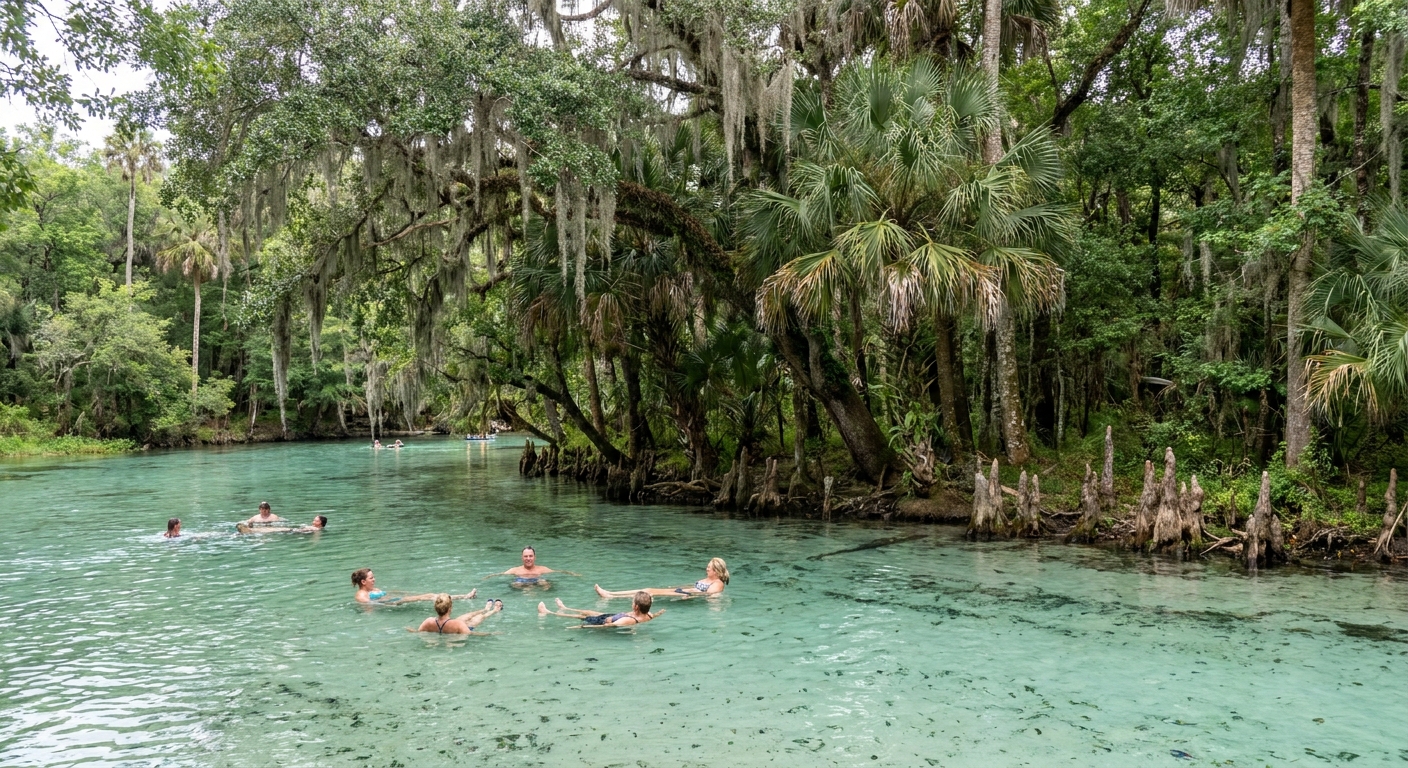
THE SPRINGS AT A GLANCE · FLORIDA
The water holds at 73.4°F every day of the year, so the season you choose decides whether that reads as relief, as a shock, or as the reason a hundred manatees are parked in front of you.
73.4°F ALL YEAR · NORTHERN HALF OF THE STATE · MANATEES IN WINTER
Go for: water clear enough to read the bottom through, a swim that works in August and in January, and manatees within arm’s reach of a boardwalk in winter.
Think twice before: driving up from a beach base on a summer Saturday. The well-known springs close their gates when the parking lot fills.
Temperatures and flows: USGS NWIS, Sep 11, 2026 · Manatees and karst: Southwest Florida Water Management District · Fees: Florida Administrative Code 62D-2 · full sources at the end
On this page
- Why the water is 73.4°F in August and in JanuaryThe constant temperature
- The clearest springs, by measured flowSilver Springs, Blue Spring, Manatee Spring
- Where Florida’s springs are on the mapThe northern half of the state
- Swimming with manatees in winterBlue Spring and Homosassa
- Springs warm enough to soak inWarm Mineral and Sulphur Springs
- State park entrance fees at the springsFees set park by park
The USGS monitors Florida springs by name and publishes temperature and discharge as instantaneous readings. Every figure here comes from one such read, on September 11, 2026, so take it as a snapshot of a single morning rather than a promise about yours. Temperature barely moves from site to site or month to month. Flow moves more.
Why Florida springs stay the same temperature all year
Across the sites read on September 11, 2026, the median spring temperature was 23.0°C, or 73.4°F, inside a narrow band running from 69.6°F to 75.6°F. That band is the entire annual weather report for a Florida spring. In August, with the air at 95°F and the boardwalk too hot for bare feet, 73.4°F is cold enough to take your breath, and people enter one rung of the ladder at a time.
Turn the year around and the same number does the opposite work. On a 50°F January morning the water sits more than twenty degrees above the air, fog hangs on the surface until the sun clears it, and the swimmers you see are not being brave. They are in the warmer of the two mediums available, by a margin you can watch steaming off the run.
Six degrees separate the coolest monitored site from the warmest, and inside that band a swim behaves differently at each end. Small bodies lose heat faster than adult ones in water this cool, so the towel and the dry shirt matter in July exactly as much as in January. Florida with kids makes the same case for the rest of the state’s water.
The steadiness comes from where the water has been. It arrives from the Upper Floridan aquifer, underground and out of reach of the sun, and the Southwest Florida Water Management District describes that discharging water as relatively warm in winter. Air temperature never touches it. The springs therefore run against the state’s usual logic, since the water is the fixed part and your tolerance for it is the variable: our month-by-month guide covers the Florida where the calendar decides.
The clearest springs in Florida, and why
| Spring | Where | Discharge, Sep 11, 2026 |
|---|---|---|
| Silver Springs | near Ocala | 264 cubic feet per second |
| Blue Spring | Orange City | 160 |
| Manatee Spring | near Chiefland | 137 |
| Homosassa Springs | Homosassa | 98 |
| Silver Glen Springs | near Astor | 87 |
Water leaving the rock at 264 cubic feet per second does not stay put long enough to grow anything. That is the whole explanation for the clarity, and it is why the photographs look retouched and are not: at Silver Springs you can pick out a single fish on the bottom from a paddleboard.
The five sites above were read the same morning and they are not in the same league. Silver Springs was moving three times what Silver Glen Springs near Astor was moving at 87, with Blue Spring at Orange City between them at 160. Lower flow is not the same as murky water. Homosassa Springs read 98 and Manatee Spring near Chiefland 137, and both run clear enough to see bottom.
Rainbow Springs sits outside those readings and belongs in any account of clear water here: the Southwest Florida Water Management District calls it one of the largest springs in the world, and counts five of Florida’s first-magnitude springs inside that one district. First magnitude is a flow class, not a rating of the swimming. It happens to predict the swimming anyway, because volume and transparency travel together.
Where are Florida’s springs?
The limestone that makes a spring comes close to the surface in the northern half of the state, and the water district calls the result a karst landscape: sinkholes, sinking streams, underground caverns. Rivers drop out of sight in one county and reappear in another. A single district, one of four covering Florida, names 155 springs in its own report, so the statewide count runs well past the dozen names a visitor could recite.
For planning, the names the USGS monitors fall into groups. Ocala anchors the largest: Silver Springs, Silver Glen Springs near Astor, then Wekiwa Springs and Rock Springs near Apopka toward Orlando, with Sanlando in the same orbit. Blue Spring at Orange City lies north of Orlando. The Gulf side holds Homosassa Springs, with Manatee Spring near Chiefland above it. Madison Blue, Gilchrist Blue, Gum Springs and Jackson Blue near Marianna are scattered west, and Marianna is a Panhandle drive of its own. Distances are handled in our Florida road trip guide.
Swimming with manatees in Florida springs
Manatees gather at and near springs in the winter months because the water discharging from the Upper Floridan aquifer is relatively warm. That sentence belongs to the Southwest Florida Water Management District, and it is the reason a January visit beats a July one when the animals are what you came for.
Nothing about the spring changed between summer and winter. The river around it cooled, and a 73.4°F spring run became the one comfortable spot on that stretch of water, which is why the animals concentrate instead of scattering across an estuary.
Blue Spring at Orange City is the winter address most visitors have heard of, and its 160 cubic feet per second of 73.4°F water is the reason. Homosassa Springs, reading 98, does the same work on the Gulf side, in the middle of a town. Both are state parks, and at both the viewing happens from land as often as from the water.
The season that suits the animals is the one that tests the visitor. In January the air can sit near 50°F while the water holds at 73.4°F, so the hard part is not the swim, it is the ten minutes after it. A fleece, a knit hat and a second towel left in the car change that afternoon more than anything you would think to pack for Florida.
Where you may get in the water with them, and under what conditions, is regulated site by site and season by season, and each park publishes its own rules. The operators, the timing and the etiquette are in our guide to swimming with manatees, including Crystal River, the name attached to most of the in-water tours.
Which Florida springs are warm?
Two springs break the pattern. Warm Mineral Springs, near Woodmere, read 29.2°C on September 11, 2026, which is 84.6°F. Sulphur Springs, in Tampa, read 27.0°C, or 80.6°F. Against a 73.4°F median those are a different substance underfoot, and the word warm in a Florida spring name turns out to be a measurement rather than a brochure flourish.
That changes the activity. At 84.6°F you soak, and the water gives you no reason to keep moving the way 73.4°F does, so these two read as bathing places rather than swimming holes. Both also sit well south of the Ocala group, closer to Sarasota and Tampa than to spring country, so neither works as a detour off a north Florida weekend.
Where you can swim and tube: Wekiwa Springs · Rainbow Springs · Ichetucknee Springs · Gilchrist Blue Springs · Fanning Springs · De Leon Springs · Troy Spring · Silver Glen Springs. Where the manatees go in winter: Blue Spring · Homosassa Springs · Manatee Springs. Where you watch the water instead of entering it: Silver Springs · Wakulla Spring. Where the divers go: Ginnie Springs · Wes Skiles Peacock Springs · Madison Blue Spring. The one that is actually warm: Warm Mineral Springs. And the mermaid show: Weeki Wachee Springs.
Florida state park entrance fees at the springs
One figure is fixed statewide: children under six enter Florida state parks free, set in the Florida Administrative Code rather than at the gate. The same chapter gives Florida residents aged 65 or over half the base camping fee. Everything else about what you pay is decided locally.
The rule instructs the Division to set entrance fees park by park, weighing user demand, the distance from the nearest city, the cost of running the place, the facilities it offers and the season. A price quoted for one spring says nothing about the spring an hour up the road, and a price quoted for October is not automatically the July price at the same gate.
So we publish no entrance fee and no opening hour for any individual spring park. floridastateparks.org returned a 403 to our requests on September 10 and 11, 2026, and the fee schedules live with each park in any case. Check the park’s own page the night before you drive, and give yourself the early start: the popular springs close their gates when the lot fills, and no posted schedule shows that. On a summer Saturday it means being in the parking lot before mid-morning.
Sources & data for this guide
- Spring temperatures, the 73.4°F median and the 69.6–75.6°F band · U.S. Geological Survey, National Water Information System, instantaneous readings at Florida spring sites · checked Sep 11, 2026
- Discharge for Silver Springs, Blue Spring, Manatee Spring, Homosassa and Silver Glen Springs · USGS NWIS · checked Sep 11, 2026
- Warm Mineral Springs (84.6°F) and Sulphur Springs (80.6°F) · USGS NWIS · checked Sep 11, 2026
- Manatees and warm spring discharge, karst landscape, 155 springs in one district, Rainbow Springs and first-magnitude springs · Southwest Florida Water Management District, The Hydrology and Water Quality of Select Springs, May 2001, revised March 2011 · checked Sep 11, 2026
- Free entry under six, the resident 65+ camping discount, and fees set park by park including by season · Florida Administrative Code, chapter 62D-2 · checked Sep 11, 2026
- Editorial note: we could not read floridastateparks.org, which returned HTTP 403 to our requests on Sep 10 and Sep 11, 2026. No entrance fee or opening hour appears on this page for that reason.