
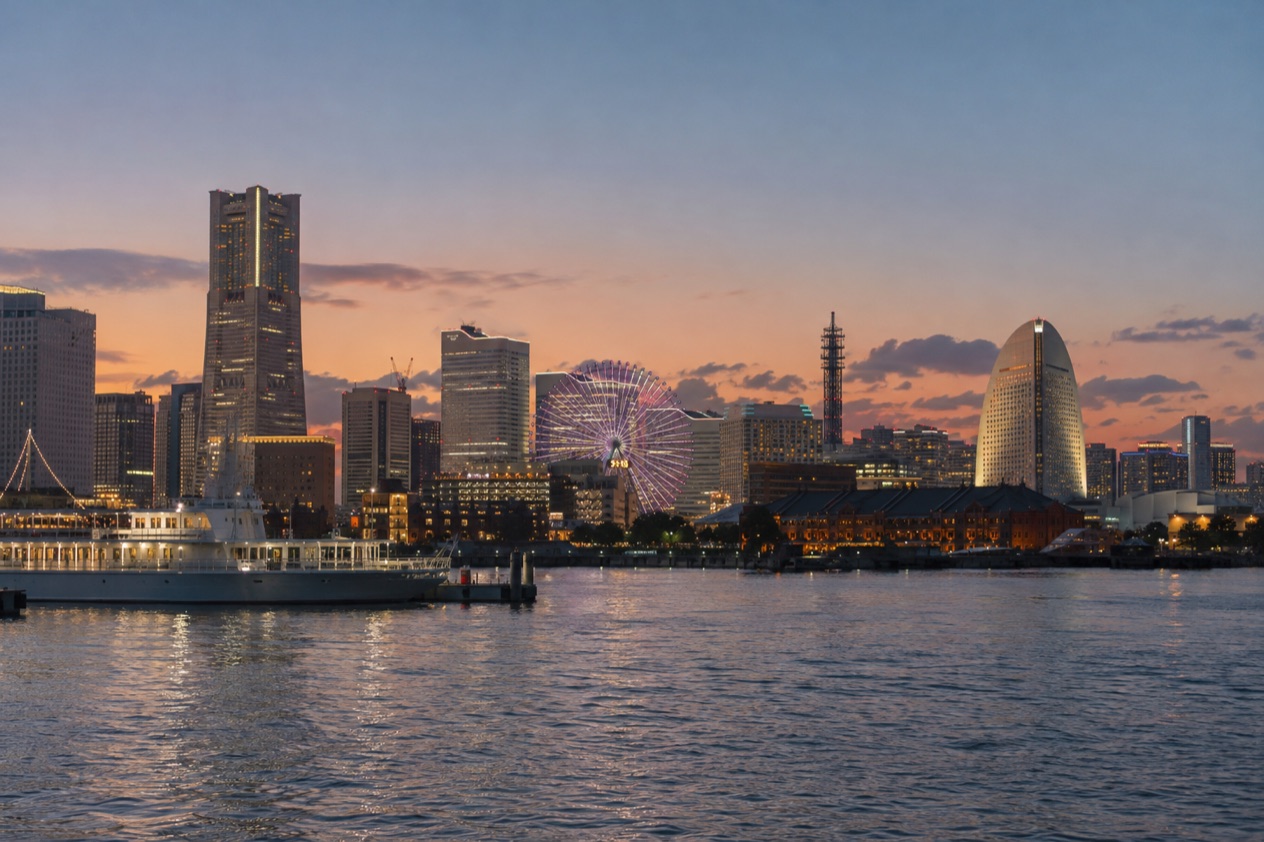
In October, the harbor breeze in Yokohama turns crisp, and steam rises from bamboo baskets of dumplings in the lanes of Chinatown. Ferries cross the bay, the glass towers of Minato Mirai catch the low autumn light, and people stroll the waterfront promenades in long sleeves again. The month suits a traveler who wants a port city for walking, eating and lingering by the water, once summer’s stickiness has loosened its grip.
What is the weather like in Yokohama in October?
October in Yokohama is mild and fairly wet, a clear step down from the warmth of September and not yet the chill of November.
| Month | Average high (°F) | Average low (°F) | Precipitation (in) | Days with 1 mm or more of precipitation | Hours of sunshine | Daylight on the 15th |
|---|---|---|---|---|---|---|
| September | 81.1 | 69.8 | 9.51 | 11.5 | 141 | 12 h 27 min |
| October | 71.6 | 60.3 | 9.46 | 10.7 | 137 | 11 h 21 min |
| November | 62.8 | 50.2 | 4.24 | 7.7 | 151 | 10 h 20 min |
Highs in the low 70s mean you can walk the waterfront all afternoon in a light layer, and the lows around 60 make an evening by the harbor call for a sweater or a jacket. Summer clothes are mostly behind you, though a T-shirt under an overcoat still works in the sunnier hours.
Rain is part of the month, with showers on roughly one day in three and a total close to September’s. Plan for a compact umbrella in your bag and shoes that cope with wet pavement, and keep a museum or a covered arcade in mind for the gray days. Humidity has eased from the late-summer peak, so wet days feel cooler rather than heavy.
Daylight keeps shrinking, a little over eleven hours in mid-month, so the harbor lights come on earlier than they did a few weeks ago. That suits the city well, since the bay front looks its best with the towers lit and the ferries glowing against the dark water.
What to do in Yokohama in October
October is a month for walking Yokohama’s edges: the promenades along Tokyo Bay, the brick warehouses of the old port, the lanes of Chinatown and the gardens that suit cooler air. The leaves have not turned yet. At the Yokohama station, maples usually change color in mid-December, so this is a month of green gardens and autumn light, not of foliage.
The city opened its port to foreign trade in 1859, and that history still shapes what you see: Western-style buildings, a waterfront made for strolling, and a food scene that borrows from China and beyond. Cooler weather makes it pleasant to cover these places on foot, with a café stop whenever a shower passes.
Minato Mirai and the waterfront
Minato Mirai is the modern harbor district, a cluster of towers, shopping complexes, a Ferris wheel and a long promenade on the bay. In October you can walk from one end to the other with a jacket on and the sea air in your face, pausing at the benches and the waterside parks.
The old Red Brick Warehouses sit close to the water and have been turned into shops, galleries and cafés, with open space for events through the year. Yamashita Park runs along the bay beside the Osanbashi pier, where ships come and go and the wooden deck gives wide views over the harbor. It makes a good place to watch the light fade, and when the lights come on, the towers reflect in the water.
Chinatown and the food of the season
Yokohama Chinatown is a dense grid of gates, red lanterns, restaurants and street stalls, and it rewards a slow walk with an appetite. Autumn calls for hot, filling food: steamed buns, pan-fried dumplings, noodle soups and plates of stir-fried vegetables, eaten at a table or from a paper tray while you stroll.
The season also brings chestnuts, sweet potatoes and persimmons to sweet shops and café menus across Japan, and you will see them in wagashi (traditional sweets) and in seasonal cakes. A round of tea, a sweet and a rest in a warm café fits a wet October afternoon perfectly.
Gardens and quieter corners
When you want a break from the harbor, the city’s Japanese gardens and hillside districts offer a change of pace. Sankeien is a landscaped garden with traditional buildings and ponds, and cooler air makes a long wander among its paths and bridges comfortable.
The Yamate hill, with its Western-style houses and the foreigners’ cemetery from the port’s early days, tells the other side of the city’s story. Gray weather suits it, with wet stone, quiet gardens and the occasional café tucked into an old house. Time spent here balances the glass and steel of the waterfront.
A two-day itinerary for Yokohama in October
Day 1 belongs to the waterfront. Start in the morning at Yamashita Park and the Osanbashi pier, where the bay is open and the day is still fresh.
In the afternoon, cross into Minato Mirai and follow the promenade past the towers, stopping in a café when a shower comes through. Since daylight is only a little over eleven hours, plan to be on the waterfront as the sky darkens.
Dinner can be a seafood or noodle place near the bay, and the lit towers make a fine walk home. If the rain sets in, spend the afternoon in the shopping complexes and indoor attractions of Minato Mirai.
Day 2 turns to the gardens and the hills. Begin at Sankeien and give the ponds and old buildings the morning, since a mild October day with gentle air suits slow walking. Afterward, head to the Yamate district for its Western-style houses and the foreigners’ cemetery, then stop for coffee or tea in a restored house.
Spend the late afternoon back near the harbor with a last stroll and a casual dinner, perhaps at an izakaya (a Japanese pub) serving grilled fish and seasonal vegetables. On a wet day, swap the gardens for museums and covered arcades, and leave the hill walk for a break in the clouds.
Is Yokohama busy in October?
October brings a settled, autumn rhythm to Yokohama, with the summer heat gone and the winter chill still ahead. People take advantage of the milder air to walk the waterfront and enjoy the harbor at their own pace.
The city is a major port on Tokyo Bay, and travelers from central Tokyo can reach Yokohama Station by JR train or by one of several private railway lines in about an hour. Shin-Yokohama Station, served by the Nozomi Shinkansen, is the stop for arrivals from western Japan. Between Haneda Airport and Yokohama Station, the Keikyu train line takes 20 minutes.
With the autumn leaves still a couple of months away, the city’s gardens do not draw a foliage rush in October. What shapes the month is the weather: dry-feeling afternoons bring people out to the promenades, and a rainy day sends them into cafés, shops and museums.
For a visitor, that means a city that is easy to enjoy at an unhurried pace. Spread the waterfront and garden walks across the days, and keep indoor stops in reserve for the showers.
What to pack for Yokohama in October
Pack for mild days, cooler evenings and a fair chance of rain, with layers that handle a walk along the open waterfront.
- A light jacket or a sweater, for evenings by the bay.
- A compact umbrella or a light rain shell, since showers come on roughly one day in three.
- Comfortable shoes that can handle wet pavement on the long waterfront walks.
- Short and long sleeves to mix, for the milder midday hours.
- A small day bag, to carry snacks and layers between Chinatown, the harbor and the gardens.
Good to know before you go
October is a rainy month in Yokohama, with a total close to September’s, so build slack into the plan and keep indoor options near each outdoor stop. Evenings arrive earlier as the days shorten, which is worth remembering when you schedule the harbor walks and garden visits. The city sits on Tokyo Bay, and showers can move in off the water, so a flexible day does better than a rigid one.
Yokohama in October vs September and November
Moving four weeks earlier brings you to September, which is warmer and a little stickier, with highs in the low 80s and a similar rainfall total. The light lasts about an hour longer, and summer clothes still make sense. If you prefer to travel light and do not mind the warmth, September is still an option.
Moving four weeks later brings November, when the rain eases a great deal and sunshine rises. Highs fall to the low 60s and evenings turn properly cool, so you will want a warmer coat for the promenades. Gardens and hillsides head toward their color in the weeks after, since the maples in Yokohama change in mid-December.
Choose October if you want a middle path, with light layers, comfortable walking weather and a bay front that is pleasant in the afternoon. Shift earlier if warmth matters most, and later if you want drier skies and a crisp edge to the air.
Is October a good time to visit Yokohama?
Yes, October is a good time to visit Yokohama, especially for travelers who like walking, eating and lingering by the water in mild weather.
Food lovers will enjoy the season in Chinatown and in the café menus, and anyone who likes gardens and old houses has plenty of cooler-weather walks to choose from. Those hoping for fall foliage should look to a later month, since the maples here change in mid-December, and anyone who wants a dry trip should weigh the showers that come regularly this month.
On arrival, head to the waterfront first, at Yamashita Park or along the Minato Mirai promenade, to get your bearings and feel the bay air. October in Yokohama is a month of lit towers over dark water, steaming dumplings in the lanes of Chinatown and long, unhurried walks beside the harbor.
Sources
- Japan Meteorological Agency (JMA), Normal values 1991-2020, monthly (https://www.data.jma.go.jp/stats/etrn/view/nml_sfc_ym.php?prec_no=46&block_no=47670), station Yokohama, elevation 39 m, checked October 11, 2026
- Computed from the date and the latitude of the place (sunrise equation, solar elevation -0.833 degrees), October 11, 2026
- Japan Meteorological Agency, Emergency Warnings (https://www.jma.go.jp/jma/en/Emergency_Warning/ew_index.html), checked October 11, 2026
- Japan National Tourism Organization, safety information (https://www.japan.travel/en/japan-safe-travel-information/), checked October 11, 2026
- Japan National Tourism Organization, weather and seasons in Japan (https://www.japan.travel/en/plan/weather/), checked October 11, 2026
- Japan Meteorological Agency, maple color-change dates 2025-2026 with difference from the 1991-2020 normal (https://www.data.jma.go.jp/sakura/data/phn_014.html), checked October 11, 2026
- Japan Meteorological Agency, kaede2020.pdf (https://www.data.jma.go.jp/sakura/data/kaede2020.pdf), checked October 11, 2026
- Japan National Tourism Organization, festivals and events (https://www.japan.travel/en/see-and-do/festivals-and-events/), checked October 11, 2026
- Wikipedia, Matsuri (https://en.wikipedia.org/wiki/Matsuri), checked October 11, 2026
- Wikipedia, Takayama Festival (https://en.wikipedia.org/wiki/Takayama_Festival), checked October 11, 2026
- Japan National Tourism Organization, Yokohama (https://www.japan.travel/en/destinations/kanto/kanagawa/yokohama-and-around/), checked October 11, 2026
- Wikipedia, Yokohama (https://en.wikipedia.org/wiki/Yokohama), checked October 11, 2026
- Wikivoyage, Yokohama (https://en.wikivoyage.org/wiki/Yokohama), checked October 11, 2026