
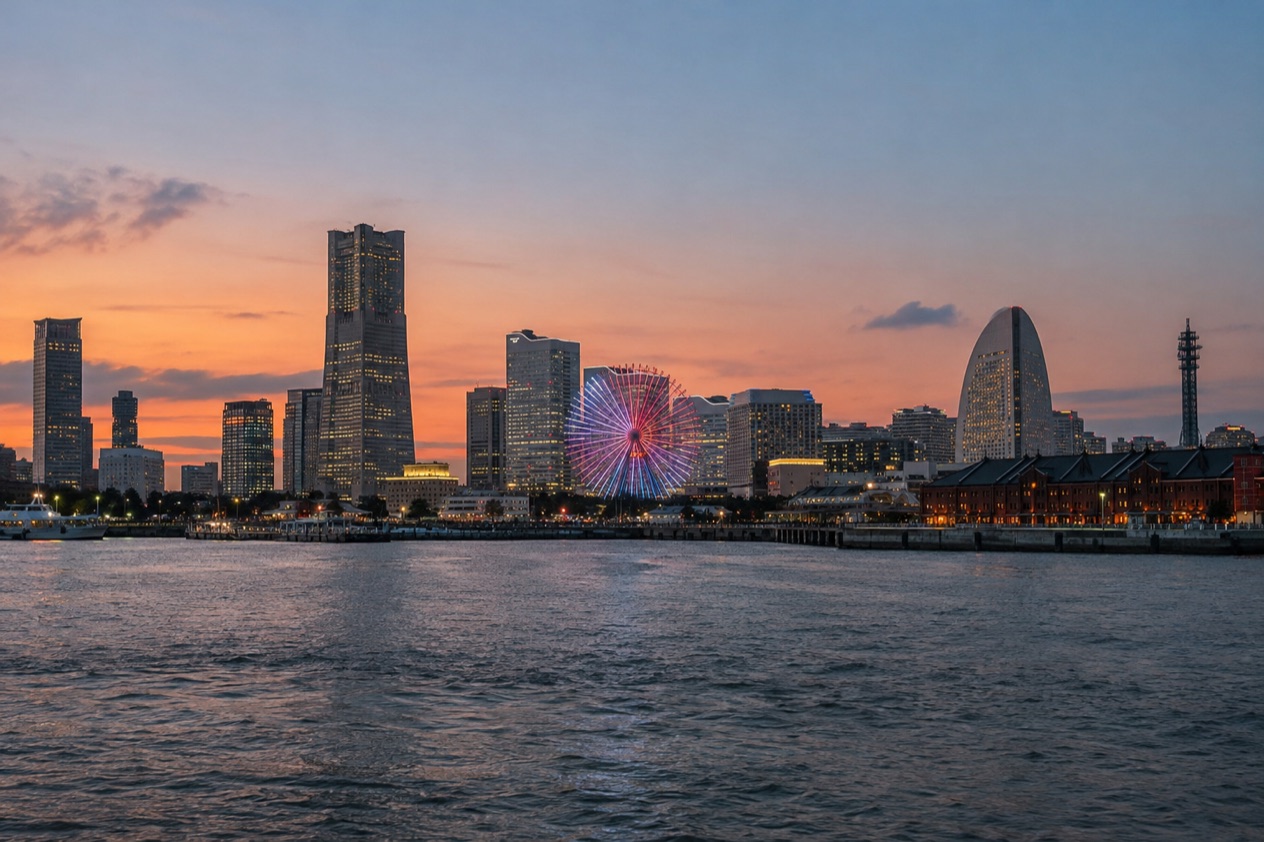
Leaving Tokyo in the morning, you ride south with the apartment blocks thinning out and the glint of Tokyo Bay waiting at the far end. Yokohama is a port city with a harbor-front promenade, a Chinatown of lacquered gates and steamed buns, and a skyline of cranes and Ferris wheel lights.
It also covers the other direction of arrival: those who land at Haneda or Narita and head straight for Yokohama without stopping in Tokyo at all.
How do you get to Yokohama from Tokyo?
From central Tokyo, a JR train or one of several private railway lines takes about 1 hour to reach Yokohama Station, and that is the way most plans begin.
Yokohama lies on the western shore of Tokyo Bay, directly south of Tokyo, which is why the trip is a straight run along the coast of the Kanto region rather than a journey with a mountain pass or a ferry in the middle. The city is the second largest in Japan, and its main station handles two million passengers a day. That tells you something about the rhythm of the trip: this is a daily commute for a great people, and the trains are built for it.
What decides your route is mostly where you want to end up. Yokohama Station is the more central of the two big stations, and from it the harbor districts are within reach by local transport.
Shin-Yokohama Station, where the Tokaido Shinkansen stops, sits in Kohoku Ward and opened in 1964 together with the Tokaido Shinkansen. It is also served by the Yokohama Line, the Yokohama Municipal Subway Blue Line, and the Sotetsu and Tokyu Shin-Yokohama lines, so it works as a junction as well as a bullet train stop.
The second thing that decides is your starting point. If you sleep near Tokyo Station, the JR lines that leave from there are an obvious fit. If you are coming off a plane, the airport links go to Yokohama Station directly. And if you are arriving from the west of Japan, the Nozomi Shinkansen stops at Shin-Yokohama, so you may not need to go through Tokyo at all.
A trip from Tokyo to Yokohama and back suits a single day. The port has been open to foreign ships since June 2, 1859, and the waterfront still carries that history in its brick warehouses, its harbor park and its old customs-house streets.
Ways to get to Yokohama from Tokyo
Tokaido Shinkansen to Shin-Yokohama
The Tokaido Shinkansen links Tokyo with Shin-Yokohama Station, and the same line carries on to Nagoya, Shin-Osaka and Hakata. It is the train for travelers already holding a bullet train ticket on a longer journey, or for those whose hotel or appointment lies near Shin-Yokohama rather than the harbor.
The station is jointly run by JR Central, JR East, the Yokohama City Transportation Bureau, Sagami Railway (Sotetsu) and Tokyu Railways, which is why you see several company logos on the signs. From Shin-Yokohama, the Blue Line subway runs to Yokohama, Kannai and beyond, and the Yokohama Line reaches Yokohama Station too. Those connections matter, because the station itself is not on the water.
JR and private railway lines to Yokohama Station
This is the standard ride: a JR train or one of several private lines from central Tokyo to Yokohama Station, taking about 1 hour. Yokohama Station is more central than Shin-Yokohama, with a large crowd of commuters, department stores and underground shopping around it, and the waterfront is reached from there by local transport.
Two JR services are worth knowing by name. The Yokosuka Line, run by JR East, connects Tokyo Station with Kurihama in Yokosuka, and most of its local trains make all stops with eleven cars, two of them Green (first class) cars.
The Shonan-Shinjuku Line, which opened in December 2001, has no track of its own and runs over shared sections of several main lines, including the Tokaido Main Line. Both are part of the same web of commuter rail that fills the Tokyo area, and both are the kind of ride where you can watch the neighborhoods change outside the window.
Local and rapid trains
Local trains in Japan stop at every station, which makes them a fit for short distances and for travelers who like to see small stations go by. Rapid trains skip the smaller stops and need no supplement, so the ticket you hold for a local ride covers them too.
Japanese trains have a reputation for being on time, which lets you plan a day to the minute. If you are meeting someone at the harbor or heading to a reserved table, that reliability is a comfort.
Airport trains and shuttle buses
Buses appear in the picture mainly as airport shuttles. From Haneda Airport, a shuttle bus reaches Yokohama Station in 30 minutes, while the Keikyu train line does the same trip in 20. From Narita Airport, Narita Express trains and shuttle buses both take approximately 1 hour 30 minutes to Yokohama Station.
This suits anyone who has just landed and wants to skip Tokyo on the first night. A flight into Haneda followed by the Keikyu line puts you in Yokohama before people have found their luggage in a Tokyo hotel. The Narita routes take longer but run direct to the same station.
Options compared
| Option | Time each way | Best for | What to know |
|---|---|---|---|
| JR train or private line from central Tokyo | About 1 hour | A day trip from a Tokyo hotel | Ends at Yokohama Station, the more central station |
| Keikyu line from Haneda Airport | 20 minutes | Arriving by plane and going straight to Yokohama | Ends at Yokohama Station |
| Shuttle bus from Haneda Airport | 30 minutes | Travelers who prefer a bus to a train | Same destination as the Keikyu line |
| Narita Express or shuttle bus from Narita Airport | About 1 hour 30 minutes | Arriving at Narita and skipping Tokyo | Both options run to Yokohama Station |
The Tokaido Shinkansen to Shin-Yokohama does not appear in the table because it belongs to a different kind of trip. It is the line you ride when Yokohama is one stop on a longer run to Nagoya, Shin-Osaka or Hakata, or when your destination is the Kohoku Ward around the station rather than the harbor.
For visitors from a Tokyo hotel, the choice comes down to a JR or private line to Yokohama Station. For those coming from the west, the Nozomi Shinkansen is the fastest rail connection, taking 1 hour 25 minutes from Nagoya and 2 hours from Kyoto and Osaka. From Hiroshima it takes 3 hours 40 minutes. Those arriving by air have the two airport links above, each ending at the same big station.
One more detail helps when you read signs in the station. Yokohama Station and Shin-Yokohama Station are different places with similar names, and the Blue Line subway and the Yokohama Line are what tie them together. Check the name on the departure board before you board.
Making a day of it
A day in Yokohama works best when it follows the water. Most of the pleasures sit along the harbor: Yamashita Park with its view of ships, the red brick warehouses that now hold shops and cafés, the Minato Mirai skyline with its Ferris wheel, and the streets of Chinatown behind them.
Chinatown and the harbor streets
Chinatown is the place to eat. The streets are lined with stalls and restaurants selling steamed buns, dumplings, noodles and sweet treats, and the colorful gates mark the entrances. Walking through it is as much about the smells and the sound of cooks calling out as about any single dish.
Beyond Chinatown, the old foreign-settlement streets keep their Western-style buildings, a reminder of the years after the port opened. Yamashita Park runs along the water, and from its benches you can watch ships and the bay. The park is a natural place to slow down after a lunch of dumplings.
Minato Mirai and the warehouses
Minato Mirai is the modern face of the city, a district of towers, shopping malls and a waterfront promenade. The Ferris wheel is the landmark you notice from far away, and at night the lights reflect off the bay. The red brick warehouses stand close by and hold shops, restaurants and event space, making them a fit for a coffee or a browse. If rain arrives, the malls and covered walkways around Minato Mirai keep a day going, and the warehouses are a good place to wait out a shower with something warm to drink.
How long to stay and what to bring
Because the trip back is about an hour on the train, you can stay for dinner and still return the same night. If you are using the Tokaido Shinkansen for a longer trip, Yokohama is a stop that can be added on the way.
Bring comfortable shoes for the waterfront, where most of the day is spent on foot, and something to carry small purchases from the Chinatown shops and the warehouses. Keep in mind that the harbor can feel breezier than the inland streets of Tokyo.
Good to know before you go
Japanese trains have a reputation for running on time, so a day trip can be planned around specific departures with some confidence. Yokohama Station is a very big place, and giving yourself a few spare minutes to find the right platform or exit is a good habit, especially on the way back.
Keep your belongings close in the crowds around the station and along Chinatown’s narrow streets, as you would in any busy city. The weather can change the feel of the harbor, so a light layer is worth carrying.
Sources
- Wikipedia, Shin-Yokohama Station (https://en.wikipedia.org/wiki/Shin-Yokohama_Station), checked October 11, 2026
- Wikipedia, Shōnan-Shinjuku Line (https://en.wikipedia.org/wiki/Sh%C5%8Dnan-Shinjuku_Line), checked October 11, 2026
- Wikipedia, Yokosuka Line (https://en.wikipedia.org/wiki/Yokosuka_Line), checked October 11, 2026
- Japan National Tourism Organization, Yokohama (https://www.japan.travel/en/destinations/kanto/kanagawa/yokohama-and-around/), checked October 11, 2026
- Wikipedia, Yokohama (https://en.wikipedia.org/wiki/Yokohama), checked October 11, 2026
- Wikivoyage, Yokohama (https://en.wikivoyage.org/wiki/Yokohama), checked October 11, 2026
- Japan National Tourism Organization, trains and buses (https://www.japan.travel/en/guide/how-to-travel-by-train-and-bus-in-japan/), checked October 11, 2026
- Japan National Tourism Organization, traveling by rail (https://www.japan.travel/en/guide/traveling-by-rail/), checked October 11, 2026
- Japan National Tourism Organization, getting around Japan: trains, subways, buses, taxis (https://www.japan.travel/en/plan/getting-around/), checked October 11, 2026