
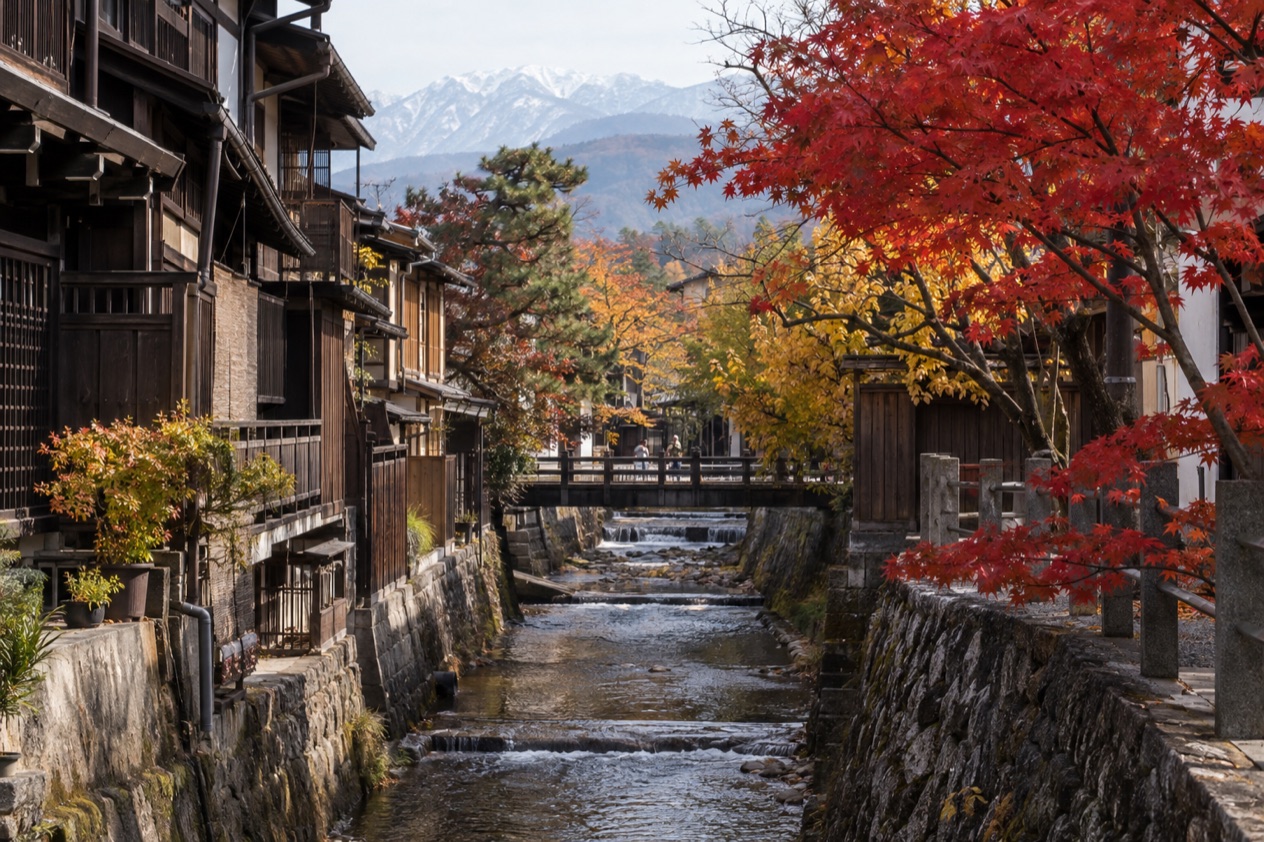
In November, woodsmoke and the sweet smell of grilled rice dumplings drift along the old merchant streets of Takayama, and the cedar balls hanging above sake brewery doors turn from green to brown. Mornings are sharp enough that people cup paper cups of hot tea at the market stalls beside the river. The maples on the hillsides are changing and the first snow is close, which makes this a month for wooden townhouses, steaming bowls of noodles and slow walks in the Japanese Alps.
What is the weather like in Takayama in November?
November in Takayama is cold and damp, a month of crisp days that sits between the last autumn mildness and the first real snow of winter.
| Month | Average high (°F) | Average low (°F) | Precipitation (in) | Days with 1 mm or more of precipitation | Hours of sunshine | Daylight on the 15th |
|---|---|---|---|---|---|---|
| October | 67.8 | 48.6 | 6.12 | 10.3 | 129 | 11 h 20 min |
| November | 55.6 | 37.2 | 3.72 | 10.4 | 101 | 10 h 17 min |
| December | 43.2 | 28.9 | 4.11 | 13.4 | 82 | 9 h 43 min |
Afternoons in the mid-50s are fine for walking if you are dressed in layers, but the mornings start close to freezing, and the cold settles in again as soon as the light fades. A wool sweater under an insulated jacket, a scarf and a hat are what people on the streets are wearing. Evenings call for the warmest layer you packed.
An umbrella or a hooded waterproof shell is more useful than anything else you can add to your bag. Wet stone and wooden boardwalks are slick, so shoes with a decent grip matter.
The sun shows itself for only part of the month, and the days have clearly shortened since October. Sightseeing fits into the hours of daylight, and by late afternoon the lanterns and shop windows of the old town take over from the sky. Gray, moist days make the red and gold of the maples look deeper against dark timber.
What to do in Takayama in November
Takayama has no big festival in November. The Autumn Takayama Festival belongs to early October, so this is the quieter stretch afterward, when the town goes back to its own rhythm of shop curtains, sake breweries and tea houses. What the month does bring is the turn of the leaves. Trees across Japan show red, yellow and orange from mid-November to early December, and the Alpine hillsides around Takayama are part of that story.
That is a guide to the season and not a date for Takayama itself. From one autumn to the next, the color on the hills above town can run earlier or later.
The old town of Sanmachi Suji
Takayama is sometimes called the Little Kyoto of Hida because of its well-kept quarter with Edo-style streets, and the district called Sanmachi Suji is where that name makes sense. Dark wooden merchant houses with latticed fronts line narrow lanes, and a small canal runs alongside. Many of the buildings house sake breweries, craft shops, miso sellers and tea rooms.
In November, the cedar balls (sugidama) that hang above brewery entrances signal that the new sake season is under way. You can step inside to taste small cups of local rice wine, and the brewery shops sell bottles as well as sake lees sweets. A drizzle suits the quarter well, since the dark wood and wet stone glow, and the covered shop fronts keep you dry between cups of tea.
Morning markets, Hida beef and cold-weather food
The morning markets by the Miyagawa river and in front of the old government house are made for cold weather. Vendors sell apples, persimmons, pickles, miso paste and sweet rice dumplings glazed with soy sauce and grilled over charcoal. Holding a hot skewer in gloved hands is part of the experience, and a roasted dumpling is a good way to warm up.
At midday the town is known for Hida beef, which turns up as a thin slice on a skewer, as sukiyaki, or grilled on a ceramic plate. Takayama ramen, a light soy broth with thin curly noodles, is the other cold-weather answer. Hoba miso is a regional dish of miso, mushrooms and vegetables cooked on a magnolia leaf over a small burner, and in November the mushrooms are right in season.
Takayama Jinya and the Hida Folk Village
Takayama Jinya is a former regional government building with tatami rooms, long wooden corridors and a garden that shows the season well. Walking its quiet interior in wool socks on a cold day is a pleasure, and the garden lights up with autumn color when the leaves turn. It makes a natural indoor stop when the rain comes in.
The Hida Folk Village is an open-air collection of old farmhouses with steep thatched roofs, set among trees and ponds. In November, smoke from the open hearths mixes with the damp air and the maples around the ponds hold their color. Visiting is mostly a walk outdoors, so a waterproof layer matters more here than in the town.
The mountains around Takayama remain part of the month’s appeal, with ridgelines crisp and light dusting on the highest peaks some mornings. Day trips into the Alps are part of many visits, and the cold sharpens the views whenever the clouds lift.
A two-day itinerary for Takayama in November
Day 1 begins at the morning markets by the river, when the stalls are setting out apples, pickles and hot dumplings. Take your time with breakfast and a coffee from a small shop, then walk into Sanmachi Suji while the lanes are still cool and the shop fronts are opening. Sample sake in a brewery or two and pause at a craft shop for lacquerware or carved wood.
For lunch, choose a bowl of Takayama ramen or a set of Hida beef on a hot plate. In the afternoon, visit Takayama Jinya, whose tatami rooms and corridors are a good shelter if rain arrives. With days this short, finish the old town before the light goes, then spend the evening in a small izakaya (a casual pub with small plates) with hoba miso and a glass of local sake.
Day 2 belongs to the Hida Folk Village, where the farmhouses and the colored maples reward a slow loop outdoors. Dress warmly, because the open hearths inside only go so far against the chill. Lunch can be soba noodles or another warming bowl near the site.
In the afternoon, return to town for a last walk across the bridges over the Miyagawa and a stop at a tea room for sweets with matcha. If the rain turns heavy, shift indoors to sake tastings, craft shops and a long dinner of Hida beef. An evening soak in an onsen (hot spring bath) at your inn is the natural way to end a cold day.
Is Takayama busy in November?
November is a season of color in Takayama, and the pace of the town reflects that without turning it into a rush. The big autumn festival has already come and gone in October, so the crowds that gather around the floats do not return in November.
The draw now is the leaves, which across Japan turn from mid-November into early December. Walking the old town and the paths of the Folk Village in that light is the main reason to come, and it gives the month a lively but unhurried mood. Mornings at the markets are full of stallholders and early walkers, while the lanes thin out as the cold evening sets in.
Winter has not fully arrived. The heavy snow that covers the mountains and northern regions of Japan in winter is still weeks off, and the long closures around the New Year holidays, when many restaurants and attractions shut, come later still. November sits comfortably in between, with the town fully open and the shops and sake breweries in full swing.
As the month goes on, the days grow shorter and the cold deepens. Travelers who come at the start of the month meet milder afternoons, while those who arrive near the end feel the first winter edge.
What to pack for Takayama in November
Pack for cold mornings, damp streets and long walks between wooden houses. Layers you can add and remove will serve you better than one heavy coat.
- A warm insulated jacket, for mornings near freezing and evenings after dark.
- A waterproof shell or compact umbrella, since rain falls on about a third of the days.
- Shoes with a good grip, because wet stone and boardwalks are slick.
- A hat, scarf and light gloves for the market stalls and outdoor loops.
- Wool socks, handy for the tatami rooms and temples where shoes come off.
- A warm sweater for izakaya dinners and onsen evenings.
Good to know before you go
Snow or sleet shows up on a handful of days in November, so keep the forecast in mind if you plan outdoor stops. The long New Year closures, when many restaurants and attractions are shut, come well after this month. One practical detail for rail travelers is that Takayama Station on the JR Takayama Line does not accept IC cards, so local line tickets must be bought in cash.
Takayama in November vs October and December
Moving the trip four weeks earlier brings milder afternoons, more hours of sun and the Autumn Takayama Festival on October 9 and 10. October is also wetter in total, with heavy rain falling on a similar number of days. The leaves, however, are usually just starting to turn, so the color is less advanced than in the second half of November.
Four weeks later, December brings real winter. Highs are well below freezing at night, the days are at their shortest and snow or sleet falls on about two days in three. Travelers find the old town lovely under snow, but outdoor stops like the Folk Village feel very different, and the leaves are long gone. Choose October for the festival and warmer walking, November for the colors, the market food and the cold-weather calm in between, and December if snow in the old town is the whole point.
Is November a good time to visit Takayama?
Yes, for travelers who like cold, crisp days, autumn color and food built around warmth. It suits people who enjoy wandering wooden streets, tasting sake and eating Hida beef or ramen after a day outdoors. It is less suited to anyone who wants long, bright days or relies on a festival to anchor the trip.
On arrival, start at the morning markets by the river, where the season shows up in apples, persimmons, pickles and hot dumplings, then step into Sanmachi Suji while the day is young. Keep the indoor options, Takayama Jinya and the brewery tasting rooms, in your pocket for the wet stretches.
What marks November here is the in-between feeling. The festival is over, the snow has not yet arrived, and maples burn red behind dark timber houses while steam rises from a grill of dumplings in the cold air.
Sources
- Japan Meteorological Agency (JMA), Normal values 1991-2020, monthly (https://www.data.jma.go.jp/stats/etrn/view/nml_sfc_ym.php?prec_no=52&block_no=47617), station Takayama, elevation 560 m, checked October 11, 2026
- Computed from the date and the latitude of the place (sunrise equation, solar elevation -0.833 degrees), October 11, 2026
- Japan Meteorological Agency, maple color-change dates 2025-2026 with difference from the 1991-2020 normal (https://www.data.jma.go.jp/sakura/data/phn_014.html), checked October 11, 2026
- Japan Meteorological Agency, kaede2020.pdf (https://www.data.jma.go.jp/sakura/data/kaede2020.pdf), checked October 11, 2026
- Japan National Tourism Organization, winter in Japan (https://www.japan.travel/en/guide/winter-guide/), checked October 11, 2026
- Japan National Tourism Organization, autumn in Japan (https://www.japan.travel/en/guide/autumn-guide/), checked October 11, 2026
- Japan National Tourism Organization, spring in Japan (https://www.japan.travel/en/guide/spring-guide/), checked October 11, 2026
- Japan National Tourism Organization, summer in Japan (https://www.japan.travel/en/guide/summer-guide/), checked October 11, 2026
- Japan Meteorological Agency, biological season observations (https://www.data.jma.go.jp/sakura/data/index.html)
- Wikipedia, Takayama, Gifu (https://en.wikipedia.org/wiki/Takayama,_Gifu), checked October 11, 2026
- Wikivoyage, Takayama (https://en.wikivoyage.org/wiki/Takayama), checked October 11, 2026
- Japan National Tourism Organization, festivals and events (https://www.japan.travel/en/see-and-do/festivals-and-events/), checked October 11, 2026
- Wikipedia, Takayama Festival (https://en.wikipedia.org/wiki/Takayama_Festival), checked October 11, 2026
To plan your stay
- Things to Do in Takayama: Old Town Streets, Morning Markets, Hida Beef and Festival Floats
- Where to Stay in Takayama: Station Area, Old Town Streets, Morning Market and Ryokan
- Takayama from Nagoya: The Hida Limited Express, Ways to Go and a Day in the Old Town
- Takayama Festival: Yatai Floats, Lantern Processions and Spring and Autumn Dates