
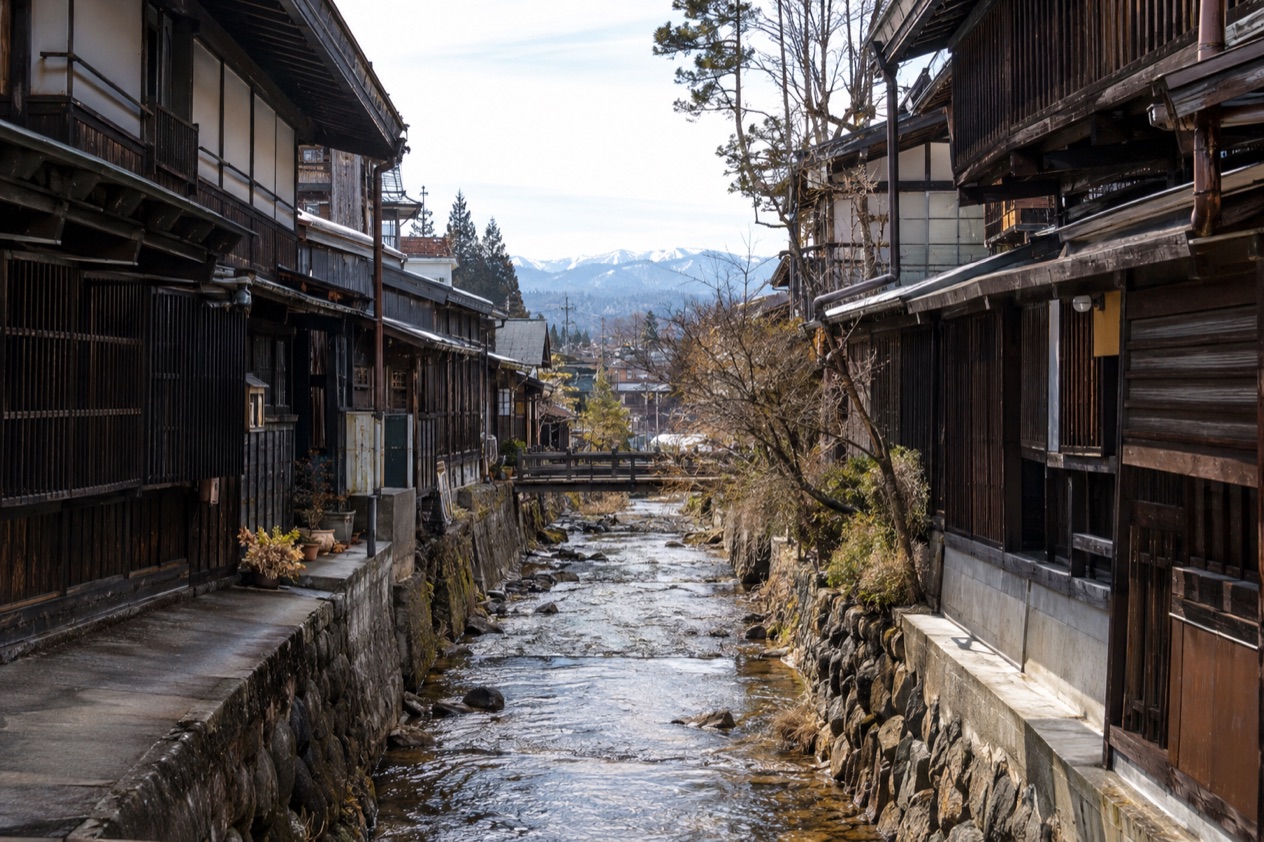
Nagoya’s platforms hum with commuters and bento sellers while the Hida limited express waits for its run into the mountains. Somewhere past the last suburbs the rice fields narrow, the river tightens and the carriages start to feel like they are climbing. At the end of the line, Takayama sits in the Japanese Alps with dark wooden merchant houses, sake breweries and a morning market along the river.
How do you get to Takayama from Nagoya?
The Hida limited express links Nagoya and Takayama in 2 hours 30 minutes, and it is the train this trip is built around. It is a limited express service run by Central Japan Railway Company, known as JR Central, along the Takayama Main Line, and it has been running since 1958. You board in Nagoya and ride the same train all the way to Takayama.
What decides how the day goes is the kind of ticket you hold. To ride the Hida, you need two tickets: a limited express fare ticket and a standard basic fare ticket. That is the one rule of the trip, and everything else is a matter of how you want to spend the hours around the ride.
Nagoya is a good place to start. The city is a major stop on the Tokaido Shinkansen, so many travelers arrive there from Tokyo, Kyoto or Osaka and then turn into the mountains.
Takayama, which people sometimes call Hida-Takayama, lies in Gifu Prefecture in the Chubu region, near the northern Japan Alps. The change of mood is part of the pleasure. You leave a big port city of office towers and enter a town of low eaves, lattice windows and narrow lanes.
Takayama is also a city of wide spaces. It covers a huge area, the largest of any city in Japan by area, so the old quarter you walk is only a small part of it. The district people come for is the well-preserved quarter with Edo-style streets, and that nostalgic look has earned the town the nickname Little Kyoto of Hida.
Seasons matter on this route more than on most. In spring the cherry blossoms in Takayama come from the middle to the end of April, about three weeks after Nagoya, so you can sometimes catch a second round of blossoms by heading up into the hills.
In winter, snow is heavy, with an annual average of 201 inches falling in the city. A morning that starts with rain on the Nagoya platforms can end with white roofs in Takayama.
Ways to get to Takayama from Nagoya
The Hida limited express
This is the direct train, and the one the schedule of the route is organized around. The Hida runs on the Takayama Main Line, and its top speed is 75 mph, a pace that suits a track winding through valleys. Trains take 2 hours 30 minutes between the two cities, long enough to settle in with a coffee and watch the landscape change from city to hills.
One daily Hida service starts in Osaka, runs to Gifu and couples there with a Hida service from Nagoya before continuing together to Takayama. If you board in Nagoya, you are simply riding a train that continues on to the mountains. The same service also carries on to Toyama, which is useful to know if you plan to keep traveling beyond Takayama after your stay.
The Hida suits anyone who wants to reach Takayama in one ride, with no transfers to track. Tickets come as the pair already mentioned, the limited express fare and the basic fare, and both are needed for the ride. Japanese trains have a reputation for running on time, which means a plan built around the Hida’s timetable holds together well.
Local and rapid trains
Local trains in Japan stop at every station, which makes them a fit for short distances, and rapid trains skip the smaller stations without asking for a supplement. Those are the general rules of the Japanese rail network.
One detail worth knowing if you end up on a local line around Takayama: Takayama Station on the JR Takayama Line does not accept IC cards, so local line tickets there must be bought in cash. Keep a few coins and notes in your pocket on arrival, even if your Suica or Pasmo has served you well in the big cities.
The Shinkansen at Nagoya
Nagoya is the stop where many visitors step off the bullet train. The Tokaido Shinkansen, the first of Japan’s high-speed lines, opened in 1964 and links Tokyo, Yokohama, Nagoya and Osaka. It currently runs at up to 177 mph. That is the line that brings you to Nagoya, and the Hida takes over from there for the mountain leg.
Seen this way, the journey to Takayama is two chapters: a fast ride across the plain on the shinkansen, then a slower, climbing ride on the Hida. If you are coming from Tokyo or Kyoto, the Nagoya platforms are where the two chapters meet, with plenty of food counters for stocking up before the mountain section.
Options compared
| Option | Time each way | Best for | What to know |
|---|---|---|---|
| Hida from Nagoya to Takayama | 2 hours 30 minutes | Reaching Takayama in a single ride from Nagoya | Needs a limited express fare ticket and a basic fare ticket |
| Hida from Osaka to Takayama | 4 hours 15 minutes | Travelers starting from Osaka | One daily service, joined with the Nagoya train at Gifu |
| Hida from Nagoya to Toyama | 4 hours | Continuing past Takayama on the same train line | Runs on the same service as the Takayama trip |
The three rows are all the same family of train, which keeps the choice simple. If your day begins in Nagoya, the first row is your trip, and the other two show how the Hida fits into a longer route. A traveler coming from Osaka rides the same train name, but meets the Nagoya section at Gifu and shares the rest of the line.
The table leaves out the questions that a timetable cannot answer. Where you sit, what you eat on board and how you spend the hour you arrive are yours to decide. What the Hida gives you is a clear, direct link, and a train culture that lets you plan down to the minute. Plan the arrival the way you would plan a meal: leave room for it, and let the rest of the day follow.
If your trip carries on to Toyama afterward, the Hida is one of the ways to do it, and the same line takes you there.
Making a day of it
A day in Takayama starts on the old streets. The quarter people call Sanmachi Suji is made of dark timber merchant houses with deep eaves, latticed windows and small canals running alongside.
Several of the old houses are sake breweries, marked by a ball of cedar branches hung over the door, and the district is a pleasure to wander slowly. Shops sell local crafts, pickles and sweets, and the smell of grilled rice cracker and soy drifts down the lanes.
Food is a big reason to come. Hida beef is the regional specialty, served as skewers on the street, in a bowl of rice or grilled at the table. Mitarashi dango, rice dumplings glazed with soy sauce, make a good snack while you walk.
Takayama ramen, with a clear, soy-based broth, is a bowl many people look for after a day outdoors. The morning markets by the river, with their stalls of vegetables, pickles and crafts, are an old habit of the town.
Spring and winter change the walk. In mid to late April, cherry blossoms appear along the river and in the hills, a few weeks after those of Nagoya.
In winter the same lanes fill with snow, roofs turn white and a hot drink feels like a necessity. Bring layers for the mountain air in either case, and shoes that handle wet pavement. The weather can shift fast in the Alps, so a light waterproof is a good companion.
One indoor stop is the Hikaru Museum. It has its own season and days, so it fits some trips and not others.
| Site | Open |
|---|---|
| Hikaru Museum | Late February to mid-December, Thursday through Tuesday, 10:00 to 17:00 (last admission 16:00) |
As for how long to stay, a day trip is possible given the length of the ride, but a night in town changes the pace. You can then see the old quarter after the day visitors have left, eat a long dinner of Hida beef and sake, and walk back through lanes lit by lanterns. If you stay only a day, give the old quarter and the market the most time, and keep the museum as a rainy-hour option.
Leave Nagoya early enough that the return train is not a worry, and keep a buffer at the station before you head back. With the Hida’s reputation for punctuality, the schedule gives you a firm frame, so the hours between arrival and departure can be spent unhurried, ending on a last skewer of beef at the station or a final look at the river.
Good to know before you go
Carry some cash for Takayama. The station on the JR Takayama Line does not take IC cards, and local line tickets there are paid for in cash.
In the old quarter, keep the usual habits of a busy town: step aside from the narrow lanes to take photos, and mind your bags in a crowd. Snow arrives heavily in winter and can change a day, so allow some flexibility in your plans between December and March, and dress for mountain weather whatever the season.
Sources
- Wikipedia, Hida (train) (https://en.wikipedia.org/wiki/Hida_(train)), checked October 11, 2026
- Wikipedia, Takayama, Gifu (https://en.wikipedia.org/wiki/Takayama,_Gifu), checked October 11, 2026
- Wikivoyage, Takayama (https://en.wikivoyage.org/wiki/Takayama), checked October 11, 2026
- Japan National Tourism Organization, trains and buses (https://www.japan.travel/en/guide/how-to-travel-by-train-and-bus-in-japan/), checked October 11, 2026
- Japan National Tourism Organization, traveling by rail (https://www.japan.travel/en/guide/traveling-by-rail/), checked October 11, 2026
- Japan National Tourism Organization, getting around Japan: trains, subways, buses, taxis (https://www.japan.travel/en/plan/getting-around/), checked October 11, 2026
- Wikipedia, Shinkansen (https://en.wikipedia.org/wiki/Shinkansen), checked October 11, 2026
- Wikipedia, Tōkaidō Shinkansen (https://en.wikipedia.org/wiki/T%C5%8Dkaid%C5%8D_Shinkansen), checked October 11, 2026
To plan your stay
- Best Time to Visit Takayama: Cherry Blossoms, Autumn Color, Snow and Festivals
- Things to Do in Takayama: Old Town Streets, Morning Markets, Hida Beef and Festival Floats
- Where to Stay in Takayama: Station Area, Old Town Streets, Morning Market and Ryokan
- Takayama in January: Snow, Weather, Old Town Food and a Two-Day Plan