
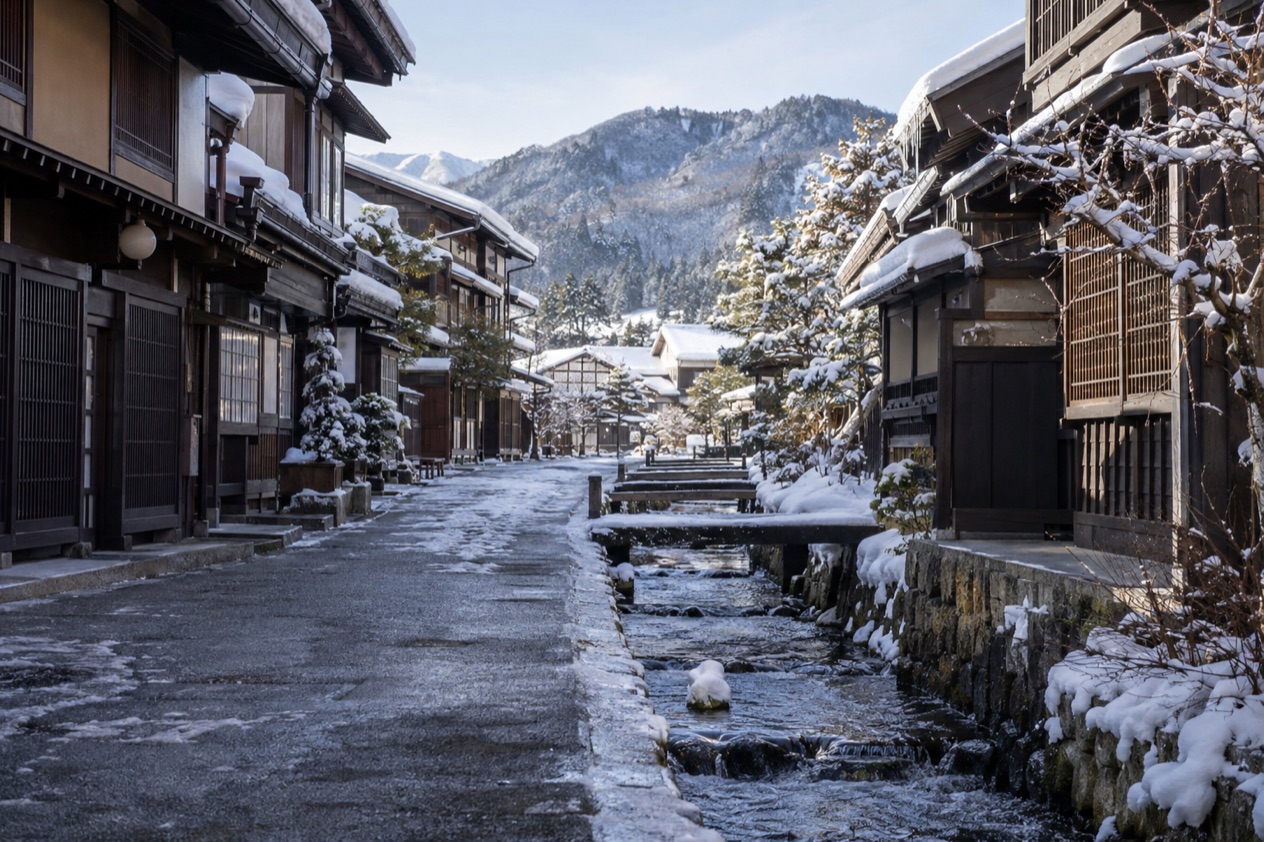
In December, the old wooden merchant houses of Takayama wear a layer of fresh snow on their dark roofs, and the narrow lanes of the old quarter go soft and hushed under it. Steam rises from cups of hot sake and bowls of noodles, and the first real winter of the Japanese Alps settles over the town. It is a month for snow-framed streets, hot food and slow walking in the Edo-style quarter that earned Takayama the nickname Little Kyoto of Hida.
What is the weather like in Takayama in December?
December in Takayama is cold, damp and snowy, a clear step into winter after a November that still feels like autumn.
| Month | Average high (°F) | Average low (°F) | Precipitation (in) | Days with 1 mm or more of precipitation | Hours of sunshine | Daylight on the 15th | Snowfall (in) |
|---|---|---|---|---|---|---|---|
| November | 55.6 | 37.2 | 3.72 | 10.4 | 101 | 10 h 17 min | 0.8 |
| December | 43.2 | 28.9 | 4.11 | 13.4 | 82 | 9 h 43 min | 26.0 |
| January | 37.8 | 23.4 | 4.01 | 14.6 | 93 | 9 h 57 min | 46.1 |
These are the figures of the Takayama station, and they describe a town where the afternoons stay just above freezing and the nights drop well below it. Precipitation falls more often as snow or sleet than as rain, on most days of the month, so the streets are often white, wet or slushy. Sunshine is limited, and gray skies are common.
For the traveler, that means layers: a warm base, an insulated coat, a hat and gloves, and waterproof shoes with a good grip for packed snow and icy patches. A waterproof outer shell helps when wet snow falls. Daylight is short, so the lanes are lit by lanterns and shop windows soon after the afternoon fades.
Humidity is high, which makes the cold feel damp, and a warm drink or a bath in the evening becomes part of the day. Fresh snow often brightens the town even under cloud, and on the rare clear spells the light on the white roofs is sharp and beautiful.
What to do in Takayama in December
The best of a Takayama December is the old town in snow. Walk the Edo-style quarter, where dark latticed merchant houses line the lanes and sake breweries mark their doors with balls of cedar needles. Takayama is a city in Gifu Prefecture, in the heart of the Japanese Alps, and winter is when that mountain setting feels closest.
Christmas is not a national holiday in Japan, though gifts are sometimes exchanged, so expect the mood in town to be one of winter rather than festivity. The real turn of the calendar comes at New Year, and the end of the month leads into it.
The Japanese New Year is celebrated on January 1, with osechi, a selection of special dishes eaten for the occasion. During the New Year holidays, many restaurants and attractions are closed, which matters for the last days of December.
The old town in snow
The preserved quarter is the reason to come, and December gives it a different face from summer. Snow settles on the eaves and the lattice windows, the small canals run dark beside white banks, and the whole district seems to slow down. You can wander in and out of shops selling local crafts, sake and snacks, and duck inside whenever the cold bites.
Wear shoes with grip, because the lanes can be icy. Cafés and shops are a good way to warm up between stretches of walking, and a hot drink in hand makes the lanes feel even more atmospheric. Shops in rural areas often close earlier, sometimes as early as 6:00 p.m., so plan your wandering for daylight.
Eating and drinking in the cold
Winter in the mountains calls for warming food. Think of hot noodle soups, grilled skewers, miso-based dishes, local pickles and the sweet snacks sold along the lanes. Sake is the natural companion to the cold, and the town’s breweries are part of the winter ritual. Evenings are for izakaya, the casual pubs where small plates arrive one after another.
A ryokan, the traditional inn, suits this month well, with a hot onsen bath after a day in the snow. Dinner at a ryokan is usually a multi-dish kaiseki-style meal, and the combination of hot water, warm food and a futon on tatami is the classic winter rest.
Winter sports and the mountains
Japan’s ski season generally opens in December, with exact dates set by each resort. The high-altitude mountains of Nagano typically have snow earlier than other regions, with peak season in January and February when snowfall is most frequent. Takayama itself, in the northern Japan Alps, sits in snow country, and the surrounding mountains are the setting for the season.
Even if you do not ski, the snowy mountain scenery around the town is part of the December mood, and the deepening winter makes the old quarter feel like a small island of warmth in a white landscape.
A two-day itinerary for Takayama in December
Day 1 begins in the old town, since daylight is short, with about nine and three-quarter hours of it in mid-month. Start with a slow walk through the merchant-house lanes while the snow is fresh, stop in a cafe for something hot, and browse the craft and sake shops. Have a warming noodle lunch in a small local restaurant and spend the afternoon visiting a sake brewery or a traditional shop, keeping indoor stops in reserve for when snow turns heavy.
As the light fades, the lanterns come on and the quarter takes on its evening glow. Dinner is for an izakaya or a ryokan, with local dishes and sake. If you are staying at an inn with an onsen, finish the day with a hot bath.
Day 2 widens the circle slightly. Lunch could be a simple set meal or grilled skewers, with a hot drink to follow.
In the afternoon, visit the shops and cafes you passed on the first day, or head to the station area if you are moving on. Takayama Station on the JR Takayama Line does not accept IC cards, so local line tickets must be bought in cash. If the weather turns, a museum, a cafe or a long ryokan afternoon is the rain card, or in this case the snow card.
Is Takayama busy in December?
December is a winter month in Takayama, with the autumn leaf season already behind it, so the pace of the town is quieter than it is in the weeks of color. The maple leaf color change at the Gifu reference point usually comes in late November, and by December the leaves have gone and the snow has arrived.
What December brings instead is the winter mood: snow on the roofs, steam from food stalls and the pull of a hot bath. The ski season generally opens in December, which draws winter sports travelers to the mountains in general, while the old town itself becomes a place for slow walking and warm indoor stops.
The end of the month is different, because the New Year holidays close many restaurants and attractions. The days around January 1 are the ones where the town’s rhythm changes most, with doors shut and a family-centered holiday mood. Earlier in the month, the pace is that of an ordinary winter week.
What to pack for Takayama in December
Pack for cold, damp days of snow and sleet, with long walks on lanes that can be icy.
- An insulated waterproof coat, for snow and sleet on most days of the month.
- Warm base layers, since nights fall well below freezing.
- Waterproof boots with good grip, for packed snow and icy lanes.
- A hat, gloves and a scarf, for hours outdoors in the old quarter.
- Cash in yen, since Takayama Station does not accept IC cards for local line tickets.
- Slip-on socks or extra pairs, for shoes that come off at ryokan and restaurants.
Good to know before you go
December in Takayama means snow, and the last week of the month leads into the New Year holidays, when many restaurants and attractions are closed. In urban areas, shops are generally open from 10:00 a.m. to 8:00 p.m. every day, but in rural areas they often close earlier, sometimes as early as 6:00 p.m. Takayama is the largest city by area in Japan, so the town you walk in is only a small part of it.
Christmas is not a national holiday in Japan, so shops and services run as usual on December 25. The year-end shutdown is what to plan around.
Takayama in December vs November and January
Moving the trip four weeks earlier brings you to November, when the town is still in autumn, with highs in the mid-50s and almost no snow. The maple leaves are turning, daylight lasts longer and the walks are less icy. You lose the white roofs, but gain easier walking and longer afternoons.
Four weeks later is January, which is colder still, with the heaviest snowfall of the three months and more days of snow or sleet. The ski season reaches its peak in January and February, and the old town is at its deepest winter. The New Year holiday closures are at the start of the month.
Choose November if you want crisp autumn air without the snow, and January if you want the full winter and the ski season at its height. December sits in between, with the first real snow of the year and the old quarter turning white.
Is December a good time to visit Takayama?
Yes, for travelers who want winter: snow on the old merchant houses, hot food, sake and an onsen bath at the end of the day. It suits those who like cold weather and slow, indoor-outdoor days, and anyone who wants to see the Japanese Alps in their first snow.
It suits less well anyone who wants long daylight, mild temperatures or open-air sightseeing without ice underfoot. Those travelers will be happier in the weeks of autumn color or the spring cherry blossoms, which in Takayama come from the middle to the end of April.
On arrival, start with a walk through the old quarter while there is daylight, then settle in with something hot. What makes December in Takayama its own is the combination of fresh snow, lantern light on dark wooden eaves and the steam of a warm meal.
Sources
- Japan Meteorological Agency (JMA), Normal values 1991-2020, monthly (https://www.data.jma.go.jp/stats/etrn/view/nml_sfc_ym.php?prec_no=52&block_no=47617), station Takayama, elevation 560 m, checked October 11, 2026
- Computed from the date and the latitude of the place (sunrise equation, solar elevation -0.833 degrees), October 11, 2026
- Japan National Tourism Organization, winter in Japan (https://www.japan.travel/en/guide/winter-guide/), checked October 11, 2026
- Wikipedia, Christmas in Japan (https://en.wikipedia.org/wiki/Christmas_in_Japan), checked October 11, 2026
- Japan National Tourism Organization, shop and attraction hours, national holidays (https://www.japan.travel/en/plan/business-hours-and-holidays/), checked October 11, 2026
- Wikipedia, Japanese New Year (https://en.wikipedia.org/wiki/Japanese_New_Year), checked October 11, 2026
- Wikipedia, Public holidays in Japan (https://en.wikipedia.org/wiki/Public_holidays_in_Japan), checked October 11, 2026
- Japan National Tourism Organization, skiing guide (https://www.japan.travel/en/guide/skiing/), checked October 11, 2026
- Japan National Tourism Organization, skiing and snowboarding in Japan: regions, resorts, seasons (https://www.japan.travel/en/sports/snow/), checked October 11, 2026
- Wikipedia, List of ski areas and resorts in Japan (https://en.wikipedia.org/wiki/List_of_ski_areas_and_resorts_in_Japan), checked October 11, 2026
- Wikipedia, Climate of Japan (https://en.wikipedia.org/wiki/Climate_of_Japan), checked October 11, 2026
- Japan Meteorological Agency, maple color-change dates 2025-2026 with difference from the 1991-2020 normal (https://www.data.jma.go.jp/sakura/data/phn_014.html), checked October 11, 2026
- Japan Meteorological Agency, biological season observations (https://www.data.jma.go.jp/sakura/data/index.html)
- Wikivoyage, Takayama (https://en.wikivoyage.org/wiki/Takayama), checked October 11, 2026
- Wikipedia, Takayama, Gifu (https://en.wikipedia.org/wiki/Takayama,_Gifu), checked October 11, 2026
To plan your stay
- Things to Do in Takayama: Old Town Streets, Morning Markets, Hida Beef and Festival Floats
- Where to Stay in Takayama: Station Area, Old Town Streets, Morning Market and Ryokan
- Takayama from Nagoya: The Hida Limited Express, Ways to Go and a Day in the Old Town
- Takayama Festival: Yatai Floats, Lantern Processions and Spring and Autumn Dates