
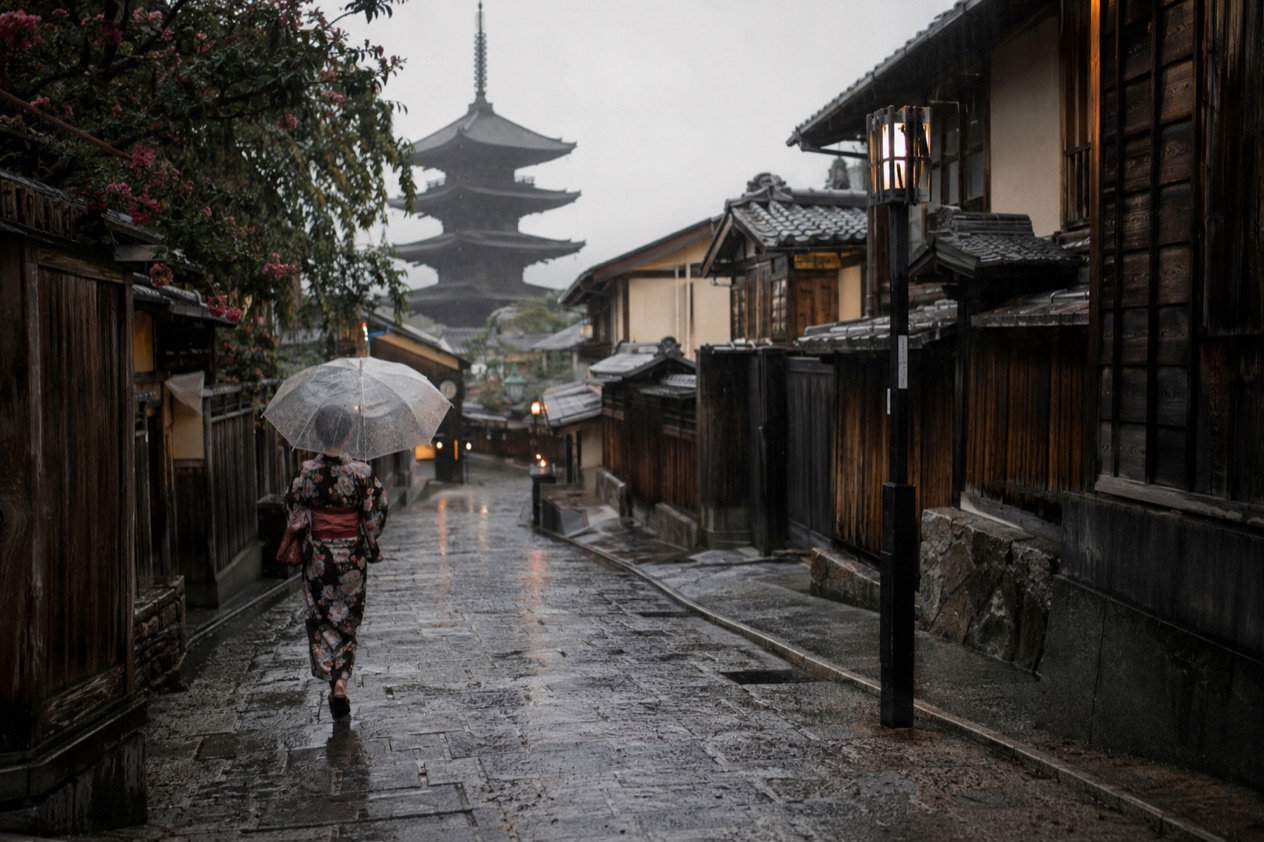
Somewhere in a Kyoto temple garden, the moss turns an almost electric green, and visitors stand under umbrellas while the rain taps on wide wooden eaves. This is tsuyu, the rainy season that settles over most of Japan as spring gives way to summer. It arrives at different times in different places, it skips one island entirely, and it shapes a trip more gently than its reputation suggests.
When is the rainy season in Japan?
The rainy season begins as summer approaches, sometime between May and June depending on where you are, and it ends in the middle of July on the main islands. The word tsuyu is written with characters that can be read as “plum rain,” a nod to the season when plums ripen. A broad band of cloud and showers, called the tsuyu front, drifts up from the south and parks over the country for weeks.
| Region | Rainy season |
|---|---|
| Okinawa | Early May through mid-June |
| Honshu, Shikoku and Kyushu | Early June to mid-July |
| Kansai and Kanto (approximate) | June 7 to July 20 |
| Hokkaido | No pronounced rainy season |
Honshu, Shikoku and Kyushu
For Tokyo, Kyoto, Osaka, Hiroshima and Fukuoka, tsuyu is the stretch between the end of spring and the true heat of summer. The exact start moves from one year to the next, so the dates in the table are the usual shape of the season rather than a promise.
What you meet on the ground is less a downpour than a mood. Skies are gray for days at a time, the air turns heavy and damp, and rain comes as steady drizzle or in heavier bursts. Between spells the clouds sometimes lift, and the cities carry on in their usual rhythm, with people moving through train stations and shopping arcades under umbrellas.
Okinawa, a month ahead of the mainland
In Okinawa, the southernmost region, the season comes roughly a month earlier than on the main islands. It begins in early May and fades by the middle of June, which means that by the time Tokyo is reaching for its umbrellas, the islands are already moving toward their summer.
The Ryukyu Islands have a humid subtropical climate in the north and a tropical rainforest climate in the south, with hot summers and very high precipitation, shaped by both the rainy season and typhoons. A trip to Okinawa in late spring is therefore a trip into the wet part of the calendar, and the weather there deserves to be planned on its own terms.
What comes after tsuyu
When the front finally weakens in the second half of July, the rain does not simply vanish from the calendar. Typhoon season follows, with five or six typhoons passing over or near Japan every year from early August to early October, sometimes causing significant damage. Typhoons in August and September can disrupt travel plans, which is a different kind of weather problem from the long gray drizzle of tsuyu.
Seen together, the two seasons frame the summer: a damp opening, then a stretch of heat, then a period when storms can interrupt trains, flights and ferries. Tsuyu is usually the gentler of the two, a season of rain that arrives slowly and leaves the same way.
Which regions does it affect?
The rainy season covers the main islands of Honshu, Shikoku and Kyushu, comes early to Okinawa, and largely misses Hokkaido. Japan stretches from Hokkaido in the north to the subtropical islands of Okinawa, and the tsuyu front crosses that long chain unevenly, so the answer depends on which end of the country you are visiting.
Hokkaido, where the front fades
Hokkaido does not have a pronounced tsuyu season, because the front usually weakens before it reaches the island. That makes it the obvious place to look at when a trip falls in June or early July and you would rather not spend it under cloud. Sapporo, Asahikawa and the countryside around them have their own climate, a humid continental one with long, very cold winters.
Hokkaido is large, and its weather is not uniform. The Okhotsk area, for instance, receives as little as 30 inches of precipitation in a year. Hokkaido is better thought of as a place where the rainy season is not the defining event, not as a place guaranteed to be dry.
The main islands and their different climates
Japan has six principal climate zones, and tsuyu falls on them in different ways. The Central Highland, the mountain area in the middle of Honshu, has a typical inland climate with large swings between summer and winter and between day and night. The Japan Alps run across the central part of the main island, and mountains cover most of the country, which is why weather can change quickly between one valley and the next.
The Seto Inland Sea area has a mild climate with many fine days throughout the year, because mountains in the Chugoku and Shikoku regions block the seasonal winds. The Sea of Japan coast is better known for winter, when the northwest wind brings heavy snow. In tsuyu, each of these areas lives under the same broad front, yet each feels it through its own landscape.
Okinawa and the far southern islands
Okinawa gets the earliest rain, and the Ryukyu chain stays warm and wet through much of the year. Farther out in the Pacific, the Ogasawara Islands, a UNESCO World Heritage archipelago far to the south of Tokyo, have a humid subtropical to tropical savanna climate, with warm to hot temperatures all year round.
Rain does not erase a coastal trip, but a gray, wet week changes what a day by the water looks like, so it is worth picking your coast with the calendar in mind.
The same season across East Asia
Tsuyu belongs to a wider pattern across the region. In Taiwan, the rainy season usually runs from May to June. Korea calls its version jangma, between June and mid-July.
In eastern China, especially around the Yangtze and Huai rivers, it lasts from mid-June to early July. Japan sits in the same band of weather, which is why a multi-country trip through East Asia in early summer can mean damp weather at every stop.
How do you plan a trip around it?
Start by deciding whether you want to be in the main islands at all during the season, and if you do, build the days around indoor sights and flexible hours. The season is a stretch of changeable, often gray weather rather than a month of constant rain, and Japan offers a great deal to do under a roof or an umbrella.
Choosing the region and the month
The simplest move is to match your dates to the map. Early June on the main islands is the front edge of tsuyu, and mid-July is its tail. Hokkaido is the island where the season is not pronounced, and Okinawa has its wet spell in May and early June, so it is a poor match for those weeks if you want sun on the shore.
Shoulder seasons are the other lever. Cherry blossoms bloom from south to north between March and May depending on location, and autumn foliage spreads from Hokkaido southward between late September and early December. A trip built around either one lands outside the rainy window entirely, though neither is a guarantee of fine weather.
What to do when it rains
Rain suits some of Japan’s best-loved experiences. Temple and shrine gardens look different in wet weather, with moss, stone lanterns and maple leaves turning deep green, and covered shopping arcades, department store food halls and museums keep a city day going. An onsen, the hot spring bath, is its own kind of rainy-day plan, especially in the mountains, where steam and rain meet over an outdoor pool.
Food is an easy answer too. Hydrangeas often flower during tsuyu, and gardens that grow them are a seasonal reason to be out between showers.
Packing and pacing
A light rain jacket and a compact umbrella cover most of what the season asks for. The air is damp and warm, so lightweight clothes that dry between wears are more useful than heavy layers. Shoes that can handle wet pavements are a sensible choice for days of walking.
Pacing matters more than gear. Leave room in an itinerary to swap an outdoor day for an indoor one, and keep the more exposed plans, such as a mountain outing or a coastal day, flexible. The most exact rainfall record is worth knowing as a sense of scale: the heaviest one-hour fall ever recorded in Japan was 6.0 inches in Nagasaki, a reminder that heavy bursts can happen even though tsuyu is mostly a season of long, soft rain.
Good to know before you go
The rainy season is separate from the typhoon season, which in Japan brings five or six storms a year in the weeks from early August to early October. Both can reshape travel plans, so treat a flexible schedule as part of the trip.
Japan also sits on the Pacific Ring of Fire and has more than 100 active volcanoes, a fact of the landscape that is part of its hot springs and mountain scenery. Keep a little extra time between connections in wet weather, and let the season set the pace rather than fight it.
Sources
- Japan National Tourism Organization, weather and seasons in Japan (https://www.japan.travel/en/plan/weather/), checked October 11, 2026
- Wikipedia, Climate of Japan (https://en.wikipedia.org/wiki/Climate_of_Japan), checked October 11, 2026
- Wikipedia, East Asian rainy season (https://en.wikipedia.org/wiki/East_Asian_rainy_season), checked October 11, 2026
To plan your stay
- Autumn Leaves Dates by City: Usual Maple Dates, 2025 Results and How Much They Shift
- Japan Autumn Leaves Forecast: Maple Dates by City, Sources and Reliability
- Autumn Leaves in Hakone: Sengokuhara Susuki Grass, Lake Ashi and Getting Around
- Autumn Leaves in Hiroshima: Color Dates, Peace Park, Miyajima and Rail Access