
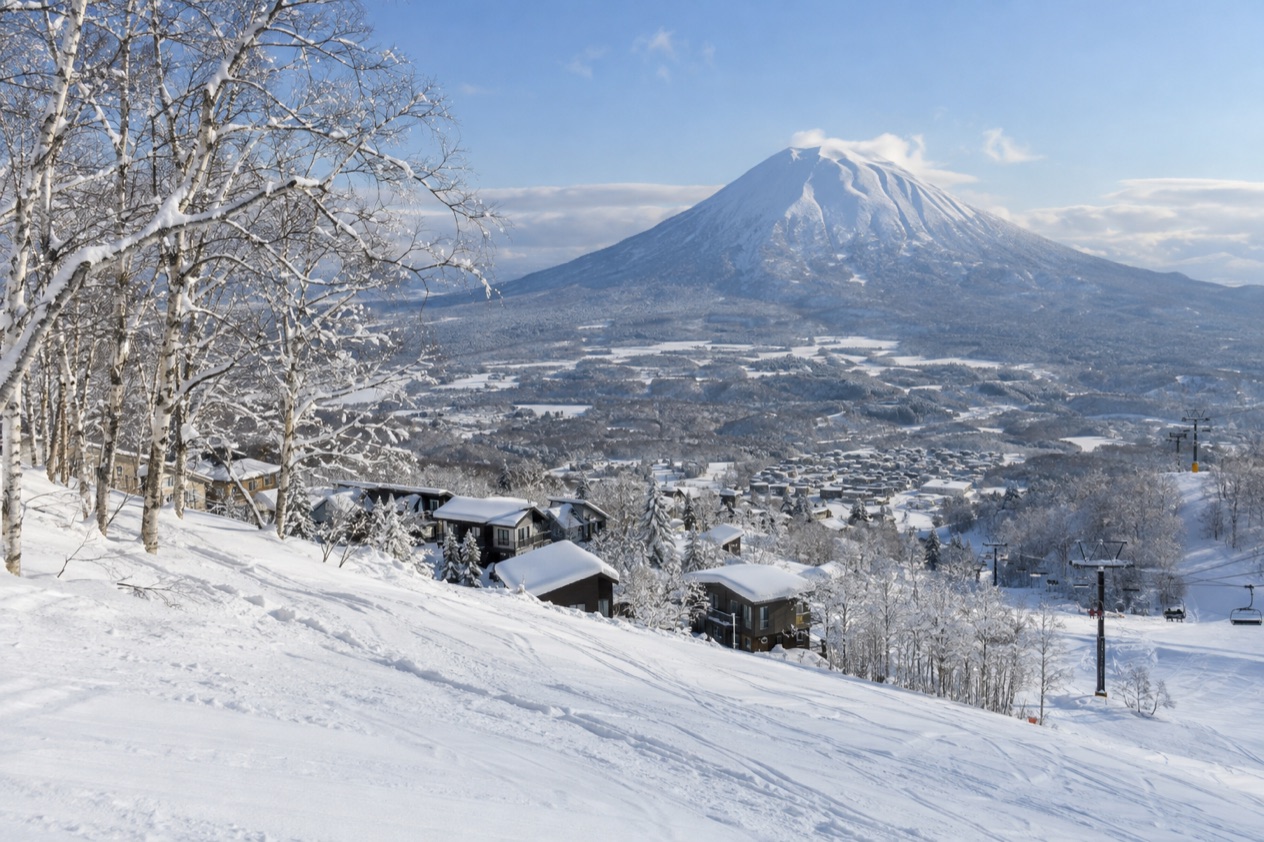
In February, Niseko wakes under a fresh layer of snow, the lifts hum into motion and skiers in bright jackets shuffle toward the gondolas with their boards on their shoulders. Steam rises from outdoor baths, and the streets of the villages are lined with banks of snow taller than a person. This is the heart of the winter season in southwestern Hokkaido, and a month for anyone who comes to Niseko for the slopes and the long, snowy evenings that follow.
What is the weather like in Niseko in February?
February in Niseko is deep winter: cold, snowy and gray for much of the month, with a few bright spells that feel like a gift.
| Month | Average high (°F) | Average low (°F) | Precipitation (in) | Days with 1 mm or more of precipitation | Hours of sunshine | Snowfall (in) | Daylight on the 15th |
|---|---|---|---|---|---|---|---|
| January | 28.4 | 14.7 | 7.26 | 24.5 | 47 | 99.6 | 9 h 21 min |
| February | 30.2 | 15.1 | 5.09 | 21.3 | 65 | 73.6 | 10 h 31 min |
| March | 37.4 | 21.7 | 3.87 | 17.0 | 121 | 48.0 | 11 h 51 min |
Afternoons in February hover just below freezing in the valley, and nights drop well into the teens. Almost everything that falls from the sky is snow, and it falls on most days of the month. Snow or sleet is recorded on 27 days, so gray skies and flurries are the normal backdrop, and the sun appears in short windows rather than long stretches.
Humidity stays high, around 80 percent, which makes the cold feel damp when the wind picks up. Layers matter more than one heavy coat: a warm base, an insulating middle layer and a waterproof shell with a hood for the falling snow. Goggles with a light lens help on the flat-light days, and gloves you can swap when one pair gets wet are worth having.
The light is returning. Daylight stretches past ten and a half hours in the middle of the month, noticeably longer than in January, so the lifts and the après-ski hours both feel less cramped. Evenings still arrive early, and the lit-up slopes and village lanterns carry you into dinner.
What to do in Niseko in February
Skiing and snowboarding are the point of February here. The season generally opens in December and runs to April, and in Hokkaido the peak comes in January and February, when snowfall is most frequent. Niseko is known for its powder snow and its welcoming atmosphere, and it is especially popular with foreign visitors.
Niseko United is described as one mountain with four resorts: Annupuri, Niseko Village, Grand Hirafu and Hanazono. Each has its own base area, its own restaurants and its own feel, and the lifts are linked so you can move between them over a day. Live lift and weather status reports for every resort are on the Niseko United website, handy on mornings when the wind or the snowfall decides which lifts spin.
Skiing the four resorts
Grand Hirafu is the busiest base, with the widest choice of restaurants and bars at the foot of the slopes. Hanazono sits at one end of the area and Annupuri at the other, with Niseko Village in between, so a day can be a slow traverse from one to the next, stopping for hot drinks in the lodges along the way.
Early February is among the periods that draw the largest number of skiers to the slopes in Japan. Lift passes can be bought online on the Niseko United website, which encourages visitors to do so to beat the lines and save money. Fresh snow on a cold morning is the thing people travel here for, and February delivers it often.
Beyond the lifts
Much of the Niseko mountain range lies within the Niseko-Shakotan-Otaru Kaigan Quasi-National Park, and Niseko Annupuri rises to 1,308 meters at the eastern end of the volcanic group. On gray days you see the white slopes dissolve into cloud, and on clear ones the volcanic shape of the range stands out against the sky.
Off the slopes, the evenings belong to hot baths, bowls of ramen and Hokkaido dairy, seafood and potatoes. Izakaya, the casual Japanese pubs, fill with skiers trading stories of the day, and the lanes between the lodges glow under the snow.
February traditions in the north
Setsubun, in early February, marks the turn toward spring. The main ritual is mamemaki: roasted soybeans called fukumame are thrown out the front door or at a family member wearing an oni (demon) mask, with the cry of Oni wa soto! Fuku wa uchi! (Devils out! Fortune in!). Afterward it is customary to eat one bean for each year of your life, plus one extra for luck in the coming year.
The Sapporo Snow Festival is held in the city of Sapporo over seven days in February, at three sites: Odori Park in the center of the city, Susukino and Tsudome. Niseko is a ski area in southwestern Hokkaido, southwest of Sapporo, and by car it is about a three-hour drive from both Sapporo and New Chitose International Airport.
A two-day itinerary for Niseko in February
Day 1 starts with a hearty breakfast and an early walk to the lifts at Grand Hirafu, where the fresh snow is best before the slopes fill. Check the live lift status first, because wind and snowfall decide which upper lifts are running. Spend the morning on the main runs, then stop in a base lodge for a bowl of ramen or curry rice at midday.
In the afternoon, traverse toward Niseko Village and Hanazono, working through the linked resorts at your own pace. Daylight lasts a little over ten hours in mid-February, so plan to be off the mountain as the light fades. Evening is for a soak in a hot bath and dinner at an izakaya in Hirafu.
Day 2 heads to the other end of the mountain: Annupuri, with its own lifts and a different mood from the busy Hirafu base. Ski the morning there, break for lunch in a slopeside restaurant, and spend the afternoon on the runs you skipped the day before.
If the weather turns and the lifts close, February offers plenty of indoor comforts: a long lunch of Hokkaido seafood, a hot spring, or an afternoon in a café watching the snow pile up outside. Finish with a slow dinner and a last bowl of something warm.
Is Niseko busy in February?
Yes, February is the heart of the season. In Hokkaido the peak comes in January and February, when snowfall is most frequent, and early February is one of the periods that draw the largest number of skiers to the slopes in Japan.
Niseko is the most famous ski area in Japan and is especially popular with foreign visitors, so the villages feel international, with a mix of languages in the lifts and the restaurants. The lift lines are part of that picture, which is why the Niseko United website encourages buying passes online.
The pace of the month is lively from the first gondola to the last bar, and the energy of a full season runs through the base areas. Later in the month the mood stays busy but the days grow longer, and the slopes feel a little more open as March approaches.
What to pack for Niseko in February
February in Niseko is cold, damp and snowy, so pack for days on the mountain and evenings in the village.
- A waterproof shell with a hood, because snow falls on most days.
- Warm base layers and an insulating middle layer, for lows well below freezing.
- Goggles with a lens for flat light, since gray skies are common.
- Waterproof gloves, ideally a spare pair, for wet snow.
- Warm socks and boots with a good grip for snowy village lanes.
- A hat and neck warmer for wind on the lifts.
Good to know before you go
February is the middle of the ski season, and weather decides much of the day. The Niseko United website carries live lift and weather status for every resort, and lift passes can be bought online. Heavy snow regularly covers the mountains and northern regions of Japan, so expect the landscape to look quite different from the big cities. Many restaurants and attractions close over the New Year holidays, but by February the season is in full swing and the villages are open for business.
Niseko in February vs January and March
Moving the trip earlier, to January, brings more snow and less daylight. It is the snowiest month of the three, with a little over nine hours of light in the middle of the month, so days on the mountain are shorter and the cold is slightly deeper.
Moving later, to March, brings milder afternoons, more sunshine and longer days, with a little under twelve hours of light in the middle of the month. Snow still falls, but less of it, and the slopes feel more spring-like. Choose January for the deepest winter feel, February for the balance of frequent snow and lengthening days, and March for sunnier skiing in gentler temperatures.
Is February a good time to visit Niseko?
Yes, for anyone who wants to ski or snowboard in the middle of the Hokkaido winter. February sits inside the peak season, when snowfall is most frequent, and the four linked resorts are fully alive.
It suits skiers and snowboarders who like cold, snowy days, a lively international atmosphere and hot baths at night. It is a poorer choice for anyone who wants sunshine, mild afternoons or a quiet village, since gray skies and busy lifts are part of the month.
On arrival, check the live lift status for the resort you plan to ski first, then head up while the snow is fresh. What is special about February in Niseko is the snow itself, falling on most days over a mountain with four resorts, and the bowls of hot food waiting at the end of each one.
Sources
- Japan Meteorological Agency (JMA), Normal values 1991-2020, monthly (https://www.data.jma.go.jp/stats/etrn/view/nml_sfc_ym.php?prec_no=16&block_no=47433), station Kutchan, elevation 176 m, checked October 11, 2026
- Computed from the date and the latitude of the place (sunrise equation, solar elevation -0.833 degrees), October 11, 2026
- Wikipedia, Setsubun (https://en.wikipedia.org/wiki/Setsubun), checked October 11, 2026
- Japan National Tourism Organization, festivals and events (https://www.japan.travel/en/see-and-do/festivals-and-events/), checked October 11, 2026
- Sapporo Snow Festival official website (https://www.snowfes.com/english/), checked October 11, 2026
- Wikipedia, Sapporo Snow Festival (https://en.wikipedia.org/wiki/Sapporo_Snow_Festival), checked October 11, 2026
- Japan National Tourism Organization, winter in Japan (https://www.japan.travel/en/guide/winter-guide/), checked October 11, 2026
- Japan National Tourism Organization, skiing and snowboarding in Japan: regions, resorts, seasons (https://www.japan.travel/en/sports/snow/), checked October 11, 2026
- Wikipedia, Climate of Japan (https://en.wikipedia.org/wiki/Climate_of_Japan), checked October 11, 2026
- Japan National Tourism Organization, flowers by season: cherry blossom, plum, wisteria, hydrangea, where and when (https://www.japan.travel/en/see-and-do/flowers/), checked October 11, 2026
- Wikipedia, Prunus mume (https://en.wikipedia.org/wiki/Prunus_mume), checked October 11, 2026
- Japan National Tourism Organization, skiing guide (https://www.japan.travel/en/guide/skiing/), checked October 11, 2026
- Wikipedia, List of ski areas and resorts in Japan (https://en.wikipedia.org/wiki/List_of_ski_areas_and_resorts_in_Japan), checked October 11, 2026
- Japan National Tourism Organization, weather and seasons in Japan (https://www.japan.travel/en/plan/weather/), checked October 11, 2026
- Niseko United, winter (https://www.niseko.ne.jp/en/winter/), checked October 11, 2026
- Japan National Tourism Organization, Niseko (https://www.japan.travel/en/destinations/hokkaido/hokkaido/niseko-and-nearby-ski-resorts/), checked October 11, 2026
- Wikipedia, Niseko (https://en.wikipedia.org/wiki/Niseko), checked October 11, 2026
- Wikivoyage, Niseko (https://en.wikivoyage.org/wiki/Niseko), checked October 11, 2026