
In the first half of March, burning torches sweep along the wooden balcony of a hall above Todai-ji, and sparks fall into the dark while the deer of Nara Park sleep nearby. The days are cool and brightening, the cherry trees are still bare, and the city feels like it is holding its breath for spring. March is the month to see Nara in the run-up to its blossoms, with temples, shrine paths and deer to yourself in a soft, changeable light.
What is the weather like in Nara in March?
March in Nara is cool and turning milder, with sweater weather in the sun, cold mornings and a rain shower never far away.
| Month | Average high (°F) | Average low (°F) | Precipitation (in) | Days with 1 mm or more of precipitation | Hours of sunshine | Daylight on the 15th |
|---|---|---|---|---|---|---|
| February | 49.8 | 33.8 | 2.48 | 6.9 | 121 | 10 h 55 min |
| March | 57.0 | 38.5 | 4.14 | 9.9 | 158 | 11 h 55 min |
| April | 67.6 | 47.7 | 3.89 | 9.6 | 173 | 13 h 01 min |
The afternoons reach a pleasant, jacket-or-sweater temperature, but the nights still drop close to freezing. Snow or sleet can still turn up on a handful of days, a last reminder of winter, so a hat and gloves are not silly in the first weeks.
Rain comes on roughly one day in three, and it is rarely the heavy, summer kind. Think of gray spells and drizzle that make the temple roofs shine and the gravel paths dark. That is good weather for the wooden halls and the forest, where the air smells of damp cedar and moss, and less pleasant for long stretches in open fields.
The light is the quiet gift of the month. Days are noticeably longer than in February, so you can start late and still finish a temple walk before dusk, and the sun now has some warmth in it. Layers are the answer: a light jacket or sweater over a warmer base layer, an umbrella in the bag, and something warm for the evening lantern-lit hours.
What to do in Nara in March
March in Nara begins with fire. The Omizutori ritual at Todai-ji, held in the first half of the month, is the old rite that Nara people tie to the turning of the season, and locals say spring arrives once it ends. The rest of the month is for walking through the park, the temples and the woods before the blossoms begin, and for eating the small seasonal things that Nara does well.
Omizutori at Todai-ji
Omizutori, also called Shuni-e, is a Buddhist ritual of repentance held at Nigatsu-do, a hall on the hillside within the grounds of Todai-ji. Monks carry great pine torches along the wooden balcony and swing them out over the edge, so embers rain down on the people gathered below. The sound of the chanting and the smell of smoke carry far across the slope.
The fire is the part everyone remembers, but the ritual is much older than the spectacle and continues quietly through the early part of March. The temple itself holds the giant bronze Buddha in its great wooden hall, and the whole complex belongs to the UNESCO listing of Historic Monuments of Ancient Nara.
Smoking and drone photography are prohibited in the precincts, which suits the mood. Afterward, the dark stone lanterns along the slope make a fitting walk back toward the park.
Nara Park and its deer
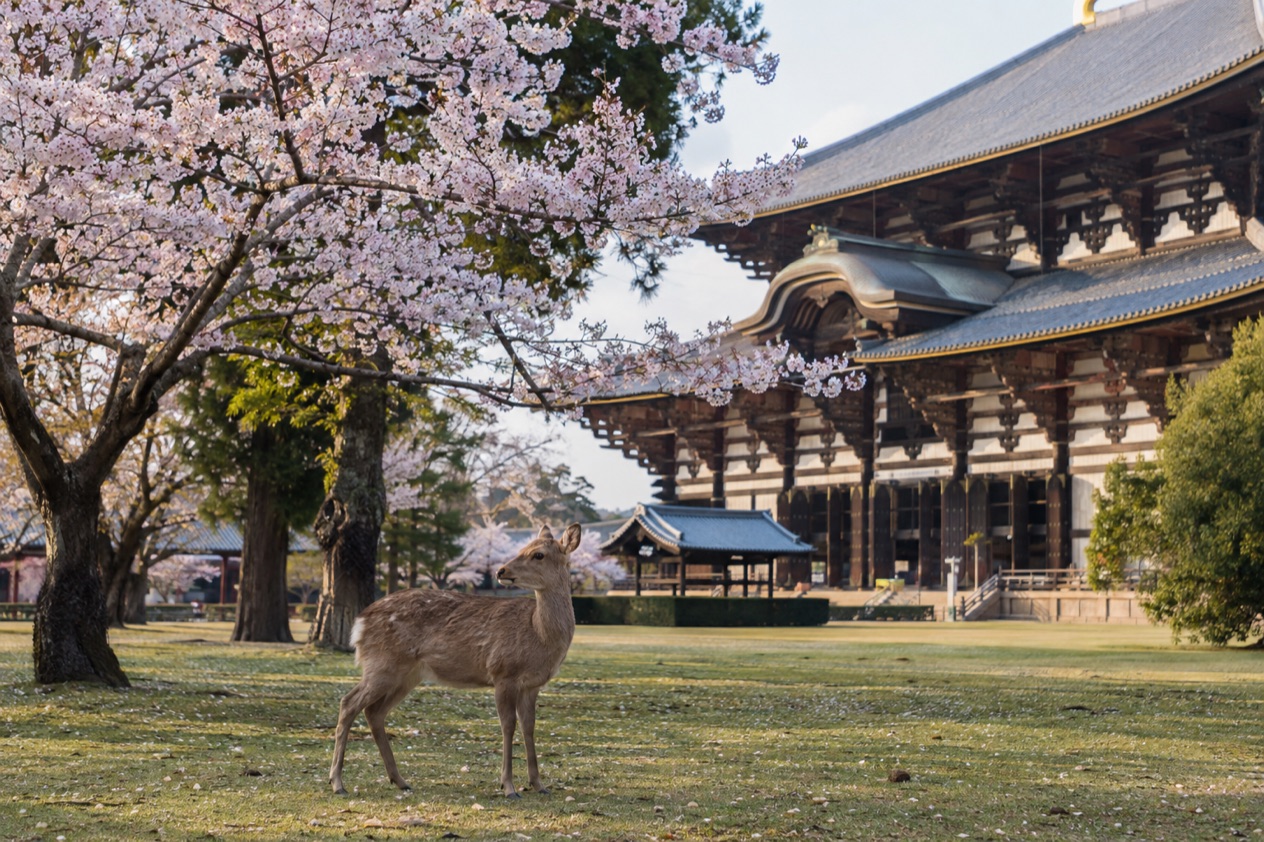
Nara Park spreads across a vast area at the foot of Mount Wakakusa, and the deer wander through it as if they owned it. According to legend, the god of Kasuga Taisha rode a white deer, which is why the animals have protected status as envoys of the god. Special deer crackers are on sale all around the park, and the deer know exactly who holds them.
In March the lawns are still brown and the trees bare, which gives the park a spare, graphic look, with deer silhouetted against pale grass and dark temple roofs. Visitors tend to bow to the deer, and a few of the animals bow back before expecting a cracker. Keep paper and maps in a bag, because the deer will happily eat them.
From Kyoto Station, the JR Rapid Express reaches Nara Station in about 41 minutes, and the Kintetsu Limited Express reaches Kintetsu-Nara Station in about 34 minutes. From Osaka Station, the JR Rapid Express takes about 52 minutes. The Kintetsu limited express from Osaka-Namba costs 520 yen more than the regular express, which takes five minutes longer.
Kasuga Taisha and the primeval forest
Kasuga Taisha is the Shinto shrine tied to the deer legend, and its approach runs beneath old trees and past rows of stone lanterns furred with moss. Kasugayama Primeval Forest, part of the same World Heritage listing, stands behind it. In the damp, gray weather March often brings, the greens look deeper and the vermilion of the shrine buildings stands out sharply.
The shrine suits a day when the showers pass through, since the long tree-lined approach gives the walk its own character even without sun. The sound of dripping branches and the occasional deer crossing the path are part of the experience. This is a place for slow, quiet looking rather than a checklist.
Other temples and the blossom run-up
Beyond the park, Kofuku-ji, Yakushi-ji, Toshodai-ji, Gango-ji, Saidai-ji and the Heijo Palace site all belong to the same UNESCO group, so a March day can be built around any of them. Each has its own character, from the old pagodas to the open grounds of the former palace.
As for blossoms, the cherry trees in Nara usually start to open around the end of March, with full bloom typically falling in early April. In recent years the first flowers have come anywhere from the third week of March to the very last days, and full bloom has ranged from late March to the second week of April. So the end of the month may bring the first pink, but plan the trip around the temples and the deer, not around a promise of flowers.
What to eat in Nara in March
Cool weather suits Nara’s traditional foods. Kakinoha-zushi, pressed sushi wrapped in persimmon leaves, is a local specialty, and narazuke, vegetables pickled in sake lees, appears at many tables. Miwa somen, thin wheat noodles, are good in a warm bowl on a gray day, and chagayu, rice porridge cooked in tea, is an old regional comfort dish.
Sweet shops start putting out spring sweets, including sakura-mochi in pink rice cake wrapped in a salted cherry leaf. Kuzu-based desserts, soft and slightly chewy, pair well with a hot cup of green tea after a morning in the park. Teahouses near the temples are a good place to sit out a shower.
A two-day itinerary for Nara in March
Day 1 is for the park and the great temple. Start with the deer on the park lawns while the morning is still cool, then walk toward Todai-ji for its bronze Buddha and the big wooden hall. With daylight now past eleven and a half hours, there is no need to rush, and a sit-down lunch of noodles or kakinoha-zushi in a small restaurant near the park makes a good midday pause.
In the afternoon, climb up to the hillside hall where the Omizutori torches are lit, and look out over the wooden rooftops. In the first half of March, return after dark to watch the fire if you can. In the evening, look for an izakaya, a casual pub serving small plates, and order something warm.
Day 2 is for Kasuga Taisha and the forest. Walk the long approach under the trees in the morning, between the stone lanterns, and visit the shrine itself. If the rain comes in, the covered halls and the temples around Kofuku-ji are a sensible card to play, followed by a long tea and a sweet at a teahouse.
After lunch, head to Yakushi-ji or Toshodai-ji for a quieter pair of temples, where the old wooden architecture is the draw. Finish the day at the Heijo Palace site, whose open grounds are best seen while the light holds. Dinner can be a bowl of miwa somen or a traditional set meal.
Is Nara busy in March?
March is the lead-in to Nara’s blossom season rather than the season itself, so the city is moving toward its busiest weeks as the month ends. The cherry trees normally open at the very end of March, with full bloom in early April, and that timing shapes the mood.
Early in the month, the park and temples feel like winter’s last chapter, with bare branches and cool air. By the last days, the first pink can appear.
The fire ritual at Todai-ji brings its own attention in the first half of the month, and it is one of the reasons March has a character of its own. Beyond that, the pace is set by the weather. Gray days keep the park quiet and give the deer more room, while a bright afternoon draws people outdoors to the lawns and the shrine paths.
If you are weighing the dates, the blossom timing is the useful signal. The earlier you visit, the more you get the bare, spare Nara of winter’s end. The later you visit, the more you meet the first signs of spring and the busier atmosphere that comes with them.
What to pack for Nara in March
A light jacket or a simple sweater covers much of a spring day in Japan, but Nara’s March calls for a few extras, since nights stay cold and showers come often.
- A warm layer for mornings and evenings, because lows stay near freezing early in the month.
- A light waterproof jacket or compact umbrella for the showers that cross the park.
- Shoes that handle damp paths, since the park and shrine approach are mostly outdoors.
- A hat and light gloves for the first weeks, when snow or sleet can still appear.
- A small bag you can close, because the deer will go after loose paper and snacks.
Good to know before you go
March is outside the typhoon season, but rain still comes on about a third of the days, so a flexible plan helps. Many of Nara’s best sights are outdoors, and the temple grounds and the forest are best on dry spells, while the wooden halls and teahouses fill the wet hours. Smoking and drone photography are prohibited at Todai-ji, and the deer in the park are wild animals protected as envoys of the god, so give them space and feed them only the special crackers sold around the park.
Nara in March vs February and April
Moving four weeks earlier brings colder, shorter days and more snow or sleet, and the park looks at its barest. Rain is lighter, and the sky is often brighter than a gray March afternoon. It suits travelers who want winter stillness and do not mind bundling up. Be aware that the Omizutori ritual begins in early March, so February is before it.
Moving four weeks later brings warmer afternoons, longer light and the cherry blossoms. Full bloom normally falls in early April, and the park and temple grounds shift from bare branches to pink. The rain is about the same, but it feels softer when the air is warm. It suits travelers who want the blossoms and are willing to share the city with others who want the same.
If the fire ritual and the quieter, in-between mood appeal, stay with March. If you hope for flowers above all, aim for the beginning of April. If you want the coldest, starkest version of the old capital, go earlier.
Is March a good time to visit Nara?
Yes, for travelers who like temples, deer and changeable weather more than guaranteed sunshine. March suits people who enjoy a cool walk, a hot bowl of noodles and the sight of a place on the edge of spring. It is less suited to anyone who wants warm afternoons or full cherry blossoms, since those come later.
On arrival, head first for the park and Todai-ji, where the deer and the great hall set the tone. Then add Kasuga Taisha and the forest path on a dry spell, and keep the teahouses and indoor halls for the rainy hours. If you are there in the first half of the month, look for the evening torches at Nigatsu-do.
What makes March in Nara its own is the in-between feeling. The fire festival marks the end of winter, the light grows longer, and the first cherry buds hint at what is coming, all while the deer wander under bare trees.
Sources
- Japan Meteorological Agency (JMA), Normal values 1991-2020, monthly (https://www.data.jma.go.jp/stats/etrn/view/nml_sfc_ym.php?prec_no=64&block_no=47780), station Nara, elevation 102 m, checked October 11, 2026
- Computed from the date and the latitude of the place (sunrise equation, solar elevation -0.833 degrees), October 11, 2026
- Japan Meteorological Agency, cherry blossom first-bloom dates 2021-2026 and 1991-2020 normal (https://www.data.jma.go.jp/sakura/data/sakura003_07.html), checked October 11, 2026
- Japan Meteorological Agency, cherry blossom full-bloom dates 2021-2026 and 1991-2020 normal (https://www.data.jma.go.jp/sakura/data/sakura004_07.html), checked October 11, 2026
- Japan Meteorological Agency, sakura2020.pdf (https://www.data.jma.go.jp/sakura/data/sakura2020.pdf), checked October 11, 2026
- Japan National Tourism Organization, flowers by season: cherry blossom, plum, wisteria, hydrangea, where and when (https://www.japan.travel/en/see-and-do/flowers/), checked October 11, 2026
- Wikipedia, Prunus mume (https://en.wikipedia.org/wiki/Prunus_mume), checked October 11, 2026
- Japan National Tourism Organization, spring in Japan (https://www.japan.travel/en/guide/spring-guide/), checked October 11, 2026
- Japan National Tourism Organization, autumn in Japan (https://www.japan.travel/en/guide/autumn-guide/), checked October 11, 2026
- Japan National Tourism Organization, summer in Japan (https://www.japan.travel/en/guide/summer-guide/), checked October 11, 2026
- Official Nara Travel Guide, Nara Park area (https://www.visitnara.jp/destinations/area/nara-park/), checked October 11, 2026
- Official Nara Travel Guide, travel to Nara (https://www.visitnara.jp/travel-to-nara/), checked October 11, 2026
- Wikipedia, Nara, Nara (https://en.wikipedia.org/wiki/Nara,_Nara), checked October 11, 2026
- Wikivoyage, Nara (https://en.wikivoyage.org/wiki/Nara), checked October 11, 2026
- Japan National Tourism Organization, Nara (https://www.japan.travel/en/destinations/kansai/nara/nara-park-and-around/), checked October 11, 2026
- Todai-ji Temple, official site (https://www.todaiji.or.jp/en/), checked October 11, 2026
- Wikipedia, Tōdai-ji (https://en.wikipedia.org/wiki/T%C5%8Ddai-ji), checked October 11, 2026
- Wikipedia, Nara Park (https://en.wikipedia.org/wiki/Nara_Park), checked October 11, 2026
- Wikipedia, Kasuga-taisha (https://en.wikipedia.org/wiki/Kasuga-taisha), checked October 11, 2026