
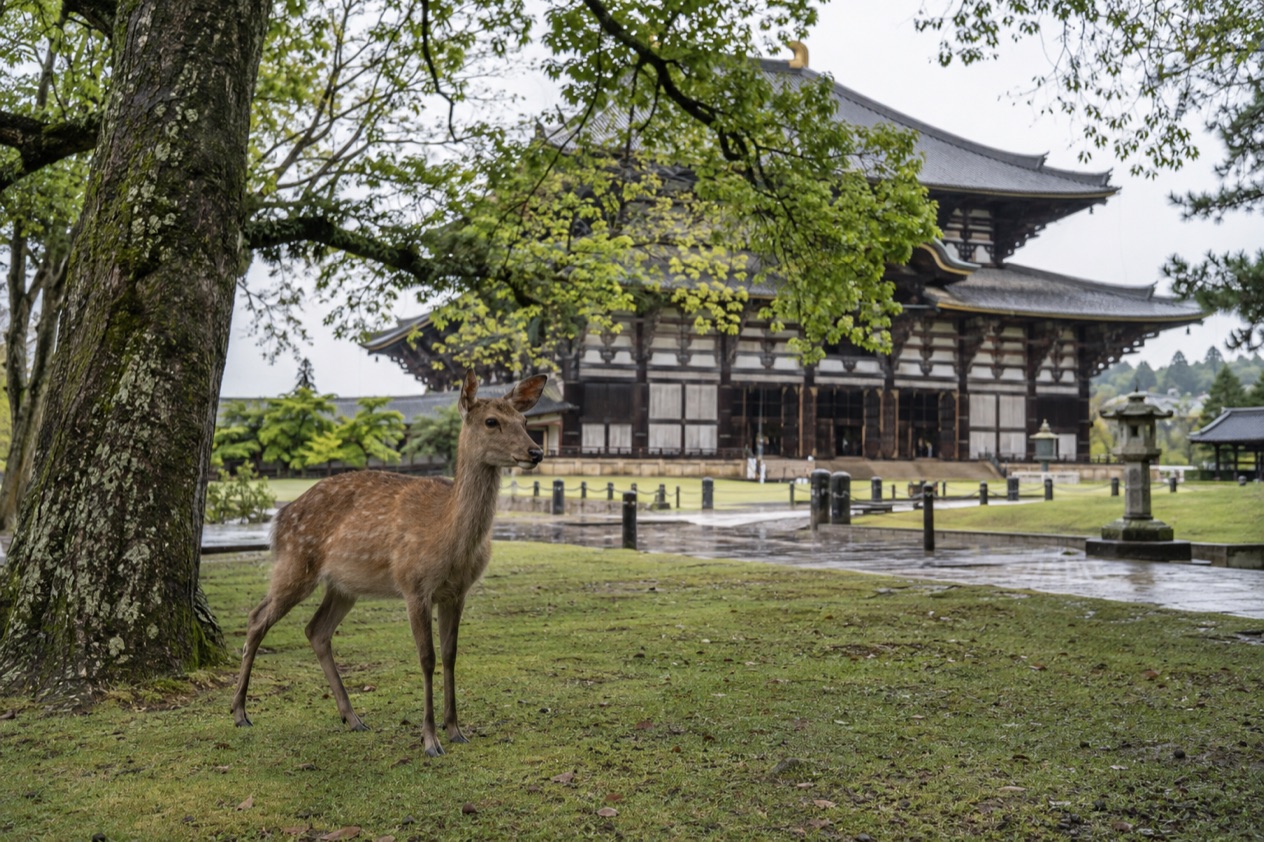
In June, the stone lanterns along the paths of Nara Park wear a coat of green moss, the air smells of wet cedar, and deer step out of the trees to look for anyone holding a cracker. Temple roofs shine dark after a shower and the lawns turn a deeper green. This is Nara in its humid, leafy season, a month for the great wooden halls, the shaded forest paths and slow days around the old capital.
What is the weather like in Nara in June?
June in Nara is warm, damp and noticeably more humid than May, with rain on roughly every third day and the heat of high summer still a few weeks off.
| Month | Average high (°F) | Average low (°F) | Precipitation (in) | Days with 1 mm or more of precipitation | Hours of sunshine | Daylight on the 15th |
|---|---|---|---|---|---|---|
| May | 76.8 | 57.0 | 5.45 | 10.0 | 188 | 13 h 57 min |
| June | 82.6 | 65.1 | 7.25 | 11.7 | 139 | 14 h 28 min |
| July | 89.1 | 73.4 | 6.83 | 11.2 | 157 | 14 h 17 min |
Afternoons feel like a warm summer day, and the nights no longer cool off the way they did in spring. Humidity sits around seventy percent, which is why a walk across Nara Park can leave you damp even under cloud. Light cotton or linen shirts do better here than anything heavy, and a thin layer is only useful for air-conditioned halls, trains and museums.
June is the wettest of the three months in the table, and it is also the one with the fewest hours of sun. Rain can come as a gray, drizzly day or as a heavier shower that passes through, so a compact umbrella or a light rain jacket belongs in the day bag. The sunniest stretches of the year are behind you, which also means the light is often soft and flat, kind to photos of moss, wet stone and temple wood.
Days are long. Daylight stretches well into the evening, so you can still be strolling the lantern-lined paths or sitting over dinner in town long after the afternoon heat has eased. With the sun up early, a day of temple-hopping has plenty of room for a break in an air-conditioned café when the humidity becomes tiring.
What to do in Nara in June
Nara in June is about green things and damp things: moss on stone, big trees in the rain, deer on wet lawns, and a historic center whose main attractions are mostly wooden halls with deep roofs. Nara is an ancient capital, and eight places here are inscribed together as the Historic Monuments of Ancient Nara, a UNESCO World Heritage Site since 1998. Five Buddhist temples, one Shinto shrine, an imperial palace site and a primeval forest make up that list.
Getting here is part of the pleasure. From Kyoto Station, the JR Rapid Express reaches Nara Station in about 41 minutes, while the Kintetsu Limited Express to Kintetsu-Nara Station takes about 34. From Osaka Station, the JR Rapid Express takes about 52 minutes. Once in the city, the Gurutto buses in Nara City cost 100 yen per trip, and Nara Kotsu runs a wider bus network out to places the trains do not serve.
Nara Park and the deer
Nara Park lies at the foot of Mount Wakakusa, and its deer are the first thing most people meet. They are tame, and visitors can approach them and feed them with crackers sold along the roadside. According to legend, the god of Kasuga Taisha rode a white deer, which is why the animals are treated as envoys of the god and protected.
In June the park is lush. The grass is long and bright, the old trees are in full leaf, and in the humid air the deer tend to gather in the shade of the trees.
Expect the crackers to draw a small crowd of insistent animals within seconds, and expect a bow or two before they get what they want. Keep your umbrella and your paper map in a bag, since a hungry deer will happily test both.
The park suits slow wandering with no fixed plan, and it joins the major sights together. A light rain does not spoil it, since the trees give cover and the paths stay quiet underfoot. Pair it with a stop at one of the nearby tea shops for a cold drink once the humidity builds.
Todai-ji and the great Buddha
Todai-ji is the temple the city is built around in most people’s minds. Its main hall is the largest wooden building in the world, and it houses the world’s largest bronze Buddha statue. Seeing both under a gray June sky is memorable, because the dark timbers and heavy roof seem to absorb the damp light.
The hall is big enough that a rain shower is a good excuse to spend extra time inside, looking up at the Buddha and at the scale of the beams. Outside, the approach is lined with tame deer and souvenir stalls. A visit pairs well with a wander through the park before or after, so you can alternate shelter and open air as the weather changes.
Kasuga Shrine and Kasugayama Primeval Forest
Kasuga Shrine is the Shinto shrine among Nara’s World Heritage monuments, and it stands beside Kasugayama Primeval Forest, which is also inscribed. The approach runs under tall trees past rows of stone lanterns, and in June the moss on them is at its thickest and brightest.
The shrine’s connection to the deer is part of the story, since the white deer of legend carried its god. A walk here is as much about the surroundings as the buildings: the forest, the sound of rain in the canopy, the damp smell of cedar and earth. In a humid month, the tree cover is welcome.
Other World Heritage temples
Beyond the park, the list includes Kofuku-ji, Saidai-ji, Gango-ji, Yakushi-ji, Toshodai-ji and the Heijo Palace site. Each has its own character, from pagodas and old temple halls to the open ground of a former imperial palace. Nara Kotsu buses and Gurutto buses help reach the ones that are spread out across the city.
June suits the temple circuit well because many of the sights are covered halls and corridors that make a good shelter when the sky opens. Spacing the visits across a couple of days, with a cool drink between them, keeps the humidity from wearing you down. The palace site is more open than the temples, so save it for a drier spell if you can.
Food and drink for a humid month
Nara has its own table. Kakinoha-zushi is sushi pressed and wrapped in persimmon leaves, a local classic that is pleasant to eat cold, and narazuke are the pickles the city is known for, often served with rice. Cold somen noodles from nearby Miwa also suit the weather.
For a sweet stop, shaved ice with syrup and cold green tea are good against the damp heat. Hydrangeas are native to Japan, and ama-cha, meaning sweet tea, is an herbal tea made from Hydrangea serrata, whose leaves develop a sweet taste. If a tea shop offers it, it makes a quiet June souvenir of a drink.
A two-day itinerary for Nara in June
Day 1 belongs to the park and its big names. Start with Nara Park in the morning, meeting the deer on the lawns and picking up crackers from a roadside seller. Continue to Todai-ji for the great hall and its Buddha, which makes a good indoor stop if the first shower arrives. Break for lunch in town, with kakinoha-zushi or a bowl of cold noodles.
In the afternoon, walk the lantern-lined approach to Kasuga Shrine and on into the edge of Kasugayama Primeval Forest, where the tree cover helps against the humidity. Because June days are long, there is still daylight left for a slow return through the park. Dinner can be a simple set meal in a restaurant in the old streets, with Nara pickles on the side.
Day 2 turns to the other heritage sites. Begin with Kofuku-ji in the center, then continue to Yakushi-ji and Toshodai-ji, using the Gurutto buses at 100 yen per trip or a Nara Kotsu bus to link them. Lunch can be a café stop to get out of the damp, ideally with a cold sweet tea.
Spend the afternoon at the Heijo Palace site and, if time allows, Saidai-ji and Gango-ji. If heavy rain sets in, give the temple halls more time and the palace grounds less, and finish at a covered shopping street for a last bag of narazuke before the train back to Kyoto or Osaka.
Is Nara busy in June?
June in Nara is shaped more by the weather than by a famous bloom or a big festival. The cherry trees belong to spring and the cooler, drier months, so the month does not carry a headline spectacle of its own.
What sets the pace is humidity and rain. Sunshine drops to its lowest of the three months, and the days are long, so the city tends to move at an unhurried rhythm, with many visitors ducking into temple halls when it rains and returning to the paths when it clears. Nara’s main sights are close together around the park, and the deer remain the main attraction, whatever the weather.
If you want a calmer rhythm, spread the visits across two days and mix covered temple halls with open-air walks. Mornings and evenings are for the park, while the heat of the day can go to a café or a long lunch. Rain adds atmosphere to the temples and the forest, and it gives the moss its brightest color.
What to pack for Nara in June
Pack for warm, damp days and quick showers, with clothes that dry fast and shoes that can handle wet paths and lawns.
- A compact umbrella or light rain jacket, for the showers that pass through on roughly every third day.
- Light, breathable cotton or linen clothes, because the humidity makes heavier fabrics feel sticky.
- Shoes with good grip that can get wet, since park paths and temple steps turn slick in rain.
- A thin layer for air-conditioned trains and halls, which feel cool after the damp outdoors.
- A small towel or handkerchief, for the humidity and for wiping off after a shower.
- A bag with a zip, to keep maps and cameras safe from the rain and from curious deer.
Good to know before you go
June in Nara is humid and warm, and the Honshu summer is known for being hot and sultry, so plan your days around the heat and keep a flexible indoor option for rainy hours. The Kintetsu Railway and West Japan Railway (JR West) operate rail service throughout Nara, and Nara Kotsu buses reach places the trains do not. The Gurutto buses in Nara City cost 100 yen per trip, which suits hopping between the central sights.
From Osaka-Namba Station, the Kintetsu limited express reaches Kintetsu Nara Station in 35 minutes and costs 520 yen more than the regular express, which takes 5 minutes longer. Tame deer roam the park, so keep snacks and paper out of sight until you are ready to feed them.
Nara in June vs May and July
Moving the trip to May brings cooler days and clearer skies. May has the most sunshine of the three months and noticeably less rain, so walking the park and the forest is more comfortable, and the light is brighter for photographs. The trade is that the lush, mossy atmosphere of June is only starting to build.
Moving to July brings more heat. Highs climb well into the upper 80s, nights stay warm, and the humidity is just as present. Rain is a little less than in June, but the temperature makes long outdoor days more tiring, so July suits travelers who plan around indoor halls and early or late walks.
Choose May if you want to walk a lot and prefer brighter, drier weather. Choose June if you like soft light, green scenery and do not mind carrying an umbrella. Choose July if you accept the heat and want the longest stretch of summer.
Is June a good time to visit Nara?
Yes, for travelers who enjoy greenery, wooden temples and a slower pace, and who are happy to plan around showers. June suits anyone who likes moss, damp stone and the soft light of an overcast day, and who does not need a bright blue sky for a good trip.
It is a harder fit for those who want dry, cool weather for long outdoor walks, or who dislike humidity. They may prefer the clearer skies of an earlier month. If you come, begin with Nara Park and Todai-ji, since the deer, the great Buddha and the lantern-lined paths set the tone for everything else. What stays with you from June here is the green: deer on dripping lawns, a cedar-scented path to Kasuga Shrine, and a huge wooden hall glowing dark under the rain.
Sources
- Japan Meteorological Agency (JMA), Normal values 1991-2020, monthly (https://www.data.jma.go.jp/stats/etrn/view/nml_sfc_ym.php?prec_no=64&block_no=47780), station Nara, elevation 102 m, checked October 11, 2026
- Computed from the date and the latitude of the place (sunrise equation, solar elevation -0.833 degrees), October 11, 2026
- Japan National Tourism Organization, weather and seasons in Japan (https://www.japan.travel/en/plan/weather/), checked October 11, 2026
- Wikipedia, Climate of Japan (https://en.wikipedia.org/wiki/Climate_of_Japan), checked October 11, 2026
- Japan National Tourism Organization, flowers by season: cherry blossom, plum, wisteria, hydrangea, where and when (https://www.japan.travel/en/see-and-do/flowers/), checked October 11, 2026
- Wikipedia, Hydrangea (https://en.wikipedia.org/wiki/Hydrangea), checked October 11, 2026
- Japan National Tourism Organization, summer in Japan (https://www.japan.travel/en/guide/summer-guide/), checked October 11, 2026
- Official Nara Travel Guide, travel to Nara (https://www.visitnara.jp/travel-to-nara/), checked October 11, 2026
- Wikipedia, Nara, Nara (https://en.wikipedia.org/wiki/Nara,_Nara), checked October 11, 2026
- Wikivoyage, Nara (https://en.wikivoyage.org/wiki/Nara), checked October 11, 2026
- Japan National Tourism Organization, Nara (https://www.japan.travel/en/destinations/kansai/nara/nara-park-and-around/), checked October 11, 2026
- Official Nara Travel Guide, getting around Nara (https://www.visitnara.jp/getting-around-nara/), checked October 11, 2026