
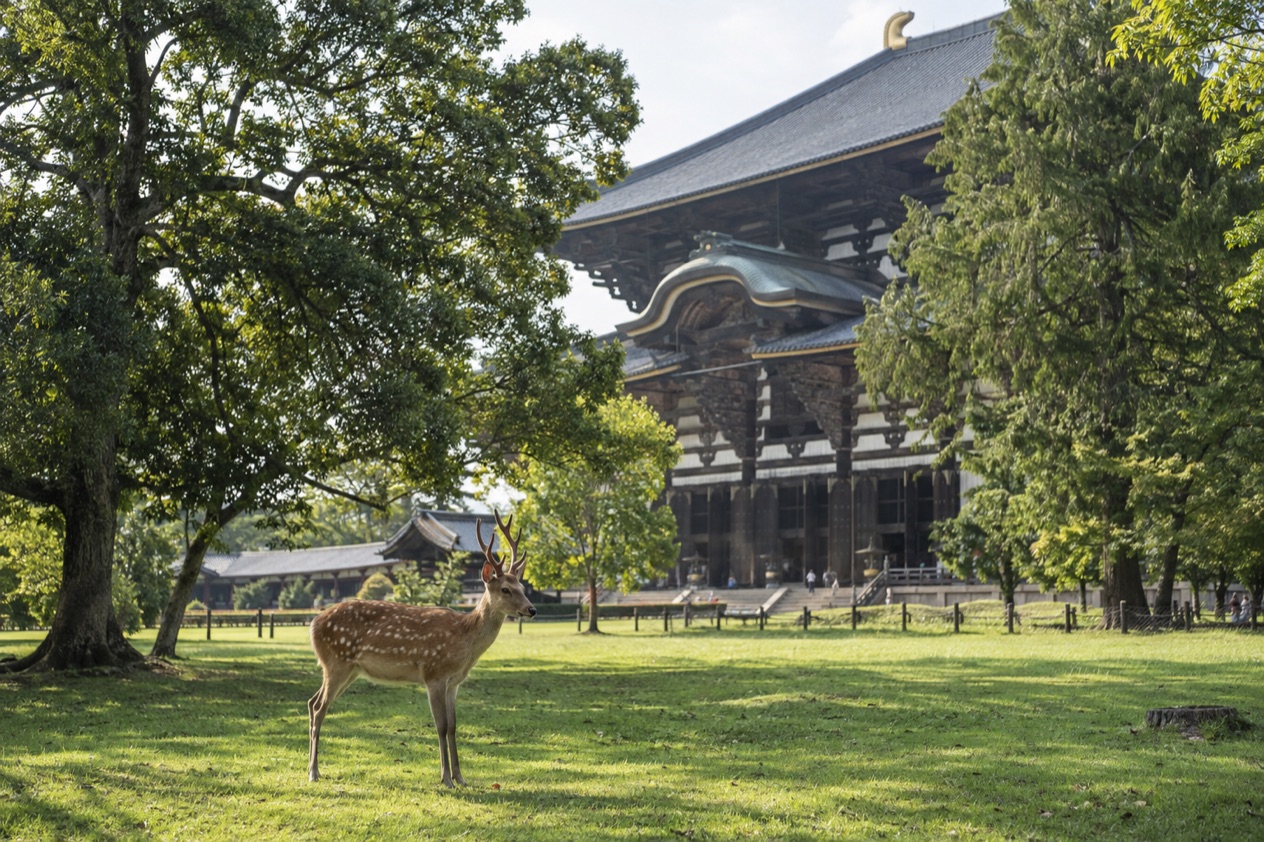
In July the deer of Nara Park lie in the grass under the trees, and the cicadas drone so loudly that the temple bells seem to come from far away. Shaved ice is sold in stalls beside the paths, and the big wooden halls give off a smell of warm timber and incense. This is Nara in high summer: hot and humid, green all around, and still a city where you spend the day among temples, a shrine and a forest that belong to the old capital.
What is the weather like in Nara in July?
July in Nara is hot, humid and often sticky, with afternoons well into the upper 80s and nights that hardly cool off.
| Month | Average high (°F) | Average low (°F) | Precipitation (in) | Days with 1 mm or more of precipitation | Hours of sunshine | Daylight on the 15th |
|---|---|---|---|---|---|---|
| June | 82.6 | 65.1 | 7.25 | 11.7 | 139 | 14 h 28 min |
| July | 89.1 | 73.4 | 6.83 | 11.2 | 157 | 14 h 17 min |
| August | 92.1 | 75.4 | 5.04 | 8.0 | 203 | 13 h 30 min |
Humidity hangs around 71 percent, which is why a July day in Nara feels warmer than the thermometer suggests. Honshu summers are described as very humid, hot and sultry, and Nara fits that picture. Light, breathable clothes that dry fast are the sensible choice, and a small towel or handkerchief in the pocket becomes part of the outfit.
Rain falls on roughly one day in three, and the month is a little drier than June. Plan on an umbrella or a light rain jacket in the bag rather than a full wet-weather wardrobe, since showers come and go between sunnier stretches. The month brings a fair amount of sun, so a hat and sunglasses belong in the bag next to the umbrella.
The light stays long at both ends of the day, giving you a generous stretch of daylight for sightseeing and an evening that remains bright well after dinner is on your mind. Nights are warm enough that a sweater is not needed outdoors, though temples and museums with air conditioning can feel cool after the heat outside.
What to do in Nara in July
The great pleasure of Nara in July is how much of it happens outdoors among old trees, with big halls to step into when the sun gets heavy. The city was Japan’s first capital, at Heijokyo, and that long history shows in its temples, its shrine and the park where wild deer wander. Three World Heritage sites sit in and around the city, so you never run short of things to see.
July does not bring a big local festival to Nara itself that we can pin down, so the month is about the sights, the food and the pace of a summer walk. Kyoto, though, holds the Gion Festival through July, and its two processions of floats, the Yamaboko Junko, take place on July 17 and 24. It is described as one of the largest and most famous festivals in Japan, and Kyoto is a train ride from Nara: about 34 minutes from Kyoto Station to Kintetsu-Nara Station on the Kintetsu Limited Express, or about 41 minutes to Nara Station on the JR Rapid Express.
Nara Park and the deer
Nara Park is a vast stretch of lawns, ponds, stone lanterns and tree-lined paths at the foot of Mount Wakakusa, and it is where the free-roaming deer live. According to legend, the god of Kasuga Taisha rode a white deer, which is why the animals are treated as envoys of the god and enjoy protected status. In July the deer often rest in the grass or under the trees, and the green is at its deepest.
Special deer crackers are on sale all around the park, and feeding them is part of the ritual. The deer know exactly what the little stacks of crackers mean, and they will bow, nudge and follow you for one. Take your time on the paths, keep food out of sight until you are ready, and treat the animals as the wild creatures they are.
Around the park you will find tea stalls and shops selling cold drinks, and benches where you can sit out the hottest hours.
Todai-ji and the Great Buddha
Todai-ji is a Buddhist temple complex in the city, and its main hall is described as the largest wooden building in the world. Inside sits the Great Buddha, a bronze statue 15 meters high, and it is described as the largest bronze Buddha statue in the world. Standing before it, you notice first the scale of the hands and the calm face, then the way the hall swallows the sound of other visitors.
A July visit suits the temple well, because the hall gives you a roof over your head when the afternoon turns sultry or a shower arrives. Smoking and drone photography are prohibited in the precincts. Before or after the hall, the approach through the gate is lined with greenery and, usually, a few deer.
Kasuga Taisha and the primeval forest
Kasuga Taisha is a Shinto shrine in Nara, reached by a path under tall trees and lined with stone lanterns that gather moss in the humid weather. The wooded slopes behind belong to Kasugayama Primeval Forest, which is part of the World Heritage listing together with the shrine. The green is dense in July, and the sound of cicadas fills the walk.
The shrine’s vermilion buildings stand out against that green, and the lanterns, hundreds of them, give the path its character. This is the place to slow down and look at details: the carved fittings, the offering boxes, the deer standing at the edge of the trees. Eight places in Nara have been inscribed as Historic Monuments of Ancient Nara since 1998, and the shrine and the forest are among them.
Temples of the old capital
Beyond the park, the same World Heritage listing covers Kofuku-ji, Saidai-ji, Gango-ji, Yakushi-ji, Toshodai-ji and the Heijo Palace site, where Japan’s first capital once stood. Each temple has its own halls, gardens and atmosphere, and they reward a slower pace than the park does. In summer, the gardens are green and the old timber halls give you a cool step out of the sun.
The open grounds of the Heijo Palace site give a sense of how wide the old capital was, with reconstructed buildings rising from grass. Yakushi-ji and Toshodai-ji sit close to each other, which makes them a natural pairing for a day built around temples rather than the park.
Eating in Nara in summer
July is a month for cold, light food. Somen, the thin wheat noodles served chilled with a dipping sauce, suit the heat, and Nara’s Miwa area is known for them. Kakinoha-zushi, sushi wrapped in persimmon leaves, is a local specialty that travels well in a bento. Shaved ice with syrup is sold at tea stalls, and cold green tea is easy to find.
Kuzu, a starch from the kudzu root, turns into silky sweets that feel right on a humid afternoon, and narazuke, vegetables pickled in sake lees, is a salty counterpoint at the table. Evenings are warm enough for a cold drink at an izakaya, the casual pub where small dishes arrive one after another.
A two-day itinerary for Nara in July
Day 1 belongs to Nara Park. Start at the park’s edge with the deer, then follow the paths to Todai-ji and the Great Buddha, which fills the middle of the day inside the big hall. Lunch can be chilled somen or a bento with kakinoha-zushi at a restaurant near the park.
In the afternoon, walk the lantern-lined approach to Kasuga Taisha and into the edge of Kasugayama Primeval Forest. With daylight lasting more than fourteen hours, you can stretch the walk and still be back at the park for a last look at the deer. Dinner might be at an izakaya, and shaved ice or kuzu sweets make a good finish. If it rains, spend more time under the roof of the Great Buddha Hall.
Day 2 moves to the temples farther out. Begin with Kofuku-ji, then take in Yakushi-ji and Toshodai-ji, which sit close together, with their gardens and old halls as a cool contrast to the heat outside. Lunch can be noodles at a small restaurant in the area.
In the afternoon, visit the Heijo Palace site and Saidai-ji, saving the open grounds of the old capital for when the day has softened a little. In the evening, try a pickle-and-sake tasting or a tea stall for kuzu. If rain sets in, the temple halls and the museum-like interiors of the older buildings give you shelter.
Is Nara busy in July?
July in Nara is a hot, humid month, and the main factor shaping your day is the weather rather than a festival rush. There is no Nara festival in the month that we can point to, while Kyoto draws attention with the Gion Festival and its processions on July 17 and 24.
The city’s attractions remain the same in summer: the park, the temples, the shrine. They are the symbols of Nara, and the deer are there in every season. What changes is the pace you set, since heat and humidity ask for a slower walk with pauses in the shade and a cold drink when you want one.
If you plan around Kyoto in the second half of the month, Nara fits as a separate day, with the train covering the distance in well under an hour. A day in Nara would then be a calm contrast to the festival crowds in Kyoto, built around green lawns and wooden halls instead of floats.
What to pack for Nara in July
Pack for heat, humidity and the occasional shower, with comfortable shoes for the park paths and temple floors.
- Light, breathable clothes that dry fast, because humidity stays high all month.
- A compact umbrella or light rain jacket for the showers.
- A hat and sunglasses for the sunny stretches in the open park.
- Comfortable shoes you can slip off easily, since shoes come off at the entrance of some temple halls.
- A small towel or handkerchief for wiping off sweat.
- A refillable water bottle for long walks between sights.
Good to know before you go
July in Nara is hot and sultry, and the rainfall is similar to June, so it helps to build the day around outdoor stretches and indoor halls. Smoking and drone photography are prohibited in the precincts of Todai-ji. The deer are protected and move freely, so keep your food out of sight and treat them with care, especially when you hold the special crackers sold around the park.
From Kyoto, the JR Rapid Express reaches Nara Station and the Kintetsu Limited Express reaches Kintetsu-Nara Station. From Osaka Station, the JR Rapid Express to Nara Station takes about 52 minutes.
Nara in July vs June and August
Moving the trip four weeks earlier brings you to June, which is cooler, with lows that feel noticeably milder and fewer hours of sun. It is also the wettest of the three months, so the park is at its greenest but umbrellas stay in your hand more often. Kyoto’s Gion Festival has not yet reached its processions, so a June trip does not fall in the Gion window.
Going four weeks later puts you in August, which is the hottest and sunniest of the three, with the least rain. The heat is stronger and the days shorter, and the walks between temples take more out of you. Sendai holds its Tanabata Festival in the first days of August, but that is in a different city.
July sits between the two, hot but with a little more rain than August and a little more daylight. Travelers who want the Gion processions in Kyoto and a day trip to Nara should stay in July. Those who dislike rain may prefer August, and those who want gentler temperatures should look at June.
Is July a good time to visit Nara?
Yes, for travelers who do not mind heat and humidity and who enjoy long, green days among temples, a shrine and free-roaming deer. If you wilt in sticky weather or want cool temperatures for walking, another month will suit you better.
July works best for people who like to start with the park, stop for cold noodles or shaved ice, and use the big halls as shelter when the sun or rain gets strong. Those who plan to see Kyoto’s Gion processions can add Nara as a separate day.
On arrival, head first for Nara Park and the Great Buddha, then spread the rest across the lantern-lined path to Kasuga Taisha and the temples of the old capital. What stays with you from July in Nara is the dense green of Kasugayama, the cicadas, and the deer lying in the grass beside a hall that has stood there for centuries.
Sources
- Japan Meteorological Agency (JMA), Normal values 1991-2020, monthly (https://www.data.jma.go.jp/stats/etrn/view/nml_sfc_ym.php?prec_no=64&block_no=47780), station Nara, elevation 102 m, checked October 11, 2026
- Computed from the date and the latitude of the place (sunrise equation, solar elevation -0.833 degrees), October 11, 2026
- Japan National Tourism Organization, weather and seasons in Japan (https://www.japan.travel/en/plan/weather/), checked October 11, 2026
- Wikipedia, Climate of Japan (https://en.wikipedia.org/wiki/Climate_of_Japan), checked October 11, 2026
- Japan National Tourism Organization, summer in Japan (https://www.japan.travel/en/guide/summer-guide/), checked October 11, 2026
- Japan National Tourism Organization, festivals and events (https://www.japan.travel/en/see-and-do/festivals-and-events/), checked October 11, 2026
- Wikipedia, Hanabi (https://en.wikipedia.org/wiki/Hanabi), checked October 11, 2026
- Wikipedia, Gion Matsuri (https://en.wikipedia.org/wiki/Gion_Matsuri), checked October 11, 2026
- Japan National Tourism Organization, Mount Fuji guide (https://www.japan.travel/en/fuji-guide/), checked October 11, 2026
- Official website for Mt. Fuji climbing, about the climb (https://www.fujisan-climb.jp/en/about/), checked October 11, 2026
- Wikipedia, Tanabata (https://en.wikipedia.org/wiki/Tanabata), checked October 11, 2026
- Official Nara Travel Guide, first-time visitors (https://www.visitnara.jp/for-first-time-visitor/), checked October 11, 2026
- Official Nara Travel Guide, Nara Park area (https://www.visitnara.jp/destinations/area/nara-park/), checked October 11, 2026
- Official Nara Travel Guide, travel to Nara (https://www.visitnara.jp/travel-to-nara/), checked October 11, 2026
- Wikipedia, Nara, Nara (https://en.wikipedia.org/wiki/Nara,_Nara), checked October 11, 2026
- Wikivoyage, Nara (https://en.wikivoyage.org/wiki/Nara), checked October 11, 2026
- Todai-ji Temple, official site (https://www.todaiji.or.jp/en/), checked October 11, 2026
- Wikipedia, Tōdai-ji (https://en.wikipedia.org/wiki/T%C5%8Ddai-ji), checked October 11, 2026
- Wikipedia, Nara Park (https://en.wikipedia.org/wiki/Nara_Park), checked October 11, 2026
- Wikipedia, Kasuga-taisha (https://en.wikipedia.org/wiki/Kasuga-taisha), checked October 11, 2026