
On the first mornings of January, families in their best coats walk the long approach to Kasuga-taisha for the year’s first shrine visit, past rows of stone lanterns and deer whose breath hangs in the cold air. Bowls of ozoni, the New Year rice-cake soup, steam in kitchens around town, and the bare branches of Nara Park let the temple roofs show through. January in Nara is a month of New Year customs, a hillside set alight and sightseeing in a good coat, for travelers who like their temples without leaves or blossoms.
What is the weather like in Nara in January?
January is the coldest of the three winter months in Nara, cold enough for a proper coat and a scarf, with modest rain and a fair share of winter sun.
| Month | Average high (°F) | Average low (°F) | Precipitation (in) | Days with 1 mm or more of precipitation | Hours of sunshine | Daylight on the 15th |
|---|---|---|---|---|---|---|
| December | 52.9 | 37.4 | 2.24 | 6.6 | 133 | 9 h 51 min |
| January | 47.7 | 33.4 | 2.06 | 6.2 | 118 | 10 h 04 min |
| February | 49.8 | 33.8 | 2.48 | 6.9 | 121 | 10 h 55 min |
In practice, afternoons stay in the upper 40s, which suits walking from one temple to the next as long as you dress in layers: a thermal base, a sweater, a coat that blocks wind. Mornings and evenings drop to around freezing, and stone paths under old cedars feel colder than the thermometer says. Gloves and a hat earn their place in the bag.
Rain falls on about six days of the month, usually as a gray, drizzly stretch rather than a downpour, so a compact umbrella or a light waterproof shell is enough. Snow or sleet is recorded on more than eleven days. The total is tiny, less than half an inch, so think flurries that melt on the pavement, though a dusting on the roof of a temple hall is something you may see.
Sunshine is a little scarcer than in December, and daylight is only just beginning to stretch back out. Plan your outdoor stops with the clock in mind, and keep a museum or a covered arcade in reserve for the grayest hours. Humidity sits near 69 percent, which makes the cold feel damp on dull days.
What to do in Nara in January
The month opens with the New Year, the most important holiday in Japan, celebrated on January 1 since the country adopted the Gregorian calendar. Hatsumode, the first visit of the year to a shrine or temple, fills the paths of Kasuga-taisha and the grounds of Todai-ji in the first days. People buy a good-luck charm, tie a paper fortune to a branch and say a short prayer for the year ahead.
Tables carry the season too. Osechi, the lacquered boxes of New Year dishes, appears in homes and in some restaurants, and ozoni arrives with its regional twist on the broth and the mochi. Around the seventh of the month, many households eat a rice porridge made with spring herbs.
In town you will also find kakinoha-zushi, the pressed sushi wrapped in persimmon leaves that Nara is known for, and Nara-zuke pickles, along with the arrowroot sweets called kuzu, comforting in cold weather. Be aware that during the New Year holidays many restaurants and attractions are closed, so the first days of the month are for shrines and walking more than for a planned lunch.
Wakakusa Yamayaki, the mountain burning
The big event of the month falls usually in late January, when the grassy slopes of Mount Wakakusa are set alight at night. Fireworks open the evening, a procession carries torches up from the foot of the hill, and then the whole hillside glows orange over the city. The tradition is tied to the temples and shrines of the park below.
Nara Park lies at the foot of Mount Wakakusa, so the lawns and roads around it become the viewing ground. Wear your warmest layers, because standing outside in a winter night is a colder thing than walking at noon. The date follows the calendar from one year to the next, so it is worth confirming the evening before you arrange the rest of the trip.
Nara Park and the deer
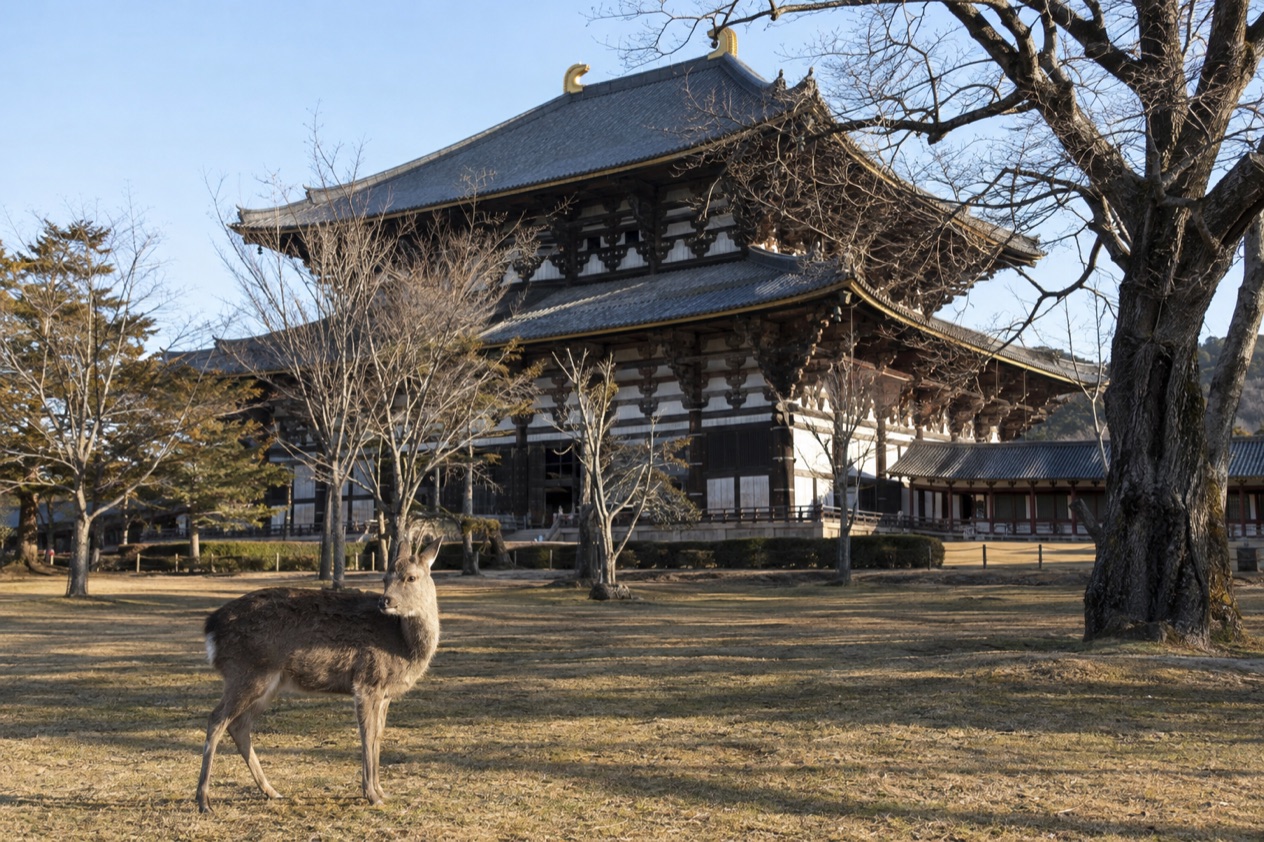
Nara Park spreads over a vast area, and its tame deer wander among the lawns, the lanterns and the temple gates. Special crackers for feeding them are sold along the roadside and all around the park. In January the trees are bare, the grass is pale and the deer have a thick winter coat, which makes for good photographs against the dark wood of the halls.
The deer are used to people and will nudge you for crackers, so hold on to maps and paper bags. Rail brings you in directly: from Osaka-Namba Station the Kintetsu limited express reaches Kintetsu Nara Station in 35 minutes, and from Kyoto Station the Kintetsu Limited Express takes about 34 minutes. Gurutto buses in the city cost 100 yen per trip.
Todai-ji and Kasuga-taisha
Todai-ji houses the Great Buddha, a bronze figure 15 meters high seated in a hall so large it dwarfs the visitors beneath it. The hall is the shelter you want on a gray day, and the grounds around it are open ground where deer graze beside the pathways. Smoking and drone photography are prohibited in the temple precincts.
Kasuga-taisha, a Shinto shrine in Nara, is reached by a path lined with stone lanterns beneath tall trees. In winter, when the New Year visitors have gone, the vermilion corridors and the hanging lanterns stand out against the bare woods.
Plum buds, old streets and winter lunches
Plum trees, Prunus mume, flower from January until late February in East Asia, so the first pale buds may appear in a garden or a temple courtyard late in the month. They are a small, early sign of spring, and cherry blossoms are still a season away.
The old merchant streets of Naramachi suit a cold afternoon, with lattice-fronted houses, small shops and cafés where you can warm up with tea and a bowl of something hot. Heijokyo, the site of Japan’s first capital from the Nara Period, offers a wide open space with reconstructed halls for a day when the sky is clear.
A two-day itinerary for Nara in January
Day 1 belongs to Nara Park. Start at Kintetsu Nara Station, walk into the park and let the deer set the pace, then continue to Todai-ji for the Great Buddha hall while the morning is still cold and still. Have lunch at a small restaurant serving noodles or a set meal with kakinoha-zushi, which is what you want before the afternoon outside.
In the afternoon follow the lantern-lined path to Kasuga-taisha and stay for the shrine’s corridors and the woods around it. Daylight lasts a little over ten hours in mid-January, so keep the longer walks for the middle of the day.
On an evening around the Wakakusa Yamayaki, end the day on the lawns to watch the hillside burn, and otherwise settle for a hot dinner in town. If rain sets in, the Great Buddha hall and the museums of the park are the indoor stops.
Day 2 turns toward the town and its older layers. Begin in Naramachi with a slow walk through the merchant houses, stop in a café for something warm, and spend the late morning in the temples and pagoda near the station that Day 1 left aside, such as Kofuku-ji.
After lunch, ride out to Heijokyo, where the reconstructed palace buildings sit on open ground and recall the first capital of Japan. From Osaka Station, JR Rapid Express reaches Nara Station in about 52 minutes, which matters if you are heading back to Osaka that evening.
On a wet day, swap the open ground of Heijokyo for a museum and a long lunch in the covered arcades of the old town. Finish with a hot-pot or ramen dinner in the streets near the station.
Is Nara busy in January?
January in Nara is a winter month, not a blossom or leaf month, so it follows the rhythm of the New Year holidays rather than the rush of the cherry or maple seasons.
The first days belong to the holiday. Many restaurants and attractions are closed during the New Year holidays, which means the shrines and temples draw people for hatsumode while a lot of the usual services pause. In urban areas shops are generally open from 10:00 a.m. to 8:00 p.m., and rural shops often close earlier, sometimes as early as 6:00 p.m., so a lunch stop near the more remote temples deserves some planning.
Public holidays can reshape a weekend. When a national holiday falls on a Sunday, the next working day becomes a public holiday, and a day between two other national holidays becomes one too. A long weekend in the middle of the month is something to look at on the calendar before you lock in a day for a particular site.
As the month moves on, the town settles into its winter pace. The trees are bare, the lawns are pale, and the deer, the Great Buddha and the lantern paths remain just as they are in any other season. The Wakakusa Yamayaki is the one evening that gathers people on the park’s lawns.
What to pack for Nara in January
Pack for cold days spent mostly on foot, on paths of stone and gravel, with a good chance of a damp spell.
- A warm coat that blocks wind, for the open lawns of Nara Park and the evenings.
- Thermal layers and a sweater, to adjust between cold outdoor paths and heated halls.
- Gloves, a hat and a scarf, since the lows sit just above freezing.
- A compact umbrella or light rain shell, for the drizzly days.
- Comfortable walking shoes that slip on and off easily, for temple halls and long paths.
- A small bag for the deer crackers, kept closed so the deer do not nose through your belongings.
Good to know before you go
The main thing to remember in January is the New Year holiday period, when many restaurants and attractions are closed, and the habit of shops in rural areas to close earlier in the day. Holiday Mondays and the days between holidays can add a closure to your plans, so look at the calendar before you fix a day for a specific site.
At Todai-ji, smoking and drone photography are prohibited within the precincts. Around the park the deer are tame and will approach for crackers, which are sold all around the park. Winter sports are a matter for the northern regions and high mountains, not for Nara.
Nara in January vs December and February
Moving the trip four weeks earlier brings you into December, which is a little milder, with afternoons in the low 50s and more sunshine. You lose the shrine visits of the New Year and the Wakakusa Yamayaki, and the daylight is slightly shorter. Snow and sleet days are also fewer than in January, though still possible.
Moving four weeks later puts you in February, slightly warmer than January but with a bit more rain and more snow in total, around an inch. Daylight is longer by a clear margin, and the plum trees have a better chance of being in bloom. The New Year observances are over, so the shrines return to their regular rhythm.
Choose January if the New Year customs and the mountain burning are what you want, and you do not mind the cold. Shift to February if you would rather have longer light and the first plum blossoms, and to December if you want the mildest of the three and the end-of-year mood.
Is January a good time to visit Nara?
Yes, for travelers who enjoy a cold-weather trip built around temples, shrines, traditions and food, and who are happy to dress in layers and keep indoor options at hand.
It suits people who want to see the New Year as it is lived, with hatsumode at Kasuga-taisha and Todai-ji, ozoni and osechi on the table, and a hillside burning in late January. It also suits photographers who like bare branches, pale lawns and deer in a winter coat. It is less suited to those who want blossoms or autumn color, or who dislike standing outside in the cold after dark.
On arrival, start with Nara Park and Todai-ji, so the deer and the Great Buddha are done while you have fresh energy, then add Kasuga-taisha and the old streets as the weather allows. Check the dates of the Wakakusa Yamayaki and the New Year closures before you set the order of your days. What is special about January in Nara is the way ancient places meet a living holiday: the lanterns, the deer, the steam from a bowl of ozoni and a mountain glowing against the night sky.
Sources
- Japan Meteorological Agency (JMA), Normal values 1991-2020, monthly (https://www.data.jma.go.jp/stats/etrn/view/nml_sfc_ym.php?prec_no=64&block_no=47780), station Nara, elevation 102 m, checked October 11, 2026
- Computed from the date and the latitude of the place (sunrise equation, solar elevation -0.833 degrees), October 11, 2026
- Japan National Tourism Organization, shop and attraction hours, national holidays (https://www.japan.travel/en/plan/business-hours-and-holidays/), checked October 11, 2026
- Wikipedia, Japanese New Year (https://en.wikipedia.org/wiki/Japanese_New_Year), checked October 11, 2026
- Wikipedia, Public holidays in Japan (https://en.wikipedia.org/wiki/Public_holidays_in_Japan), checked October 11, 2026
- Japan National Tourism Organization, winter in Japan (https://www.japan.travel/en/guide/winter-guide/), checked October 11, 2026
- Japan National Tourism Organization, skiing and snowboarding in Japan: regions, resorts, seasons (https://www.japan.travel/en/sports/snow/), checked October 11, 2026
- Wikipedia, Climate of Japan (https://en.wikipedia.org/wiki/Climate_of_Japan), checked October 11, 2026
- Japan National Tourism Organization, weather and seasons in Japan (https://www.japan.travel/en/plan/weather/), checked October 11, 2026
- Japan National Tourism Organization, skiing guide (https://www.japan.travel/en/guide/skiing/), checked October 11, 2026
- Wikipedia, List of ski areas and resorts in Japan (https://en.wikipedia.org/wiki/List_of_ski_areas_and_resorts_in_Japan), checked October 11, 2026
- Japan National Tourism Organization, flowers by season: cherry blossom, plum, wisteria, hydrangea, where and when (https://www.japan.travel/en/see-and-do/flowers/), checked October 11, 2026
- Wikipedia, Prunus mume (https://en.wikipedia.org/wiki/Prunus_mume), checked October 11, 2026
- Japan National Tourism Organization, Nara (https://www.japan.travel/en/destinations/kansai/nara/nara-park-and-around/), checked October 11, 2026
- Official Nara Travel Guide, getting around Nara (https://www.visitnara.jp/getting-around-nara/), checked October 11, 2026
- Official Nara Travel Guide, first-time visitors (https://www.visitnara.jp/for-first-time-visitor/), checked October 11, 2026
- Official Nara Travel Guide, Nara Park area (https://www.visitnara.jp/destinations/area/nara-park/), checked October 11, 2026
- Official Nara Travel Guide, travel to Nara (https://www.visitnara.jp/travel-to-nara/), checked October 11, 2026
- Todai-ji Temple, official site (https://www.todaiji.or.jp/en/), checked October 11, 2026
- Wikipedia, Tōdai-ji (https://en.wikipedia.org/wiki/T%C5%8Ddai-ji), checked October 11, 2026
- Wikipedia, Nara Park (https://en.wikipedia.org/wiki/Nara_Park), checked October 11, 2026
- Wikipedia, Kasuga-taisha (https://en.wikipedia.org/wiki/Kasuga-taisha), checked October 11, 2026