
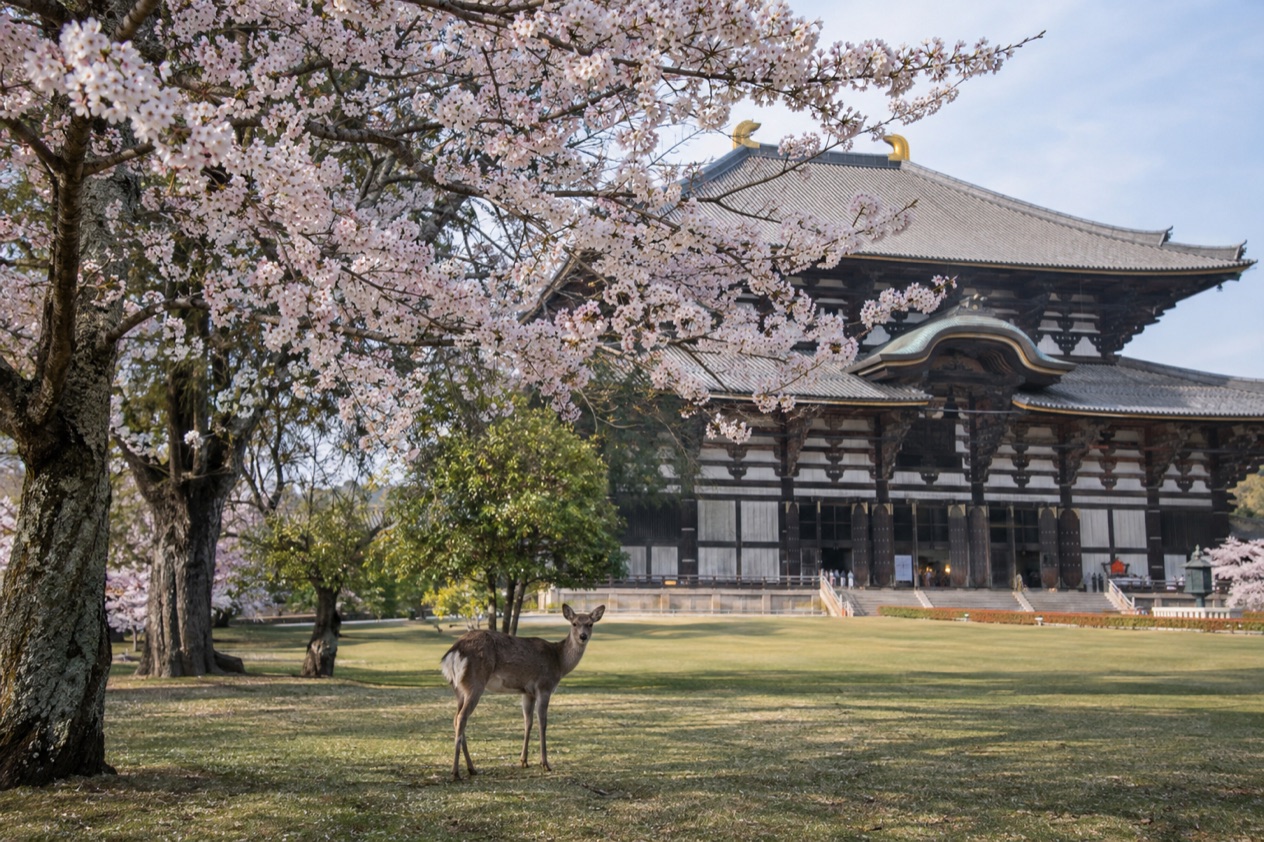
In April the last cherry petals loosen from the branches in Nara Park and drift across the lawns, where the deer go on grazing among the trees as if nothing had changed. Between the trunks you catch the dark roofs of old temples, and the air has the soft warmth of early spring. This is Nara in April, a month of blossom, temple courtyards and long days outdoors.
What is the weather like in Nara in April?
April in Nara is mild and green, a month of light layers with a little rain, and clearly warmer than March.
| Month | Average high (°F) | Average low (°F) | Precipitation (in) | Days with 1 mm or more of precipitation | Hours of sunshine | Daylight on the 15th |
|---|---|---|---|---|---|---|
| March | 57.0 | 38.5 | 4.14 | 9.9 | 158 | 11 hours 55 minutes |
| April | 67.6 | 47.7 | 3.89 | 9.6 | 173 | 13 hours 1 minute |
| May | 76.8 | 57.0 | 5.45 | 10.0 | 188 | 13 hours 57 minutes |
Highs in the upper 60s make shirt-sleeve weather for a stroll through Nara Park, while lows in the upper 40s mean a sweater or light jacket is welcome at both ends of the day. The Japan National Tourism Organization says that in spring you can travel comfortably with a light jacket or a simple sweater, and that is a fair guide here.
Rain falls on roughly one day in three, so a folding umbrella earns its place in the bag. April does not bring the long wet spells of the rainy season, and the month’s total is a little lower than March’s. Snow, which touched the city on several days in March, has nearly disappeared.
The days are long enough for a full program of temples, gardens and a late dinner. Daylight stretches by about an hour over the course of the month’s first half compared with mid-March, and the sunshine adds up to a bright, open feeling over the park’s grass and the pale blossoms.
What to do in Nara in April
The big event of an April in Nara is the cherry blossom. At Nara the first flowers usually open around the end of March, and full bloom usually falls in the first days of April.
From one spring to the next the dates move, so the trees may be at full bloom, just past it or already scattering petals when you arrive. The Japan Meteorological Agency tracks these dates, and the cherry blossom is described by the Japan National Tourism Organization as one of Japan’s most iconic symbols and the most famous flower in the country, a harbinger of spring.
Even when the peak has passed, the month stays rewarding. Fallen petals pale the paths, new leaves turn the park a fresh green, and the old temples look as they always do, only with a spring light on their roofs. Shops in urban areas are generally open from 10:00 a.m. to 8:00 p.m. every day, which leaves room for browsing between sights.
Nara Park and its deer
Nara Park covers a vast area and is renowned for its free-roaming deer and its temples. In April the deer stroll under blossoming trees, rest on the grass and gather around anyone holding food.
Special deer crackers are on sale all around the park, and feeding them is a ritual of the visit. Special deer crackers are sold around the park for visitors who want to feed the deer.
The park is the connecting thread of a Nara day. Paths lead from one great site to the next, , and teahouses and souvenir stalls sit along the way. It suits couples, families and solo travelers alike, and the spring weather lets you linger outdoors without rushing from one air-conditioned stop to another.
Todai-ji and the Great Buddha
Todai-ji Temple is the anchor of the park. Its Great Buddha hall is described as the largest wooden building in the world, and it houses the world’s largest bronze Buddha statue. Stepping through the gate in April, you pass under blossoming branches before the vast hall comes into view, and the contrast of delicate petals and heavy timber is the image people take home.
Inside, the seated figure fills the space with a scale that photographs do not capture. Light from the doors falls across the gilded details, and the quiet shuffle of visitors adds to the sense of a place that has held pilgrims for centuries. Pair it with the lawns outside, where deer often graze right up to the temple approach.
Kasuga Shrine and the primeval forest
Kasuga Shrine and Kasugayama Primeval Forest are part of the same World Heritage listing as the great temples. Stone lanterns line the approach, and the forest canopy turns a tender green as spring advances. The shrine buildings stand in vermilion against the trees, a color that looks especially bright when new leaves surround it.
A visit here is more about atmosphere than about a single monument. You move slowly under trees, pass lantern after lantern and watch the light change on the moss. It pairs well with a long afternoon in the park, and with the sweet shops and tea stalls that gather near the paths.
Temples beyond the park
Nara’s World Heritage listing, the Historic Monuments of Ancient Nara, also includes Kofuku-ji, Saidai-ji, Gango-ji, Yakushi-ji, Toshodai-ji and the site of the Heijo Palace. Heijokyo was Japan’s first capital, dating back 1300 years to the Nara Period, so the open ground of the palace site gives a sense of the scale of that early city. The temples scattered around town each have their own halls, gardens and pagodas.
If the park fills your first day, these temples give a second day its shape. Spring blossoms often dot their courtyards, and the paths between them pass through ordinary neighborhoods where the town goes about its business.
What to eat in Nara in spring
Nara’s table is a gentle one. Kakinoha-zushi, pressed sushi wrapped in persimmon leaves, is a regional specialty, and narazuke, vegetables pickled in sake lees, appears on many menus. Kudzu sweets, soft and translucent, suit a tea break after temple visits, and in April you may also spot sakura-flavored sweets and tea in shops and cafés.
A bowl of chagayu, rice porridge cooked in tea, is another local dish, and many small restaurants near the park serve simple set meals.
A two-day itinerary for Nara in April
Day 1 belongs to the park. Start at the gate of Todai-ji and spend the morning in the Great Buddha hall and its grounds, then cross the lawns to feed the deer with a few crackers. Take lunch at a small restaurant near the park, perhaps persimmon-leaf sushi or a set meal, and let the blossoms decide how long you stay under the trees.
In the afternoon, follow the stone lanterns to Kasuga Shrine and the edge of Kasugayama Primeval Forest. Daylight lasts a little over thirteen hours in the middle of April, so there is time for a slow loop and still a walk back before evening. Dinner can be a quiet set meal in town, followed by a stroll through lit streets.
If rain comes, shelter in the big temple halls and in the shops and cafés around the park. A damp afternoon suits a long tea stop with kudzu sweets.
Day 2 moves to the temples of the wider town. Begin at Kofuku-ji, close to the park, then continue to Yakushi-ji and Toshodai-ji, the sites of the World Heritage list that lie farther afield. Gurutto buses in Nara City cost 100 yen per trip, and Kintetsu and JR West trains serve the town.
Spend the afternoon at the site of the Heijo Palace, where open grounds give a sense of the first capital’s scale. Finish with dinner at an izakaya, a casual pub-style place for small dishes. For a rainy day, stay inside the temple halls and museums, and keep the open palace grounds for a dry hour.
Nara can also be visited from Kyoto or Osaka. From Kyoto Station, the JR Rapid Express takes approximately 41 minutes to Nara Station and the Kintetsu Limited Express takes approximately 34 minutes to Kintetsu-Nara Station. From Osaka Station the JR Rapid Express takes approximately 52 minutes.
Is Nara busy in April?
April is the season of the cherry blossom in Nara, and that gives the month its own rhythm, with the blossom as the draw of the park and the temples.
Full bloom at Nara usually comes in the first days of April, and from one spring to the next it can land at the end of March or a little later in the month. Visitors who time a trip for the blossom will be aiming at those dates, and the park is the setting most associated with them. When the petals fall, the green of the new season takes over, and the main sights stay open for walking and sightseeing as usual.
Golden Week brings a change at the end of the month. The holiday period runs from April 29 to May 5 and contains several public holidays, and the first of them, Showa Day, falls on April 29. When a national holiday falls on a Sunday, the next working day becomes a public holiday, and a day between two holidays also becomes one, so the calendar around these dates can add extra days off.
In practice, the first three weeks of April and the Golden Week stretch feel like two different moods. Plan the blossom for the early part of the month, and treat the final days with the holiday calendar in mind.
What to pack for Nara in April
Pack for a mild spring with layers and a little rain, and for long days on foot among temples and lawns.
- A light jacket or a simple sweater, for the cooler ends of the day.
- A folding umbrella or light rain jacket, since rain falls on a fair number of days.
- Shoes that handle gravel paths and grass, for the park and temple grounds.
- Short sleeves for the middle of the day, when highs reach the upper 60s.
- Sunglasses or a hat for bright days under the open sky.
- A small day bag for crackers, water and layers you shed.
Good to know before you go
The calendar matters most at the end of the month. Golden Week begins on April 29 with Showa Day, and the public holidays that follow shape the pace of travel and town life. In urban areas shops are generally open from 10:00 a.m. to 8:00 p.m. every day, while in rural areas they often close earlier, sometimes as early as 6:00 p.m.
Getting around is handled by Kintetsu Railway and West Japan Railway (JR West), which operate rail service throughout Nara. Nara Kotsu runs an extensive bus network, including access to remote areas not served by rail, and Gurutto buses in Nara City cost 100 yen per trip.
Nara in April vs March and May
Moving the trip four weeks earlier brings you to March, when the nights are colder, snow or sleet still shows up on some days, and the cherry trees are only starting to open. First bloom at Nara usually falls at the end of March, so you may catch buds and the first flowers rather than the full spread. Days are shorter, which trims the hours for sightseeing.
Four weeks later is May, with the warmest days of the three months, more sunshine, longer daylight and the most rain. The blossom is long over, and the park is deep green. Golden Week runs through May 5, with Constitution Memorial Day, Greenery Day and Children’s Day among its public holidays, so the start of May has its own holiday mood.
Travelers who come for the blossom should stay with early April, or aim a little before it. Those who prefer warmth and long evenings, and who do not mind a few more rainy days, can shift to May. April sits between the two, with mild weather, new leaves and the last petals.
Is April a good time to visit Nara?
Yes, April is a good time for Nara, especially for travelers who want blossom, mild weather and long days for temple and park visits.
It suits first-time visitors who want the deer, the Great Buddha and the lanterns of Kasuga in a soft season, and photographers drawn by petals on the ground and new green in the trees. It suits couples and families who like to spend a day outdoors, and anyone who likes to feed the deer under blossoming branches.
On arrival, head straight for Nara Park. The lawns, Todai-ji and the deer set the tone, and from there the rest of the town opens up in whatever order the weather suggests. The park in April, with the last cherry petals and the first bright leaves, is the picture to remember.
Sources
- Japan Meteorological Agency (JMA), Normal values 1991-2020, monthly (https://www.data.jma.go.jp/stats/etrn/view/nml_sfc_ym.php?prec_no=64&block_no=47780), station Nara, elevation 102 m, checked October 11, 2026
- Computed from the date and the latitude of the place (sunrise equation, solar elevation -0.833 degrees), October 11, 2026
- Japan Meteorological Agency, cherry blossom first-bloom dates 2021-2026 and 1991-2020 normal (https://www.data.jma.go.jp/sakura/data/sakura003_07.html), checked October 11, 2026
- Japan Meteorological Agency, cherry blossom full-bloom dates 2021-2026 and 1991-2020 normal (https://www.data.jma.go.jp/sakura/data/sakura004_07.html), checked October 11, 2026
- Japan Meteorological Agency, sakura2020.pdf (https://www.data.jma.go.jp/sakura/data/sakura2020.pdf), checked October 11, 2026
- Japan National Tourism Organization, spring in Japan (https://www.japan.travel/en/guide/spring-guide/), checked October 11, 2026
- Japan National Tourism Organization, flowers by season: cherry blossom, plum, wisteria, hydrangea, where and when (https://www.japan.travel/en/see-and-do/flowers/), checked October 11, 2026
- Wikipedia, Wisteria (https://en.wikipedia.org/wiki/Wisteria), checked October 11, 2026
- Japan National Tourism Organization, shop and attraction hours, national holidays (https://www.japan.travel/en/plan/business-hours-and-holidays/), checked October 11, 2026
- Wikipedia, Golden Week (Japan) (https://en.wikipedia.org/wiki/Golden_Week_(Japan)), checked October 11, 2026
- Wikipedia, Public holidays in Japan (https://en.wikipedia.org/wiki/Public_holidays_in_Japan), checked October 11, 2026
- Official Nara Travel Guide, getting around Nara (https://www.visitnara.jp/getting-around-nara/), checked October 11, 2026
- Official Nara Travel Guide, first-time visitors (https://www.visitnara.jp/for-first-time-visitor/), checked October 11, 2026
- Official Nara Travel Guide, Nara Park area (https://www.visitnara.jp/destinations/area/nara-park/), checked October 11, 2026
- Official Nara Travel Guide, travel to Nara (https://www.visitnara.jp/travel-to-nara/), checked October 11, 2026
- Wikipedia, Nara, Nara (https://en.wikipedia.org/wiki/Nara,_Nara), checked October 11, 2026