
Some mornings the curtain of cloud lifts off the lake and Mount Fuji simply stands there, over the water and the rooftops, while a pot of tea cools beside the window. Other evenings the mountain is gone behind gray and the only thing to do is soak in a hot bath and wait. Where you sleep around Lake Kawaguchi decides how many of those mornings you wake up inside: on the shore, in a town at the foot of the trails, in a mountain lodge or in a ryokan.
What is the best area to stay in Mount Fuji and Lake Kawaguchi?
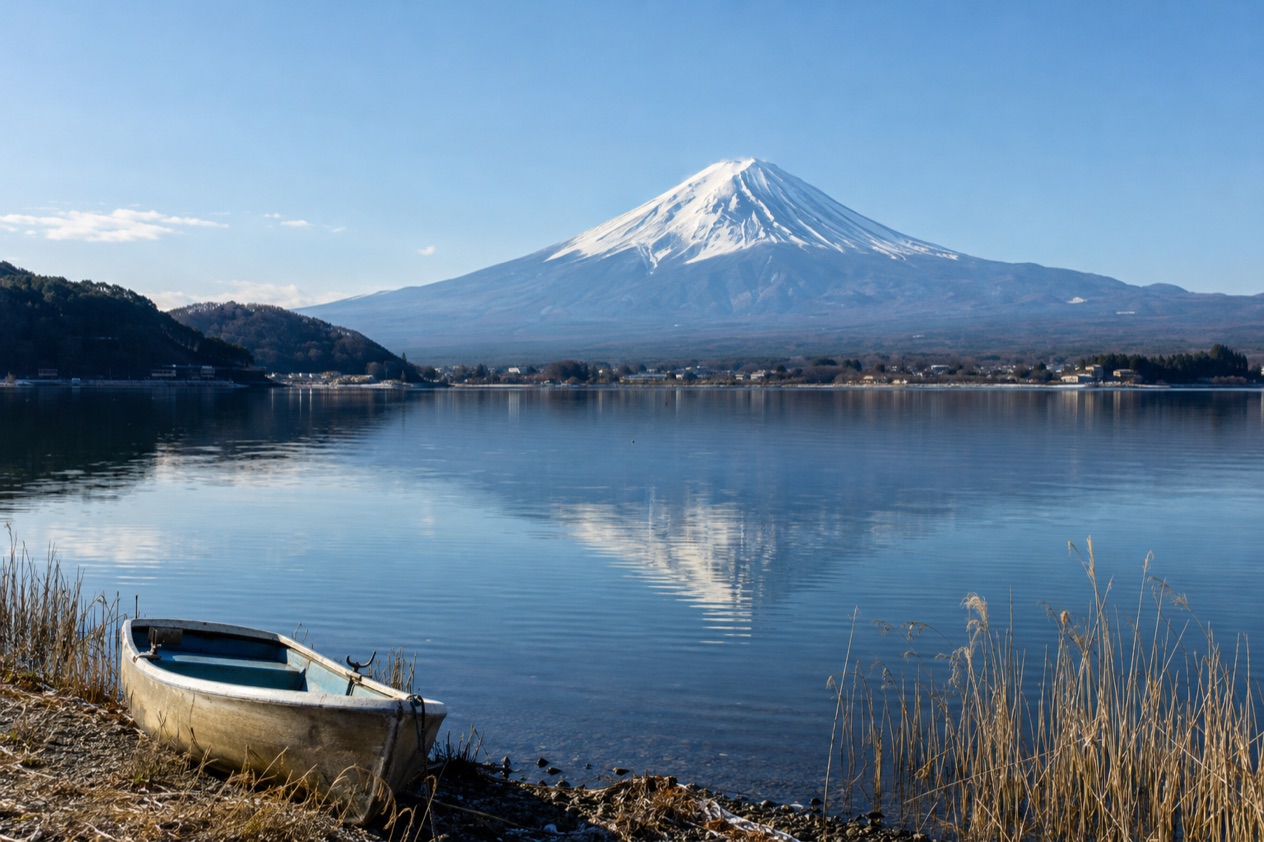
For a first visit and for sightseeing, the Lake Kawaguchi shore is the natural base, since you wake up beside the water with the mountain in view whenever the sky allows. Climbers and anyone who wants to be near the Yoshida trail will look at Fujiyoshida and at the mountain lodges.
Travelers who want an evening of tatami, a hot bath and a long dinner should aim for a ryokan. Budget stays and families fit the plainer end of the same areas, in guesthouses, business hotels and rooms with space for everyone. Nightlife is not what this region is built around, so evenings tend to be meals, baths and early nights.
The areas differ less in distance than in what surrounds your bed. Mount Fuji sits about 62 miles southwest of Tokyo and straddles the border between Shizuoka and Yamanashi prefectures, so the whole region is one mountain seen from many sides.
The lakeshore is built around the view and the water. Fujiyoshida is a town with its own streets and routines. The mountain lodges belong to the slopes themselves and open for the climbing season, while a ryokan turns the night itself into the main event.
Mount Fuji can be seen on clear days, which means the mountain is a possibility and never a promise. A room with a window facing it is pleasant when the weather cooperates, but a good base also offers something for the gray days: a bath, a meal, a town to walk through, a museum or a café. That is worth keeping in mind when you weigh a view against everything else a stay gives you.
Think too about what you plan to do. Mount Fuji is a UNESCO World Heritage site and lies within Fuji-Hakone-Izu National Park, so many visitors come to see the mountain and its surroundings rather than to climb it.
If you only want to look, the lakeshore does that job. If you hope to climb, the season runs from early July to early September, and the lodging question becomes a trail question: where you sleep the night before, and whether you sleep on the mountain itself.
A few nights in one place usually serve the region better than a bag packed each morning. Pick the area that matches your main reason for coming, then add a night in a different kind of lodging, perhaps a ryokan after a lakeshore stay, for the contrast. The sections that follow describe each area by what you find there and who it suits.
The best areas to stay in Mount Fuji and Lake Kawaguchi
The region divides into four kinds of stay, each with its own rhythm. Some are places on the map, others are types of room, and many travelers combine two of them over a longer trip.
The Lake Kawaguchi shore
The shore is where most stays begin. Hotels, small inns, guesthouses and apartment-style rooms line the water, and mornings start with a walk along the lake to see whether the mountain has shown itself. Rooms facing Fuji are the ones people ask about, and on a clear day they live up to the request, while on a cloudy day the lake is still there to look at.
This area suits first-time visitors, couples, families and anyone who wants the mountain as a backdrop to ordinary days. Boutique hotels and larger resort-style properties sit alongside simpler guesthouses, so the choice runs from a plain room for a night to a long stay with a view. Think of the day as a loop: out to see the mountain, back to the water, and a meal in town in the evening.
Fujiyoshida and the foot of the trails
Fujiyoshida is a working town with its own streets, shops and places to eat, and it is the name attached to the Yoshida trail, one of the hiking trails on Mount Fuji. Staying here puts you in a place where people live, not only vacation, and lodging runs to business hotels, guesthouses and small inns.
It suits climbers who want to sleep near the trail, travelers who like a town with an everyday feel, and those who prefer a plainer room to a resort. The Yoshida trail has On-the-Day Nature Guided Tours, a detail that matters if you plan a climb and want to set your base accordingly. Outside the climbing season the town still works as a base for looking at the mountain.
Mountain lodges on the trails
A mountain lodge is a different kind of stay: a bed on the slope itself, used by hikers during the climbing season, which runs from early July to early September. The most popular stretch for hiking is July and August, when huts and facilities are operating and the weather is warmest. Outside that window the lodges are not an option, and climbing from October to May is discouraged because of cold weather.
Lodges matter for a practical reason. On the Yoshida trail the prefecture limits hikers to 4,000 per day and closes the trail between 4 p.m. and 3 a.m., except for guests in mountain lodges. The Shizuoka side has a similar closure on the Subashiri, Gotemba and Fujinomiya trails, again with an exception for lodge guests. For a hiker, a lodge bed is how you remain on the mountain through the night.
Ryokan stays around the lake
A ryokan is a traditional Japanese inn, and the form is believed to have emerged in the 8th century. Rooms have tatami floors, futons laid out for the night, and often private baths, sometimes outdoors. You wear a yukata, a light cotton robe, eat a kaiseki dinner of small seasonal dishes and wake to a traditional Japanese breakfast.
Staff explain the customs as you arrive, including removing shoes indoors, bathing in the onsen (hot spring bath) and wearing the yukata, so no one needs to know the routine in advance. A ryokan suits couples, anyone marking an occasion and travelers who want the evening itself to be the destination. It turns a gray day, when the mountain hides, into a good one.
Mount Fuji and Lake Kawaguchi areas compared
| Area | Best for | Feel |
|---|---|---|
| Lake Kawaguchi shore | First visits, couples, families, looking at the mountain | Hotels, inns and guesthouses along the water, built around the view |
| Fujiyoshida | Climbers, travelers who like a real town | Everyday streets, business hotels and small inns near the Yoshida trail |
| Mountain lodges | Hikers during the climbing season | A bed on the slope itself, open only in the season |
| Ryokan | An evening of tatami, baths and kaiseki | Traditional inn routine, with a yukata and futons |
The main trade-off is between the water and the town. The lakeshore gives you the view and the sense of being on vacation, but it is built for visitors, so the feel is one of rooms and restaurants set up for guests. Fujiyoshida gives you a place with its own life, where a meal can feel like part of someone’s evening, though you trade some of the lakeside outlook for it.
The second trade-off is between comfort and closeness to the mountain. A ryokan offers the fullest evening, with a bath, a long dinner and a quiet room. A mountain lodge gives you the slope, and for hikers it is the way to be on the trail through the night. They are different tools, and a long stay can use both: a lodge for the climb, then a ryokan to recover.
A third choice is between a simple room and a rich stay. Guesthouses and business hotels give a bed and a base, with the day spent outside. A ryokan or a boutique hotel asks you to stay in and enjoy the evening. Neither is better, they just fit different plans.
Finally, weigh the season. Mountain lodges operate only in the climbing season, while the lakeshore, the town and the ryokan can all be used outside it. In the months when the trails are closed above the 5th station, the choice narrows to the shore, the town and the inns, which is a perfectly good way to see the mountain from below.
How to choose your hotel in Mount Fuji and Lake Kawaguchi
Start with what you want from the evening. A ryokan offers tatami floors, futons, a private or outdoor bath, a yukata, a kaiseki dinner and a Japanese breakfast, so it is a stay with a script. If that appeals, choose a ryokan and let the dinner and the bath carry the night. If you would rather spend the evening out in town and sleep in a plain room, a business hotel or guesthouse will do.
The other traditional option is a Heritage Stay, where visitors can take part in activities such as a tea ceremony, calligraphy and wearing traditional Japanese clothing. Reservations for these are required and can often be made through the property’s website or by phone. It suits travelers who want a cultural experience built into the stay rather than added to a day of sightseeing.
Think about the mountain itself. If your main goal is to see Mount Fuji, a room that faces it is worth looking for, remembering that the mountain can be seen on clear days and not on every day. If your goal is to climb, the choice is between a base in Fujiyoshida and a mountain lodge on the trail, and the lodge is the only stay that lets you remain on the slope between 4 p.m. and 3 a.m.
Climbing outside the season is extremely dangerous, since first-aid centers and mountain huts close, cell phone service is lost and the weather turns severe. That is why a lodge is not just a bed but part of how the trail works. If you visit in autumn or winter, plan on looking at the mountain, not climbing it, and choose your hotel for the view, the bath and the town.
Families and travelers with mobility needs should think about the layout of a property: a ryokan with futons on tatami floors is a different experience from a hotel with beds, and a room with a bath inside may suit some people better than a shared onsen. A hotel or apartment-style room gives more flexibility, while a traditional inn gives more atmosphere. Choose the one that matches the people in your group.
A capsule hotel is a very small sleeping unit, built for a night’s rest and nothing more. It suits a solo traveler who wants a bed and little else, and it is not the right fit for a family or for anyone who plans to spend time in the room. For a stay centered on Mount Fuji and the lake, most travelers will do better with one of the other types.
Good to know before you go
Mount Fuji is Japan’s highest mountain and a UNESCO World Heritage site, and the official website for Mt. Fuji climbing is the place to check the latest information before any climb. The climbing season ends on September 10th, and in winter the Yoshida, Subashiri and Gotemba trails are closed from the 5th station to the summit, while the Fujinomiya trail closes from the 6th station.
A summit post office opens from early July to late August. Lodging is for the lakeshore, the town, the mountain lodges and the inns, and each of them keeps to the season of its own.
Sources
- Japan National Tourism Organization, Mount Fuji guide (https://www.japan.travel/en/fuji-guide/), checked October 11, 2026
- Official website for Mt. Fuji climbing, about the climb (https://www.fujisan-climb.jp/en/about/), checked October 11, 2026
- Official website for Mt. Fuji climbing, information (https://www.fujisan-climb.jp/en/info/), checked October 11, 2026
- Wikipedia, Mount Fuji (https://en.wikipedia.org/wiki/Mount_Fuji), checked October 11, 2026
- Wikivoyage, Mount Fuji (https://en.wikivoyage.org/wiki/Mount_Fuji), checked October 11, 2026
- Japan National Tourism Organization, ryokan stays, what is included, etiquette (https://www.japan.travel/en/guide/japanese-ryokan/), checked October 11, 2026
- Japan National Tourism Organization, heritage stays (https://www.japan.travel/en/heritage-stays/), checked October 11, 2026
- Japan National Tourism Organization, wellness and onsen (https://www.japan.travel/en/guide/wellness-travel-in-japan/), checked October 11, 2026
To plan your stay
- Best Time to Visit Mount Fuji and Lake Kawaguchi: Weather, Seasons, Autumn Leaves and Snow
- Things to Do in Mount Fuji and Lake Kawaguchi: Lakeside Views, Fuji-Q Highland, Hiking Season and Local Food
- Mount Fuji and Lake Kawaguchi from Tokyo: Fuji Excursion, the Fujikyuko Line and Climbing Season
- Mount Fuji and Lake Kawaguchi in January: Winter Weather, New Year Traditions and What to Do