
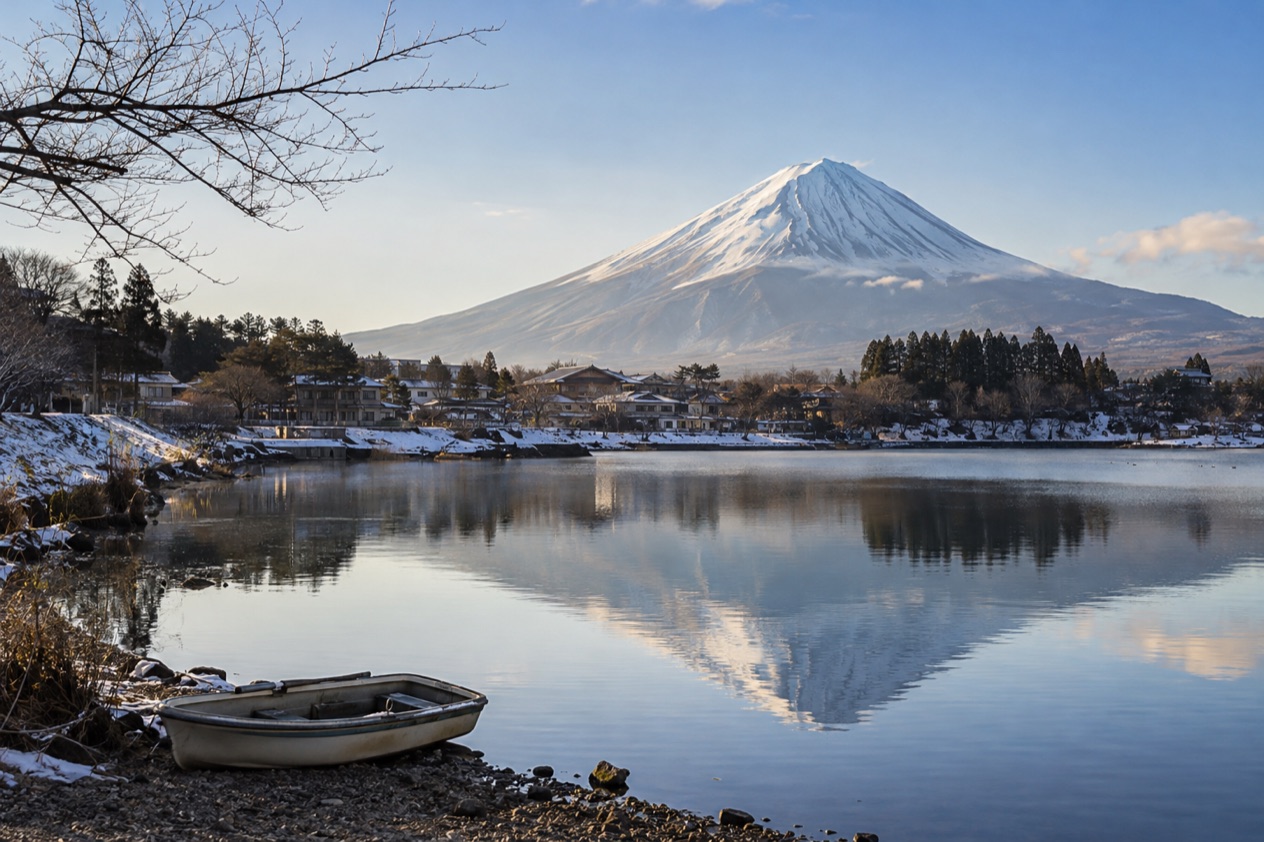
In March, the shore of Lake Kawaguchi is still wearing its winter colors: bare branches, patches of old snow in the shade, and the white cone of Fuji standing over the water. Mornings are crisp and the air feels clean, while the first hints of spring begin to soften the afternoons. It is a month for people who want the mountain at its most wintry, with the lakeside towns calm and the season slowly turning.
What is the weather like in Mount Fuji and Lake Kawaguchi in March?
March at Lake Kawaguchi is cold but turning, with chilly mornings, cool afternoons and a mix of rain and snow that makes it feel like late winter giving way to spring.
| Month | Average high (°F) | Average low (°F) | Precipitation (in) | Days with 1 mm or more of precipitation | Snowfall (in) | Hours of sunshine | Daylight on the 15th |
|---|---|---|---|---|---|---|---|
| February | 43.9 | 23.4 | 2.18 | 5.1 | 11.0 | 191 | 10 h 53 min |
| March | 50.9 | 29.7 | 4.24 | 9.1 | 7.9 | 186 | 11 h 54 min |
| April | 61.0 | 38.7 | 4.18 | 8.5 | 1.6 | 186 | 13 h 03 min |
The lake sits high on the mountain’s flank, so nights still fall below freezing and the cold bites after sunset. Afternoons, especially in the sun, feel noticeably milder, and you can walk the shore without a heavy parka, though a warm coat is still the right choice for early and late hours.
Precipitation arrives more often than in February, and some of it is still snow or sleet. Expect gray spells, damp paths and the odd morning of wet flakes that melt by midday. Waterproof shoes matter more than an umbrella here, because slush and meltwater collect along the lakeshore.
Daylight stretches to nearly twelve hours by mid-month, which gives a comfortable window for sightseeing. The light is low and clear on dry days, good for photographs of the mountain, although clouds often hide the summit and you should treat a full view as a chance, never a promise.
What to do in Mount Fuji and Lake Kawaguchi in March
March is a month of in-between pleasures. The summit is far above the reach of ordinary visitors, since the climbing season runs from the beginning of July to about the first week of September and the trails are closed from the upper stations to the top during winter. What you get instead is the mountain as scenery: snowy, sharp and framed by bare trees and cold water.
Cherry blossoms are not the main event at the lake this month. At Kofu, the nearest reference point for the area, first bloom usually arrives in late March and full bloom around the start of April, so at the lake itself the trees are often still bare or just budding. Plum blossoms, which flower from January until late February in East Asia, are mostly finished, and so the landscape stays austere in a way many photographers like.
Lakeside walks and views of Fuji
The shore of Lake Kawaguchi is where people spend their days. You walk along the water with the mountain reflected on calm mornings, stopping at cafés and small shops to warm up. The north shore tends to be the spot people choose for the classic view, with the cone rising behind the water.
Dress for standing still, because photographing the mountain means pausing in the wind off the lake. When clouds close in, the walk becomes a moody, quiet stroll instead, with mist lying over the water and the peak coming and going. A hot drink at a lakeside café turns a gray hour into a pleasant one.
This outing suits anyone who likes slow days and open air. Wet paths and patches of ice can linger in shaded spots, so shoes with grip are a better choice than smooth soles.
Arakurayama Sengen Park
Arakurayama Sengen Park, in Fujiyoshida in Yamanashi Prefecture, is a hillside park known for a view that frames Fuji with a pagoda in the foreground. It is a place people come to photograph the mountain, and in March the bare trees keep the scene clean and graphic rather than crowded with blossom.
Go with the idea that the view is a gift of the day. Steps and hillside paths can be slick after rain or melting snow, so move carefully.
Pair it with a meal in Fujiyoshida afterward. Hearty noodle dishes and hot soups suit the cold, and a bowl of something warm is a fitting reward after standing outdoors for photographs.
Warming up: food and hot drinks
Cold weather means comfort food. Look for hot noodle bowls, miso-based stews, grilled skewers and sweet red bean treats, all of which feel right after a morning outside. Many lakeside towns also have cafés where you can sit by a window with a view of the water and linger over tea or coffee.
Onsen baths, the hot springs found around the lake, are a natural way to end a chilly day. Soaking while the air outside is near freezing is part of the pleasure, and a ryokan stay with dinner served in your room makes the evening feel unhurried.
Spring is only beginning, so do not expect fresh seasonal flowers on every table. The mood is of winter food enjoyed with the first light of spring outside the window.
A two-day itinerary for Mount Fuji and Lake Kawaguchi in March
Day 1 begins with a slow morning on the lakeshore, when the air is coldest and the water often calmest. Walk the north shore with a hot drink, keeping an eye on the sky for a clear window onto the mountain. By midday, move to a noodle shop for lunch and let the afternoon sun warm you a little.
In the afternoon, head to Arakurayama Sengen Park in Fujiyoshida while daylight lasts, since the sun sets after about six in the evening at this time of year. Come back to the lake for dinner and, if your lodging has one, an onsen bath to finish the day. If rain or snow sets in, swap the park for café time and a long bath.
Day 2 can be gentler. Spend the morning wandering the town near your lodging, browsing small shops and sitting in a café, then take a long lunch of hot local dishes. If the sky is clear, go back to the shoreline for a second look at the mountain, since the view changes with the light.
Use the afternoon for whatever the weather allows: another lakeside stroll if it is dry, or an indoor stop and a bath if it is wet. Dinner and an early night suit a month when evenings are cold and the darkness arrives with a sharp chill.
Is Mount Fuji and Lake Kawaguchi busy in March?
March sits between winter and the spring blossom season, so the lakeside tends to feel like a pause rather than a peak. The mountain climbing season is months away, and cherry blossoms around Kofu usually come only toward the end of the month, so the big seasonal draws have not yet arrived.
That shapes the pace of the area. Walks along the water feel unhurried, and the mood in the lakeside towns is calm. Cherry blossom time later in spring, and the climbing season in summer, are the moments that change the character of the area most.
If you come in late March, the first buds in the broader region may start to draw people looking for early blossoms. For a visit focused on the mountain and the lake itself, though, March offers a quieter, colder, more wintry atmosphere than the months that follow.
What to pack for Mount Fuji and Lake Kawaguchi in March
Pack for a cold morning and a mild afternoon, with the chance of rain or wet snow in between.
- A warm coat, because nights stay below freezing and the wind off the lake is sharp.
- Layers such as a sweater and a light jacket, for afternoons that warm up in the sun.
- Waterproof shoes with grip, since paths can be wet, slushy or icy.
- Gloves and a hat for standing still while photographing the mountain.
- A compact rain jacket, because precipitation falls on about nine days of the month.
- Sunglasses, for bright light reflecting off snow.
Good to know before you go
March is still winter on the mountain. The Yoshida, Subashiri and Gotemba trails are closed from the 5th station to the summit during winter, and the Fujinomiya Trail is closed from the 6th station up, so the summit is not part of a March trip. Visitors who plan to climb in season are advised to check the official website for Mt. Fuji climbing. Snow and sleet still fall on many days, so allow some flexibility in your plans and keep an indoor option, such as a café or a hot spring, for the wet hours.
Mount Fuji and Lake Kawaguchi in March vs February and April
Going four weeks earlier brings deeper winter. February is colder, with more snow on the ground and fewer days of rain, so the landscape is whiter and the air drier. It suits people who want the mountain at its most wintry and do not mind the cold.
Going four weeks later brings a clear step toward spring. April is noticeably warmer, snow becomes rare, and the cherry blossoms around the region are in or near full bloom, which changes the mood of the whole area. The trees that were bare in March start to dress the shoreline.
March is the choice for travelers who want something in between: a bit of snow, a bit of thaw, and a lake that is quiet before the blossom season. If you want crisp winter views, shift earlier. If you want blossoms and gentler afternoons, shift later.
Is March a good time to visit Mount Fuji and Lake Kawaguchi?
Yes, for travelers who like cold, clear air, bare-branch landscapes and slow days by the water more than flowers and warm afternoons.
People who enjoy photography, soaking in hot springs and quiet walks will get the most from the month. Anyone hoping for cherry blossoms right at the lake, or for a climb, should choose another season, since the blossoms come later and the trails stay closed to the summit.
On arrival, start with the lakeshore and keep an eye on the sky, because a clear view of the mountain can come and go. Then fit the rest of the days around the weather, with baths and warm meals ready for the wet hours. What stays with you from March here is the contrast: a snow-streaked cone above dark water, a hot bath after a cold walk, and the first sense that spring is somewhere just beyond the next few weeks.
Sources
- Japan Meteorological Agency (JMA), Normal values 1991-2020, monthly (https://www.data.jma.go.jp/stats/etrn/view/nml_sfc_ym.php?prec_no=49&block_no=47640), station Kawaguchiko, elevation 860 m, checked October 11, 2026
- Japan Meteorological Agency (JMA), Normal values 1991-2020, monthly (https://www.data.jma.go.jp/stats/etrn/view/nml_sfc_ym.php?prec_no=49&block_no=47639), station Fujisan, elevation 3,775 m, checked October 11, 2026
- Computed from the date and the latitude of the place (sunrise equation, solar elevation -0.833 degrees), October 11, 2026
- Japan Meteorological Agency, cherry blossom first-bloom dates 2021-2026 and 1991-2020 normal (https://www.data.jma.go.jp/sakura/data/sakura003_07.html), checked October 11, 2026
- Japan Meteorological Agency, cherry blossom full-bloom dates 2021-2026 and 1991-2020 normal (https://www.data.jma.go.jp/sakura/data/sakura004_07.html), checked October 11, 2026
- Japan Meteorological Agency, sakura2020.pdf (https://www.data.jma.go.jp/sakura/data/sakura2020.pdf), checked October 11, 2026
- Japan National Tourism Organization, flowers by season: cherry blossom, plum, wisteria, hydrangea, where and when (https://www.japan.travel/en/see-and-do/flowers/), checked October 11, 2026
- Wikipedia, Prunus mume (https://en.wikipedia.org/wiki/Prunus_mume), checked October 11, 2026
- Japan National Tourism Organization, spring in Japan (https://www.japan.travel/en/guide/spring-guide/), checked October 11, 2026
- Japan National Tourism Organization, autumn in Japan (https://www.japan.travel/en/guide/autumn-guide/), checked October 11, 2026
- Japan National Tourism Organization, summer in Japan (https://www.japan.travel/en/guide/summer-guide/), checked October 11, 2026
- Japan Meteorological Agency, biological season observations (https://www.data.jma.go.jp/sakura/data/index.html)
- Wikipedia, Mount Fuji (https://en.wikipedia.org/wiki/Mount_Fuji), checked October 11, 2026
- Wikivoyage, Mount Fuji (https://en.wikivoyage.org/wiki/Mount_Fuji), checked October 11, 2026
- Japan National Tourism Organization, Mount Fuji guide (https://www.japan.travel/en/fuji-guide/), checked October 11, 2026
- Official website for Mt. Fuji climbing, about the climb (https://www.fujisan-climb.jp/en/about/), checked October 11, 2026
- Official website for Mt. Fuji climbing, information (https://www.fujisan-climb.jp/en/info/), checked October 11, 2026
- Wikipedia, Arakurayama Sengen Park (https://en.wikipedia.org/wiki/Arakurayama_Sengen_Park), checked October 11, 2026
To plan your stay
- Things to Do in Mount Fuji and Lake Kawaguchi: Lakeside Views, Fuji-Q Highland, Hiking Season and Local Food
- Where to Stay in Mount Fuji and Lake Kawaguchi: Lakeshore Hotels, Fujiyoshida, Mountain Lodges and Ryokan
- Mount Fuji and Lake Kawaguchi from Tokyo: Fuji Excursion, the Fujikyuko Line and Climbing Season
- Best Views of Mount Fuji: Five Lakes, Fifth Station Promenades and When to Go