
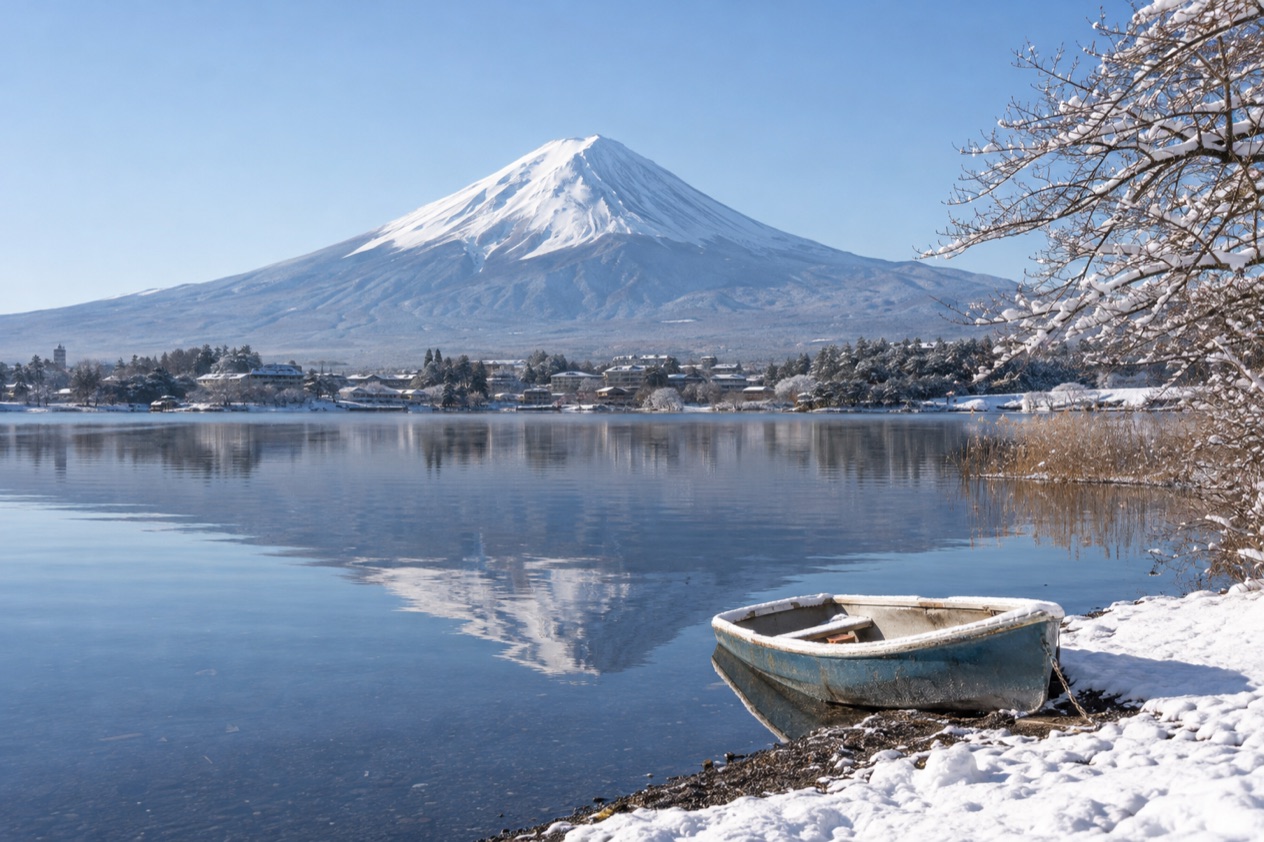
On a January morning at Lake Kawaguchi, your breath hangs in front of you, the grass along the shore is stiff with frost and a bowl of hoto, the thick miso noodle stew of Yamanashi, steams on the table in front of you. The lake towns settle into a winter rhythm after the New Year holidays, and the mountain above them turns white from its shoulders to its crown. January here is for cold, clean air, hot food and slow days around the water, with Mount Fuji as the backdrop whenever the clouds allow.
What is the weather like in Mount Fuji and Lake Kawaguchi in January?
January is cold and often bright at Lake Kawaguchi, with hard frost at night, afternoons that stay a little above freezing and snow that falls on a good share of the days.
| Month | Average high (°F) | Average low (°F) | Precipitation (in) | Days with 1 mm or more of precipitation | Hours of sunshine | Daylight on the 15th | Snowfall (in) |
|---|---|---|---|---|---|---|---|
| December | 47.3 | 26.8 | 1.96 | 4.6 | 200 | 9 h 47 min | 2.8 |
| January | 41.9 | 21.7 | 2.40 | 4.9 | 212 | 10 h 00 min | 14.6 |
| February | 43.9 | 23.4 | 2.18 | 5.1 | 191 | 10 h 53 min | 11.0 |
Most of what falls from the sky in January comes as snow or sleet, on about nine days of the month, so the little rain there is turns up as flakes drifting over the lake rather than as downpours. Those snowy days are separated by long, dry, sunny stretches, and January is the sunniest of the three months. That sun is real, but it does not warm much: the air stays sharp even when the sky is blue.
Dress in layers you can add and remove, starting with a thermal base, then a fleece or wool sweater and a warm coat with a hood. Boots with a grippy sole matter more than anything else, because shaded paths and parking lots hold ice. Up on the summit, the daily average high sits near 5°F, which is why the climbing trails are closed for the winter and why the mountain is something you admire from below.
Daylight is short, so the day has a compact shape. Sightseeing outdoors fits between breakfast and the time the light fades, and the evenings belong to hot baths, grilled skewers and a table close to the heater.
What to do in Mount Fuji and Lake Kawaguchi in January
The month opens with Japanese New Year, celebrated on January 1 under the Gregorian calendar. Families gather over osechi, the lacquered boxes of small symbolic dishes eaten at the start of the year, and people visit a shrine for the first prayers of the year, known as hatsumode.
During the New Year holidays many restaurants and attractions close, so the first days of January are quiet and a little slow. Once the shops and kitchens reopen, the lake towns move into their ordinary winter routine.
Winter is also the season when the air is at its driest and coldest, and the mountain is dressed in snow. Walking along the shore of the lake, with the white cone above the far bank when the cloud lifts, is the central pleasure of the month. It costs nothing, asks for nothing but warm clothes and patience, and changes with every shift of the weather.
Fuji views around Fujiyoshida and the lake
Arakurayama Sengen Park, in Fujiyoshida, is the kind of viewpoint people come to with a camera: a hillside park with a pagoda in the foreground and the mountain rising behind it. In January, snow on the slopes sharpens the outline of the peak, and bare cherry branches along the hill give the scene a stark, graphic look. The park sits in the town of Fujiyoshida in Yamanashi Prefecture, and steps and slopes can hold ice on cold days, so sturdy shoes help.
The mountain does not always show itself. Clouds can wrap the summit for hours, then part without warning, so it pays to leave time for waiting and to treat any glimpse as a gift rather than a promise. Warm drinks from a vending machine, a patient pause on a bench and a second look half an hour later often change the whole picture.
Around the lake in winter
Lake Kawaguchi is a place of lakeside promenades, small museums, cafés with big windows and hot spring inns. In January the summer boats and picnic crowds are gone, leaving gray water, frosted reeds and a handful of walkers wrapped in scarves. It is a landscape for people who like stillness, and the cold itself becomes part of the experience.
Shops in rural areas often close earlier than those in cities, sometimes as early as 6:00 p.m., so errands and souvenir hunting belong to the daylight hours. After that, the evening is for the inn, a hot bath and dinner. If the weather turns, lake-view cafés and small museums make easy places to wait out a snow squall.
Food and drink of the season
Hoto is the dish of the region and the one to order first: wide, flat wheat noodles simmered with pumpkin, mushrooms and vegetables in a miso broth, served bubbling in an iron pot. It is built for cold weather and arrives hot enough to fog your glasses. Around New Year you will also meet ozoni, a soup with rice cakes whose style differs from one region to the next, and osechi boxes in restaurant and inn menus.
Evenings call for a hot bath at an onsen, followed by grilled fish or skewers, hot pot and warm sake. Many lakeside inns serve dinner in the room or in a dining hall, and the long hours indoors on a January night are part of the stay.
Plum blossoms and winter light
Plum trees, Prunus mume, flower across East Asia from January until late February, and a few early blossoms against a gray winter sky are a welcome sign that spring is already on its way. Cherry blossoms are still months off, so January is not the month for petals but for bare branches, snow and low sun. The light is clean and slanting, and photographers value it for the long shadows it throws across the frozen ground.
As for the mountain itself, the climbing trails are closed in winter, the Yoshida, Subashiri and Gotemba trails from the 5th station to the summit and the Fujinomiya trail from the 6th station up. The climbing season ends on September 10th, so January is a month for looking at Mount Fuji, not climbing it. The official website for Mount Fuji climbing is the place for current information.
A two-day itinerary for Mount Fuji and Lake Kawaguchi in January
Day 1 starts with a slow breakfast, because the cold does not reward early heroics and the light is short anyway. Spend the late morning on the shore of Lake Kawaguchi, walking at your own pace and stopping whenever the cloud over the mountain thins. Lunch is a bowl of hoto in a noodle house, an excellent way to warm up before the afternoon.
In the afternoon, visit a lakeside museum or a café with a view, using the daylight hours for any outdoor stop and leaving the indoor ones for the hours when your hands go numb. Dinner is an evening of grilled dishes or hot pot, followed by an onsen bath at your inn if it has one. The order is deliberate: outdoors first while there is light, then warmth for the rest of the day.
Day 2 heads to Fujiyoshida and Arakurayama Sengen Park for the pagoda and mountain view, taking the steps carefully if they are icy. Afterward, wander the town for a late lunch in a local eatery and for small shops that stock regional sweets and crafts. Shops in rural areas may close earlier than city ones, so shopping comes before late afternoon.
If snow or low cloud settles in, switch to an indoor day: a long soak in a hot spring, a slow lunch, a museum or a café with a window onto the lake.
Is Mount Fuji and Lake Kawaguchi busy in January?
The first days of January are the quietest, with many restaurants and attractions closed for the New Year holidays, and the pace stays unhurried afterward as the lake towns slip into winter.
Japan marks the start of the year as a family holiday, so the first days are devoted to rest, shrine visits and long meals at home rather than to sightseeing. That is why closed doors are normal in the first days of the year, and why it makes sense to treat that stretch as a slow start rather than a time to plan a full schedule. Once things reopen, the lakeside regains its ordinary winter routine.
January also has two other effects on the pace of a visit. Snow and short daylight discourage long outdoor days, so people tend to cluster around the cafés, onsen and indoor spots in the afternoon. Shops in rural areas often close early, sometimes as early as 6:00 p.m., which makes evenings quiet and sends diners to their inns or the few restaurants that stay open.
Winter sports are in full season elsewhere in Japan, with the snow peak in January and February in Hokkaido and the high mountains of Nagano, but that belongs to other regions. At Lake Kawaguchi the month is defined by cold, snow flurries and the view of the mountain.
What to pack for Mount Fuji and Lake Kawaguchi in January
Pack for freezing nights, a snowy lakeside and long stretches outdoors with little to warm you up between stops.
- A thermal base layer, to hold the warmth through cold evenings and nights.
- A warm coat with a hood, for snow flurries and the wind off the lake.
- Waterproof boots with a grippy sole, for icy steps and shaded paths.
- A hat, gloves and a scarf, because hands and ears feel the cold first while you wait for the clouds to clear.
- Sunglasses, since sunny days over snow can be glaring.
- A small thermos or a few coins for hot drinks from vending machines.
Good to know before you go
The main things to know for January are the New Year closures, the cold and the early closing times. During the New Year holidays, many restaurants and attractions are closed, so lunch plans in the first days of the month may have to change. In rural areas shops often close earlier than in cities, sometimes as early as 6:00 p.m.
Snow can fall on many days of the month, and ice sits on steps and shaded paths well after the flakes stop. The climbing trails on Mount Fuji are closed in winter, so the mountain is seen from the surrounding towns and lakes. A national holiday that falls on a Sunday moves to the next working day, which can add a long weekend and change opening patterns.
Mount Fuji and Lake Kawaguchi in January vs December and February
December is milder and much less snowy, with only a thin dusting on average, and it is a good choice for people who want to be outdoors without heavy winter gear. The days are slightly shorter, and the mountain has not yet received its full winter coat. The New Year closures start near the end of the month, so late December plans should account for them.
February is a touch warmer than January but still deeply wintry, with snow on about ten days and the days getting noticeably longer. It is a little less sunny, and the first plum blossoms are by then well on their way across East Asia, since they flower from January until late February. That makes February a bridge toward spring while keeping the snowy scenery.
Choose December for gentler weather and a lighter suitcase, and February for longer days and a first hint of the end of winter. Stay with January if you want the coldest, sunniest and most distinctly winter version of the lake, with the mountain at its whitest.
Is January a good time to visit Mount Fuji and Lake Kawaguchi?
Yes, for travelers who like cold, clear winter days, hot food and the quiet of a lake town in the off-season, and less so for anyone who wants to climb the mountain or spend long hours outdoors in mild weather.
January suits photographers, onsen lovers and people who enjoy slow travel, because the pleasures here are simple: a bowl of hoto, a long bath, a walk by the water and the chance of seeing the snowy cone appear between clouds. It is a poor fit for anyone who needs the summit trails, a packed schedule of outdoor stops or temperatures that allow light clothing.
On arrival, put the outdoor time first. Walk the shore while the light lasts, take any view the clouds offer, and save the museums, cafés and the hot bath for the cold hours. What makes January here its own is the combination of frozen stillness, steaming noodle pots and a mountain that is there even when you cannot see it.
Sources
- Japan Meteorological Agency (JMA), Normal values 1991-2020, monthly (https://www.data.jma.go.jp/stats/etrn/view/nml_sfc_ym.php?prec_no=49&block_no=47640), station Kawaguchiko, elevation 860 m, checked October 11, 2026
- Japan Meteorological Agency (JMA), Normal values 1991-2020, monthly (https://www.data.jma.go.jp/stats/etrn/view/nml_sfc_ym.php?prec_no=49&block_no=47639), station Fujisan, elevation 3,775 m, checked October 11, 2026
- Computed from the date and the latitude of the place (sunrise equation, solar elevation -0.833 degrees), October 11, 2026
- Japan National Tourism Organization, shop and attraction hours, national holidays (https://www.japan.travel/en/plan/business-hours-and-holidays/), checked October 11, 2026
- Wikipedia, Japanese New Year (https://en.wikipedia.org/wiki/Japanese_New_Year), checked October 11, 2026
- Wikipedia, Public holidays in Japan (https://en.wikipedia.org/wiki/Public_holidays_in_Japan), checked October 11, 2026
- Japan National Tourism Organization, winter in Japan (https://www.japan.travel/en/guide/winter-guide/), checked October 11, 2026
- Japan National Tourism Organization, skiing and snowboarding in Japan: regions, resorts, seasons (https://www.japan.travel/en/sports/snow/), checked October 11, 2026
- Wikipedia, Climate of Japan (https://en.wikipedia.org/wiki/Climate_of_Japan), checked October 11, 2026
- Japan National Tourism Organization, weather and seasons in Japan (https://www.japan.travel/en/plan/weather/), checked October 11, 2026
- Japan National Tourism Organization, skiing guide (https://www.japan.travel/en/guide/skiing/), checked October 11, 2026
- Wikipedia, List of ski areas and resorts in Japan (https://en.wikipedia.org/wiki/List_of_ski_areas_and_resorts_in_Japan), checked October 11, 2026
- Japan National Tourism Organization, flowers by season: cherry blossom, plum, wisteria, hydrangea, where and when (https://www.japan.travel/en/see-and-do/flowers/), checked October 11, 2026
- Wikipedia, Prunus mume (https://en.wikipedia.org/wiki/Prunus_mume), checked October 11, 2026
- Japan National Tourism Organization, Mount Fuji guide (https://www.japan.travel/en/fuji-guide/), checked October 11, 2026
- Official website for Mt. Fuji climbing, about the climb (https://www.fujisan-climb.jp/en/about/), checked October 11, 2026
- Official website for Mt. Fuji climbing, information (https://www.fujisan-climb.jp/en/info/), checked October 11, 2026
- Wikipedia, Mount Fuji (https://en.wikipedia.org/wiki/Mount_Fuji), checked October 11, 2026
- Wikipedia, Arakurayama Sengen Park (https://en.wikipedia.org/wiki/Arakurayama_Sengen_Park), checked October 11, 2026
To plan your stay
- Things to Do in Mount Fuji and Lake Kawaguchi: Lakeside Views, Fuji-Q Highland, Hiking Season and Local Food
- Where to Stay in Mount Fuji and Lake Kawaguchi: Lakeshore Hotels, Fujiyoshida, Mountain Lodges and Ryokan
- Mount Fuji and Lake Kawaguchi from Tokyo: Fuji Excursion, the Fujikyuko Line and Climbing Season
- Best Views of Mount Fuji: Five Lakes, Fifth Station Promenades and When to Go