
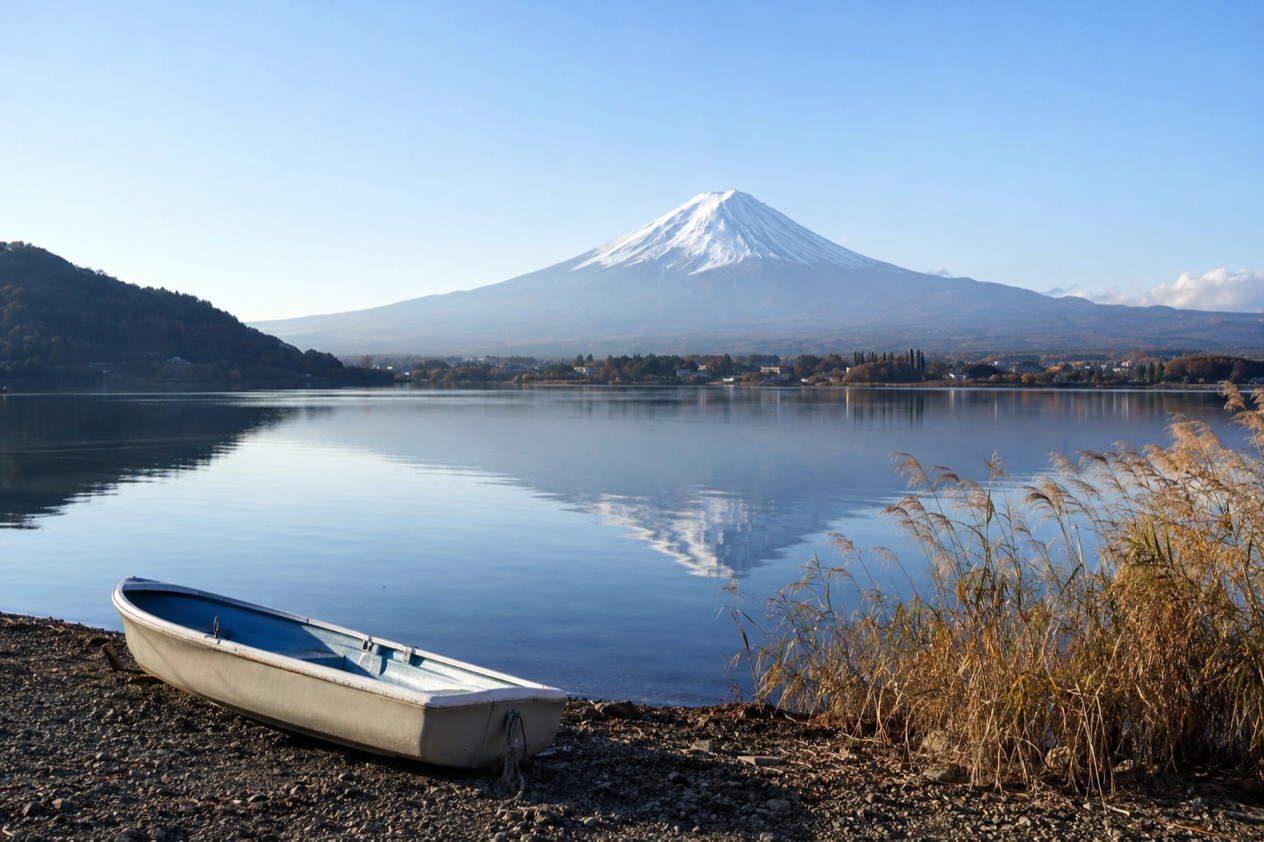
Leaving Tokyo for Mount Fuji means starting at Shinjuku Station, one of the great railway crossroads of the city, and watching the capital thin out into river valleys and wooded ridges as the train heads west. Somewhere along the way the mountain begins to appear between the hills, and on a clear day it keeps showing itself in the window. The ride ends at Kawaguchiko Station, the door to Lake Kawaguchi and the northern face of Fuji.
How do you get to Mount Fuji and Lake Kawaguchi from Tokyo?
Mount Fuji stands about 62 miles southwest of Tokyo, and the Fuji Excursion train connects Shinjuku Station directly with Kawaguchiko Station in Yamanashi Prefecture. The train uses the Chuo Line and then the Fujikyuko Line, so a single named service carries you from the capital to the lake town without a change of trains in the middle.
The Fuji Excursion has been running since March 16, 2019, and it makes four round trips a day. That small number is the first thing to plan around, because the whole trip is built on the times of those departures. Between Shinjuku and Otsuki the train is coupled with an Azusa or Kaiji limited express, and at Otsuki it separates and continues on its own onto the Fujikyuko Line, the railway that climbs toward the lake.
What decides your choice is how you want to spend the day. The Fuji Excursion asks for a limited express ticket on top of the basic fare, which is the price of a through ride.
The alternative is to travel on ordinary trains, including local trains that stop at every station, and switch at Otsuki to the Fujikyuko Line. That route trades a direct ride for flexibility and for the pleasure of stopping at small stations on the way up.
The Fujikyuko Line matters here for another reason. It is the only railway to reach the northern Yamanashi side of Mount Fuji and the Fuji Five Lakes, which lie within Fuji-Hakone-Izu National Park. Whichever way you leave Tokyo, the final stretch to Lake Kawaguchi runs on that line.
Japanese trains have a reputation for keeping to their timetable, and that lets you plan the day around a connection at Otsuki with some confidence. In Tokyo, Shinjuku is served by Japan Railways (JR) alongside Tokyo Metro and Toei Subway lines, so reaching the station from your hotel is a matter of picking the line that suits your neighborhood.
Ways to get to Mount Fuji and Lake Kawaguchi from Tokyo
The Fuji Excursion limited express
The Fuji Excursion is the direct train between Shinjuku and Kawaguchiko, and it stops at Shinjuku, Tachikawa, Hachioji, Otsuki, Tsurubunkadaigakumae, Shimoyoshida, Mt. Fuji, Fujikyu-Highland and Kawaguchiko. Every service uses an E353 series train of three cars, so the whole ride happens on the same compact set, from the Tokyo suburbs to the lakeside.
A limited express ticket is required in addition to the basic fare, and the service runs four round trips a day. It suits travelers who want one train from the city to the lake, without hunting for a connection in Otsuki. The tip is to build the day around the departure you choose, since the choices are few, and to look at the stop list: several stations on the Fujikyuko stretch sit close to the mountain’s name or to the lake.
Local trains on the Fujikyuko Line
The Fujikyuko Line is a private railway in Yamanashi Prefecture, run by Fuji Kyuko, and it connects Otsuki Station with Kawaguchiko Station over 17 miles. Along the way it climbs from 358 meters above sea level at Otsuki to 857 meters at Kawaguchiko, a rise of about 500 meters, which is why the air feels different when you step out at the lake.
Local trains on this line stop at every station and run about every 30 minutes. In many places along the track Mount Fuji can be seen from the train, so a seat by the window is part of the experience. This option suits anyone arriving at Otsuki on an ordinary service, or anyone who would rather watch the villages go by than ride straight through.
Rapid and local trains on the way to Otsuki
Ordinary trains on the way to Otsuki follow the pattern of Japanese rail in general. Local trains stop at every station, which makes them a fit for short distances, while rapid trains skip the smaller stations and do not require a supplement. Together they form a way to reach Otsuki without the limited express charge, with the Fujikyuko Line taking over for the last climb.
This route suits travelers who value flexibility over a single through ticket, or who want to stop at one of the stations between Tokyo and the foot of the mountain. Because the Fuji Excursion shares its track with Azusa and Kaiji services between Otsuki and Shinjuku, the corridor is clearly a busy route for trains heading to Yamanashi.
Options compared
| Option | Best for | What to know |
|---|---|---|
| Fuji Excursion | A through ride from Shinjuku to Kawaguchiko | Four round trips a day, limited express ticket required on top of the basic fare |
| Ordinary trains to Otsuki, then the Fujikyuko Line | Travelers who prefer to change trains and watch the line climb | Local trains on the Fujikyuko Line stop at all stations and run about every 30 minutes |
| Rapid trains toward Otsuki | Reaching the junction without a supplement | Rapid trains skip smaller stations and need no extra fee |
The three options share the same last leg, since the Fujikyuko Line is the only railway serving this side of the mountain. The real difference is in the first part of the trip, between Shinjuku and Otsuki. One way gives you a named train that continues to the lake, the other gives you the freedom of ordinary services and a change at the junction.
If the Fuji Excursion departure times fit your morning, it is the one that keeps the trip in a single piece. If they do not, the ordinary trains with a change at Otsuki carry you to the same station at the lake. Either way you arrive at Kawaguchiko, where the view of the mountain usually decides what you do next.
Making a day of it
A day at Lake Kawaguchi begins well on the train itself. On the Fujikyuko Line the mountain shows up in many places along the track, and on a clear day it can be seen from Tokyo too, so the ride is part of the outing rather than a stretch to get through. Station names on the Fuji Excursion give a preview of the day: Shimoyoshida, Mt. Fuji and Fujikyu-Highland come in quick succession before the train reaches the lake.
Stopping at one of these stations on the way is possible by using local trains, which halt at every station on the Fujikyuko Line. That suits a traveler who would like to see a smaller town before reaching the lakeshore, instead of going straight to the end of the line. Kawaguchiko Station, in Fujikawaguchiko, remains the main gateway for Lake Kawaguchi itself.
Mount Fuji is the highest mountain in Japan and a UNESCO World Heritage site, added to the list as a cultural site on June 22, 2013. Many travelers come simply to look at it from the lake, which is a complete day on its own. Those who want to go onto the mountain should know that the Yoshida Trail is one of its hiking trails, and that on this trail on-the-day nature guided tours are available.
Climbing has a season. The most frequented period is July and August, when huts and facilities are operating and the weather is warmest, and the official season ends on September 10.
Outside it, climbing is extremely dangerous because first-aid centers and mountain huts close, cell phone service is lost and the weather turns severe. Climbing from October to May is discouraged, and in winter the Yoshida, Subashiri and Gotemba trails are closed from the 5th station to the summit.
Anyone planning to climb is strongly advised to check the latest information on the Official Website for Mt. Fuji Climbing, which gives guidance to all climbers for a safe ascent and return. The summit rim trail, known as Ohachimeguri, is closed from July 1 to 10 for those on the Yoshida or Subashiri trails. For everyone else, a day by the lake with the mountain in view is a full outing, and the train ride back to Shinjuku closes it.
Good to know before you go
Japanese trains are known for running on time, so a connection at Otsuki can be planned to the minute. Because the Fuji Excursion makes only four round trips a day, it is worth fixing your return departure from Kawaguchiko before you wander off to the lake. The mountain itself is visible only when the weather allows, and a cloudy day can hide it completely, so the view is a chance rather than a promise.
Sources
- Wikipedia, Fuji Excursion (https://en.wikipedia.org/wiki/Fuji_Excursion), checked October 11, 2026
- Wikipedia, Fujikyuko Line (https://en.wikipedia.org/wiki/Fujikyuko_Line), checked October 11, 2026
- Japan National Tourism Organization, Mount Fuji guide (https://www.japan.travel/en/fuji-guide/), checked October 11, 2026
- Official website for Mt. Fuji climbing, about the climb (https://www.fujisan-climb.jp/en/about/), checked October 11, 2026
- Official website for Mt. Fuji climbing, information (https://www.fujisan-climb.jp/en/info/), checked October 11, 2026
- Wikipedia, Mount Fuji (https://en.wikipedia.org/wiki/Mount_Fuji), checked October 11, 2026
- Japan National Tourism Organization, trains and buses (https://www.japan.travel/en/guide/how-to-travel-by-train-and-bus-in-japan/), checked October 11, 2026
- Japan National Tourism Organization, traveling by rail (https://www.japan.travel/en/guide/traveling-by-rail/), checked October 11, 2026
- Japan National Tourism Organization, getting around Japan: trains, subways, buses, taxis (https://www.japan.travel/en/plan/getting-around/), checked October 11, 2026
To plan your stay
- Best Time to Visit Mount Fuji and Lake Kawaguchi: Weather, Seasons, Autumn Leaves and Snow
- Things to Do in Mount Fuji and Lake Kawaguchi: Lakeside Views, Fuji-Q Highland, Hiking Season and Local Food
- Where to Stay in Mount Fuji and Lake Kawaguchi: Lakeshore Hotels, Fujiyoshida, Mountain Lodges and Ryokan
- Mount Fuji and Lake Kawaguchi in January: Winter Weather, New Year Traditions and What to Do