
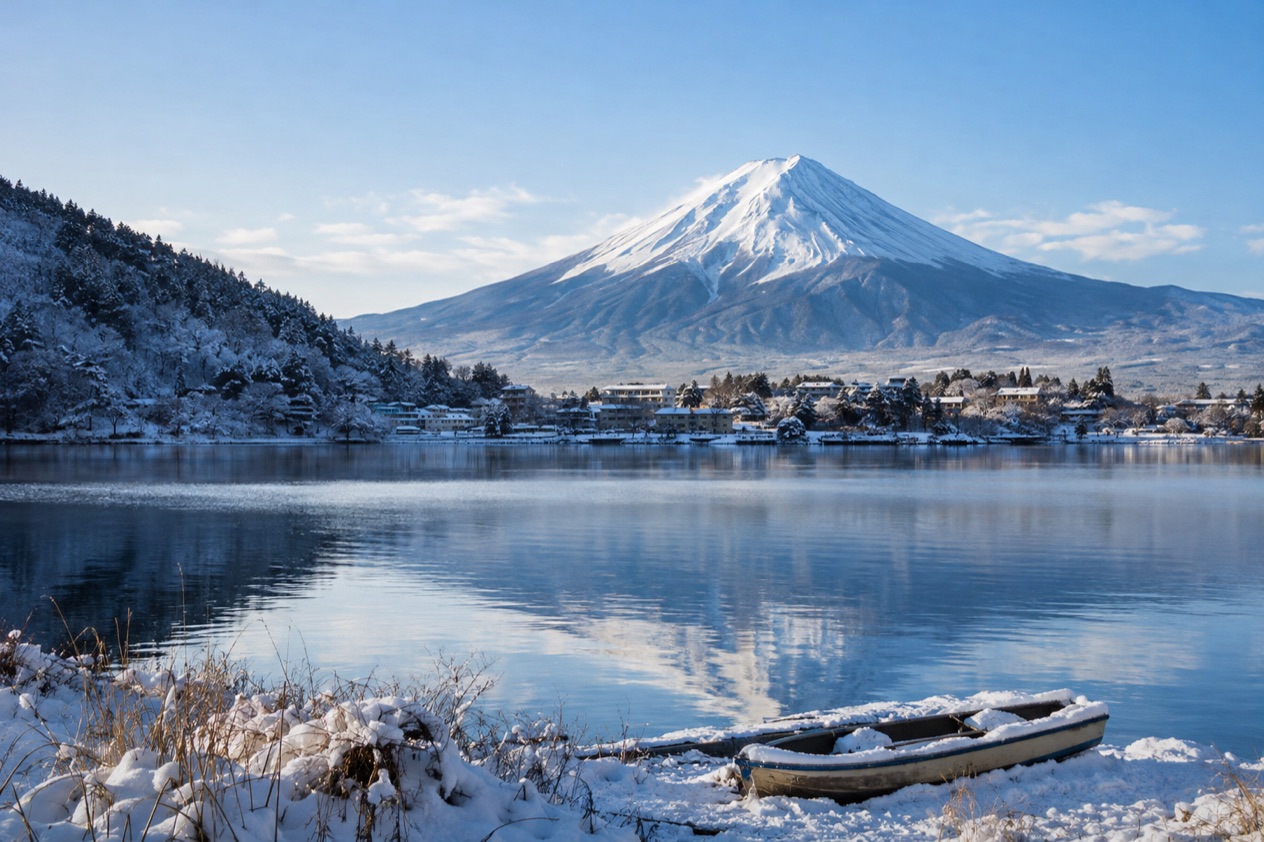
In February, the shore of Lake Kawaguchi is a place of hard frost, bare branches and a white cone that rises above the cloud when the sky decides to open. Indoors, steam climbs from bowls of hoto, the thick miso noodle stew of Yamanashi, and early in the month families toss roasted soybeans out of their doors to chase away bad luck. This is the cold heart of winter at the foot of Mount Fuji, a month for hot baths, warm bowls and a mountain you look at rather than climb.
What is the weather like in Mount Fuji and Lake Kawaguchi in February?
February is cold, with freezing nights, chilly afternoons and a good deal of sunshine between the snowy days. At Kawaguchiko, on the shore of Lake Kawaguchi, the weather runs like this across the three winter months.
| Month | Average high (°F) | Average low (°F) | Precipitation (in) | Days with 1 mm or more of precipitation | Hours of sunshine | Daylight on the 15th | Snowfall (in) |
|---|---|---|---|---|---|---|---|
| January | 41.9 | 21.7 | 2.40 | 4.9 | 212 | 10 h 00 min | 14.6 |
| February | 43.9 | 23.4 | 2.18 | 5.1 | 191 | 10 h 53 min | 11.0 |
| March | 50.9 | 29.7 | 4.24 | 9.1 | 186 | 11 h 54 min | 7.9 |
Afternoons in the low 40s are cold but workable for walking the lakeshore if you are dressed in layers, while nights drop well below freezing, so anything wet or damp turns to ice after dark. Rain is not the story in February. Snow is, and it falls on a good number of days, usually in modest amounts that dust the roads and the shoreline rather than bury them.
The sun shows itself often enough that a gray morning can turn into a bright, hard-edged afternoon, and the light is low and clear over the water. Higher up, the Mount Fuji summit sits far colder, with average highs of only about 6°F, which is why the upper slopes stay a world of ice and wind.
What to wear follows from this: a warm coat, thermal layers, gloves, a hat and waterproof shoes with a grip. A scarf earns its place on the lakeshore, where the air off the water bites. Moisture in the air is moderate, so the cold feels dry and sharp rather than damp.
What to do in Mount Fuji and Lake Kawaguchi in February
The best of February here is simple pleasures: a long look at the mountain whenever the clouds part, a walk along a frosty shore, a hot bath afterwards and a bowl of something thick and savory. The month also opens with one of Japan’s best-loved household rituals, which gives the first days a festive edge even in the small towns around the lake.
Setsubun and the bean-throwing
Setsubun, in early February, marks the eve of the start of spring in the old calendar. The main ritual is mamemaki, in which roasted soybeans called fukumame are thrown out the front door, or at someone in an oni (demon) mask, while everyone shouts “Oni wa soto! Fuku wa uchi!”, meaning devils out, fortune in.
Afterward comes the eating. Custom says you eat one bean for every year of your life, plus one extra for luck in the coming year, counting age the traditional way known as kazoedoshi.
It is a lively thing to witness at a shrine or temple, and an amusing thing to join in at home or in a guesthouse that sets out a little bowl of beans. In the frozen landscape around Mount Fuji, the talk of spring feels both ironic and hopeful.
The lakeshore and the white cone
Lake Kawaguchi is where visitors set up their days, and in February the shoreline has a stripped, graphic look: dark water, bare trees, snow along the banks and Mount Fuji standing over all of it. When the sky is clear, the cone can appear in the water’s surface as well as above the horizon. When it is not, the cloud has a beauty of its own, sweeping across the lake in slow gray sheets.
Walking a stretch of the shore, stopping at a café window and then walking again suits this weather, because the cold encourages short outdoor spells with warm interludes. Sunshine is generous in February, so there are bright hours to look for, but the mountain makes its own decisions. Plan for several glimpses rather than a single perfect view, and bring a camera that tolerates cold fingers.
The mountain in winter
In winter the climbing routes are shut. The Yoshida, Subashiri and Gotemba trails are closed from the 5th station to the summit, and the Fujinomiya Trail is closed from the 6th station up, and the climbing season itself ends in early September. February at Mount Fuji is therefore about looking, photographing and understanding the mountain from below, with the summit far above in conditions that belong to mountaineers only.
That shapes the whole mood of the month. Visitors come for the shape of the peak, for the lake and for the warmth indoors, rather than for a summit push. Climbers planning a future trip are advised to check the Official Website for Mt. Fuji Climbing, which carries the latest information for those who want to go up in the proper season.
Hoto, hot baths and winter tables
Hoto is the dish of the region and the one to order in February. Wide, flat noodles simmer in a miso broth with pumpkin, root vegetables and mushrooms, arriving in an iron pot that stays hot for the length of the meal. It is the sort of food that makes sense of cold fingers and a frosty walk, thick enough to be a whole meal.
A hot bath is the other half of a February day by the lake. Onsen (hot spring baths) and ryokan (Japanese inns) turn the cold into a pleasure, with steam rising from outdoor pools into the winter air and tatami rooms to retire to afterward. Late-winter plum trees also flower across East Asia from January until late February, a first small sign of spring to look for on garden walls and in gardens.
A two-day itinerary for Mount Fuji and Lake Kawaguchi in February
Day 1 starts with the lake. Daylight is limited to a little under eleven hours, so spend the morning outdoors while the air is clearest and the cold has the crispest feel. Walk a stretch of the Lake Kawaguchi shore with Fuji in your sights, and take your time over photographs, since the cloud may come and go.
At midday, find a warm room and order hoto, since a pot of noodles and vegetables is the right reward for a cold morning. The afternoon can go to a slower circuit by the water, with café stops to thaw. As the light drops, head for an onsen, and finish with dinner at your inn or at an izakaya (a casual pub), where the evening can run long because there is little reason to be outside.
Day 2 turns to the mountain’s wider surroundings. Spend the morning looking at Fuji from a different angle along another stretch of shoreline or from a lookout point, and let the weather decide how long you stay. Snow on the ground slows everything a little, so build in time for breaks rather than packing the day.
If the weather turns, put the plan indoors. Bring a book, since a gray day by the lake invites exactly that. A last warm meal in the evening closes the trip without any need to hurry back out.
Is Mount Fuji and Lake Kawaguchi busy in February?
February is deep winter here, with snow on the ground, a closed climbing season and the cherry blossom season still weeks away. The big reasons that draw visitors to the region at other times of year, a summit climb in summer or blossoms in spring, are not in play this month. What February offers is the mountain in its winter coat and the comforts of a cold-weather stay.
Snow sports are a different story elsewhere in Japan. Peak ski season falls in January and February in Hokkaido and the high mountains of Nagano, where snowfall is most frequent. Those are other places, and they set their own pace. Around Lake Kawaguchi, the month is defined by cold air, hot food and the shape of the peak.
The cherry blossom date at Kofu, the reference point for the area, usually falls in late March, so the blossom crowds belong to a later season. February sits before that rush, in the tail of winter, when the main event is the weather itself. Anyone arriving should take the season as it is: short bright spells, snow and an early dusk.
What to pack for Mount Fuji and Lake Kawaguchi in February
Pack for freezing nights and cold afternoons, with snow on the ground on a fair number of days. Layers matter more than a single heavy item, since you will move between the cold outdoors and warm interiors.
- A warm, windproof coat, because the air off the lake is sharp.
- Thermal base layers, for the long hours by the shore.
- Waterproof boots with a good grip, for snow and ice along the paths.
- Gloves, a hat and a scarf, since hands and ears feel the cold first.
- A camera or phone that works in the cold, with a spare battery, for the mountain views.
- Slip-on shoes or easy socks, since shoes come off at the entrance of a ryokan.
Good to know before you go
February is outside the typhoon season and the rainy season, and the weather question here is cold and snow. Snow or sleet falls on roughly ten days of the month, so expect icy ground, especially at night and early in the day.
The climbing trails above the 5th station (6th on the Fujinomiya side) are closed in winter, so the summit is not an option. Setsubun, early in the month, is a household and temple tradition rather than a closure day.
Mount Fuji and Lake Kawaguchi in February vs January and March
Going four weeks earlier brings the deepest cold of the winter. January has the lowest temperatures in the table and more snowfall, with longer sunshine hours but also shorter days. The New Year holidays also fall at its start, a time when many restaurants and attractions are closed in Japan. February keeps the frost but opens a little more light.
Going four weeks later brings a milder, wetter month. March is noticeably warmer, with more days of precipitation and much less snow, and the light stretches toward twelve hours. The cherry blossom date at the reference city of Kofu usually arrives around March 25 for first bloom, so a late-March trip leans toward spring rather than winter.
Those who want snow, hard frost and a purely winter mood should stay with February or move to January. Those who would rather have a softer edge to the air, with the first hints of spring and rain in place of snow, will prefer March. February sits in the middle, still wintry but with the days already lengthening.
Is February a good time to visit Mount Fuji and Lake Kawaguchi?
Yes, for travelers who enjoy winter, want the mountain in its snowy season and would happily trade a summit for a hot bath. February suits people who like cold, bright days, thick noodle stews and long evenings in a ryokan, and who are content to watch Fuji from the lakeshore.
It is a poor fit for anyone hoping to climb the mountain, since the trails are closed, or for those wanting cherry blossoms, which come weeks later. Travelers who dislike cold or icy paths should also look to a milder month. On arrival, the first task is to see the mountain while the sky is clear, then settle into the warmth of a meal and a bath.
What marks February here is the combination of a hard winter landscape and the small domestic rituals that answer it: beans thrown from doorways, steam from a hoto pot, the white peak lifting out of the cloud above a dark, cold lake.
Sources
- Japan Meteorological Agency (JMA), Normal values 1991-2020, monthly (https://www.data.jma.go.jp/stats/etrn/view/nml_sfc_ym.php?prec_no=49&block_no=47640), station Kawaguchiko, elevation 860 m, checked October 11, 2026
- Japan Meteorological Agency (JMA), Normal values 1991-2020, monthly (https://www.data.jma.go.jp/stats/etrn/view/nml_sfc_ym.php?prec_no=49&block_no=47639), station Fujisan, elevation 3,775 m, checked October 11, 2026
- Computed from the date and the latitude of the place (sunrise equation, solar elevation -0.833 degrees), October 11, 2026
- Wikipedia, Setsubun (https://en.wikipedia.org/wiki/Setsubun), checked October 11, 2026
- Japan National Tourism Organization, festivals and events (https://www.japan.travel/en/see-and-do/festivals-and-events/), checked October 11, 2026
- Sapporo Snow Festival official website (https://www.snowfes.com/english/), checked October 11, 2026
- Wikipedia, Sapporo Snow Festival (https://en.wikipedia.org/wiki/Sapporo_Snow_Festival), checked October 11, 2026
- Japan National Tourism Organization, winter in Japan (https://www.japan.travel/en/guide/winter-guide/), checked October 11, 2026
- Japan National Tourism Organization, skiing and snowboarding in Japan: regions, resorts, seasons (https://www.japan.travel/en/sports/snow/), checked October 11, 2026
- Wikipedia, Climate of Japan (https://en.wikipedia.org/wiki/Climate_of_Japan), checked October 11, 2026
- Japan National Tourism Organization, flowers by season: cherry blossom, plum, wisteria, hydrangea, where and when (https://www.japan.travel/en/see-and-do/flowers/), checked October 11, 2026
- Wikipedia, Prunus mume (https://en.wikipedia.org/wiki/Prunus_mume), checked October 11, 2026
- Japan National Tourism Organization, skiing guide (https://www.japan.travel/en/guide/skiing/), checked October 11, 2026
- Wikipedia, List of ski areas and resorts in Japan (https://en.wikipedia.org/wiki/List_of_ski_areas_and_resorts_in_Japan), checked October 11, 2026
- Japan National Tourism Organization, weather and seasons in Japan (https://www.japan.travel/en/plan/weather/), checked October 11, 2026
- Japan Meteorological Agency, cherry blossom first-bloom dates 2021-2026 and 1991-2020 normal (https://www.data.jma.go.jp/sakura/data/sakura003_07.html), checked October 11, 2026
- Japan Meteorological Agency, cherry blossom full-bloom dates 2021-2026 and 1991-2020 normal (https://www.data.jma.go.jp/sakura/data/sakura004_07.html), checked October 11, 2026
- Japan Meteorological Agency, biological season observations (https://www.data.jma.go.jp/sakura/data/index.html)
- Wikivoyage, Mount Fuji (https://en.wikivoyage.org/wiki/Mount_Fuji), checked October 11, 2026
- Japan National Tourism Organization, Mount Fuji guide (https://www.japan.travel/en/fuji-guide/), checked October 11, 2026
- Official website for Mt. Fuji climbing, about the climb (https://www.fujisan-climb.jp/en/about/), checked October 11, 2026
- Official website for Mt. Fuji climbing, information (https://www.fujisan-climb.jp/en/info/), checked October 11, 2026
To plan your stay
- Things to Do in Mount Fuji and Lake Kawaguchi: Lakeside Views, Fuji-Q Highland, Hiking Season and Local Food
- Where to Stay in Mount Fuji and Lake Kawaguchi: Lakeshore Hotels, Fujiyoshida, Mountain Lodges and Ryokan
- Mount Fuji and Lake Kawaguchi from Tokyo: Fuji Excursion, the Fujikyuko Line and Climbing Season
- Best Views of Mount Fuji: Five Lakes, Fifth Station Promenades and When to Go