
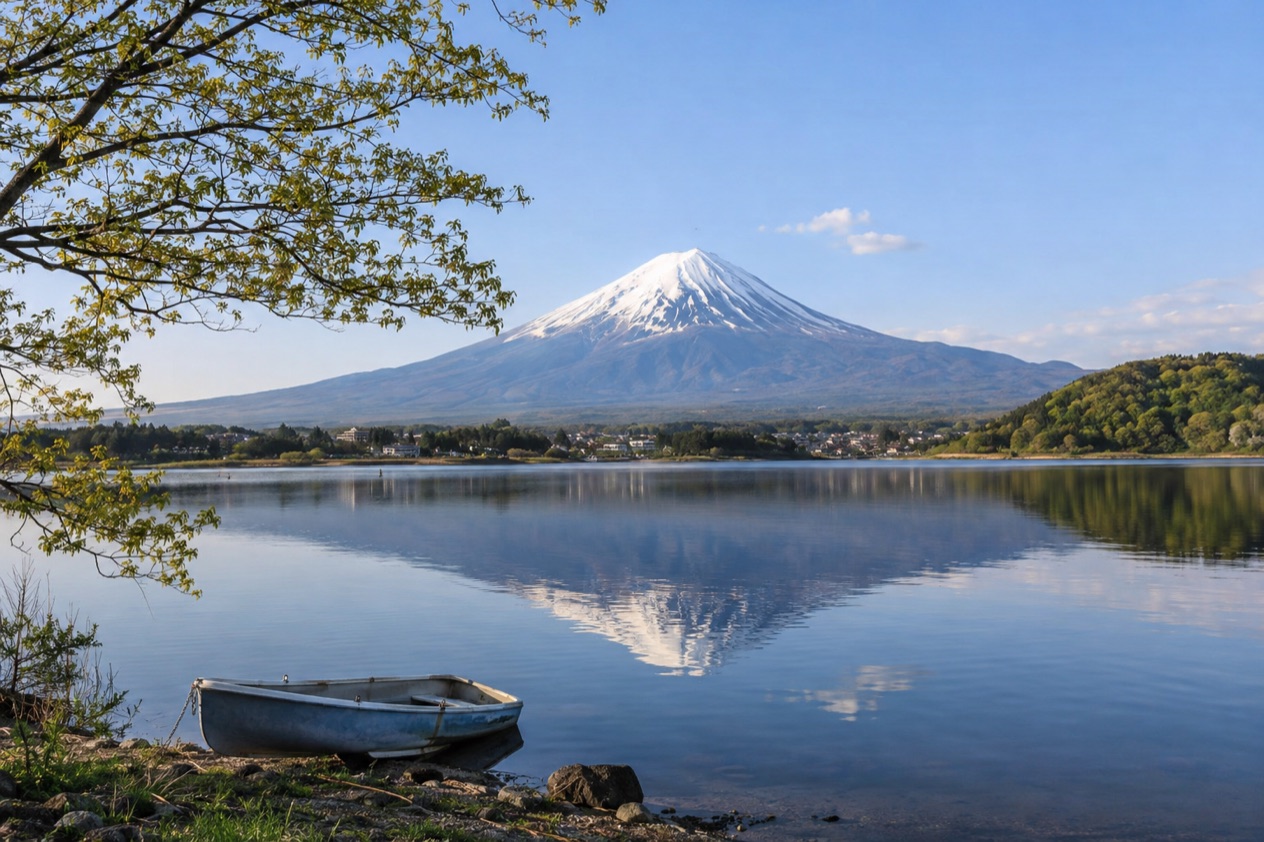
In April, the cherry trees around the lake are starting to flower, and the mountain stands over them with its upper slopes still white. Visitors walk the shore with cameras pointed at that pairing, a soft pink foreground against a snow-covered cone.
The air is cool, the days are lengthening, and winter has not quite let go. It is a month for people who want Fuji in its spring dress, with petals, steaming bowls of noodles and a light jacket.
What is the weather like in Mount Fuji and Lake Kawaguchi in April?
April at Lake Kawaguchi is cool and changeable, with fresh afternoons, cold nights and a mix of sunny spells and passing showers. At Kawaguchiko, on the lakeshore at 860 meters, the month sits between a wintry March and a distinctly milder May.
| Month | Average high (°F) | Average low (°F) | Precipitation (in) | Days with 1 mm or more of precipitation | Hours of sunshine | Daylight on the 15th |
|---|---|---|---|---|---|---|
| March | 50.9 | 29.7 | 4.24 | 9.1 | 186 | 11 h 54 min |
| April | 61.0 | 38.7 | 4.18 | 8.5 | 186 | 13 h 03 min |
| May | 69.1 | 48.0 | 4.85 | 9.4 | 181 | 14 h 01 min |
What this means in practice is layers. A light jacket or a simple sweater is enough for much of Japan in spring, but at this altitude the nights stay close enough to winter that a warm layer under the jacket is welcome. Once the sun is out, a sweater and a scarf feel right for strolling the shore, and you can peel one off when you stop for lunch.
Rain falls on roughly one day in three, usually as showers rather than a whole week of gray, so an umbrella or a packable rain shell earns its place in the bag. A little snow or sleet can still turn up on a couple of days, and the summit of Fuji itself stays far colder than the lake, with highs well below freezing. That is why the cone keeps its white cap while the shoreline turns green.
Sunshine hours are the same as in March, so the sky is brighter mostly because the days are longer and the sun sits higher.
What to do in Mount Fuji and Lake Kawaguchi in April
The cherry blossom is the heart of the month. It is one of Japan’s most iconic symbols and the harbinger of spring, and in the Fuji area it comes with a view that few other blossom spots can offer.
The Japan Meteorological Agency has no blossom observation point at the lake, and the nearest reference is Kofu, where the usual first bloom falls around March 25 and full bloom around April 2. In recent years Kofu has seen first bloom anywhere from mid to late March, so the flowers vary from one spring to the next, and the lake’s own timing can differ from the valley’s.
Spring here is also a season of other flowers, from plum and peach to the moss phlox carpets that gardens around the mountain plant on their hillsides. Peach trees signal spring in places like Toyota in Aichi Prefecture, and the same idea of an orchard in bloom applies across the Kofu basin below Fuji. April days reward anyone who likes to wander slowly and stop whenever a branch frames the mountain.
Blossoms and the mountain along the lake
The northern shore of Lake Kawaguchi is where visitors look for the picture. Cherry trees line parts of the lakeside paths, and on a clear day Fuji rises behind them with its reflection sometimes broken into ripples by a passing boat. Oishi Park, with its flowerbeds and lake-edge lawns, is a favorite spot for this kind of view, and locals bring picnic sheets in the spring for hanami, the custom of sitting under the blossoms to eat and talk.
Clouds hide the mountain on some days, and that is part of the deal with Fuji. When it stays covered, the lakeside is still pleasant for a slow walk, a coffee or a boat ride, and the blossoms look good against a pale sky. It suits people who enjoy photography and slow outdoor time more than a packed list of sights.
Seeing Fuji from above and from the water
The Kachi Kachi Ropeway climbs from the lakeshore to a small viewpoint above the water, where the lake, the town and the cone fit in one frame. The name comes from a Japanese folktale, and a tanuki (raccoon dog) statue and little shops at the top keep that story alive. In April the hillside around it is turning from brown to green, which makes the view feel different from a winter or summer visit.
Down at the water, sightseeing boats cross the lake, and the shoreline walk is as much a part of the experience as the ride. Anyone with a long afternoon can also continue to one of the other lakes in the Fuji area, each with a slightly different angle on the mountain. Fuji sits on the border of Shizuoka and Yamanashi prefectures, so the view changes with every shore.
Hot springs and hoto noodles
After a cool day outdoors, the area’s onsen (natural hot springs) are the obvious reward, and several lakeside inns have baths with a view of the mountain. Yamanashi’s local comfort dish is hoto, thick flat wheat noodles simmered in a miso broth with pumpkin, mushrooms and other vegetables, served bubbling in an iron pot. In a month when mornings and evenings are cold, it is exactly the right thing to eat.
Wild mountain vegetables (sansai) appear on spring menus, often as tempura or in small dishes beside rice, and fresh strawberries are a seasonal treat in the region’s fruit-growing valleys. Yamanashi is known for its fruit and its wine, so a glass of local white with a plate of spring vegetables is a natural pairing for a lakeside dinner.
Mount Fuji itself is a UNESCO World Heritage site, and the official climbing season is not April. The most popular period for hiking is July and August, when huts and facilities are operating and the weather is warmest, and anyone planning to climb is advised to consult the official climbing website. In April the mountain is for looking at, photographing and circling by road, rather than climbing.
Rainy or cloudy days point toward indoor stops: museums and galleries around the lake, a craft workshop, or a long lunch in a noodle restaurant. Shops in towns generally keep long hours, so a gray afternoon can turn into a browse through souvenir stores and sweets shops selling local fruit jellies and mochi.
A two-day itinerary for Mount Fuji and Lake Kawaguchi in April
Day 1 belongs to the lake. Start with a walk along the shore at an unhurried pace, stopping where the cherry trees open onto a view of the mountain, and take time to look at the snowline before the light changes. Mid-morning is a good moment for a boat on the water or a visit to the ropeway for the view down onto the lake.
Midday means hoto noodles in a restaurant with a wooden interior, since the broth and the heat of the pot make sense in a cool month. In the afternoon, go to Oishi Park for flowerbeds, blossoms and the long view across the water, then rest with coffee or sweets. Evening belongs to an onsen and a dinner of local vegetables, fish and Yamanashi wine, with the day’s long light fading slowly.
Day 2 widens the circle. Spend the morning at another of the Fuji area lakes, where the shoreline and the mountain have a different feel, and linger over spring flowers and the colors of the hills. April’s longer days leave room for a last stroll along the water before dinner.
If the weather turns, switch the order. Keep the museum, the onsen and the long lunch for the wet hours, and save the viewpoints for whenever the cloud lifts, since Fuji is often visible only in pieces. A rainy afternoon is also a good moment for a tea house, a tasting of local wine or a slow walk under an umbrella through blossom-lined paths.
Is Mount Fuji and Lake Kawaguchi busy in April?
April is a month of blossoms, and cherry-blossom season is the reason people pick this time to see Japan, so the lakeside takes on a spring-break mood. The Fuji area is part of that story, because the combination of flowers and the mountain is a favorite subject for visitors and photographers. The pace is lively along the shore and around the main viewpoints, with groups gathered under the trees whenever the blossoms are at their height.
The calendar changes at the very end of the month. Showa Day on April 29 opens Golden Week, a holiday period that runs to May 5 and contains several public holidays.
Four of those days are officially designated as public holidays: Showa Day, Constitution Memorial Day on May 3, Greenery Day on May 4 and Children’s Day on May 5. When a national holiday falls on a Sunday, the next working day becomes a public holiday, and a day squeezed between two holidays becomes one too.
For a visitor, that means the first three weeks of April and the last days of the month have different rhythms. The earlier part is a time of blossoms, flower festivals and mild days, while the last days merge into a long national holiday. Anyone with flexible dates can pick the part of the month that suits them.
What to pack for Mount Fuji and Lake Kawaguchi in April
Pack for a cool spring at 860 meters, with a mix of sun, showers and cold nights. The aim is to be warm enough by the water and comfortable once the sun is out.
- A light jacket, as spring in Japan is comfortable with one over a simple sweater.
- A warm layer or fleece, since nights are cold at the lake.
- A packable rain shell or umbrella for the showers.
- Walking shoes that can handle damp paths and petals.
- A scarf and light gloves for early and late hours by the water.
- Sunglasses for bright days with snow still on the mountain.
Good to know before you go
The main calendar point in April is Golden Week, which begins on April 29 and brings several public holidays through May 5. Weather at the lake can change quickly, and a little snow or sleet is still possible on a couple of days, so the clothing in your bag matters more than the date on the calendar. Mount Fuji’s summit is far colder than the shoreline, and the climbing season for the mountain is summer, so the official climbing website is the place to look if a climb is part of your plans.
Mount Fuji and Lake Kawaguchi in April vs March and May
Moving the trip four weeks earlier brings a colder, more wintry lake. March has the most snow of the three months, with the mountain deep in white and the shoreline still bare, and the cherry blossoms are far from the lake. It suits people who want a snowy Fuji and quieter paths, and who do not mind cold hands.
Four weeks later, May is noticeably warmer, with green hills, longer days and more rain on the calendar. The blossoms are over, the days are comfortable in a light layer, and the mountain keeps less of its snow. May also has Golden Week at its start, so the early days of the month belong to the national holiday.
April sits in between, which is why it works for people who want both blossoms and a snow-capped mountain in the same view. Travelers who care most about flowers should aim for April, those who prefer warm hiking days should lean toward May, and anyone chasing a winter landscape should choose March.
Is April a good time to visit Mount Fuji and Lake Kawaguchi?
Yes, April is a very good time for anyone who wants flowers, a cool climate and a snow-capped mountain in the same frame. It suits photographers, slow walkers, onsen lovers and anyone who likes the idea of a bowl of hoto after a day outdoors. Visitors who want to climb Fuji, swim or enjoy warm, settled summer weather should choose another season.
On arrival, start with the shoreline. A first walk by the water shows how the cloud, the blossoms and the snowline are behaving that day, and it helps decide whether to head for the ropeway or settle into a museum and a long lunch first. Keep the warm layer close at hand, because the temperature drops quickly when the sun goes behind a cloud.
What makes April special at Lake Kawaguchi is the contrast. Pink petals fall at the foot of a mountain that is still wearing winter, the water carries both in its reflection, and a pot of steaming noodles waits at the end of the walk.
Sources
- Japan Meteorological Agency (JMA), Normal values 1991-2020, monthly (https://www.data.jma.go.jp/stats/etrn/view/nml_sfc_ym.php?prec_no=49&block_no=47640), station Kawaguchiko, elevation 860 m, checked October 11, 2026
- Japan Meteorological Agency (JMA), Normal values 1991-2020, monthly (https://www.data.jma.go.jp/stats/etrn/view/nml_sfc_ym.php?prec_no=49&block_no=47639), station Fujisan, elevation 3,775 m, checked October 11, 2026
- Computed from the date and the latitude of the place (sunrise equation, solar elevation -0.833 degrees), October 11, 2026
- Japan Meteorological Agency, cherry blossom first-bloom dates 2021-2026 and 1991-2020 normal (https://www.data.jma.go.jp/sakura/data/sakura003_07.html), checked October 11, 2026
- Japan Meteorological Agency, cherry blossom full-bloom dates 2021-2026 and 1991-2020 normal (https://www.data.jma.go.jp/sakura/data/sakura004_07.html), checked October 11, 2026
- Japan Meteorological Agency, sakura2020.pdf (https://www.data.jma.go.jp/sakura/data/sakura2020.pdf), checked October 11, 2026
- Japan National Tourism Organization, spring in Japan (https://www.japan.travel/en/guide/spring-guide/), checked October 11, 2026
- Japan National Tourism Organization, flowers by season: cherry blossom, plum, wisteria, hydrangea, where and when (https://www.japan.travel/en/see-and-do/flowers/), checked October 11, 2026
- Wikipedia, Wisteria (https://en.wikipedia.org/wiki/Wisteria), checked October 11, 2026
- Japan National Tourism Organization, shop and attraction hours, national holidays (https://www.japan.travel/en/plan/business-hours-and-holidays/), checked October 11, 2026
- Wikipedia, Golden Week (Japan) (https://en.wikipedia.org/wiki/Golden_Week_(Japan)), checked October 11, 2026
- Wikipedia, Public holidays in Japan (https://en.wikipedia.org/wiki/Public_holidays_in_Japan), checked October 11, 2026
- Japan Meteorological Agency, biological season observations (https://www.data.jma.go.jp/sakura/data/index.html)
- Official website for Mt. Fuji climbing, information (https://www.fujisan-climb.jp/en/info/), checked October 11, 2026
- Wikipedia, Mount Fuji (https://en.wikipedia.org/wiki/Mount_Fuji), checked October 11, 2026
- Wikivoyage, Mount Fuji (https://en.wikivoyage.org/wiki/Mount_Fuji), checked October 11, 2026
- Japan National Tourism Organization, Mount Fuji guide (https://www.japan.travel/en/fuji-guide/), checked October 11, 2026
- Official website for Mt. Fuji climbing, about the climb (https://www.fujisan-climb.jp/en/about/), checked October 11, 2026
To plan your stay
- Things to Do in Mount Fuji and Lake Kawaguchi: Lakeside Views, Fuji-Q Highland, Hiking Season and Local Food
- Where to Stay in Mount Fuji and Lake Kawaguchi: Lakeshore Hotels, Fujiyoshida, Mountain Lodges and Ryokan
- Mount Fuji and Lake Kawaguchi from Tokyo: Fuji Excursion, the Fujikyuko Line and Climbing Season
- Best Views of Mount Fuji: Five Lakes, Fifth Station Promenades and When to Go