
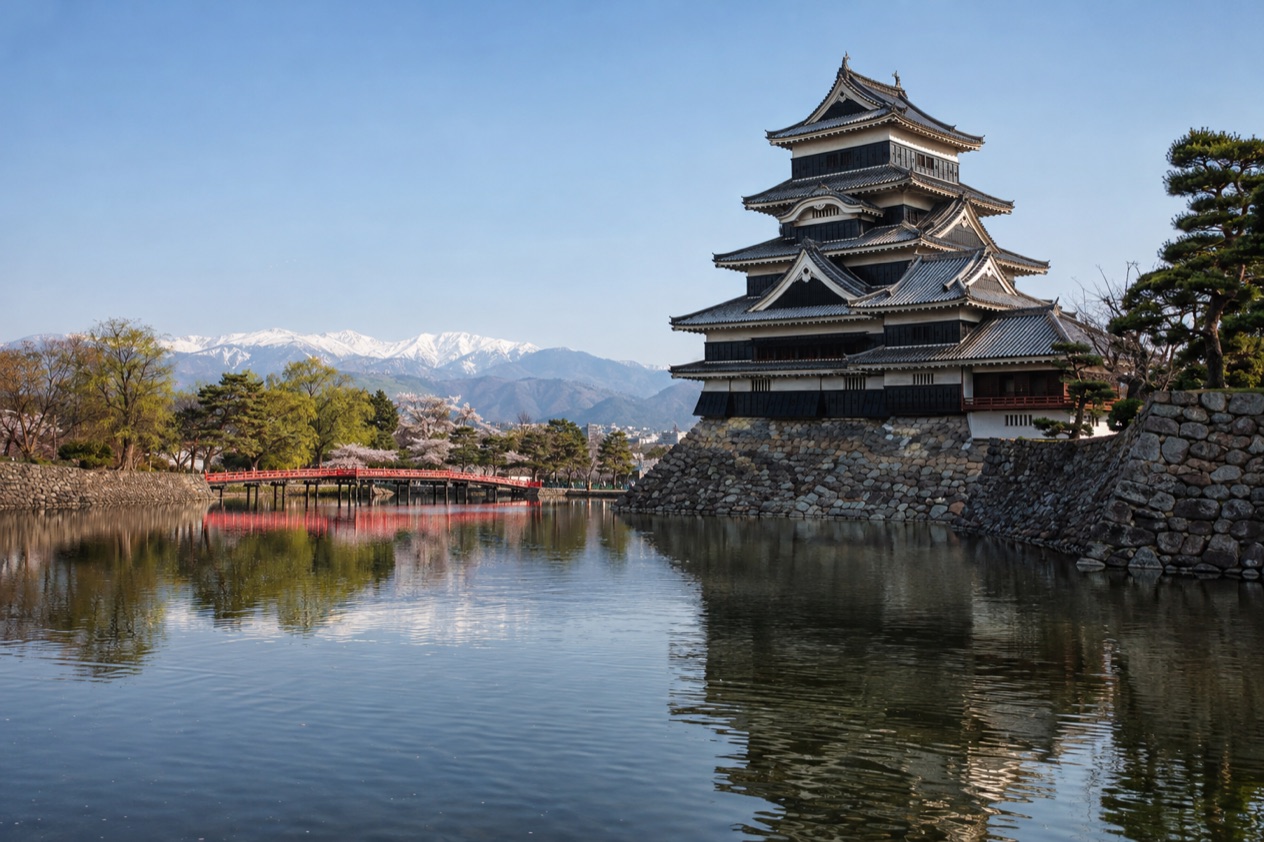
The black keep of Matsumoto Castle holds its reflection in the moat, and over the rooftops the peaks of the Japan Alps cut a hard line against the sky. Down the lanes, soba shops hang their noren curtains, and a gallery or a craft store seems to sit on every other corner. Matsumoto is a city in Nagano Prefecture for travelers who like a real castle, good art and mountain scenery in the same stay.
Where is Matsumoto and what is it like?
Matsumoto is a city in Nagano Prefecture at the eastern end of the Japan Alps, south of Nagano City, and it works as a town where a castle, museums and mountain country meet. It is a place you move through at the pace of a walker with a camera and a free afternoon, stopping for coffee between a moat and a gallery.
The mountains are the backdrop to everything. From the castle grounds and from many streets you see the Alps standing behind the buildings, and that horizon gives the city its mood: a mountain town with the manners of a small cultural center.
The Hida Mountains lie in the same part of the country, and Kamikochi, a highland valley in Chubu-Sangaku National Park, belongs to that range in western Nagano Prefecture. Matsumoto is the city people think of when they picture a base for that scenery.
The character is more about craft and taste than spectacle. You find old storehouse-style buildings with white lattice walls, shops selling folk crafts and woodwork, small coffeehouses, and restaurants built around Nagano’s love of buckwheat noodles. Evenings are for izakaya, the casual pubs where plates of grilled and simmered dishes arrive one after another with a glass of local sake.
Matsumoto suits travelers who enjoy history, art and walking, and who like a base with a mountain horizon. It also suits people who want a stop between Tokyo and the Alps or between Nagoya and Nagano. It may disappoint anyone looking for a seaside resort or a big-city nightlife scene, because the pleasures here are quieter and more local: a castle at dusk, a gallery, a bowl of soba, a view of snow-streaked peaks.
The city has been designated a core city since April 1, 2021, a status that speaks to its size as a regional center. For a visitor, what that means is a town with real shops, museums and transport links, set in a landscape of mountains rather than skyscrapers.
What is there to do in Matsumoto?
The reasons to come are a castle that survived from the age of the samurai, a museum devoted to woodblock prints, streets that suit browsing and eating, and the Alps just beyond. What sets Matsumoto apart from its neighbors is that the castle still stands in its original form, so you see the real structure rather than a modern rebuild.
Matsumoto Castle
Matsumoto Castle was built at the end of the 16th century and is one of the oldest original castles in Japan, a National Treasure that has stood for more than 400 years. Its dark exterior and white-trimmed upper stories give it a bold look, and it sits within a moat that mirrors the keep in the water. You walk the grounds, cross the red bridge near the moat, and take in the keep from several angles.
Inside, the keep is a world of heavy timber, steep wooden stairs and narrow windows, the kind of interior that makes the castle’s military purpose easy to read. It suits anyone interested in samurai history or architecture, and it rewards a slow visit with a camera. Pair it with a stroll around the moat so you see the building from outside as well as within.
Japan Ukiyo-e Museum
The Japan Ukiyo-e Museum holds over 10,000 pieces of ukiyo-e, the largest private collection of its kind in the world. Ukiyo-e are the woodblock prints of Japan’s old city culture, with themes such as actors, beauties, landscapes and scenes of daily life. Seeing them in one place lets you follow how the style, color and subject matter shifted from artist to artist.
It is a good fit for a rainy afternoon or a break from walking, and for travelers who enjoy Japanese art without needing deep background. The prints reward close looking at line and color, and they tie neatly to the city’s craft traditions.
Streets, crafts and food
Matsumoto rewards wandering. Nakamachi is the street known for its kura, the white-walled storehouses with black lattice patterns, and many now hold shops and cafes. Nawate Street is a lane of small stalls and snack vendors. Folk crafts, called mingei, are part of the local identity, and you see woodwork, ceramics and textiles in shop windows.
For meals, Nagano is soba country, and a bowl of cold buckwheat noodles with a dipping sauce, grated radish and scallions is the dish to look for. Oyaki, stuffed dumplings of the prefecture, make a snack, and local sake pairs with the izakaya plates of an evening. The city is also known for its art, including the Matsumoto City Museum of Art, whose collection includes work by Yayoi Kusama, an artist born here.
The mountains around Matsumoto
Kamikochi is a remote highland valley in the Hida Mountains, preserved within Chubu-Sangaku National Park in western Nagano Prefecture. Travelers think of it as a destination for mountain scenery, with rivers, peaks and forest, and Matsumoto is the city that puts you in this region.
Even without leaving town, the Alps are present on the skyline, and the seasons reshape the view: green slopes, autumn color on the hillsides, and white on the tops in winter. It is a landscape you keep noticing as you walk to the castle or a museum.
How many days do you need in Matsumoto?
A long weekend is enough to see the city well, and a few extra days let you add the mountains and a neighboring town. The core sights, the castle and the ukiyo-e museum, fit comfortably into a single day, leaving time for the old streets and a good dinner.
With two days, you can add a slower pass through Nakamachi and Nawate Street, a gallery such as the Matsumoto City Museum of Art, and a long lunch of soba. A second evening in an izakaya fits well. This pace suits travelers who like to linger over coffee and to see the castle once in daylight and once when the lights come on around the moat.
Matsumoto is also a stop on routes to other towns: a bus service links it with Takayama in Gifu Prefecture, which makes a combined trip across the Alps possible, and Nagano Station is a short train ride away if you want to continue to Nagano City.
If you are passing through on the way between Tokyo and Nagoya or Nagano, even a single night is worthwhile. Arrive in time to see the castle, have dinner in town, and spend the next morning in a museum or on the old streets before moving on. A trip that includes the mountains deserves more time, because the valley and the city each ask for their own days.
Where to stay in Matsumoto
Staying in the city itself is the choice that makes the most sense, because the castle, the museums, the craft streets and the restaurants all sit in the town and the Alps rise just behind. A base in Matsumoto lets you walk out in the evening to see the castle lit and then have dinner without needing a train.
The kinds of lodging you will meet are the ones you find in many Japanese cities: business hotels, small inns and the occasional ryokan, the traditional inn where shoes come off at the entrance, rooms have tatami floors and guests change into a yukata, a light cotton robe. If your trip is about the castle and museums, a place in town works well. If your trip centers on the mountains, think about how early you want to start your days and whether you want city comforts at the end of them.
Travelers arriving by plane have another option: Matsumoto Airport sits about 20 minutes from downtown, so a night in the city fits naturally after a late flight from Osaka, Sapporo or Fukuoka. Those arriving by train step into the city directly, with the train lines from Tokyo, Nagoya and Nagano all ending in town.
What you want from a room tells you where to look. A traveler who loves old Japan might choose a ryokan for the experience of tatami, futon bedding and a multi-course dinner in the room or dining hall.
Someone on a tighter schedule may prefer a hotel for the flexibility. Either way, the city’s scale means that most of what you came for lies in the town, and the mountain horizon follows you wherever you sleep.
How do you get to Matsumoto and get around?
Visitors come by train, from Tokyo, Nagoya or Nagano, and a few arrive by air or by bus. Matsumoto lies 104 miles from central Tokyo, and the rail connections tie it to the big cities on either side.
| From | By | Time |
|---|---|---|
| Tokyo (Shinjuku Station) | Train | 2 hours 40 minutes |
| Nagoya Station | Train | 2 hours |
| Nagano Station | Train | 50 minutes |
| Takayama (Gifu Prefecture) | Bus | 2 hours 30 minutes |
Matsumoto Airport (MMJ) has commercial flights only from Osaka, Sapporo and Fukuoka, which makes it a gateway for travelers coming from those cities. Downtown is about 20 minutes from the airport. Anyone arriving from elsewhere typically comes by rail from one of the neighboring cities.
Once in town, the sights are in the city itself, and you can reach the castle, the old streets and the museums on foot or by bus. One detail matters when you board a bus: Japanese IC cards, such as Suica and Pasmo, do not work on buses in Matsumoto. Contactless payment with major credit cards is possible, except Mastercard.
Kamikochi lies in the Hida Mountains of western Nagano Prefecture, inside Chubu-Sangaku National Park, and it is a destination that needs its own planning rather than a quick add-on. For the bus to Takayama, the connection is a direct service that links the two places, a useful route for travelers crossing between Nagano and Gifu Prefectures.
When is the best time to visit Matsumoto?
Spring and autumn are the seasons that travelers aim for, roughly April and May and then October and November. In spring, cherry trees and fresh green set off the dark castle and the moat, and in autumn the hillsides around the city turn red and gold, a color that pairs well with the black walls of the keep and the sight of the Alps in the distance.
Summer is the season of green mountains and long days for the highlands, and it is when travelers drawn to the Alps think of Kamikochi. Winter changes the picture again: the peaks behind the city carry snow, the air turns cold, and the castle takes on a stark look against a white and gray sky. It is a good time for museums, hot food and long evenings in an izakaya, though you should dress for cold weather in the mountains.
Matsumoto does not hinge on one big festival, so the choice comes down to the landscape you want to see. Blossoms and fresh green point to spring, red leaves to autumn, snow-covered peaks to winter and open mountain country to summer. Whichever season you choose, the castle, the ukiyo-e collection and the old streets are all there, so a trip never depends on a single moment of the year.
Good to know before you go
Money matters on the bus: Japanese IC cards are not accepted on buses in Matsumoto, though contactless payment with major credit cards other than Mastercard works, so a different card is worth carrying if you hold only Mastercard. Beyond that, the city runs on ordinary Japanese habits: shoes come off at ryokan entrances, voices stay low on public transport, and a bow or a quiet thank-you goes a long way in shops and restaurants.
Matsumoto is a mountain city, so the weather can shift with the seasons and the altitude of the Alps behind it. Pack layers for the changes between morning and evening, and bring comfortable shoes for the castle grounds and the old streets. The castle, the museum and the markets are what you come for, and the town gives you plenty of reasons to slow down and look.
Sources
- Japan National Tourism Organization, Matsumoto (https://www.japan.travel/en/destinations/hokuriku-shinetsu/nagano/matsumoto-and-around/), checked October 11, 2026
- Wikipedia, Matsumoto, Nagano (https://en.wikipedia.org/wiki/Matsumoto,_Nagano), checked October 11, 2026
- Wikivoyage, Matsumoto (https://en.wikivoyage.org/wiki/Matsumoto), checked October 11, 2026
- Wikipedia, Matsumoto Castle (https://en.wikipedia.org/wiki/Matsumoto_Castle), checked October 11, 2026
- Wikipedia, Kamikōchi (https://en.wikipedia.org/wiki/Kamik%C5%8Dchi), checked October 11, 2026