
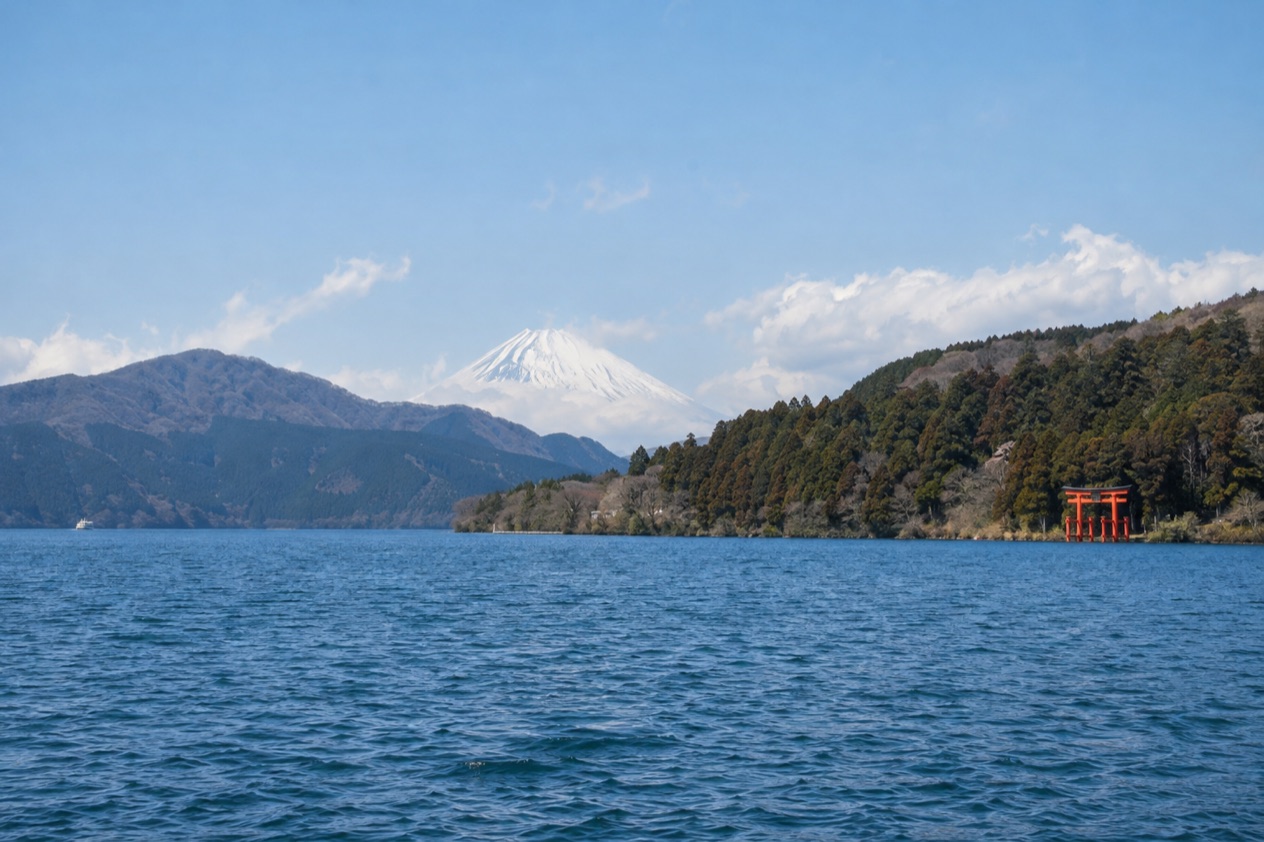
A pirate-style ship slides away from the pier, its flag snapping in the wind, and the water opens out into a wide caldera lake ringed by wooded ridges. On a clear day Mount Fuji hangs over the far end like a painted backdrop. Lake Ashi is a place for slow looking and for hopping between piers, shrines and viewpoints.
Is visiting Lake Ashi worth it?
Yes, for travelers who like their scenery with a bit of theater: a crater lake, boats styled after sailing warships, hot springs close by and a view of Mount Fuji when the sky allows it. It suits first-time visitors to Japan who want a break from Tokyo, couples, families who enjoy boats, and anyone building a loop around Hakone.
What sets it apart from other lakes in the region is that it works as the hinge of a whole circuit. The cruise connects to the Hakone Ropeway at Togendai, the ropeway leads to Sounzan, and from there a cable car and a train carry you down toward Odawara.
Lake Ashi also lies along the historic Tokaido road, the route that once linked Kyoto and Tokyo, so a stroll along the shore brushes against centuries of travelers. The views of Mount Fuji are a gift, not a guarantee, and clouds can hide the peak. Even then the lake has plenty to offer, from a shrine on the water’s edge to a former imperial retreat that is now a public park.
What to see at Lake Ashi
The Hakone Sightseeing Cruise
The ships on the lake are themed to resemble pirate ships, and several of the boats and ferries are styled after sailing warships. They look a little playful against the quiet forested shore, and children tend to love them. The Hakone Sightseeing Cruise is operated by the Odakyu Hakone Company and runs counterclockwise, calling at Togendai Station, Moto-Hakone Port and Hakone-Machi Port before returning to Togendai.
A crossing between Togendai on the north shore and either Hakone-machi or Moto-hakone on the south shore takes 25 minutes, while a full loop takes about 90 minutes. The Royal II has been newly renovated, and the Victory and Moto-Hakone Port have been remodeled to offer an elegant cruise. On deck, watch for Fuji over the water and for the red torii that stands in the lake near the shrine.
Hakone Shrine on the shore
Hakone Shrine sits along the edge of the lake and has been visited by shogun, samurai and ordinary travelers for centuries. It is the kind of place where tall trees, stone steps and the smell of old wood do most of the talking.
Pair it with a walk along the shoreline near Moto-Hakone, where the old Tokaido road once passed. Imagine the travelers of long ago catching their first glimpse of the water here. Take your time on the shrine paths, and look at the lanterns and the small offering stalls.
Onshi Park
Onshi Park was established in 1886 as a summer retreat for the imperial family and is now open to the public. Its setting on the lake gives it the air of a garden made for looking outward, with the water in front and the hills behind.
It is a pleasant place to sit after the cruise and let the lake come to you. Bring a camera for Fuji if the day cooperates, and enjoy the old-fashioned atmosphere of a former royal getaway.
Togendai, the ropeway and Owakudani
At Togendai you can step from the cruise onto the Hakone Ropeway, which connects to Sounzan. Along the ropeway lies Owakudani, where a new tourist spot has opened with the Earth Valley observation area and the new Owakudani Station. OWAKUDANI KITCHEN has opened at Earth Valley, and the area is where visitors taste the black eggs said to prolong life. During scheduled maintenance, a replacement bus service operates on sections of the ropeway, so the ride may look different depending on the day.
Hours, tickets and rules
The lake itself is a natural landscape, so there is no gate to pass through. What carries a schedule and a fare is the transport around it, and the details of the cruise, ropeway and bus timetables are set by the Odakyu Hakone Group. Hakone Shrine and Onshi Park are open to visitors, though opening hours and admission are not set out here.
For getting around, the Hakone Freepass offers unlimited rides on eight different transportation means in Hakone, including the Hakone Tozan Train, the Hakone Ropeway and the Hakone Sightseeing Cruise. A Plus version also exists, described in the table.
| Pass | Valid for | What it covers |
|---|---|---|
| Hakone Freepass “Hako Ticket” Plus | 2 days or 3 days | Digital Hakone Freepass with unlimited use of 8 modes of transport, plus the Hako Ticket for applicable art museums, hot springs and activity facilities |
| Hako Ticket Plus with Odakyu Line ticket | 2 days or 3 days | Same as above, plus 1 return trip on the Odakyu Line between the departure station and Odawara Station |
Rules on swimming, drones, tripods or climbing are not given for the lake, so none are stated here. Official times for trains and buses in the Hakone area come from the Odakyu Hakone Group.
How to get to Lake Ashi
Lake Ashi lies in the Hakone area of Kanagawa Prefecture, in the western part of the prefecture and within Fuji-Hakone-Izu National Park. Visitors build a loop that links several kinds of transport, and the pieces fit together around the lake.
From the lake, the Hakone Sightseeing Cruise reaches Togendai, Moto-Hakone and Hakone-Machi. At Togendai the Hakone Ropeway connects to Sounzan. From Sounzan, the Hakone Tozan Cable Car links to the Hakone Tozan Line for travel to Odawara, with onward connections to Tokyo via the Tokaido Shinkansen. Read in the other direction, that chain is also how you reach the lake from Odawara.
Hakone-Yumoto, known for its many restaurants and gift shops, is another base in the area, and Sengokuhara is filled with art museums. The official Hakone website offers a route search and a timetable search, though both work only for transfers within Hakone or to the Odakyu Line or the Odakyu Highway Bus. The Hakone Freepass covers the Hakone Tozan Train, the ropeway and the cruise, so the same ticket carries you through much of this loop.
When to visit Lake Ashi
The air figures here belong to Odawara, at the foot of Hakone, so the lakeside itself is likely to feel cooler and wetter, since the mountain side of Hakone gets much more rain.
In October, Odawara has highs in the low 70s and lows in the upper 50s, with 131 hours of sunshine. Rain is common, so a gray day is a real possibility, and clouds can sit over Fuji.
January is cold, with highs near 51°F at Odawara and a clearer, crisper feel to the air, though the mountain side is colder still. April brings highs of about 66°F and heavier rain on the mountain, while July is warm and humid at the foot of Hakone, with highs near 84°F and a lot of rain on the mountain side.
| Month (Odawara) | Average high (°F) | Average low (°F) | Precipitation (in) | Sunshine (hours) |
|---|---|---|---|---|
| January | 51.1 | 33.1 | 3.30 | 180 |
| April | 66.0 | 48.6 | 7.15 | 177 |
| July | 84.2 | 71.6 | 8.50 | 163 |
| October | 72.0 | 57.4 | 9.40 | 131 |
Mountain-side precipitation at the Hakone station is far higher than at Odawara: 5.03 inches in January, 12.67 in April, 16.74 in July and 15.90 in October. In wet months, treat a clear view of Fuji as a pleasant bonus.
Tips for your visit
Plan the cruise as the center of the day. A full loop takes about 90 minutes, and a single crossing takes 25 minutes, so you can ride it as transport or as a sightseeing trip. If you want to see the water from several piers, stay aboard for the whole loop.
Combine the lake with the rest of Hakone. Owakudani and its black eggs are reached by the ropeway from Togendai, Sengokuhara has its art museums, and Hakone is known for its hot springs and traditional ryokan. Hakone also has the open-air art installations of Japan’s first open-air museum.
Bring layers, since the mountain side is cooler and wetter than the foot of Hakone, and bring a camera for the shrine gate and the Fuji view. Guide availability, parking and beach access are not covered here, so they are left out. If a maintenance notice affects the ropeway, a replacement bus runs on sections of it, which can change your plans for the day.
Good to know before you go
Rain is frequent in autumn and summer around Hakone, so a light rain layer is handy. The official Odakyu Hakone Group publishes train and bus times, and the Hakone Freepass is the pass designed for moving between the cruise, ropeway and train. Move at the lake’s own pace, and let the shrine, the park and the ship give the day its shape.
Sources
- Hakone Tourist Information (https://www.hakonenavi.jp/international/en/), checked October 11, 2026
- Wikipedia, Lake Ashi (https://en.wikipedia.org/wiki/Lake_Ashi), checked October 11, 2026
- Japan National Tourism Organization, Hakone (https://www.japan.travel/en/destinations/kanto/kanagawa/hakone-and-around/), checked October 11, 2026
- Japan Meteorological Agency (JMA), Normal values 1991-2020, monthly (https://www.data.jma.go.jp/stats/etrn/view/nml_amd_ym.php?prec_no=46&block_no=1008), station Odawara, elevation 14 m, checked October 11, 2026
To plan your stay
- Best Time to Visit Japan: Cherry Blossoms, Autumn Colors, Weather and Festivals
- Where to Stay in Japan: Ryokan, Temple Stays, Capsule Hotels and the Best Cities to Base In
- Sending Luggage from the Airport in Japan: Hands-Free Travel, Hotel Delivery and Coin Lockers
- Know Before You Go to Japan: Entry, Money, Etiquette and Getting Around