
Stepping out at Hakone-Yumoto, you walk into a street of restaurants and gift shops, with the wooded mountains rising behind and the promise of a hot spring bath somewhere up the line. Hakone lies within Fuji-Hakone-Izu National Park, and a few things shape a trip here: how the trains, cable cars and boats link together, how differently the weather behaves at the foot and higher up, and the habits of a ryokan stay.
What should you know before visiting Hakone?
Four things matter most: how you get up from Tokyo, how the chain of local transport works once you are in the mountains, how the weather changes between the foot of Hakone and the heights, and the rhythm of a night in a traditional ryokan. Get those right and the rest of the trip falls into place around hot springs, a boat on the lake and a few good museums.
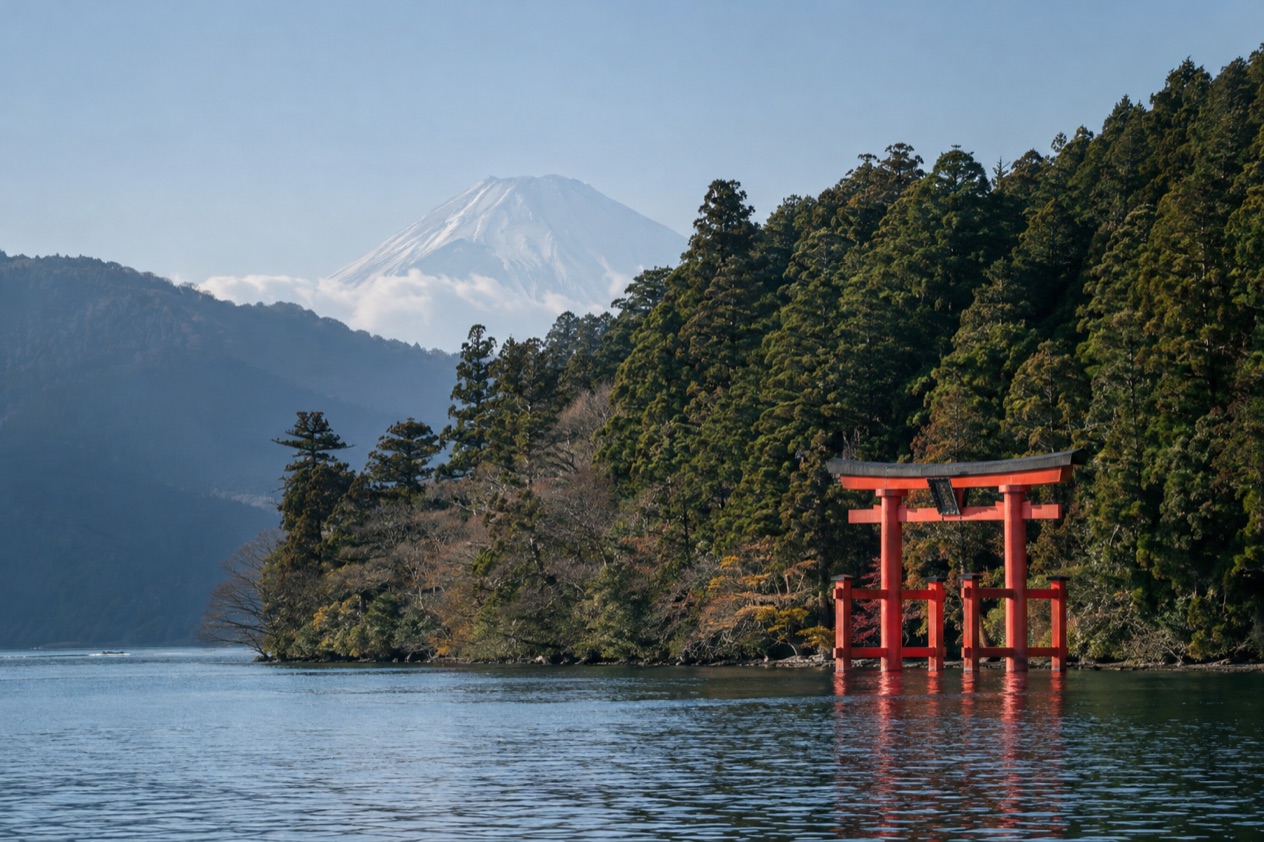
What usually surprises first-time visitors is that Hakone is not one town but a mountainous area west of Tokyo, a string of places with different personalities. Hakone-Yumoto is known for its many restaurants and gift shops. Sengokuhara is filled with art museums. Lake Ashi offers views of Mount Fuji, and the lake sits at the center of a national park that is volcanically active, which is why steam and sulfur are part of the scenery.
That volcanic ground is also the reason for the classic Hakone outings. You can bathe in one of Japan’s best hot springs, cross Lake Ashinoko by boat, taste the black eggs at Owakudani that are said to prolong life, and wander among sculptures at Japan’s first open-air museum. Each of these is a different stop on a different line, so a day in Hakone tends to feel like a small journey of its own, with trains giving way to cable cars, ropeways and boats.
One more surprise concerns timing. Visitors staying at a traditional ryokan should plan to arrive at least one day after landing in Tokyo, to avoid missing dinner or being locked out at curfew time. A ryokan runs on its own clock, with an evening meal at a set hour, and a trip that begins straight off a long flight does not fit that rhythm well.
Entry, customs and paperwork
For tourist or business visa-free stays of up to 90 days, the U.S. State Department says U.S. citizens must have a valid passport and should have proof of a return or onward ticket. The passport has to remain valid for the entire time you are staying in Japan, so it is worth looking at its expiration date well before you pack.
A visa-free stay is for visiting, not for earning a living. U.S. citizens cannot work on the local economy while in Japan on this basis, which includes the kind of informal work people sometimes picture during a long trip.
Once you are inside the country, Hakone itself asks for nothing more at the door.
Money, cards and tipping
International credit, debit and prepaid cards are generally accepted throughout Japan, which covers most of what a visitor spends in Hakone, from a restaurant lunch in Hakone-Yumoto to a souvenir from one of its gift shops. In some cases stores do not display the symbols of the cards they accept, so the habit is to ask the seller whether your card can be used before you put things on the counter.
Tipping is not part of everyday life in Japan. A meal, a taxi ride or a night at a ryokan is paid at the price given, and staff do not wait for something extra. Politeness and a simple thank-you do the work that a tip does elsewhere.
A single pass can also take care of much of the spending on movement. The Hakone Freepass bundles rides on eight kinds of transport, and the Hako Ticket Plus adds applicable art museums, hot springs and activity facilities, so a number of small payments across a day become one purchase made at the start.
Getting around and staying connected
From Shinjuku Station in Tokyo, the Odakyu Line runs to Hakone-Yumoto Station in about 1 hour and 30 minutes, and the Romancecar limited express also runs between Shinjuku and Hakone-Yumoto. From Tokyo Station, you can take the JR Tokaido Shinkansen to Odawara Station and transfer to the Hakone Tozan Railway for Hakone-Yumoto, about 55 minutes in all.
Once you are in the mountains, Hakone works as a relay. The Digital Hakone Freepass allows unlimited rides on the Hakone Tozan Line, the Hakone Tozan Bus in designated areas, the Hakone Tozan Cable Car, the Hakone Ropeway, the Hakone Sightseeing Cruise, the Odakyu Highway Bus in designated areas, the Tokai Bus in designated areas and the KANKO SHISETSU-MEGURI Bus. That makes eight modes, and the train, cable car, ropeway and boat are the ones that link the foot of the mountain to Lake Ashi.
The Hakone Freepass “Hako Ticket” Plus goes a step further. It combines the Digital Hakone Freepass with the Hako Ticket, which grants unlimited use of applicable art museums, hot springs and activity facilities, and it is valid for 2 days or 3 days. A version with an Odakyu Line ticket includes one return trip on the Odakyu Line between the departure station and Odawara Station.
| Place | Last cable car |
|---|---|
| Mt. Komagatake | 16:50 |
The cable car at Mt. Plans built around the lake, the museums of Sengokuhara and the sights on the mountain are easier to arrange once you know where the last ride falls.
Health, water and the weather
Hakone has a humid subtropical climate, with warm summers and cool winters, and the figures that follow describe Odawara, at the foot of Hakone. Winters are cool and bright, and January is among the sunniest months. Spring warms slowly, and summer afternoons turn hot and humid. Early autumn is wet, and September is the wettest month in Hakone.
| Month | Odawara high (°F) | Odawara low (°F) | Odawara rain (in) | Mountain side rain (in) | Odawara sunshine (hours) |
|---|---|---|---|---|---|
| January | 51.1 | 33.1 | 3.30 | 5.03 | 180 |
| April | 66.0 | 48.6 | 7.15 | 12.67 | 177 |
| July | 84.2 | 71.6 | 8.50 | 16.74 | 163 |
| October | 72.0 | 57.4 | 9.40 | 15.90 | 131 |
The last two columns on rain matter most when you plan a day. The mountain side of Hakone receives far more rain than the foot in every month shown, so a dry afternoon at Odawara says little about the lake or the ropeway above it. Rain gear for the heights is part of any visit, and a gray, wet day is a good one to spend in a museum in Sengokuhara or in a hot spring.
A hot spring bath suits a cool, damp day, and the winter air makes the steam rising from an open-air bath part of the pleasure. In summer, the warm air at the foot of the mountain and the cloudier days make a boat on Lake Ashinoko a good choice for time on the water.
Local customs and etiquette
The habit you meet first is the shoes. In Japan it is customary to remove shoes at the entrance of a building, put on indoor slippers and place the shoes in a shoe box or to one side. In a ryokan this happens at the front door, and the pair you arrived in waits there until you leave.
Inside a Japanese home or ryokan, the custom goes one step further. Slippers come off when walking on tatami mats, the woven straw floors of the guest rooms, and you step onto them in socks or bare feet. Slippers come off again when using the bathroom, and a separate pair of toilet slippers is often provided, so you swap one pair for the other at the door and swap back on the way out.
Public life runs on quiet consideration. On trains and buses, people keep their voices low and phone calls for later. When a cable car, bus or ropeway is waiting to board, people form a line and move forward in turn. A small bow or a nod with a thank-you is a common way to greet someone or acknowledge a favor, and visitors who return it are usually met with warmth.
Streets in Japan have few public trash cans, and people often carry their wrappers and bottles with them until they reach one, or take them back to the hotel. In Hakone-Yumoto, where you may be eating on the move or carrying souvenirs, a small bag for your own garbage fits the local habit. Dinner at a ryokan is a slow, seated meal, and it is polite to arrive at the table on time.
Good to know before you go
The U.S. State Department rates Japan Level 1: Exercise Normal Precautions.
In Japan you must always carry your U.S. passport or a Japanese Residence Card with you, and you may be questioned or detained if you cannot show proof of identity and status. Keep the passport in a bag or a pocket on days out on the lake and the mountain.
CBD may be illegal in Japan depending on the amount of THC it contains, so it is better left at home. As for weather, Hakone is wettest in early autumn, with September the wettest month, and the mountain side stays wetter than the foot in every season, so a light rain jacket belongs in the day bag.
Sources
- Japan National Tourism Organization, Hakone (https://www.japan.travel/en/destinations/kanto/kanagawa/hakone-and-around/), checked October 11, 2026
- Hakone Tourist Information (https://www.hakonenavi.jp/international/en/), checked October 11, 2026
- Wikipedia, Hakone, Kanagawa (https://en.wikipedia.org/wiki/Hakone,_Kanagawa), checked October 11, 2026
- Wikivoyage, Hakone (https://en.wikivoyage.org/wiki/Hakone), checked October 11, 2026
- U.S. Department of State, Japan travel information, local laws and special circumstances (https://travel.state.gov/content/travel/en/international-travel/International-Travel-Country-Information-Pages/Japan.html), checked October 11, 2026
- Japan National Tourism Organization, manners, etiquette, shoes, bowing, chopsticks, public behavior (https://www.japan.travel/en/guide/understanding-and-mastering-japanese-manners-and-etiquette/), checked October 11, 2026
- Japan National Tourism Organization, credit cards and cash, where cards are accepted (https://www.japan.travel/en/plan/credit-cards/), checked October 11, 2026
- U.S. Department of State, Japan travel advisory (https://travel.state.gov/content/travel/en/international-travel/International-Travel-Country-Information-Pages/Japan.html), checked October 11, 2026
- U.S. Department of State, Japan travel information, entry and exit requirements (https://travel.state.gov/content/travel/en/international-travel/International-Travel-Country-Information-Pages/Japan.html), checked October 11, 2026
- Japan Meteorological Agency (JMA), Normal values 1991-2020, monthly (https://www.data.jma.go.jp/stats/etrn/view/nml_amd_ym.php?prec_no=46&block_no=1008), station Odawara, elevation 14 m, checked October 11, 2026
To plan your stay
- Best Time to Visit Hakone: Autumn Leaves, Rainy Season, Weather by Month and Festivals
- Things to Do in Hakone: Lake Ashi, Owakudani, Open-Air Museum and Hot Springs
- Where to Stay in Hakone: Hakone-Yumoto, Lake Ashi, Sengokuhara and Ryokan Stays
- Hakone from Tokyo: Romancecar, Shinkansen, Local Trains and the Hakone Freepass