
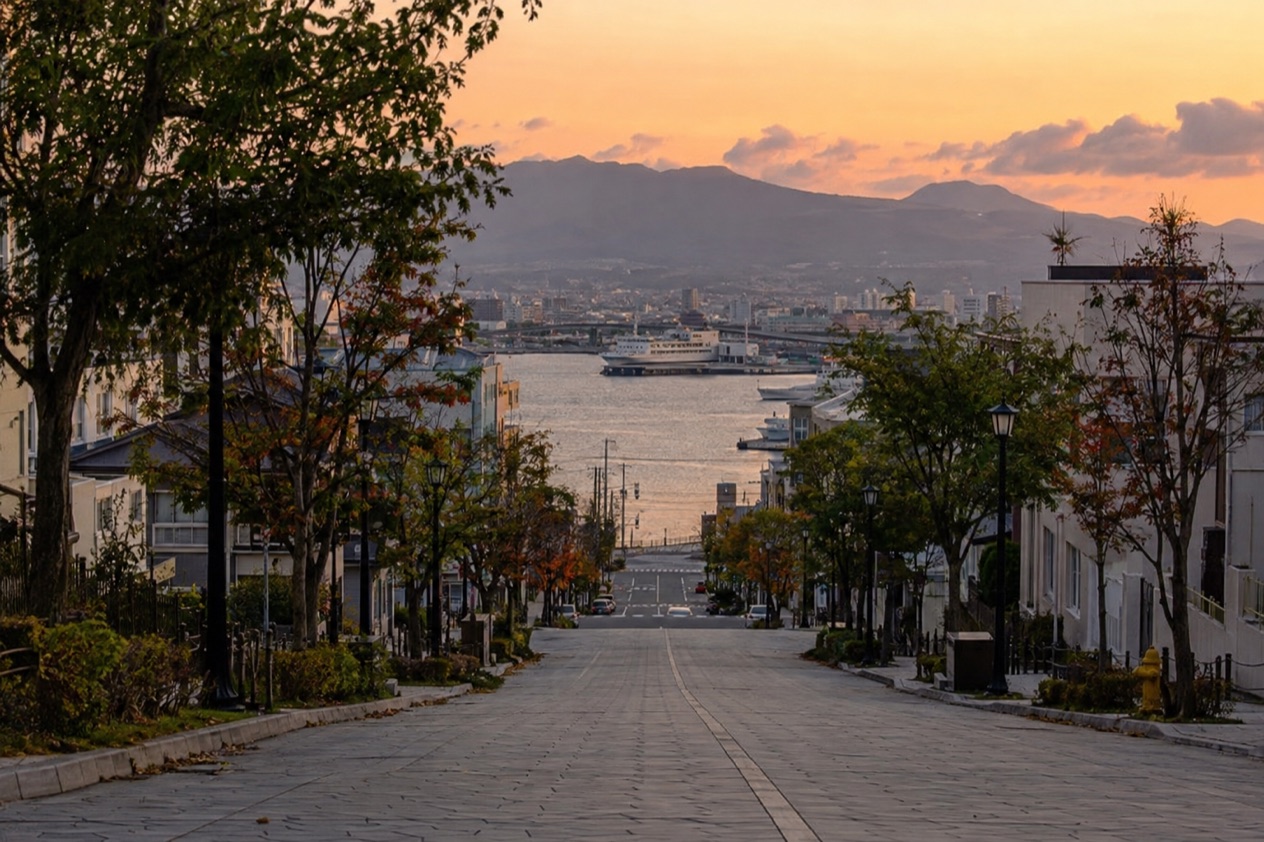
Squid is grilled over charcoal and sold by the harbor, ferry horns sound across the water, and up the slope the stone paving of old foreign-trade streets turns steep toward the sea. Hakodate is a port city at the southern tip of Hokkaido, with a seafood table, a star-shaped fort and a waterfront of red-brick warehouses. It suits travelers who like to roam a harbor town on foot, eat well and take in a city where the sea shows at the end of almost every street.
Where is Hakodate and what is it like?
Hakodate sits at the southern tip of Hokkaido, in Oshima Subprefecture, and it is the capital city of that subprefecture. The Tsugaru Strait separates it from Honshu, the main island, so the city feels like a doorway between two worlds. It is the third largest city in Hokkaido after Sapporo and Asahikawa.
What gives Hakodate its character is its port. In 1854, after the Convention of Kanagawa, it became the first city in Japan whose port opened to foreign trade.
That history still shows in the streets: churches, old Western-style buildings and warehouses by the water sit among ordinary neighborhoods. The city lies along a narrow neck of land, with water close on either side and a mountain rising behind, which is why so many streets seem to point at the sea.
The pace is slower than in Sapporo or Tokyo. Mornings begin around the fish stalls and markets, afternoons drift between slopes, churches and cafés, and evenings gather around ramen counters and izakaya (casual Japanese pubs) serving the day’s catch. Hakodate rewards people who like to wander, snack and watch ships.
It may not suit travelers who want a long list of big-ticket attractions or a nightlife scene. The pleasures here are modest and spread out: a view, a bowl of rice topped with raw seafood, a stroll beside old brick. If that sounds right, the city is a pleasure.
What is there to do in Hakodate?
Hakodate’s big reasons to come are a mountain with a city view, a star-shaped fort, a historic waterfront and a table built on seafood. Together they give the city a different flavor from the rest of Hokkaido, where the draw is often wide landscapes. Here the draw is a compact harbor town with a past as an international port.
Mount Hakodate and the view over the city
Mount Hakodate rises behind the city, and from its summit you look down on the narrow strip of land that holds Hakodate, with water on both sides. The lights of the city curve around the bays after dark, and visitors come up to see that shape. The summit can be reached by hiking trail, cable car or car.
A tour bus or a direct bus also leaves from JR Hakodate Station for the mountain. That makes the climb possible even without a car, and it gives you a choice between going up on foot, by cable car or by road. Bring a layer for the summit, where the wind off the water can be sharper than in town.
Goryokaku, the star fort
Goryokaku is a star fort in the city of Hakodate, and its shape is the whole point. Seen on a map or from above, the five-pointed outline looks like a drawing rather than a fortress. On the ground you walk along earthen ramparts and moats, with trees along the edges that change with the seasons.
The park is a pleasant place for a slow circuit, with space to sit and look at the water in the moat. It fits well between the harbor and the mountain, as a change of scene from the old port. Anyone curious about how Japan built defenses in a Western style will find it interesting.
The waterfront and the red-brick warehouses
The old port area is where Hakodate’s trading past is easiest to feel. Red-brick warehouses line the water, and many have been turned into shops, restaurants and galleries where you browse glass, music boxes and local sweets. Gulls wheel over the dock, and the sea air carries a hint of salt and fish.
This district is also the setting for the Hakodate Christmas Fantasy, held every year from December 1 to 25. A giant Christmas tree floats on the sea beside the warehouses, and the brick buildings and the harbor become a winter stage. Even outside that season, the waterfront is a place to walk at an easy rhythm with a hot drink.
Eating in a port city
Seafood is the reason people book their trip. Squid is the emblem of the town, served raw, grilled or in a seafood bowl (kaisen-don) piled with sea urchin, crab and salmon roe. Shio ramen, with its clear salt-seasoned broth, is another local favorite, and so are sushi counters and izakaya.
The markets near the station are good for browsing, and the cafés in older buildings along the slopes are good for a break. Order what looks freshest, and leave room for a sweet at the end, since Hokkaido’s dairy shows up in soft-serve and cakes.
How many days do you need in Hakodate?
A long weekend is enough to see Hakodate well, and two nights is a natural fit if you have already come a long way. The city’s main sights sit close enough in character that you can combine them without feeling rushed, as long as you leave space for meals.
With a short stay, give one day to the old port and the red-brick warehouses, with a market breakfast and a seafood lunch. Spend an evening on Mount Hakodate for the view of the city. A second day can go to Goryokaku, the churches and old buildings on the slopes, and a ramen supper before you leave.
With three or four days, you can slow down and add a stretch of the hiking trail up the mountain rather than taking the cable car. You can also spend time in cafés, visit more of the old foreign-trade streets, and add an onsen (hot spring) soak, as Hakodate has hot spring districts of its own. The town rewards repeat walks, since the view changes with the light and the weather.
A longer stay opens up southern Hokkaido. The region around Hakodate has lakes, volcanic scenery and old castle towns, and these make good day trips. Onuma Quasi-National Park, with its lakes and views of a mountain, and the castle town of Matsumae are the kinds of outings travelers add. Treat them as a way to see the countryside around the city, not as a replacement for the city itself.
Where to stay in Hakodate
Where you stay depends on what you want from the city. The area around JR Hakodate Station puts you near the morning market and the buses, including the direct bus to Mount Hakodate. It suits travelers who arrive by train and want to set out on foot or by bus without much planning.
The waterfront near the red-brick warehouses suits those who want to wake up to harbor views, with the shops, cafés and the Christmas Fantasy display close at hand. Sleeping near the slopes of the old foreign quarter, called Motomachi, gives you churches and old buildings at your door, and a steep walk back from dinner.
Another choice is to stay near Goryokaku, where the park is the neighbor and the neighborhood feels more residential. It is a good fit for travelers who prefer a calmer base and do not mind going into the center for meals. Hot spring lodgings, including ryokan (traditional inns) with onsen baths, are another way to stay, and they make sense for travelers who want an evening soak after a day on foot.
Travelers who arrive by bullet train may also consider a night near Shin-Hakodate-Hokuto Station, the northernmost terminal of the bullet train line. It is a practical choice for a late arrival or an early departure, but it places you outside the city itself, so visitors look for a bed in Hakodate proper.
How do you get to Hakodate and get around?
You can reach Hakodate by air or by bullet train. Hakodate Airport has direct flights from Sapporo (to Okadama by JAL and to Shin-Chitose by ANA), Tokyo-Haneda, Nagoya-Centrair, Osaka-Itami and Taipei-Taoyuan. That mix covers both domestic travelers and visitors coming through Taiwan.
By rail, the JR Tohoku/Hokkaido Shinkansen from Tokyo to Shin-Hakodate-Hokuto Station takes 4 hours. From there, you take a local train for the last leg into Hakodate. The JR Rail Pass is valid on the JR Tohoku/Hokkaido Shinkansen and on JR express and local trains from Sapporo to Hakodate.
Shin-Hakodate-Hokuto Station is the northernmost terminal of the bullet train, and it lies to the north of Hakodate Station, so the local train ride is a real part of the journey rather than a few steps. Plan your day around it, especially if you are coming from Tokyo.
Once in the city, the sights are spread across the harbor, the slope, the mountain and Goryokaku, and you will combine walking with other transport. JR Hakodate Station is a hub, and a tour bus and a direct bus to Mount Hakodate depart from it. The mountain can also be reached by hiking trail, cable car or car, so a rental car is one option for those who want to move freely.
Taxis and local buses fill the gaps between the sights. Walking is the best way to enjoy the old port and the slopes, where you will want to look at the buildings, the churches and the water as you go.
When is the best time to visit Hakodate?
Late autumn into December is when Hakodate has its most distinctive moment, because of the Hakodate Christmas Fantasy, held every year from December 1 to 25. The giant Christmas tree floating on the sea in the red-brick warehouses area turns the waterfront into a winter scene. Cold air, lights and hot drinks go together here, and it is the time of year when the harbor feels most festive.
Winter in Hokkaido means cold and snow, and Hakodate shares in that mood, with the port taking on a quieter look. Summer and early autumn bring a greener town, with the slopes, the park around Goryokaku and the mountain all more pleasant to walk.
Spring brings the thaw and the first color to Goryokaku’s park, and autumn changes the trees along the moat. For the view from Mount Hakodate, any season can work, since the city lights are there whenever you go up, though the weather decides how much you can see. Choose the season by what you want to do: lights and snow in winter, walking and gardens when it is green.
Good to know before you go
Prices in Hakodate are in yen, and the city’s best moments are simple ones: a market breakfast, a walk along the water, a view from the mountain. Sights are spread out between the station, the waterfront, the slope and Goryokaku, so allow time to move between them by bus, taxi or on foot. The weather can change quickly near the sea, so a layer is useful on the summit, and travelers in winter will find the cold a part of the experience.
Sources
- Japan National Tourism Organization, Hakodate (https://www.japan.travel/en/destinations/hokkaido/hokkaido/hakodate-and-hokkaido-south/), checked October 11, 2026
- Wikipedia, Hakodate (https://en.wikipedia.org/wiki/Hakodate), checked October 11, 2026
- Wikivoyage, Hakodate (https://en.wikivoyage.org/wiki/Hakodate), checked October 11, 2026
- Wikipedia, Goryōkaku (https://en.wikipedia.org/wiki/Gory%C5%8Dkaku), checked October 11, 2026
All our pages
Things to do
- Things to Do in Hakodate: Goryokaku, Mount Hakodate Views, Seafood and Day Trips
- Hakodate Night View from Mount Hakodate: Ropeway, Bus Access, Fares and Seasons