
On a cruise morning in Yokohama, the harbor fills with the low horn of a big white ship and passengers lean on the rail to watch the port come awake. For Americans who want to see Japan from the water, one Princess ship is the answer: Diamond Princess, a vessel built in Nagasaki and set up to sail around Japan and Southeast Asia. Her story, her ports and the way Princess has used her over the years explain what a Princess cruise in Japan looks like.
What do Princess cruises in Japan offer?
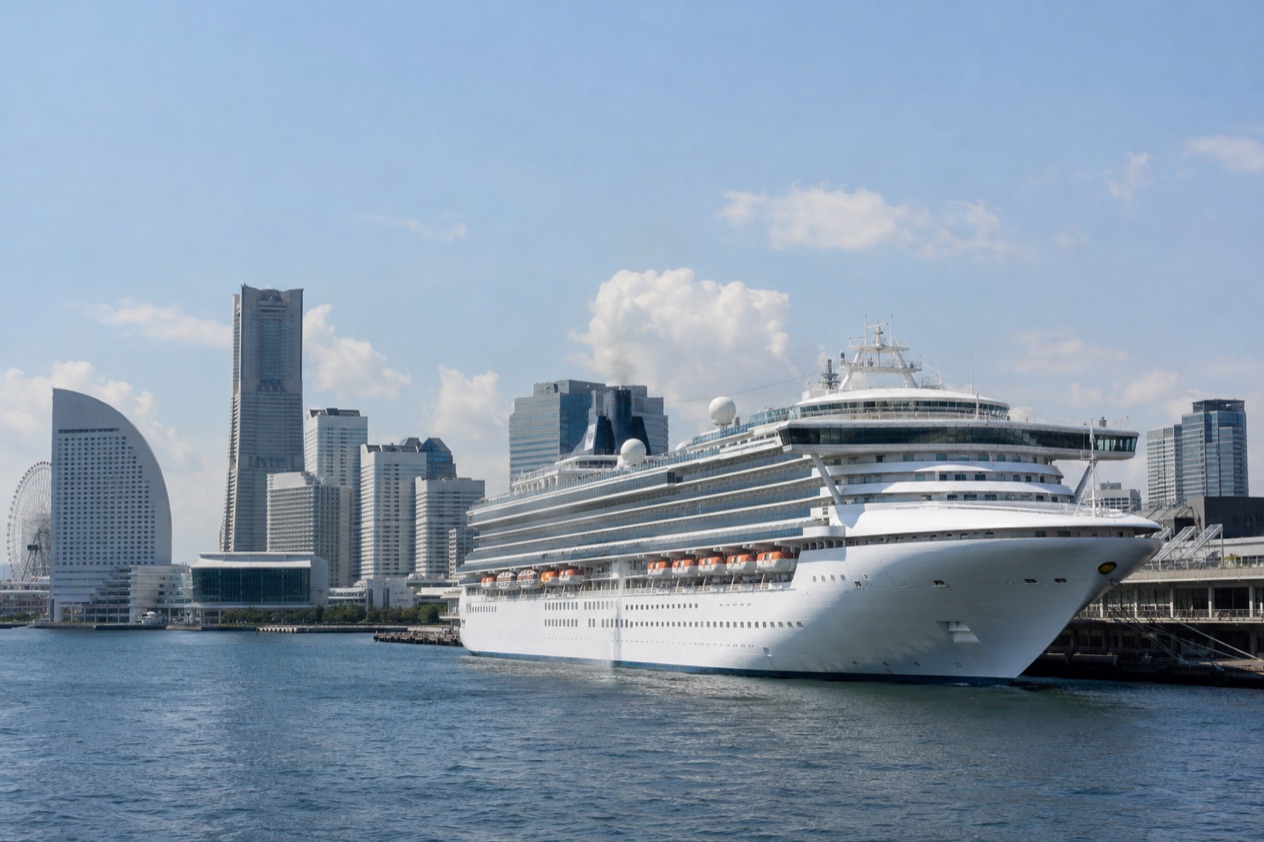
Princess offers Japan as a floating hotel that moves you from port to port, and the ship it uses for that job is Diamond Princess, which is outfitted to sail exclusively around Japan and Southeast Asia. A cruise ship is, at heart, a large passenger vessel used mainly for vacationing. In Japan that means you unpack once, wake up in a new harbor, spend the day ashore and return to your own cabin in the evening.
The rhythm of the trip is different from a rail journey. There are no luggage transfers between hotels and no changing stations with a suitcase. Between ports there are hours on board with the sea, the deck and the dining rooms, which gives the days a slower pace than a city-hopping itinerary.
Diamond Princess, a ship built in Japan
Diamond Princess was built by Mitsubishi Heavy Industries in Nagasaki, so the ship that sails you around Japan was born in a Japanese shipyard. She began operation in March 2004. She is owned by Carnival Corporation & plc and operated by Princess Cruises, and she has been registered in London since 2014.
| Detail | Diamond Princess |
|---|---|
| Operator | Princess Cruises |
| Owner | Carnival Corporation & plc |
| Builder | Mitsubishi Heavy Industries, Nagasaki, Japan |
| Passenger capacity | 2,670 |
| Registry | London, United Kingdom (since 2014) |
| Began operation | March 2004 |
Life on board
Dining on almost all cruise ships is included in the cruise price, and that is the habit most travelers notice first. Breakfast, lunch and dinner are part of the day, so you plan your shore time around the ship’s meals or around a Japanese lunch in port, the way you prefer. Ramen, sushi counters and noodle shops wait on land, while the ship keeps its own dining rooms open for the evening.
With a ship of this size, the company on board is varied, from couples to groups of friends to several generations traveling together. A cabin with a balcony lets you watch a port slide past in the morning, with a coffee in hand and the harbor cranes in view.
The Princess name
Princess Cruises was founded in 1965 by Stanley McDonald. In the 1980s the line rose in prominence because the American television series The Love Boat was set primarily on its ship Pacific Princess. For many Americans that show is the picture of a cruise: sunny decks, ports of call and a cast of passengers with stories to tell.
That American heritage matters in Japan in a practical way. The line is operated by Princess Cruises, an English-speaking company, while the ship was built by a Japanese yard and sails among Japanese ports. The result is a cruise made for Western travelers that spends its time in Japanese harbors.
Which routes does Princess sail?
The Japan routes of Princess have centered on Diamond Princess sailing from Yokohama, with cruises for Tokyo or Kobe in the northern summer season, a pattern that began in 2014. Before that, the ship had spent her northern summers on glacier cruises and her southern summers in Australia and New Zealand, so Japan became her home waters only after a long career elsewhere.
Yokohama to Tokyo or Kobe
Starting in 2014, Diamond Princess undertook cruises from Yokohama for Tokyo or Kobe in the northern summer season. That pairing is the heart of the Japan program. Yokohama is a harbor city with a long waterfront, Tokyo is the capital’s gateway for a cruise, and Kobe is a port city with its own mountains and harbor views.
A route like this suits travelers who want to see two very different sides of Japan without repacking. One end is the great metropolis around Tokyo. The other is the Kansai side, where Kobe sits within reach of the neighboring cities of the region.
Southeast Asia and beyond
Japan is only part of the ship’s life. For the 2016–17 season, Diamond Princess sailed round-trip cruises in the northern winter months from Singapore. She resumed voyaging from Sydney for the 2017–18 season. After the Australia and New Zealand cruises of that season, she was re-positioned into South-East Asia for most of 2018, varying between Japan, South Korea, Singapore, Vietnam, Taiwan and Malaysia.
That mix shows how Princess treats the ship as a seasonal traveler. A cruise in Japan is therefore tied to the season in which the ship is based in Yokohama, not to the whole year.
Back in service after the pandemic
Diamond Princess officially returned to service in November 2022 after the COVID-19 pandemic lay-up. The ship had been out of regular sailing for a long stretch, and her return marked the restart of the Japan and Southeast Asia program for Princess.
Since then she has gone back to the role described by the line: a ship outfitted to sail exclusively around Japan and Southeast Asia. For a traveler, that means the route pattern described above is the one to keep in mind when thinking about a Princess cruise in Japan.
Where do the ships go?
Historically, the supplied route record places Diamond Princess in Yokohama, Tokyo and Kobe, as well as ports elsewhere in Asia. Each of these ports has a different personality, and the Japanese ones are worth a closer look because they are where the cruise begins and ends.
Yokohama, the home port
Yokohama is where the Japan cruises of Diamond Princess start. The city is a working port with a long waterfront, and its harbor is the setting for the ship’s Japan story. In March 2020, the ship underwent a cleaning and disinfection process at Daikoku Pier at the Port of Yokohama, after the outbreak of COVID-19 on board the previous month.
That outbreak in February 2020 led 712 of the 3,711 people on board to become infected, and it put Yokohama and the ship in the news around the world. The ship has since returned to service, and the episode is part of her record as a vessel based in Japanese waters.
Tokyo
Tokyo is one end of the northern summer cruises that begin in Yokohama. For a cruise passenger it is the great city of the trip, a place of train stations, department stores, shrines tucked between office towers and neighborhoods that each have their own streets of food. Ramen shops, izakaya (casual pubs serving small plates) and depachika, the food halls in the basements of department stores, give a taste of what is on offer.
A day in Tokyo from a ship is a day of choices, since the city is large enough to fill many visits. A traveler might spend it at a temple such as Senso-ji, in the shopping streets around it, or wandering a neighborhood of small restaurants. The ship’s schedule decides how much of that fits in, and the evening return is part of the plan.
Kobe and its artificial islands
The Port of Kobe is a Japanese maritime port in Kobe, Hyogo, in the Keihanshin area, backgrounded by the Hanshin Industrial Region. Flat land is limited here, so artificial islands have been built to make room: Port Island, Rokko Island and the island of Kobe Airport. Seen from a ship, the port is a place where the city, the hills and the sea meet along a narrow strip.
Kobe is the other end of the cruises that begin in Yokohama. On shore, the city is known for beef, bakeries and cafes, and for a harbor area that invites a stroll. Its position in the Kansai region also makes it a point from which to think about the neighboring cities.
Ports around Asia
When Diamond Princess was re-positioned into South-East Asia in 2018, her itineraries varied between Japan, South Korea, Singapore, Vietnam, Taiwan and Malaysia. A traveler who sees a cruise that combines Japan with one of these countries should expect a trip with a different feel in each place, from Japanese temple towns to the street food of Southeast Asia.
Singapore, in particular, served as a home port for the round-trip winter cruises of the 2016–17 season. That detail shows how the ship moves with the seasons, spending part of the year in one corner of Asia and part in another.
Good to know before you go
Ashore in Japan, the currency is the yen, and a day in port goes more smoothly with some in your pocket for small purchases such as snacks, a temple offering or a drink from a vending machine. Shoes come off at the entrance of many traditional buildings, and carrying a small bag for them is a habit travelers pick up quickly. The Japanese ports on a Princess itinerary are cities with large train networks, so a day ashore usually means walking, riding public transit and eating well, always with an eye on the clock for the ship’s departure.
Sources
- Wikipedia, Princess Cruises (https://en.wikipedia.org/wiki/Princess_Cruises), checked October 11, 2026
- Wikipedia, Diamond Princess (https://en.wikipedia.org/wiki/Diamond_Princess_(ship)), checked October 11, 2026
- Wikipedia, Cruise ship (https://en.wikipedia.org/wiki/Cruise_ship), checked October 11, 2026
- Wikipedia, Port of Kobe (https://en.wikipedia.org/wiki/Port_of_Kobe), checked October 11, 2026
To plan your stay
- Japan Cruise in March: Weather by Port, Cherry Blossom Timing and What You See
- Cruises from Los Angeles to Japan: Departure Port, Yokohama Arrival and Crossing Length
- How Much Does a Japan Cruise Cost?: What the Fare Covers, Drinks and Shore Excursions
- Japan Cruise in April: Cherry Blossoms, Spring Weather and What You See From Port