
On an October evening the lights of Osaka Bay come on one by one, and the air on deck has the first real edge of autumn. Out on the water, the question is what a cruise along these coasts actually feels like once the summer heat has loosened its grip. October is a month of mild days in the big cities, a warm tropical sea around Okinawa and the first color in the far north, which makes it an appealing time to see Japan from a ship.
What is a Japan cruise like in October?
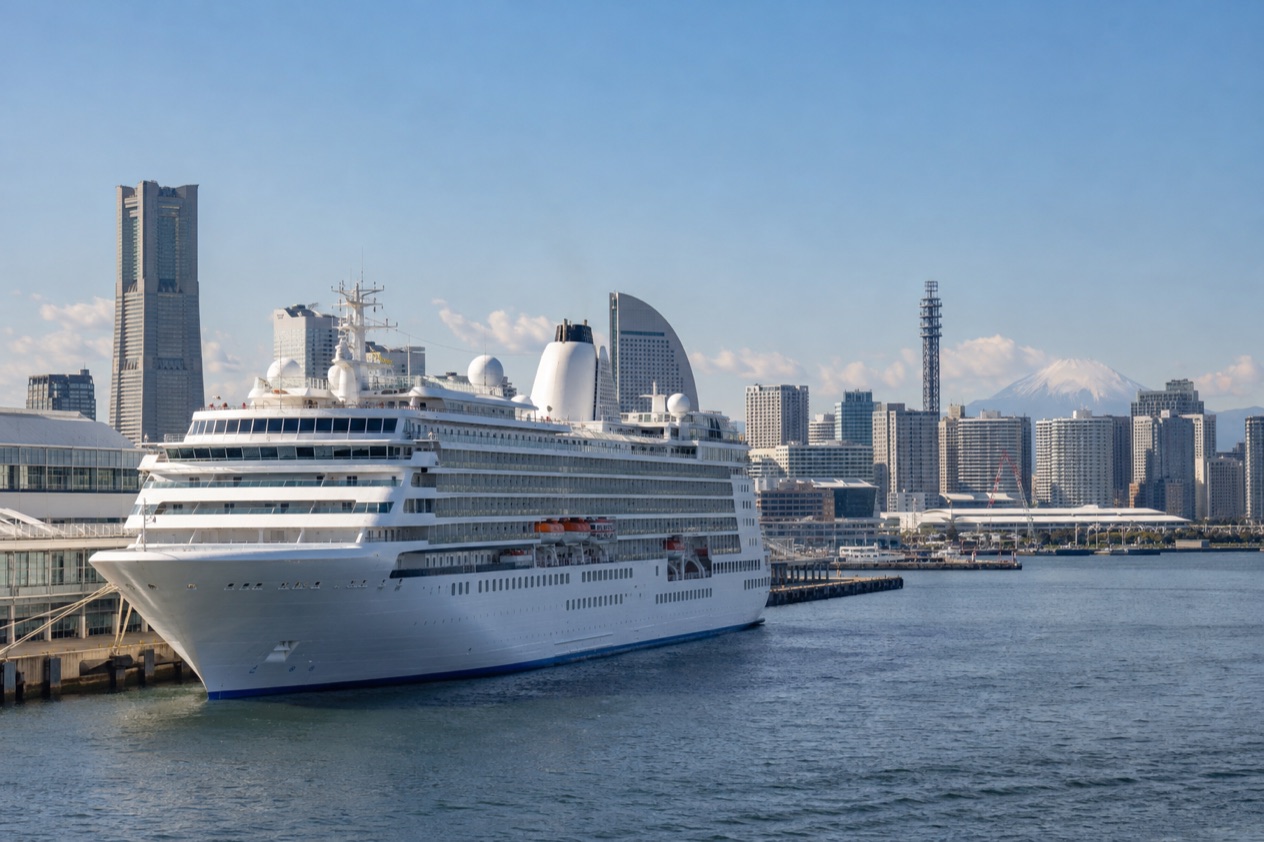
A Japan cruise in October is a vacation aboard a large passenger ship, with days at sea alternating with days ashore in cities that are comfortable to walk around in autumn air. Cruise ships are large passenger ships used mainly for vacationing, and the rhythm is the same here as anywhere. You unpack once, the coastline changes outside your window, and each morning brings a different harbor.
Dining on almost all cruise ships is included in the cruise price, so breakfast, lunch and dinner on board are part of the fare. Most cruise lines leave alcoholic beverages out of their fares, and passengers pay for drinks as they consume them. Since a Japan itinerary tends to tempt you ashore with food, travelers treat the ship’s dining room as the base and the harbor towns as the adventure.
Osaka and Kobe: the ports of Osaka Bay
The Port of Osaka is the main port in Japan, set within Osaka Bay, and it is the harbor of a city built around food, canals and a famously blunt sense of humor. Ashore, the street-food list writes itself: takoyaki (battered octopus balls), okonomiyaki (savory griddle pancakes) and kushikatsu (skewers of deep-fried bites). In October the afternoons are mild enough to walk between them with a jacket over your arm.
The Port of Kobe sits in Kobe, in Hyogo, in the Keihanshin area, backed by the Hanshin Industrial Region. Flat land is limited here, so the city built artificial islands, among them Port Island, Rokko Island and the island that holds Kobe Airport.
Kobe is the city of Kobe beef, of hillside neighborhoods with a Western-influenced past and of bakeries and coffee houses that fill the streets with a warm smell. Both Osaka and Kobe belong to the same bay, which is why a traveler who knows one often wants to see the other.
Life on board and life ashore
A typical day on a ship follows a loose pattern. Breakfast comes early, a shore excursion or a self-guided wander fills the middle of the day, and the evening belongs to the dining room, the theater or the deck. October’s long evenings are a pleasure on deck, with a sweater rather than a coat, and the harbors look their best lit up after dark.
Ashore, the pleasure is in the small things. A convenience-store onigiri (rice ball) eaten on a bench, a bowl of noodles at a counter, a shrine gate glimpsed down a side street.
Autumn adds its own flavors to menus across Japan, such as chestnuts, persimmons, sweet potatoes and grilled saury (sanma), a fish that arrives with the cooler weather. If you step into a restaurant, expect to take your shoes off at some, where tatami floors call for it, and to hear a cheerful greeting as you enter.
What is the weather in October?
October weather in Japan runs from comfortably mild in Tokyo and Osaka to genuinely cool in Sapporo and still summery in Okinawa, so what you pack depends on where the ship goes. The table gives the figures for four places along the length of the country.
| Place | Average high (°F) | Average low (°F) | Precipitation (inches) | Days with rain (1 mm or more) | Sunshine (hours) | Humidity (%) | Daylight on Oct 15 |
|---|---|---|---|---|---|---|---|
| Tokyo | 71.6 | 58.6 | 9.24 | 10.5 | 129 | 71 | 11 h 21 min |
| Osaka | 74.7 | 60.8 | 5.35 | 8.3 | 166 | 65 | 11 h 22 min |
| Naha, Okinawa | 82.6 | 74.3 | 7.06 | 8.8 | 163 | 72 | 11 h 35 min |
| Sapporo | 61.5 | 46.4 | 4.33 | 11.6 | 146 | 67 | 11 h 07 min |
Tokyo and Osaka: mild days, cooler nights
The rain comes on roughly a third of the days, and it is the wettest of these four places by a wide margin. A gray, drizzly day is plausible, so a compact umbrella earns its place in the daypack.
Osaka is a little warmer by day and noticeably sunnier, with less rain and a drier feel in the air. That suits a city where much of the pleasure is outdoors, in the covered shopping arcades, along the canals and around the castle grounds. Daylight is close to the same in both cities, so the evenings arrive at about the same hour.
Okinawa: still a warm-weather island
Naha stays in summer clothes in October. Highs reach the low 80s and nights barely cool, though the humidity makes the air feel heavy when the wind drops. The sea near Naha averages 83.2°F this month, a figure that comes from daily maximum readings and so runs a shade warmer than a 24-hour average.
Rain falls on a good share of the days, usually in showers rather than all-day gray, and sunshine is plentiful between them. Light cotton, sunscreen and a hat suit the island, with a thin rain layer for the showers.
Sapporo: the first cold of the north
Sapporo feels like a different season. Afternoons are cool and nights are chilly, and a proper jacket, a scarf and closed shoes make sense. It is also the place with the most rain days of the four, and a dusting of snow or sleet shows up on a couple of days in an average October, though the total is small.
Daylight is shortest here, so the light fades earlier than in Okinawa. A warm bowl of miso ramen, a Sapporo specialty, tastes especially good after a day in this air.
What do you see in October?
In October you see the turn from summer to autumn: leaves beginning to change in the far north, harbors and city parks still green in the south, and festival season starting in towns across the country. The color depends heavily on latitude, and that matters for a ship that covers a long coast.
Early leaf color in the north
The Japan Meteorological Agency defines the maple color change day as the first day when most of a sample tree’s leaves have turned red. By that measure the change starts in mid-October in eastern Hokkaido, which makes Hokkaido the place to look for red and gold this month. Sapporo’s cool air fits the picture, with parks and tree-lined avenues beginning to turn.
Farther south the color comes later. It reaches the Tohoku region and eastern Hokuriku around the third week of November, the Kanto, Tokai, Chugoku, Shikoku and northern Kyushu regions around the end of the month, and the Pacific coasts of Kanto and Tokai, the Kinki region and southern Kyushu in early to mid December.
Matsuri in the autumn air
Matsuri, the traditional festive occasions of dance and music, are part of the calendar all year, and estimates put the number of festivals across Japan between 100,000 and 300,000. In October the Autumn Takayama Festival is held on October 9 and 10, a counterpart to the spring festival, which is centered on the Hie Shrine and is held to pray for a good harvest.
Festival food stalls selling grilled corn, candied fruit and fried noodles are part of the scene. If you stumble on one, follow the drums.
Cities, bays and the Okinawa coast
In Osaka and Kobe the view is of water and cranes and lit towers, the working harbor beside the entertainment districts. Walking Kobe’s hills gives wide looks back over the bay, and Osaka’s canals and bridges make a good evening stroll in mild air.
Okinawa offers the opposite mood, a subtropical island with its own food, such as Okinawa soba and goya champuru (a stir-fry of bitter melon), and its own music built around the sanshin, a three-stringed instrument. The warm sea is the draw, but whether a given beach suits a swim depends on local conditions on the day.
Is October a good month for a Japan cruise?
October is a good month for a Japan cruise if you like mild city weather, a warm sea in the south and the first signs of autumn color, and less so if you are set on seeing red maples in Tokyo or Kyoto. The month rewards a flexible attitude and a layered suitcase.
Who it suits
It suits travelers who dislike extremes. Tokyo and Osaka are comfortable for a day on foot, Okinawa still feels like summer, and the nights are cool enough to enjoy dinner on deck without a heavy coat. Food lovers get autumn ingredients on menus, from chestnuts to saury.
It also suits those who want a taste of northern autumn. Hokkaido’s color change begins this month, and Sapporo’s crisp air is a pleasant contrast to the humid south. A ship that spans more than one climate lets you have both in a single trip.
What to weigh
Rain is the main caveat. Tokyo has the wettest October of these cities, with showers that can turn a day gray, and Sapporo has the most rain days. Pack a light rain shell and shoes that handle wet pavement, and keep an indoor plan in mind for each port, such as a market hall, a museum or a covered arcade.
The other trade-off is the leaf color. If red maples are the point of the trip, October falls early for most of the main island, and the color arrives in late November and December. If you are drawn to harbors, food, festivals and a warm southern sea, the timing works well.
Good to know before you go
Bring layers, since a cruise can carry you from a warm island to a cool northern city within days, and remember that drinks on board are usually billed separately from meals. The Japan National Tourism Organization keeps a Japan Safe Travel Information page with safety tips and government information for travelers.
The Japan Meteorological Agency has run its Emergency Warning System since 30 August 2013, which alerts people to the significant likelihood of catastrophes tied to natural phenomena of extraordinary magnitude. A weather app and the ship’s daily bulletin are enough to keep up with the sky.
Sources
- Japan Meteorological Agency (JMA), Normal values 1991-2020, monthly (https://www.data.jma.go.jp/stats/etrn/view/nml_sfc_ym.php?prec_no=44&block_no=47662), station Tokyo, elevation 25 m, checked October 11, 2026
- Computed from the date and the latitude of the place (sunrise equation, solar elevation -0.833 degrees), October 11, 2026
- Japan Meteorological Agency (JMA), Normal values 1991-2020, monthly (https://www.data.jma.go.jp/stats/etrn/view/nml_sfc_ym.php?prec_no=62&block_no=47772), station Osaka, elevation 23 m, checked October 11, 2026
- Japan Meteorological Agency (JMA), Normal values 1991-2020, monthly (https://www.data.jma.go.jp/stats/etrn/view/nml_sfc_ym.php?prec_no=91&block_no=47936), station Naha, elevation 28 m, checked October 11, 2026
- Open-Meteo Marine API, average 2015-2024, checked October 11, 2026
- Japan Meteorological Agency (JMA), Normal values 1991-2020, monthly (https://www.data.jma.go.jp/stats/etrn/view/nml_sfc_ym.php?prec_no=14&block_no=47412), station Sapporo, elevation 17 m, checked October 11, 2026
- Japan Meteorological Agency, Emergency Warnings (https://www.jma.go.jp/jma/en/Emergency_Warning/ew_index.html), checked October 11, 2026
- Japan National Tourism Organization, safety information (https://www.japan.travel/en/japan-safe-travel-information/), checked October 11, 2026
- Japan National Tourism Organization, weather and seasons in Japan (https://www.japan.travel/en/plan/weather/), checked October 11, 2026
- Japan Meteorological Agency, maple color-change dates 2025-2026 with difference from the 1991-2020 normal (https://www.data.jma.go.jp/sakura/data/phn_014.html), checked October 11, 2026
- Japan Meteorological Agency, kaede2020.pdf (https://www.data.jma.go.jp/sakura/data/kaede2020.pdf), checked October 11, 2026
- Japan National Tourism Organization, festivals and events (https://www.japan.travel/en/see-and-do/festivals-and-events/), checked October 11, 2026
- Wikipedia, Matsuri (https://en.wikipedia.org/wiki/Matsuri), checked October 11, 2026
- Wikipedia, Takayama Festival (https://en.wikipedia.org/wiki/Takayama_Festival), checked October 11, 2026
- Wikipedia, Cruise ship (https://en.wikipedia.org/wiki/Cruise_ship), checked October 11, 2026
- Wikipedia, Port of Kobe (https://en.wikipedia.org/wiki/Port_of_Kobe), checked October 11, 2026
- Wikipedia, Port of Osaka (https://en.wikipedia.org/wiki/Port_of_Osaka), checked October 11, 2026
To plan your stay
- Celebrity Japan Cruises: Asia Voyages, Hiroshima and Tokyo Sights, and the Port of Kobe
- Cruises from Los Angeles to Japan: Departure Port, Yokohama Arrival and Crossing Length
- How Much Does a Japan Cruise Cost?: What the Fare Covers, Drinks and Shore Excursions
- Holland America Japan Cruises: Asia Sailings, Ports and Ships