
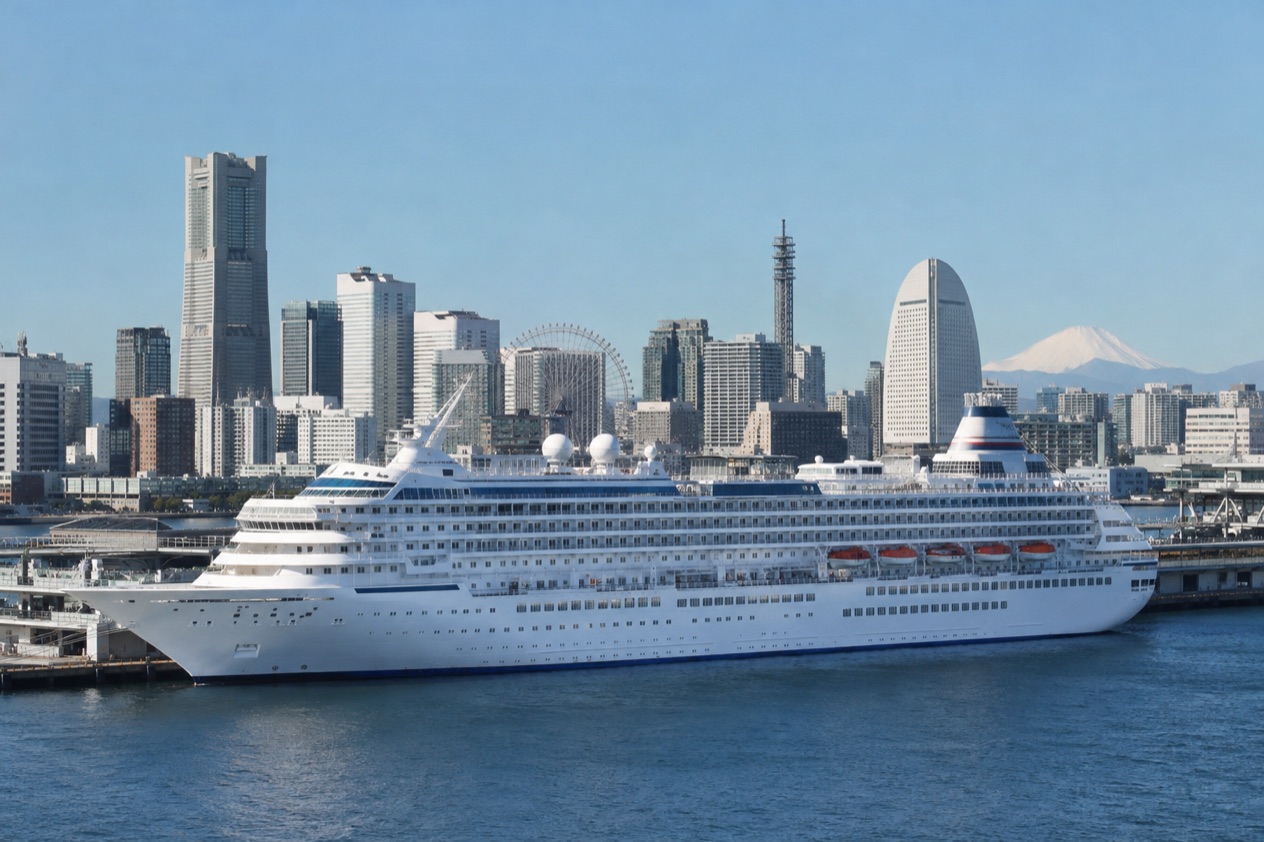
On a March morning, a ship slides into Osaka Bay while the plum trees ashore are finishing and the first cherry buds are still tightly closed. Winter has not quite let go in Hokkaido, yet Okinawa already feels like spring. A Japan cruise in March is a season of change, with a coat on deck in the north and a light layer in the south, and the blossoms arriving port by port.
What is a Japan cruise like in March?
A Japan cruise in March is a trip through a country shifting from winter to spring, where the weather at each port can feel like a different month. A cruise ship is a large passenger vessel used mainly for vacationing, and on almost all of them dining is included in the cruise price. You wake up in a new harbor, spend the day ashore, and come back to a dinner table that is already set.
Most cruise lines do not include alcoholic drinks in their fares, so passengers pay for them as they go. That is worth knowing for the evenings, when the bar on deck becomes a place to watch the lights of a port go by.
Osaka and Kobe, the gateways of Osaka Bay
The Port of Osaka sits within Osaka Bay and is described as the main port in Japan. Kobe lies on the same bay, in the Keihanshin area, and its waterfront is built partly on artificial islands (Port Island, Rokko Island and the island of Kobe Airport) because flat land is so limited there. The Port of Kobe was the world’s busiest container port from 1973 to 1978, a reminder that these harbors were working docks long before they welcomed passengers.
Ashore, Osaka is known for its street food, takoyaki (battered octopus balls) and okonomiyaki (savory griddled pancakes), and Kobe for its beef and its harbor-side promenades. A day here suits travelers who like to eat their way through a city, with a sweater in the cooler hours.
Ports in the south and the north
Naha, on Okinawa, feels like another country in March compared with Sapporo in Hokkaido. In Naha you can wander the covered market streets, taste Okinawan soba and look out over water that stays warm. In Sapporo, snow is still part of the scene, and a bowl of miso ramen or a seafood rice bowl is the natural way to warm up.
Fukuoka, on Kyushu, has its own place in the blossom calendar this month, with cherry trees opening toward the end of March. Its yatai, the open-air food stalls serving ramen and skewers, are a pleasure for an evening ashore.
What is the weather in March?
The weather in March depends heavily on the port, running from freezing in Sapporo to almost warm in Naha, with Tokyo and Osaka in between at cool spring levels. The Japan National Tourism Organization notes that in spring you can travel comfortably with a light jacket or a simple sweater, and for much of Japan that holds. For Sapporo, a proper winter coat is a different matter.
| Port | Average high (°F) | Average low (°F) | Precipitation (inches) | Rain days | Sunshine (hours) | Daylight on March 15 |
|---|---|---|---|---|---|---|
| Tokyo | 57.6 | 41.0 | 4.57 | 9.2 | 175 | 11 h 54 min |
| Osaka | 57.6 | 42.8 | 4.06 | 9.1 | 172 | 11 h 55 min |
| Naha, Okinawa | 71.4 | 62.1 | 5.62 | 10.9 | 115 | 11 h 58 min |
| Sapporo | 40.1 | 27.7 | 3.06 | 13.9 | 145 | 11 h 51 min |
Tokyo and Osaka: cool days, mild afternoons
In both cities, afternoons are mild enough to walk around in a jacket, while mornings and evenings call for another layer. Sunshine is fairly generous, so a gray morning often gives way to a brighter spell.
Naha: spring-like and humid
Naha is the warm port of the itinerary, with afternoons in the low 70s and nights that stay mild. The sea near Naha averages about 71°F in March, a figure taken from daily highs, so it is slightly warmer than a full-day average would be.
Sapporo: winter on the dock
Sapporo stays below freezing at night and barely climbs above 40°F by day. Snow or sleet falls on most days of the month, and the total snowfall for March is substantial. Days still reach nearly twelve hours of daylight, but you will want a warm coat, gloves and good boots for any time ashore.
What do you see in March?
In March you see the end of the plum season and the first stirrings of cherry blossom, with the flowers moving northward week by week. The cherry blossom is one of Japan’s most iconic symbols and a harbinger of spring, so the timing of the bloom shapes how travelers plan their trip.
Cherry blossom timing by port
The Japan Meteorological Agency records first bloom when five or six flowers are open on a sample tree, and full bloom when about 80 percent of the buds are open. The Somei-Yoshino cherry reaches Kyushu, Chugoku, Shikoku, Kinki, Tokai and Kanto in late March. In Fukuoka the first bloom usually falls around March 22 and the full bloom around March 31, though in recent years both have moved earlier or later from one spring to the next.
Farther north the picture is different. In Aomori the usual first bloom comes around April 22, so a March ship will not find blossoms there. In Okinawa, the Hikan-zakura begin to bloom around mid-January, so by March the show has already passed. Sapporo is still deep in winter, and the cherry trees there open much later.
Plum and peach blossoms
Plum trees (Prunus mume) typically flower from January until late February in East Asia, so in March you may catch only the last of them, often in shrine and temple gardens. Their fruit ripens much later, in early summer. Peach blossoms are another sign of the turning season: in Toyota, in Aichi Prefecture, a kilometer-long stretch of weeping peach trees shows white, red and pink hues.
Snow and sea
Not every scene is floral. In Sapporo you may see the city dressed in snow, a vivid contrast to the open decks of a ship in the south. Naha offers the opposite: a harbor under a soft, humid sky, with a sea that is warm by comparison. A single cruise can take in both ends of the season.
Is March a good month for a Japan cruise?
March suits travelers who enjoy the changing season and do not mind packing for several climates, but it is not a month for guaranteed blossoms. The bloom dates are averages, and from one spring to the next they can shift by days or even weeks, so the flowers are a chance rather than a promise.
Who March suits
If your ship calls at Fukuoka, Osaka or Kobe toward the end of the month, you are closer to the early cherry bloom than at the start. If it calls at Naha, you get mild air and a warm sea. Travelers who want snow scenes will find them in Sapporo. Those hoping for full bloom across the whole route should know that the northern ports bloom only in April or later.
What to pack
- A light jacket or sweater for Tokyo, Osaka and Kobe, with an extra layer for evenings.
- A warm coat, gloves and waterproof boots if Sapporo is on the route.
- A rain layer, since every port in the table sees rain on several days of the month.
- Light clothes for Naha, where afternoons run in the low 70s.
With dining included in the cruise price, meals are settled, and the main extras are drinks and whatever you choose to eat ashore. A morning of street snacks in Osaka or a bowl of ramen at a Fukuoka stall is part of the pleasure of a port day.
Good to know before you go
Drinks are the main extra on most cruise lines, since dining is already in the fare. Bring layers rather than a single heavy coat, because one itinerary can run from snow to a warm, humid afternoon. March sits ahead of the rainy season that comes with early summer, but showers and a few gray days are part of the month in every port on the table, so a compact umbrella earns its place in the bag.
Sources
- Japan Meteorological Agency (JMA), Normal values 1991-2020, monthly (https://www.data.jma.go.jp/stats/etrn/view/nml_sfc_ym.php?prec_no=44&block_no=47662), station Tokyo, elevation 25 m, checked October 11, 2026
- Computed from the date and the latitude of the place (sunrise equation, solar elevation -0.833 degrees), October 11, 2026
- Japan Meteorological Agency (JMA), Normal values 1991-2020, monthly (https://www.data.jma.go.jp/stats/etrn/view/nml_sfc_ym.php?prec_no=62&block_no=47772), station Osaka, elevation 23 m, checked October 11, 2026
- Japan Meteorological Agency (JMA), Normal values 1991-2020, monthly (https://www.data.jma.go.jp/stats/etrn/view/nml_sfc_ym.php?prec_no=91&block_no=47936), station Naha, elevation 28 m, checked October 11, 2026
- Open-Meteo Marine API, average 2015-2024, checked October 11, 2026
- Japan Meteorological Agency (JMA), Normal values 1991-2020, monthly (https://www.data.jma.go.jp/stats/etrn/view/nml_sfc_ym.php?prec_no=14&block_no=47412), station Sapporo, elevation 17 m, checked October 11, 2026
- Japan Meteorological Agency, cherry blossom first-bloom dates 2021-2026 and 1991-2020 normal (https://www.data.jma.go.jp/sakura/data/sakura003_07.html), checked October 11, 2026
- Japan Meteorological Agency, cherry blossom full-bloom dates 2021-2026 and 1991-2020 normal (https://www.data.jma.go.jp/sakura/data/sakura004_07.html), checked October 11, 2026
- Japan Meteorological Agency, sakura2020.pdf (https://www.data.jma.go.jp/sakura/data/sakura2020.pdf), checked October 11, 2026
- Japan National Tourism Organization, flowers by season: cherry blossom, plum, wisteria, hydrangea, where and when (https://www.japan.travel/en/see-and-do/flowers/), checked October 11, 2026
- Wikipedia, Prunus mume (https://en.wikipedia.org/wiki/Prunus_mume), checked October 11, 2026
- Japan National Tourism Organization, spring in Japan (https://www.japan.travel/en/guide/spring-guide/), checked October 11, 2026
- Japan National Tourism Organization, autumn in Japan (https://www.japan.travel/en/guide/autumn-guide/), checked October 11, 2026
- Japan National Tourism Organization, summer in Japan (https://www.japan.travel/en/guide/summer-guide/), checked October 11, 2026
- Wikipedia, Cruise ship (https://en.wikipedia.org/wiki/Cruise_ship), checked October 11, 2026
- Wikipedia, Port of Kobe (https://en.wikipedia.org/wiki/Port_of_Kobe), checked October 11, 2026
- Wikipedia, Port of Osaka (https://en.wikipedia.org/wiki/Port_of_Osaka), checked October 11, 2026
To plan your stay
- Celebrity Japan Cruises: Asia Voyages, Hiroshima and Tokyo Sights, and the Port of Kobe
- Cruises from Los Angeles to Japan: Departure Port, Yokohama Arrival and Crossing Length
- How Much Does a Japan Cruise Cost?: What the Fare Covers, Drinks and Shore Excursions
- Holland America Japan Cruises: Asia Sailings, Ports and Ships