
At dawn on deck, passengers line the rail with coffee in hand while a smoking cone slowly comes into view over the water, and the talk turns to what the day on shore will hold. Japan from a ship is a country seen one harbor at a time, with the cabin and the dining room waiting back on board. Holland America Line, an American cruise line, includes Japan in its Asia cruises, with calls at cities, volcanoes and sacred mountain views.
What do Holland America cruises in Japan offer?
They offer a way to see Japan in pieces, with one floating base for the whole trip, as part of the line’s wider Asia cruises. You unpack once, wake up in a new port, and spend the day on shore before returning to the same cabin. The line is an American one, a subsidiary of Carnival Corporation & plc and headquartered in Seattle, Washington, so the service and the way the ship runs will feel familiar to many U.S. travelers.
Dining on almost all cruise ships is included in the cruise price, and that habit shapes the rhythm of a day. Breakfast on board, a shore excursion in the middle of the day, then dinner at sea while the ship moves on to the next harbor. For a country where changing cities by land means repacking, that routine is much of the appeal.
What the Asia cruises add to a Japan visit
Holland America presents its Asia cruises around experiences that go beyond a city stop. Passengers can see Mt. Fuji, described by the line as Japan’s most sacred and tallest mountain, from multiple vantage points. They can watch Sakurajima Volcano, an active volcano, send smoke plumes skyward. In Tokyo and Hiroshima, the line points to city walks, temples and local food.
The cruises also include overnight stays in six top ports, including up to forty hours in Shanghai. That detail concerns the China portion of an itinerary, but it shows the idea: some calls are long enough to see a city after dark, not only in daylight hours between sailings. For Japan, the line adds three new ports on its Asia cruises in the seasons it has announced, plus scenic cruising through Maizuru Bay.
Ship size matters too. Holland America’s ships can reach remote ports such as Jeju and Boracay, which tells you the fleet is not limited to the biggest harbors. The line also reports a two-to-one guest-to-crew ratio and was voted Best Service by Cruise Critic four years in a row.
The ships behind the itineraries
The fleet is grouped into classes, from the smaller Rotterdam class to the larger Pinnacle class. The line’s ships carry Dutch-style names ending in dam, a nod to a company that began in Rotterdam, Netherlands, as the Netherlands-America Steamship Company. The classes and their passenger complements are set out here.
| Class | Ships (year) | Passenger complement |
|---|---|---|
| Rotterdam | MS Volendam (1999), MS Zaandam (2000) | 1,432 each |
| Vista | MS Zuiderdam (2002), MS Oosterdam (2003), MS Westerdam (2004), MS Noordam (2006) | About 1,916 to 1,924 |
| Signature | MS Eurodam (2008), MS Nieuw Amsterdam (2010) | 2,104 and 2,106 |
| Pinnacle | MS Koningsdam (2016), MS Nieuw Statendam (2018), MS Rotterdam (2021) | 2,650 each |
A smaller complement means fewer passengers sharing the gangway and the lounges, while the Pinnacle class carries more people and more on-board spaces. Which ships sail in Japan depends on the itinerary the line publishes for a given season.
Which routes does Holland America sail?
Holland America sails Japan within its Asia cruises, which also visit Korea, China, Vietnam, Singapore and the Philippines. For Japan, the Asia program is the one to look at.
Asia cruises with Japanese ports
An Asia cruise strings together several countries, so Japan is one chapter of a longer story. The line’s own descriptions name Seoraksan in Korea, where passengers can hike rugged granite peaks and visit Buddhist temples tucked into the mountains. They name Halong Bay in Vietnam, with emerald waters weaving between towering limestone pillars, hidden caves and tranquil beaches.
They also name Singapore’s Botanic Gardens and Boracay, where passengers can dip into crystal-clear waters near Willy’s Rock. Halong Bay and the Botanic Gardens are among the UNESCO World Heritage Sites the Asia cruises reach. Put side by side, these stops show how a Japanese port can sit between mountain temples in one country and island water in another.
New Japanese ports and Maizuru Bay
On its Asia cruises in the seasons it has announced, Holland America lets passengers visit three new ports in Japan. The line also adds scenic cruising through Maizuru Bay.
The line’s material does not name the three ports here, so the sailing you are considering is the place to confirm which ones it includes. What stays constant is the format: a ship arrives, the day belongs to the town and its surroundings, and the evening is spent at sea or in port depending on the schedule.
The world cruise and other regions
Holland America also offers an annual world cruise. A voyage of that kind crosses many regions, and Asia, with its Japanese calls, can be part of the broader picture.
Where do the ships go?
In Japan, the line points to Tokyo, Hiroshima and Miyajima, views of Mt. Fuji, and the active volcano of Sakurajima, with Kobe as a major Japanese port in the same waters. Each offers a different kind of day on shore, from city streets to a memorial park to a smoking mountain.
Tokyo
In Tokyo, passengers can brave the busy Shibuya Crossing, where waves of pedestrians cross in every direction at once. The line also points to wandering Edo-era neighborhoods, a name for the older districts that grew up when the city was called Edo. There are temples to visit, food to sample and shopping to do.
A day here mixes the very new and the older city. A stroll through a temple precinct, with incense drifting and visitors rinsing their hands at the water basin, sits a short step in spirit from the screens and crowds of Shibuya.
Street snacks and sit-down meals both fit a port day, and shops range from department stores to small craft counters. It suits travelers who like to keep moving and see several moods of one city.
Hiroshima and Miyajima
In Hiroshima, passengers can wander through Peace Memorial Park, a space of reflection in the middle of the city. The line also points to Miyajima, where a floating torii gate stands in the water, the shrine gate that has become one of the images people associate with the region.
Food is part of the day as well, and passengers can taste okonomiyaki, a savory griddle pancake layered with cabbage, noodles, egg and sauce. Cooked on a hot plate in front of you, it is a dish tied to Hiroshima. A visit here combines history, a shrine setting and a meal, and it suits travelers who want a day with weight as well as scenery.
Mt. Fuji and Sakurajima
Passengers can experience Mt. Fuji, Japan’s most sacred and tallest mountain, from multiple vantage points. Seeing it depends on the sky, so the mountain is a chance rather than a promise, and weather decides how much of it shows. When clouds lift, the shape is unmistakable.
Sakurajima is a different kind of mountain. This active volcano sends smoke plumes skyward, and watching them rise is a scene you will not find in most cruise ports. The two mountains, one sacred and quiet in outline, the other restless, give a Japan cruise two very different faces of the same landscape.
Kobe and its man-made islands
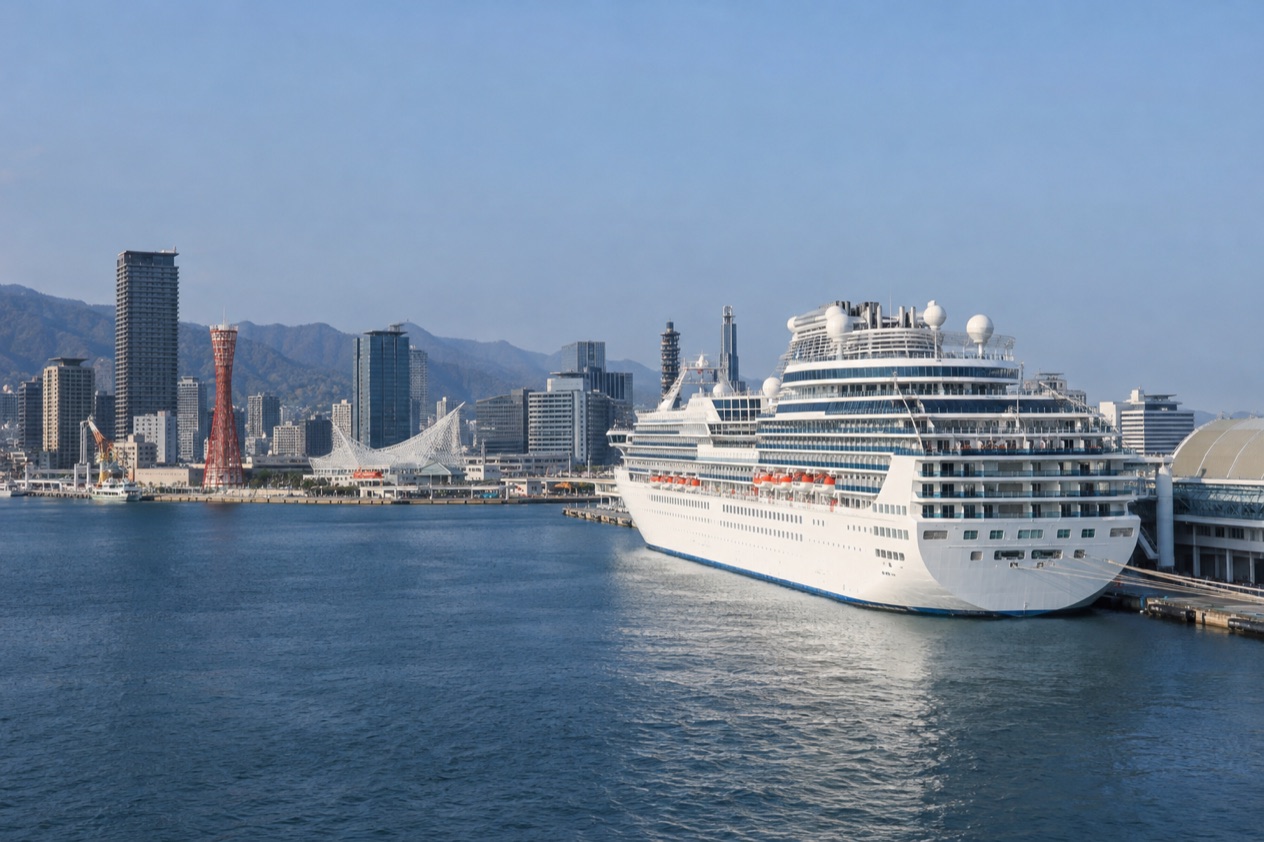
The Port of Kobe is a Japanese maritime port in Kobe, Hyogo, in the Keihanshin area, backed by the Hanshin Industrial Region. Flat land is limited there, so artificial islands were built, including Port Island, Rokko Island and the island that holds Kobe Airport.
That shapes the first impression of the area: a harbor city where land has been extended into the water. Holland America’s own descriptions do not tie a specific Kobe call to a given sailing, so read it as a port of the region and look at the itinerary for what a particular cruise includes.
Good to know before you go
A cruise keeps money matters simple on board, since dining on almost all cruise ships is included in the cruise price, but ashore you will want yen for small purchases in each port. Itineraries cover several countries, so what you spend and how you pay can change from one stop to the next.
Sailings pass through places with an active volcano and an exposed sea, so shore plans give way to the ship’s schedule and the weather. Wear shoes you can walk in, since temples, shrines and old neighborhoods are explored on foot.
Sources
- Wikipedia, Holland America Line (https://en.wikipedia.org/wiki/Holland_America_Line), checked October 11, 2026
- Holland America Line, Asia cruises (https://www.hollandamerica.com/en/us/cruise-destinations/asia-cruises), checked October 11, 2026
- Wikipedia, Cruise ship (https://en.wikipedia.org/wiki/Cruise_ship), checked October 11, 2026
- Wikipedia, Port of Kobe (https://en.wikipedia.org/wiki/Port_of_Kobe), checked October 11, 2026
To plan your stay
- Japan Cruise in March: Weather by Port, Cherry Blossom Timing and What You See
- Cruises from Los Angeles to Japan: Departure Port, Yokohama Arrival and Crossing Length
- How Much Does a Japan Cruise Cost?: What the Fare Covers, Drinks and Shore Excursions
- Japan Cruise in April: Cherry Blossoms, Spring Weather and What You See From Port