
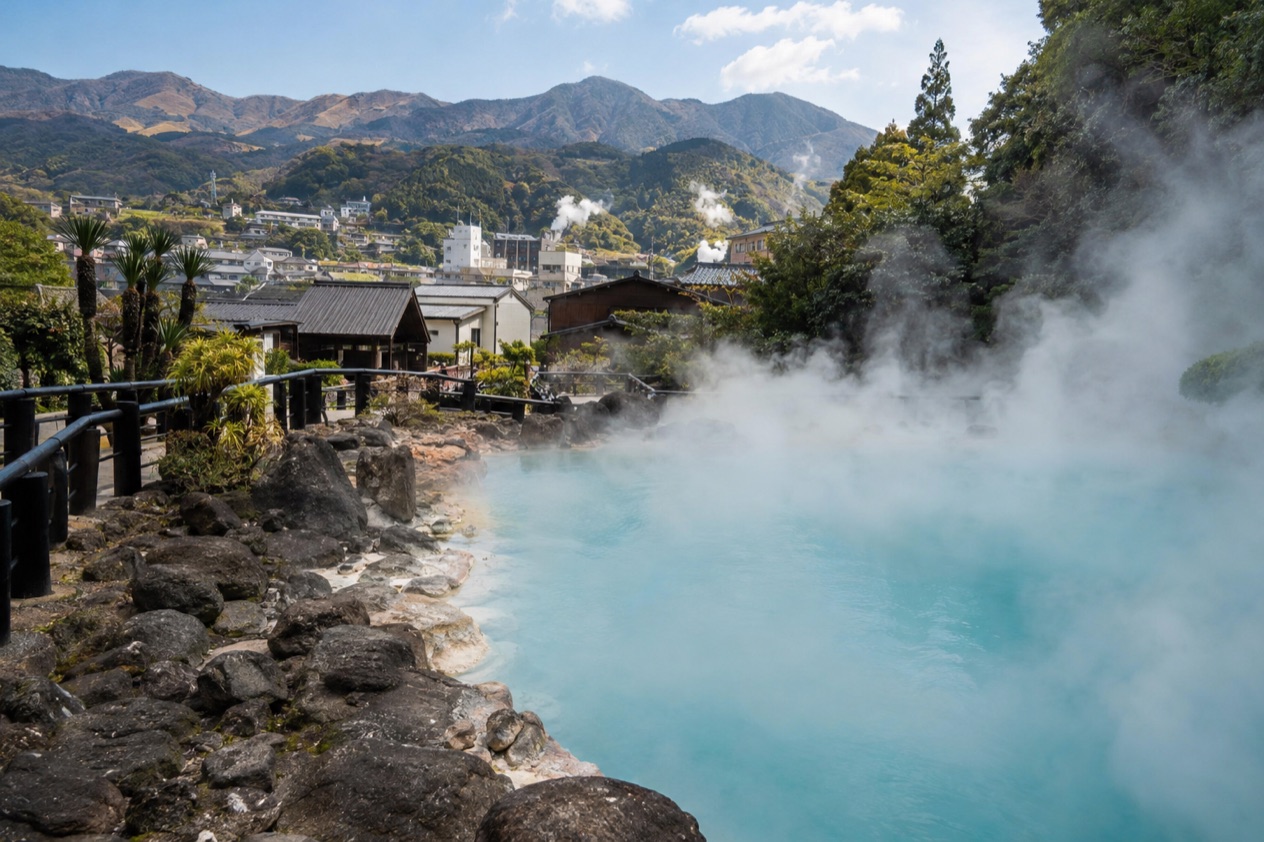
Steam rises across Beppu, especially around Kannawa, while the streets near the train station have a more urban feel. Choosing where to sleep here means choosing which of those two moods you want to wake up in, and whether your bath is in a private tub or a shared hall.
What is the best area to stay in Beppu?
For a first visit built around the hot springs, the Kannawa district is the strongest choice, because it is where most of the Beppu Hells sit and where the steam is part of daily life. If you arrive by rail and want to keep things simple, the area around Beppu Station puts you where the Sonic limited express stops. Shibaseki has two of Beppu’s hells, about a five-minute bus or car ride from the Kannawa group.
By kind of trip, the picture sorts itself out quickly. Sightseeing centered on the hells points to Kannawa. Arriving from Fukuoka or Kokura by train, or leaving again the next morning, points to the station side. A trip that adds a ryokan night, with a kaiseki dinner and a soak, depends less on the district than on the property you pick, so it is worth looking at the lodging first and the map second.
Beppu is the largest hot spring resort in western Japan, and that shapes every choice here. The city counts eight major hot spring zones and about 3,000 steam vents, so bathing water is not a special feature of one neighborhood.
It is the background of the whole place. What changes from one area to the next is what surrounds the water: a railway station and city streets, a hillside of steaming pools, or a quieter stretch near the Shibaseki hells.
Budget travelers, families and anyone planning evenings out should think about the geography before booking. Most of the hells lie in Kannawa, almost on the opposite side of the city from the train station. That single fact decides a great deal. Sleeping near the station means a trip across town to see the hells, and sleeping in Kannawa means a trip back across town for the train.
For families, the appeal of Kannawa is that five of the hells are within walking distance of each other, so a day can be spent on foot among bubbling mud, cobalt water and clouds of steam without changing buses. Children tend to remember the geyser and the strange colors long after they have forgotten the temples of other cities. Evenings out are a different matter, and the station side, being the part of the city that works like a regular downtown, is where you would look for a choice of places to eat after dark.
A traveler with a long list of onsen to try has a different calculation again. With over 150 individual bathing facilities in the city, the question is not whether a bath is near your bed but how you want to move between them.
Some visitors take up the onsen stamp rally, in which collecting 88 stamps earns the title of onsen meijin, an onsen expert.
Nightlife in Beppu is the least resort-like part of the trip. People come here for the bathing, and the evening is built around it: a long soak, a meal, a stroll in a yukata if your inn lends one. If a late night of bars matters to you, the station side of town is the sensible choice, since it is the part of Beppu that behaves like a city rather than a spa village.
The best areas to stay in Beppu
Around Beppu Station
The station side is the city’s front door. The Sonic limited express runs twice an hour from Fukuoka (Hakata Station) and Kokura, stops at Beppu and carries on to its terminus at Oita. Travelers arriving on the Sonic or departing by rail in the morning may prefer to stay near Beppu Station.
What you find here is the everyday Beppu: streets of shops and restaurants, the rhythm of commuters, and the occasional wisp of steam from a bathhouse or a vent between buildings. The kinds of lodging that suit this sort of neighborhood are business hotels and simple city stays, the sort of room you use as a base while the day belongs to the baths and the hills. A traveler who wants a ryokan with tatami and a kaiseki dinner will be choosing a specific property rather than a district.
The tradeoff is distance from the hells. They sit mostly in Kannawa, almost on the other side of the city, so sightseeing from here is a matter of heading out and coming back. It suits travelers who are passing through, those who are happy to move around by bus or car, and anyone who wants the station close at hand more than the steam.
Kannawa, the district of the hells
Kannawa is where Beppu looks the way the postcards promise. Five of the hells are here, within walking distance of each other: Umi Jigoku, the Sea Hell with its vibrant cobalt-blue water, and Kamado-Jigoku, the furnace, where rice was once cooked over the geyser, are two of the names you will hear.
These are thermal waters reaching around 98°C, and they cannot be bathed in. They are for looking at, and for the eggs and puddings sold nearby that are steamed in the vents.
Sleeping in Kannawa means the steam is part of your morning. A ryokan in a district like this follows the traditional pattern: tatami floors, futons laid out in the evening, a private bath that is sometimes outdoors, a yukata to wear, a kaiseki dinner and a traditional Japanese breakfast. The staff explain the customs, from taking off shoes indoors to the order of bathing in the onsen, so a first-timer is guided rather than left to guess.
The hells open from 08:00 to 17:00, which is worth keeping in mind when you plan the hours around them. Tatsumaki-Jigoku may stay open a little later after its geyser’s last eruption.
| Site | Open |
|---|---|
| The eight Beppu Hells | 08:00-17:00 |
| Tatsumaki-Jigoku | May stay open a little later after the geyser’s last eruption |
Kannawa suits first-time visitors who came for the hells, couples looking for a ryokan evening, and families who want to cover several sights on foot. A useful rhythm is to see the hells in daylight, then spend the evening soaking and eating at your lodging instead of heading back across the city.
Shibaseki, the second hells district
Shibaseki is the smaller of the two hells districts. Two of the hells are here, about a five-minute bus or car ride from the Kannawa group. That puts it in a useful middle position for travelers who want to see all of the hells and would rather not commit to the busiest part of the district for their bed.
Tatsumaki-Jigoku erupts every 30 to 40 minutes for about 5 minutes, so expect to wait between eruptions. The rhythm of it makes the stop easy to remember, and having a bed close by means you can return when the crowds around it have changed.
Lodging choices in a district like this lean toward hotels and inns that are used as a base for the hells and the onsen.
Beppu areas compared
| Area | Best for | Feel | Getting around |
|---|---|---|---|
| Around Beppu Station | Arriving by the Sonic limited express | The city’s everyday side, opposite the hells | The Sonic stops at Beppu, twice an hour from Fukuoka (Hakata Station) and Kokura |
| Kannawa | Seeing the Beppu Hells | Steam from the vents, the hells close together | Five of the hells within walking distance of each other |
| Shibaseki | Seeing the geyser and the second pair of hells | A separate hells district with its own pair of hells | About a five-minute bus or car ride from the Kannawa hells |
The main trade-off is between the station and the steam. Near the station, the train is right there and the city feels like a city, but the hells are almost on the opposite side of Beppu. In Kannawa the reverse is true: the hells are on your doorstep and the walk between five of them needs no vehicle, but the train station is a journey away.
A second trade-off is between the older onsen town and the newer city around the rail line. Beppu has grown up around its water, and neighborhoods have their own bathhouses, so a short stay near the station does not rule out a soak. What you give up is the daily sight of steam over the roofs, and the sense of waking up inside the hot spring landscape that visitors come here to see.
Shibaseki sits between the two ideas. It gives you the geyser and a second pair of hells, and it is only a short bus or car ride from the Kannawa group, so a traveler can sleep here and still reach the main cluster without much planning. It makes the most sense for those who have a vehicle or are comfortable with the bus, and less for someone who wants to step out the door straight into the hells.
There is no wrong answer, only a matter of how your days are likely to run. Count the hours you plan to spend at the hells, the number of times you will use the train, and how much you want a traditional inn to be the center of the trip. If the inn is the point, choose it first. If the sights are the point, choose the district first.
How to choose your hotel in Beppu
In a hot spring city, the first question is what kind of stay you want, since it changes the evening more than the district does. A ryokan, a traditional Japanese inn, is the stay that people picture. These inns are believed to have emerged in Japan in the 8th century, and they typically feature tatami floors, futons, private baths that are sometimes outdoors, yukata to wear, a kaiseki dinner and a traditional Japanese breakfast.
Staying in a ryokan is as much about the routine as the room. Shoes come off at the entrance, slippers take over, and staff explain the customs of the house, including how to bathe in the onsen and how to wear the yukata.
Dinner is served as a sequence of small dishes, and the futon is usually laid out while you are at the table or in the bath. Because Beppu is a city of hot springs, a stay like this fits the place unusually well.
A more modest stay, such as a business hotel near the station or a simple guesthouse, makes sense when the baths are the plan and the room is only a place to sleep. With over 150 individual bathing facilities in the city, you can spend the day moving among them and treat your lodging as a base. This approach suits travelers who like to collect baths, whether or not they are chasing the stamp rally.
Think about where your day will end. If the hells are the center of the trip, staying in Kannawa shortens the day and puts the steam at your window. If you are heading on by rail the next morning, the station side makes the departure straightforward. If you have a car or are happy on the bus, Shibaseki gives the geyser and the second pair of hells a place in the plan.
For families, the useful questions are practical ones. Does the property have a private bath, which some ryokan offer, so that everyone can soak together without the shared hall? Is there a meal included, which means no search for a restaurant after the day’s outing?
And is the district one where the next day’s sights are close? A private bath and a dinner at the inn can turn the evening into the best part of the trip for children as well as adults.
Travelers with limited mobility should consider the layout of the district as well as the room. Kannawa is a hillside of steam and pools, and the five hells there are within walking distance of each other.
The station side is the part of the city where you arrive by rail. Weigh how much walking each day will involve, and whether a bus or car ride to the other side of the city is the better trade.
One more note on the hells themselves. They are thermal waters reaching around 98°C, and they are for looking at rather than bathing in. You will still want a proper bath at the end of the day, which is why a lodging with its own onsen, or one close to a public bathhouse, matters more here than in most cities.
Good to know before you go
Beppu is a city in Oita Prefecture on the island of Kyushu, and the rail link into it is the Sonic limited express, which runs twice an hour from Fukuoka (Hakata Station) and Kokura, stops at Beppu and ends its run in Oita. The hells are open from morning into the late afternoon, and the geyser at Tatsumaki-Jigoku erupts at intervals, so plan the sightseeing in daylight and leave the evening for the baths.
Sources
- Japan National Tourism Organization, Beppu (https://www.japan.travel/en/destinations/kyushu/oita/beppu-and-yufuin-around/), checked October 11, 2026
- Wikipedia, Beppu, Ōita (https://en.wikipedia.org/wiki/Beppu,_%C5%8Cita), checked October 11, 2026
- Wikivoyage, Beppu (https://en.wikivoyage.org/wiki/Beppu), checked October 11, 2026
- Japan National Tourism Organization, ryokan stays, what is included, etiquette (https://www.japan.travel/en/guide/japanese-ryokan/), checked October 11, 2026
- Japan National Tourism Organization, heritage stays (https://www.japan.travel/en/heritage-stays/), checked October 11, 2026
- Japan National Tourism Organization, wellness and onsen (https://www.japan.travel/en/guide/wellness-travel-in-japan/), checked October 11, 2026