
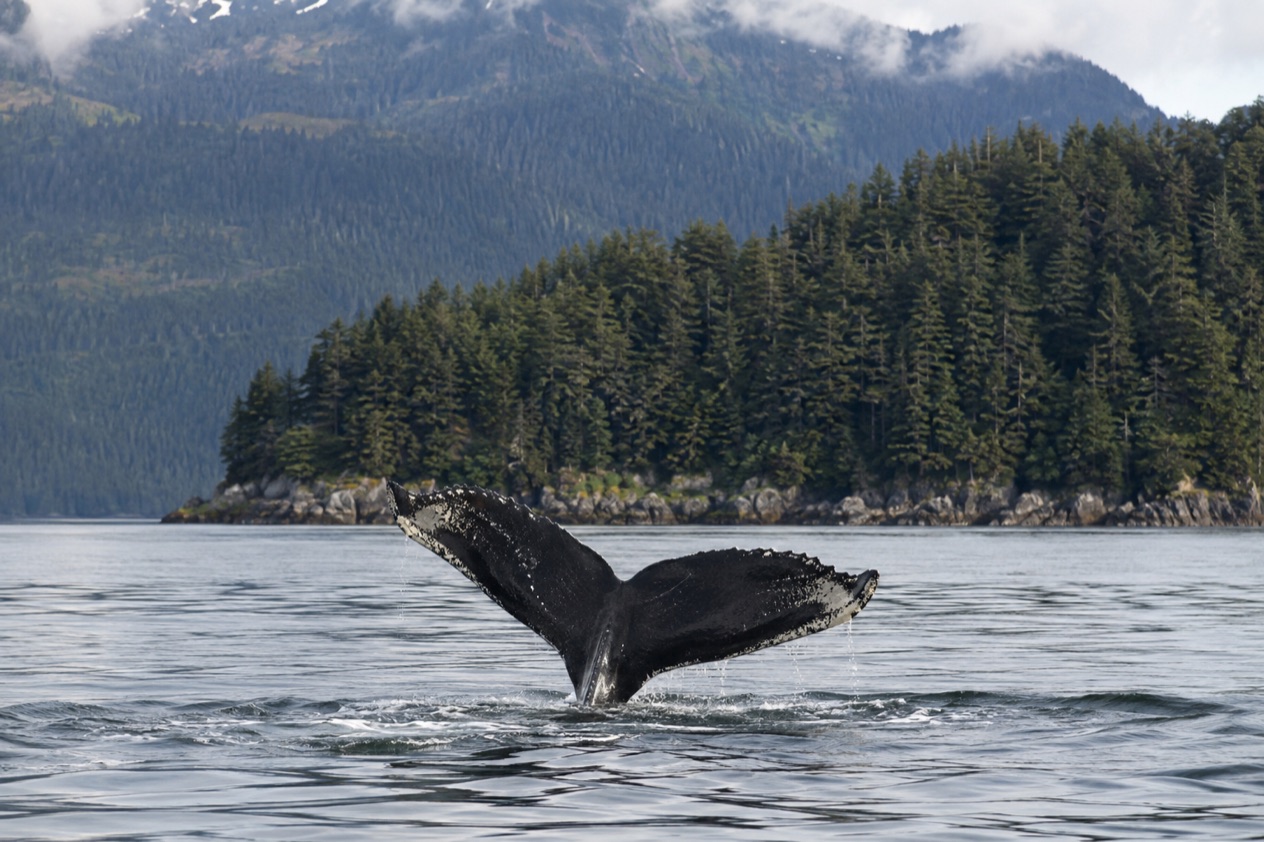
A humpback exhales out on the water, and a soft, misty blow hangs for a moment against the dark green wall of the Tongass. Boats slip out of Auke Bay Harbor, passengers line the rails with cameras and hot drinks, and everyone goes quiet at the same instant. Whale watching in Juneau is a boat outing in the rainforest-bordered waters of Southeast Alaska, a chance to meet one of the great migrants of the North Pacific from the capital city.
Is visiting whale watching in Juneau worth it?
Yes, if you want your first look at wild Alaska to happen on the water, and it suits almost anyone who likes animals, big scenery and a slow, watchful kind of day. Juneau is a state capital with a historic district, museums and restaurants, yet the whales are part of the same trip, not a separate expedition to a far-off lodge.
What sets Juneau apart from other whale-watching towns is the setting. The city sits along the Gastineau Channel inside the Tongass National Forest, the world’s largest temperate rainforest, so the boats pass forested shorelines instead of open, empty ocean.
Wildlife tours here are not limited to whales, either. They can bring you close to black bears, Dall’s porpoises, sea lions, harbor seals, sea otters, mountain goats and Sitka blacktail deer, which makes a single outing feel like a small safari.
Whales are never guaranteed, and that is part of the appeal. A sighting is a chance, and the days when it comes together are remembered long after the trip. If a whale does not cooperate, the eagles, seals and shoreline still give you a good reason to be out there. For travelers who also want glaciers, hiking and a walkable downtown, Juneau packs all of that around the harbor.
What to see at whale watching in Juneau
Humpback whales
The humpback is the whale most people come for, a baleen whale known for breaching and other surface behavior. Adults are long and heavy, ranging from 46 to 56 feet and weighing up to 40 metric tons. Visitors in Juneau are likely to see humpbacks, along with bears and bald eagles, especially from April through November.
Watch for the blow first, a breath of mist that often shows before the animal does. Then comes the long, rolling back and, sometimes, the tail lifting clear as the whale dives. Each tail carries its own markings, which is how researchers and patient watchers tell individuals apart. A breach, when the whole body leaves the water, is the rarer moment that everyone hopes to catch.
Bubble-net feeding
A group of humpbacks bubble-net fishing has been observed near Juneau, one of the most remarkable feeding behaviors in the animal world. The whales work together, blowing a curtain of bubbles around a school of fish, then rise through the middle with mouths wide open. It is a chance, not a promise, but it is the kind of sight that explains why people book a boat.
Even when you only see ordinary feeding, the cooperation is striking. Gulls often gather where the whales work, and a sudden crowd of birds on the surface can signal that something is happening below. Boats keep their distance by rule, so the scene unfolds at a respectful remove, and binoculars help.
Orcas, porpoises and other marine life
Orcas range through the waters off Alaska, and transient pods have been sighted from southern Alaska all the way to central California. These are the fast, black-and-white hunters people picture, and a sighting would be a bonus rather than something to count on. Dall’s porpoises, sea lions, harbor seals and sea otters are also named among the animals that wildlife tours in Juneau can get visitors close to.
Each of these animals gives a different rhythm to the day. Seals haul out and watch the boat with round, curious eyes. Sea otters float on their backs, and sea lions announce themselves with a bark before you see them. Between whale spouts, there is always something to look at.
Eagles, bears and the shoreline
The forested edge of the channel is part of the show. Bald eagles perch in the tall trees and wheel over the water, and the same tours that find whales can also bring you near black bears and mountain goats on the slopes. Tahku, the life-sized bronze humpback in Juneau, is a good way to picture the animal’s scale before or after you go out.
Hours, tickets and rules
What you are buying is a seat on a boat that heads out from Auke Bay Harbor, and the details belong to the company you choose.
The rule that shapes every outing is about distance. Regulations on whale watching vessels restrict how close boats can get to the whales, so captains hold back and let the animals decide whether to approach. That is why long lenses and binoculars matter, and why the best sightings often come when a whale chooses to surface near a boat that is simply sitting still.
Seeing a whale also means respecting its space from your side of the rail. The point of the rule is to leave the animals undisturbed while they feed, rest or travel, and it protects the very behavior people come to watch.
How to get to whale watching in Juneau
Juneau has no roads connecting it to the rest of Alaska or the Lower 48, so you arrive by plane or by boat. It is Alaska’s closest big city to the Lower 48, which makes it reachable any time of year. Once you are in town, the whale-watching departure point named for Juneau is Auke Bay Harbor.
Many visitors come off cruise ships. Between May and September, the city sees a daily influx of 16,000 people or more from visiting ships, and whale watching is one of the outings passengers can choose in Juneau. Royal Caribbean lists whale watching in Auke Bay Harbor as a Juneau activity, alongside tundra trekking over Mendenhall Glacier.
If you want to combine the water with the ice, Mendenhall Glacier is 13 miles from downtown Juneau and near the airport, and visitors can drive directly to it. It is visible from the local road system, which makes it a natural companion to a day on the harbor. Whale watching is also offered off Icy Strait Point, a separate stop with its own tours.
When to visit whale watching in Juneau
The stretch from April through November is when visitors in Juneau are likely to see humpback whales, along with bears and bald eagles. Humpbacks migrate between feeding areas toward the poles and breeding areas near the equator, so the animals you meet in Alaska are feeding visitors, not year-round residents. Mothers typically give birth in mid-winter, usually to a single calf, far from these cold waters.
Summer is also the season of the crowds. From May to September, cruise ships bring a large wave of passengers into town every day, so the harbor and the downtown streets feel busy. Juneau’s summers are cool and fresh, with glacier views, cold water and the Juneau Icefield nearby, which suits a day on a boat.
The shoulder months at either end of the whale season, April and the fall, are quieter in a town without ships in port. Whales are chances in every month, never promises, so a flexible schedule helps. Winter belongs to other pursuits, with downhill skiing, cross-country skiing and snowboarding on offer, and the whales are not part of that picture.
Tips for your visit
Pair the boat with the rest of Juneau. The historic district is small and walkable, with several sights, and it makes an easy fit with a harbor outing. Rotating museum galleries, local live performances and the nationally acclaimed Perseverance Theatre round out a town that has more to offer than its wildlife.
History is close at hand. The Alaska State Capitol downtown was built as the Federal and Territorial Building in 1931, and the Empty Chair Memorial in Capital School Park, dedicated in July 2014, remembers the removal of Juneau’s Japanese community during World War II. The city also offers mining history, a living Alaska Native culture and fresh wild Alaska seafood in one trip.
If one day on the water leaves you wanting more, you can charter a boat to fish for salmon, take a small plane or helicopter to land on a glacier for hiking or dog-sledding, or choose among more than 250 miles of hiking trails. The visitors guide from Travel Juneau is available on request for further planning. Look for the humpback sculpture Tahku in town as a souvenir photo of the animal you came to see.
Good to know before you go
Juneau is cool and fresh in summer, and the water stays cold, so the sea is something to watch from a boat and never a place to swim.
Male humpbacks sing complex songs lasting from 4 to 33 minutes, but those sounds belong to the whales’ own world, and the hours on deck are about watching and waiting. The region’s humpback population is estimated at around 21,000, which helps explain why Alaska keeps drawing watchers.
Sources
- Wikipedia, Humpback whale (https://en.wikipedia.org/wiki/Humpback_whale), checked October 11, 2026
- Wikipedia, Orca (https://en.wikipedia.org/wiki/Orca), checked October 11, 2026
- Travel Juneau, things to do (https://www.traveljuneau.com/things-to-do/), checked October 11, 2026
- Wikipedia, Juneau, Alaska (https://en.wikipedia.org/wiki/Juneau,_Alaska), checked October 11, 2026
- Royal Caribbean, Alaska cruises (https://www.royalcaribbean.com/cruise-destinations/alaska-cruises), checked October 11, 2026
- National Park Service, Glacier Bay National Park & Preserve, plan your visit (https://www.nps.gov/glba/planyourvisit/index.htm), checked October 11, 2026
- Visit Anchorage, wildlife viewing (https://www.anchorage.net/outdoors/wildlife-viewing/), checked October 11, 2026