
FLORIDA · FEBRUARY · DRY SEASON
February is Florida at its most flattering and its most misread. The state is 450 miles tall, and the month pulls it apart: on the same mid-February morning, Key West wakes to an average low of 67.1°F while the Jacksonville gauge that stands in for St. Augustine records 46.1°F, and on 2.7 nights in an average February it drops to freezing. One state, one week, two wardrobes.
The month’s other selling point is what it lacks. February sits in the middle of the dry season, November through April, and nowhere near the Atlantic hurricane season, which runs June 1 to November 30. The catch is the water. Off Fort Lauderdale the sea averages 77.5°F, off Tampa 66.6°F, and that difference decides whether a beach day involves swimming or a windbreaker.
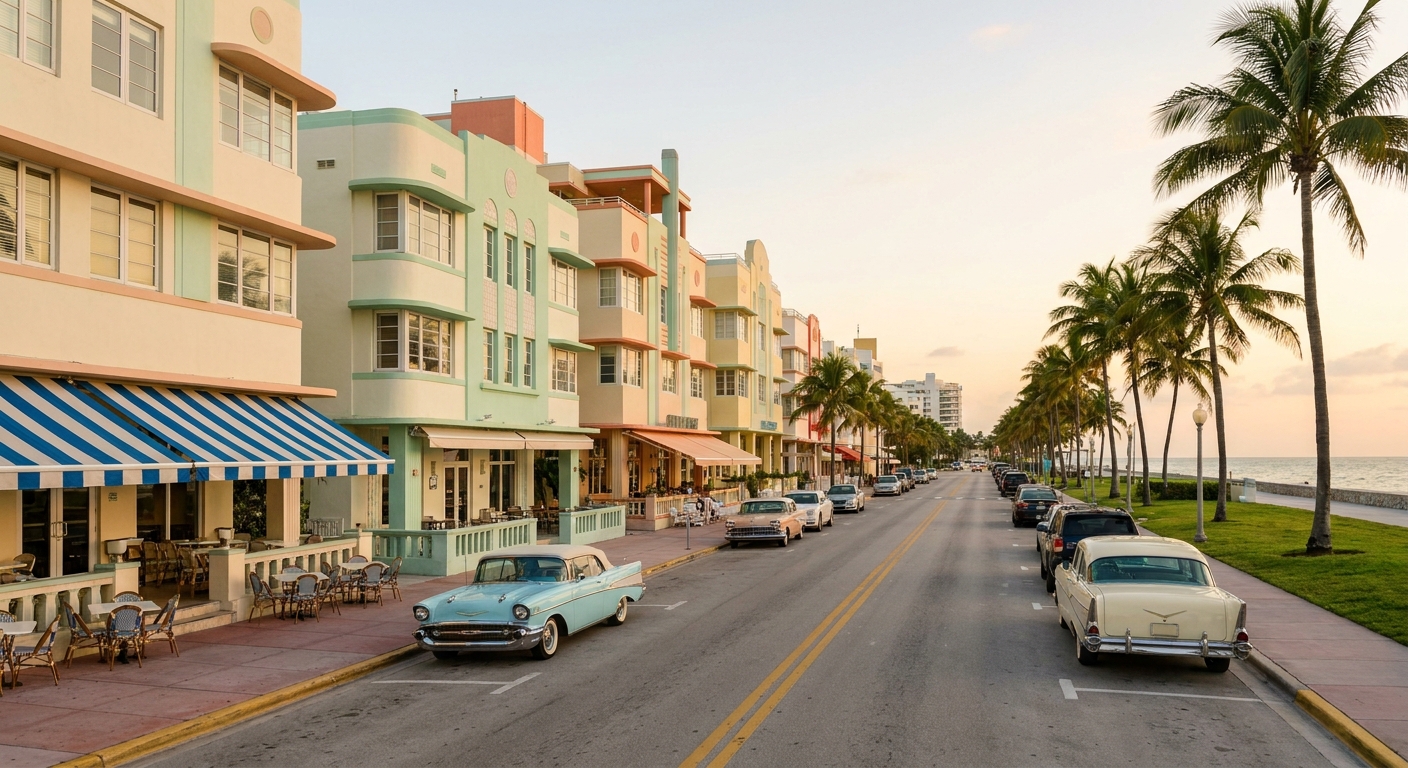
THE MONTH AT A GLANCE · FLORIDA · FEBRUARY
February delivers Florida’s driest, calmest weather and its widest north-south split: swim on the southeast coast and in the Keys, walk the old towns up north, and expect the state’s busiest booking window.
DRY SEASON: NOV TO APR · OUTSIDE HURRICANE SEASON · SEA 63.8°F TO 77.5°F
Go for: dry ground in the Everglades, 76.9°F sea off Miami, evenings outdoors in the Keys, and a month that falls outside the June 1 to November 30 hurricane season.
Think twice before: booking a Gulf swimming week at Tampa’s 66.6°F water, or a northeast beach trip on 46.1°F nights and a 63.8°F ocean.
Climate: NOAA NCEI 1991-2020 station normals · Sea: Open-Meteo Marine 2015-2024 · Hurricanes: NOAA NHC · full sources at the end
On this page
- Average highs and lows by citySix NOAA stations, from Key West to Jacksonville
- Is February dry season or wet season?Dry season, November through April
- Sea temperature for swimming63.8°F to 77.5°F, coast by coast
- How crowded Florida is in FebruaryThe February-to-April demand window
- Things to do in FebruaryEverglades, Vizcaya and PAMM with prices and hours
- Which region suits the monthSoutheast coast, the Keys, the northeast
- February compared with January and MarchRain, temperature and the March event calendar
- Is February a good time to visit?Who the month suits, and the fallback month
Every figure here comes from NOAA’s 1991-2020 monthly normals, read at named airport gauges: Miami International (USW00012839), Key West International (USW00012836), Fort Lauderdale-Hollywood (USW00012849), Orlando International (USW00012815), Tampa International (USW00012842) and Jacksonville International (USW00013889), the nearest official station to St. Augustine. Sea readings come from a separate marine dataset averaged over 2015 to 2024, and its measurement quirk is spelled out below.
Florida weather in February: average highs and lows in north, central and south Florida
| City · NOAA station | Avg high | Avg low | Rain | Days with 0.10 in or more |
|---|---|---|---|---|
| Key West · USW00012836 | 77.4°F | 67.1°F | 1.54 in | 2.4 |
| Miami · USW00012839 | 78.2°F | 63.2°F | 2.15 in | 3.6 |
| Fort Lauderdale · USW00012849 | 77.4°F | 63.3°F | 2.38 in | 3.4 |
| Orlando · USW00012815 | 74.9°F | 52.4°F | 2.04 in | 3.8 |
| Tampa · USW00012842 | 74.0°F | 55.5°F | 2.62 in | 3.6 |
| St. Augustine · USW00013889 (Jacksonville) | 68.9°F | 46.1°F | 2.86 in | 4.8 |
Start with the spread. Key West’s average high of 77.4°F runs 8.5 degrees above St. Augustine’s 68.9°F. It sounds survivable. The nights are where the state comes apart: 67.1°F against 46.1°F, a 21-degree gap inside one state line. The frost count sharpens it further, with 2.7 nights at or below 32°F at the Jacksonville gauge against 0.2 in Orlando and 0.1 in Tampa.
Ranked by daytime warmth, the six barely separate: Miami at 78.2°F, Key West and Fort Lauderdale both at 77.4°F, Orlando at 74.9°F and Tampa at 74.0°F, with St. Augustine trailing. Nights sort them differently. Orlando averages 52.4°F after dark and Tampa 55.5°F, pleasant in a theme-park queue and cold on a terrace at nine.
Rain in February is a rumor in the south and a mild nuisance in the north. Key West records 1.54 inches across 2.4 days that reach a tenth of an inch, St. Augustine 2.86 inches across 4.8 such days. Days delivering a full inch or more stay rare everywhere, from 0.4 in Key West to 0.8 in Tampa and St. Augustine. A wet February day usually costs an hour of the schedule rather than the whole afternoon.
The gap between day and night is your packing instruction. Orlando spreads 22.5 degrees between its average high and low, St. Augustine 22.8, and both make a real jacket after dark non-negotiable. Key West spreads 10.3 degrees and asks for a shirt. On a trip that runs from Miami up to the northeast, pack for both cities: the suitcase crosses two climates in five hours of driving.
Light is the quiet constraint. On February 15, St. Augustine gets 11 hours 11 minutes of daylight and Key West 11 hours 23, twelve minutes apart across 500 miles. The clock matters more than the total: sunset falls around 6:14 p.m. in Miami, 6:16 in Orlando, 6:21 in Tampa. Boardwalk loops, boat trips and the drive back from the Everglades all have to land before that.
Is February in Florida’s dry season or wet season?
February belongs to the dry season, which runs November through April statewide. The wet season is May through October. The Miami International gauge shows the difference without adjectives: 2.15 inches of rain in February against 10.51 inches in June, the wettest month of its year.
In practice this removes the afternoon thunderstorm from the plan. From June to September a Florida day gets built around a 4 p.m. downpour; in February it gets built around dinner. Trails stay walkable, mosquito pressure drops, and Everglades wildlife concentrates around shrinking water, which is why the dry months are the park’s viewing season. Our Everglades guide covers the trails and entrances.
The hurricane question deserves a flat answer. The Atlantic season runs June 1 to November 30 and peaks on September 10, with most activity between mid-August and mid-October, per NOAA’s National Hurricane Center. February falls outside those dates. That is a fact of the calendar and nothing more, and it explains a good deal about why winter beds get taken early.
So February’s booking math differs from September’s. Refundable rates matter less when no storm can close an airport, and the pressure shifts to availability. What can still spoil a week is a cold front pushing down the peninsula: the northern record carries those 2.7 freezing nights, and a front that puts St. Augustine at 32°F leaves Orlando in the 40s. Reserve the beds early, and read the forecast three days out rather than three months.
Can you swim in Florida in February? Sea temperature by coast
Yes, on one coast. February sea temperatures average 77.5°F off Fort Lauderdale, 76.9°F off Miami and 76.3°F off Key West, all comfortably swimmable without neoprene. The Gulf reading in our set, Tampa, comes in at 66.6°F, a brisk 10.9 degrees below Fort Lauderdale. Further north, the Atlantic off St. Augustine averages 63.8°F, which is wetsuit water for anyone who is not a surfer.
One caveat rides with those numbers. They are means of the daily maximum sea surface temperature across 2015 to 2024, so they describe the warmest point of the day rather than a 24-hour average, and they read a shade high for a 7 a.m. swim. Popular sea-temperature sites also disagree about Miami in winter, quoting anywhere from about 72°F to 76°F. That is why the method travels with the figure here.
How busy is Florida in February?
February is high season, and the calendar explains it plainly enough: the dry season is the state’s selling window, snowbird leases run through the winter, and half the country is shopping for 78°F. Hotel market data compiled by the trade, which is not an official statistic, puts room rates at their highest from February through April and their lowest from August to October.
That changes the order of operations. Beds and rental cars go first, above all in the Keys, where inventory is finite and the road in is one lane each way. February does dodge the March pile-up: the Miami Open runs March 14 to 28, 2027 at Hard Rock Stadium, Ultra follows March 26 to 28 at Bayfront Park, and Miami Beach’s spring-break traffic plan, announced for 2026 and adjusted each year, operates from 6 p.m. Thursday through Sunday.
A monthly visitor count by city and a monthly price series are both missing from the sources listed at the end, so February gets no ranking against March on cost. Even the add-ons resist a firm number: published Miami Beach resort fees run from roughly $25 a night on average to $35 or $95 depending on the property. Budget the top of that spread, then enjoy being wrong.
Things to do in Florida in February
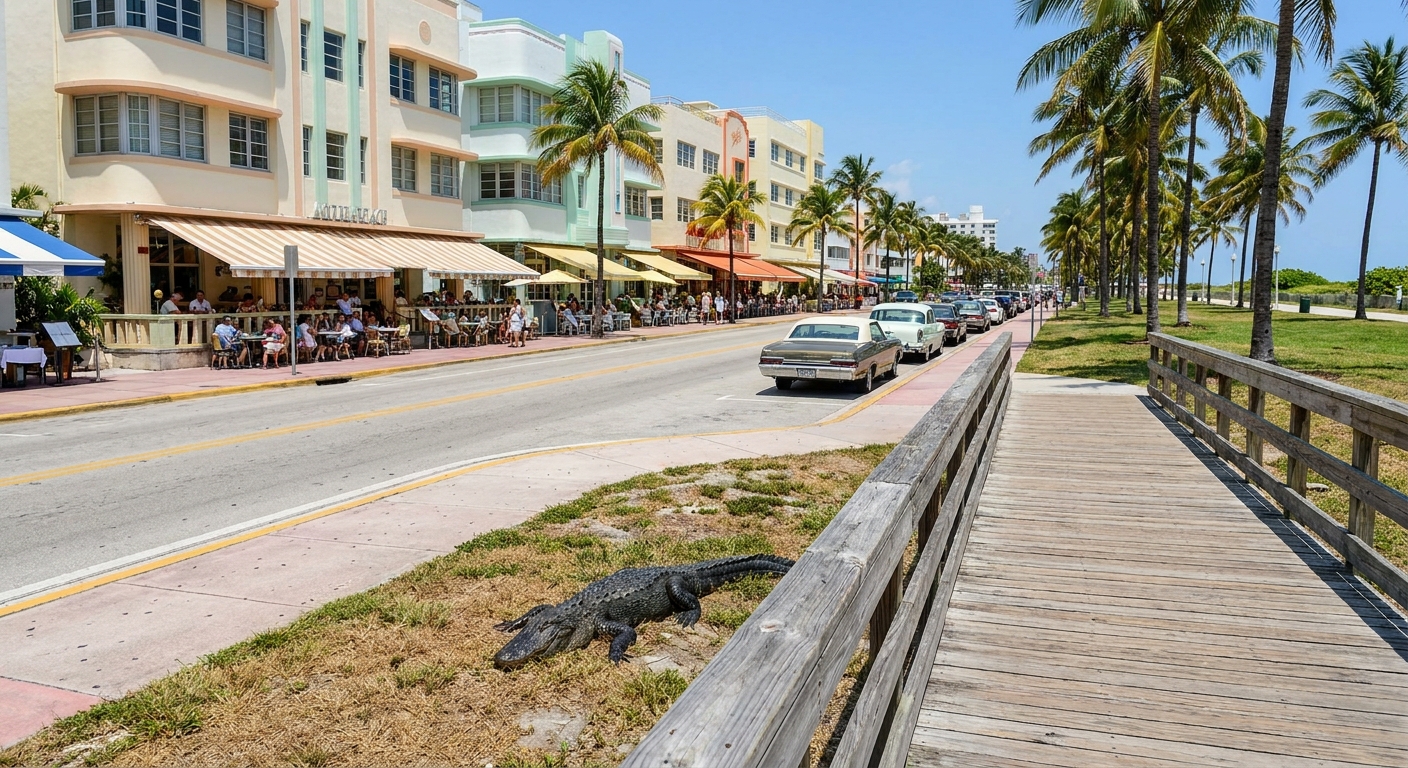
February hands you dry ground and, on the southeast coast, a sea you can enter without neoprene. Manatees gather in the warm inland springs through the cold months, the Everglades’ wading birds crowd the last water holes, and a mid-morning boardwalk walk happens under 70-degree air instead of August humidity. Our manatee guide covers where and how, and Things to Do in Florida ranks the rest.
Start with the fixtures that publish their hours. Vizcaya Museum and Gardens in Coconut Grove opens Wednesday to Monday from 9:30 a.m., last admission 4:30 p.m., closed Tuesdays, $20 for adults during restoration work and $5 for ages 6 to 12. Pérez Art Museum Miami is free Thursdays 5 to 9 p.m. and free all day the second Saturday of the month. Everglades National Park charges $35 per vehicle for seven days. The Miami Beach trolley runs free, 8 a.m. to 11 p.m.
Where to go in Florida in February: best regions and cities
South Florida wins the month on the numbers. Miami’s 78.2°F high is the warmest of the six stations, Fort Lauderdale’s water is the warmest at 77.5°F, and both cities average under three and a half days with a tenth of an inch of rain. For a trip built around water and outdoor evenings, sleep somewhere between Fort Lauderdale and Key West and stop negotiating. Miami is the easiest base of the two.
The northeast loses, and it loses for swimmers specifically. St. Augustine’s February brings 46.1°F nights, 4.8 damp days and a 63.8°F ocean, which closes the beach for most visitors and leaves everything else open: the Spanish old town walks better at 68.9°F than under August heat, and the light is low and long. Our St. Augustine guide handles the fort and the streets.
The Keys run on their own thermostat. Key West’s average high of 77.4°F sits below Miami’s, yet its average low of 67.1°F runs 3.9 degrees warmer than Miami’s and 21 degrees warmer than St. Augustine’s. That is why the evenings feel different down there. It also stays the driest of the six, at 1.54 inches over 2.4 wet days. Treat the drive as a day, not a transfer, and see Key West and Dry Tortugas.
One line to carry away: water trips go south of Fort Lauderdale, town-and-trail trips go north, and nobody plans a Gulf swim at Tampa’s 66.6°F. The best-time page runs that same logic across all twelve months.
Florida in February vs January and March
| Month | Temperature we hold | Rain at Miami Intl | On the calendar |
|---|---|---|---|
| January | Miami near 76°F by day · Jacksonville near 65°F | 1.83 in | Rates climbing toward the February-to-April peak |
| February | Miami 78.2°F / 63.2°F · Key West 77.4°F / 67.1°F · St. Augustine 68.9°F / 46.1°F | 2.15 in | Dry season · outside hurricane season · before spring break |
| March | No 1991-2020 figure held in this dataset | No figure held in this dataset | Miami Open Mar 14 to 28, 2027 · Ultra Mar 26 to 28 · Miami Beach spring-break plan |
January and February are close relatives at the Miami gauge: 1.83 inches of rain against 2.15, with January days near 76°F while Jacksonville holds about 65°F, the same eleven-degree split that structures the whole winter. On sea temperature we hold February by coast, plus a winter average near 72°F off Miami with sources spread between 72 and 76. March sits outside this dataset entirely, and we are not going to invent it.
Shift four weeks either way and the trade is visible. January buys marginally less rain at the Miami gauge and the same warm southeast water, at the cost of the coldest nights in the north. March buys longer evenings and the Miami Open, Ultra and a spring-break traffic plan on Miami Beach, with rates still inside the February-to-April peak.
Profiles sort it quickly. Families locked to Presidents’ Day week take February and accept the company. Anyone whose itinerary includes a Gulf swim should read Tampa’s 66.6°F and plan that beach for walking. Travelers who want the dry season without the March events already have their answer, and those who want the same weather rules with less demand should look at November, which opens the dry season outside that rate peak.
Is February a good time to visit Florida?
Yes, with one asterisk. For a warm, dry, storm-free week on the southeast coast or in the Keys, February is as reliable as this state gets: 78.2°F days in Miami, a 76.9°F sea, fewer than four days of measurable rain. It is a poor month for a Gulf swimming holiday, a cold one for beach days in the northeast, and a busy one everywhere, since it opens the February-to-April stretch of highest room rates.
If the asterisk is yours, shift rather than cancel. November opens the same dry season and falls outside that rate window, with the caveat that the hurricane season officially runs to November 30. For warmer Gulf water, look later into spring, and let the month-by-month verdict and the seven-day route settle the shape of the trip.
The last word
Pick the coast before you pick the month. February’s whole argument is that 21-degree gap between a Key West night and a St. Augustine one, and travelers who choose the right side of it get a state that behaves for a week. Land in Miami, ride the free Metromover through Downtown and Brickell while the cars come every 90 seconds, be on the sand at Lummus Park by four, and let the 6:14 p.m. sunset call time on the day.
Sources & data for this guide
- February normals for Miami, Key West, Fort Lauderdale, Orlando, Tampa and Jacksonville (for St. Augustine) · NOAA NCEI monthly normals 1991-2020, stations USW00012839, USW00012836, USW00012849, USW00012815, USW00012842, USW00013889 · checked Sep 10, 2026
- Rain-day counts and freezing-night counts · same NOAA NCEI 1991-2020 station normals · checked Sep 10, 2026
- Sea surface temperatures by coast · Open-Meteo Marine API, 2015-2024 mean of daily maxima · checked Sep 10, 2026 · popular sea-temperature sites quote Miami’s winter water anywhere from about 72°F to 76°F, and we have not resolved that gap
- Daylight and sunset times for February 15, converted from UTC to America/New_York · sunrise-sunset.org · checked Sep 10, 2026
- Hurricane season dates and the September 10 peak · NOAA National Hurricane Center · checked Sep 10, 2026
- Dry season November to April and wet season May to October · our own Florida best-time page and National Weather Service · checked Sep 10, 2026
- Vizcaya hours and admission · vizcaya.org · checked Sep 10, 2026 · Pérez Art Museum Miami free hours · pamm.org · checked Sep 10, 2026
- Everglades entrance fee of $35 per vehicle for seven days · National Park Service · checked Sep 10, 2026
- Miami Open (March 14 to 28, 2027) and Ultra (March 26 to 28, 2027) · official event sites, dates given as subject to change · checked Sep 10, 2026
- Miami Beach spring-break traffic and parking measures are those announced for 2026 and are reissued each winter · hotel rate seasonality is market data, not an official series · we publish no monthly price ranking