
FLORIDA · JANUARY · THE DRY SEASON
An average January afternoon in Miami reaches 76.2°F. At the Jacksonville International gauge, the long-record station closest to St. Augustine, the same afternoon reaches 65.5°F, and an average January there counts 6.2 nights at or below freezing. Both figures are NOAA normals covering the same thirty years. Florida in January is not a temperature. It is a gradient roughly 450 miles long, and the trip turns on where you stand in it.
The month itself is settled. January sits deep in the dry season and well outside hurricane season, with the Atlantic off Fort Lauderdale averaging 77.6°F while the Gulf off Tampa reads 63.0°F. The useful question is not whether Florida works in January. It is which Florida.
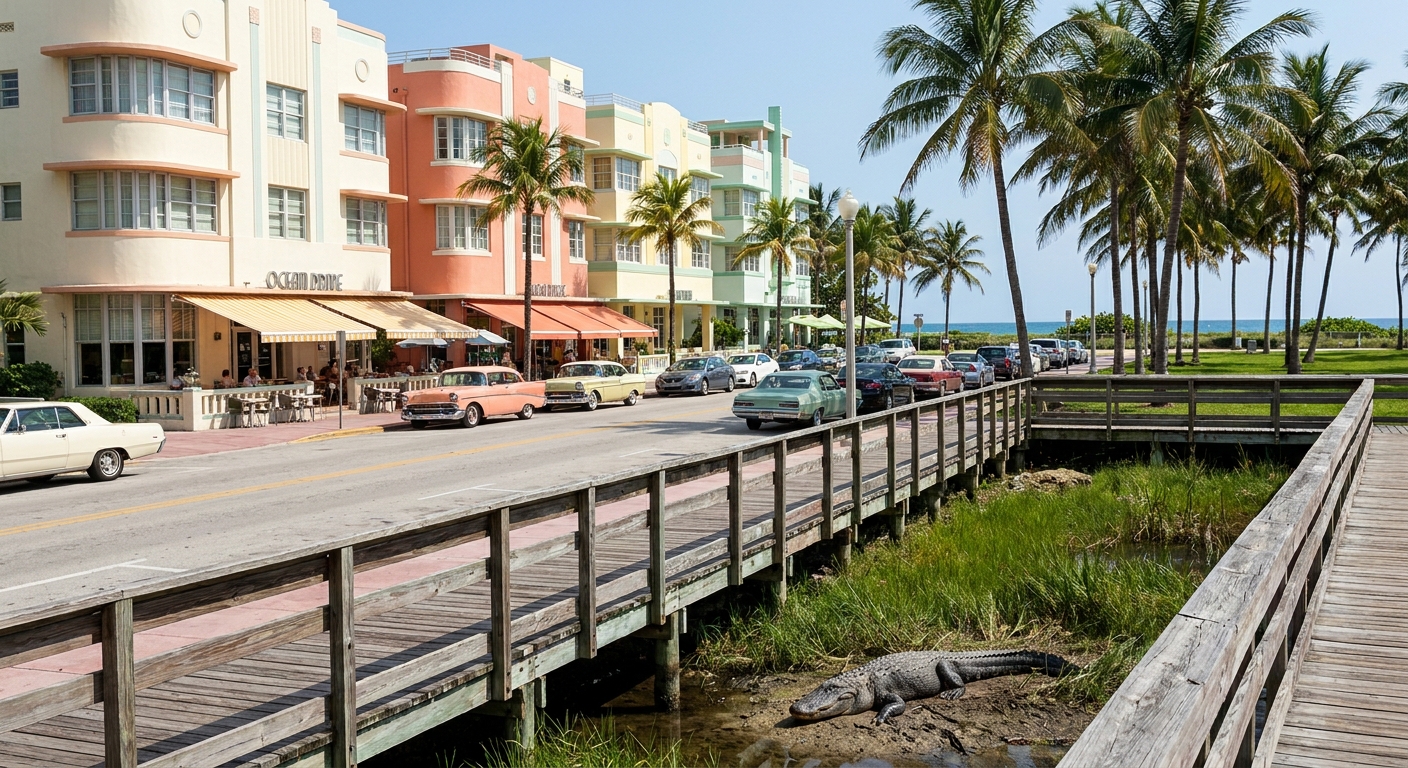
THE MONTH AT A GLANCE · FLORIDA · JANUARY
January hands south Florida a 76°F afternoon and a 77°F sea while the northeast counts freezing nights, so the only decision that matters is how far south you sleep.
DRY SEASON · OUTSIDE HURRICANE SEASON · 10.7°F BETWEEN MIAMI AND THE JACKSONVILLE GAUGE
Go for: Everglades wildlife at its dry-season concentration, swimmable Atlantic water off Miami and Fort Lauderdale, manatees in the interior springs, and a month that falls entirely outside hurricane season.
Think twice before: booking a north Florida beach week. The sea off St. Augustine averages 62.6°F and the Jacksonville gauge records 6.2 freezing nights in an average January.
Normals: NOAA NCEI 1991-2020 station data · Storms: NOAA National Hurricane Center · Water: Open-Meteo Marine · full sources at the end
On this page
- January temperatures, city by citySix NOAA stations, 65.5°F to 76.2°F
- Dry season or wet season?Dry, November through April
- Swimming in Florida in JanuarySea temperature, Atlantic and Gulf
- How crowded Florida gets in JanuaryWhere the month sits in the demand cycle
- Things to do in JanuaryEverglades, Vizcaya, PAMM, the springs
- Where to go this monthSoutheast Florida, the Keys, the northeast
- January vs December and FebruaryWhat four weeks either way changes
- Is January worth it?Who should come, and who should wait
Every figure here comes from NOAA NCEI monthly normals for 1991 to 2020, read station by station: Miami International (USW00012839), Key West International, Orlando International, Tampa International, Fort Lauderdale-Hollywood, and Jacksonville International, which stands in for St. Augustine. Those are gauges at real airports rather than a model grid. The water numbers come from a separate marine series with its own caveat, spelled out further down.
Florida weather in January: Miami 76.2°F, St. Augustine 65.5°F
| City | Average high | Average low | Rain | Days with 0.10 in or more |
|---|---|---|---|---|
| St. Augustine (Jacksonville gauge) | 65.5°F | 42.9°F | 3.28 in | 5.2 |
| Orlando | 71.8°F | 49.5°F | 2.48 in | 4.0 |
| Tampa | 71.3°F | 52.8°F | 2.65 in | 4.4 |
| Fort Lauderdale | 75.6°F | 60.9°F | 2.90 in | 3.8 |
| Miami | 76.2°F | 61.0°F | 1.83 in | 3.8 |
| Key West | 75.8°F | 65.5°F | 1.83 in | 3.3 |
The spread is 10.7 degrees. Miami International averages a 76.2°F high in January. The Jacksonville International gauge, 340 miles up the same coast, averages 65.5°F. Nothing about that gap is exotic weather, it is simple latitude, and it is the single fact that decides a Florida January. A state that markets one climate keeps at least two on any given afternoon in the middle of winter.
Read the six cities north to south and the gradient barely stutters: 65.5, then Orlando at 71.8, Tampa at 71.3, Fort Lauderdale at 75.6, Miami at 76.2, Key West at 75.8. The one inversion sits at the bottom of the map. Key West’s afternoon runs a half-degree cooler than Miami’s, while its night runs 4.5 degrees warmer, 65.5°F against 61.0°F.
Rain in January arrives with a date attached rather than a daily habit. Key West records 3.3 days with at least a tenth of an inch, Miami and Fort Lauderdale 3.8, Orlando 4.0, Tampa 4.4, the Jacksonville gauge 5.2. Days of an inch or more are rarer still: 0.4 in Miami and Key West, 1.2 up north. In practice that means a gray band crossing during the morning, and a usable afternoon behind it.
What catches visitors is the swing, not the high. St. Augustine’s average day climbs from 42.9°F to 65.5°F, nearly 23 degrees between breakfast and four o’clock. Orlando moves 49.5 to 71.8. Key West travels 10.3 degrees all day and stops. Freezing nights are a northern item, 6.2 in an average January at the Jacksonville gauge against 1.1 in Orlando and 0.5 in Tampa. Sleep north of Orlando and a real coat earns its suitcase space.
On January 15 the daylight runs from 10 hours 29 minutes at St. Augustine to 10 hours 49 at Key West, twenty minutes of difference across the length of the state. In Miami the sun comes up at 7:07 a.m. and goes down at 5:52 p.m. local time. Tampa keeps the latest mainland sunset at 5:57 p.m., a west-side quirk of the same time zone. Beach afternoons are short, and the good light starts around four.
Is January in Florida’s dry season or wet season?
January sits in the dry season, and not at its edge. Statewide, the dry half of the year runs November through April, the wet half May through October, and those months are the frame our best time to visit guide applies to all twelve. January is the fourth month of six inside the dry window.
On the ground the difference is enormous. The Miami International gauge collects 10.51 inches in June against 1.83 in January. Wet-season rain builds every afternoon on schedule. January rain comes with a front every week or so, sits for a morning, then leaves the state. Plans made at breakfast in January usually survive to dinner, which is not a claim anyone should make about August.
The Atlantic hurricane season runs June 1 to November 30 and peaks on September 10, with most activity between mid-August and mid-October, per the National Hurricane Center. January falls outside those dates entirely. That is a calendar fact, not a promise about weather: cold fronts, three days of wind and a gray stretch all happen in a Florida winter. They are simply not tropical systems.
At booking, that converts into one decision. The refundable-rate discipline a late-September trip deserves does not earn its premium in January, so the money is better spent on location, which is what the where-to-stay guide argues at length. The thing that can rearrange a January week is a front dropping the northern half of the state ten degrees for two days, and no cancellation policy fixes that.
Can you swim in Florida in January? Sea temperature by coast
Off Fort Lauderdale the January sea averages 77.6°F. Off Miami, 77.0°F. Off Key West, 76.5°F. Those are swimming temperatures by any American standard, and the published series put south Florida’s winter water as the warmest in the country outside the tropical islands in December, January and February. Cross to the Gulf and the same month reads 63.0°F off Tampa, while the north Atlantic coast off St. Augustine reads 62.6°F. Nearly fifteen degrees of water separates Fort Lauderdale from Tampa Bay.
One caveat belongs with those figures. They are averages of daily maxima over 2015 to 2024 from the Open-Meteo marine series, so they sit a shade above a 24-hour mean and further above what you meet at eight in the morning. Other published sources place January water off Miami somewhere between about 72°F and 76°F. Take 77°F as the warm end of a plausible band rather than a reading you can count on before breakfast.
How busy is Florida in January?
January belongs to Florida’s busy half. The dry season is when the state fills, and the curve inside it is not flat: the holiday weeks closing December are the spike, January is the long plateau behind them, and March brings spring break to the beach towns and the parks. Mid-January, once the New Year traffic clears the causeways, is the quietest part of a month that is not quiet.
Book whatever has a fixed number of beds first, which in this month means Key West and anything near an Everglades entrance. Inside the park, the three entrances and the Flamingo Visitor Center sit at least an hour’s drive apart, so choosing an entrance is really choosing a town to sleep in. Get that order backwards and you spend the dry season’s best light on US-41.
What cannot be put a number to here: monthly occupancy for the state, and any ranking of months by price. No official monthly series covers either one. Market data relayed by the trade puts hotel rates at their lowest August to October and their highest February to April, which is a trend rather than a statistic, and it places January on the way up rather than at the top. The cost guide handles the rest.
Things to do in Florida in January
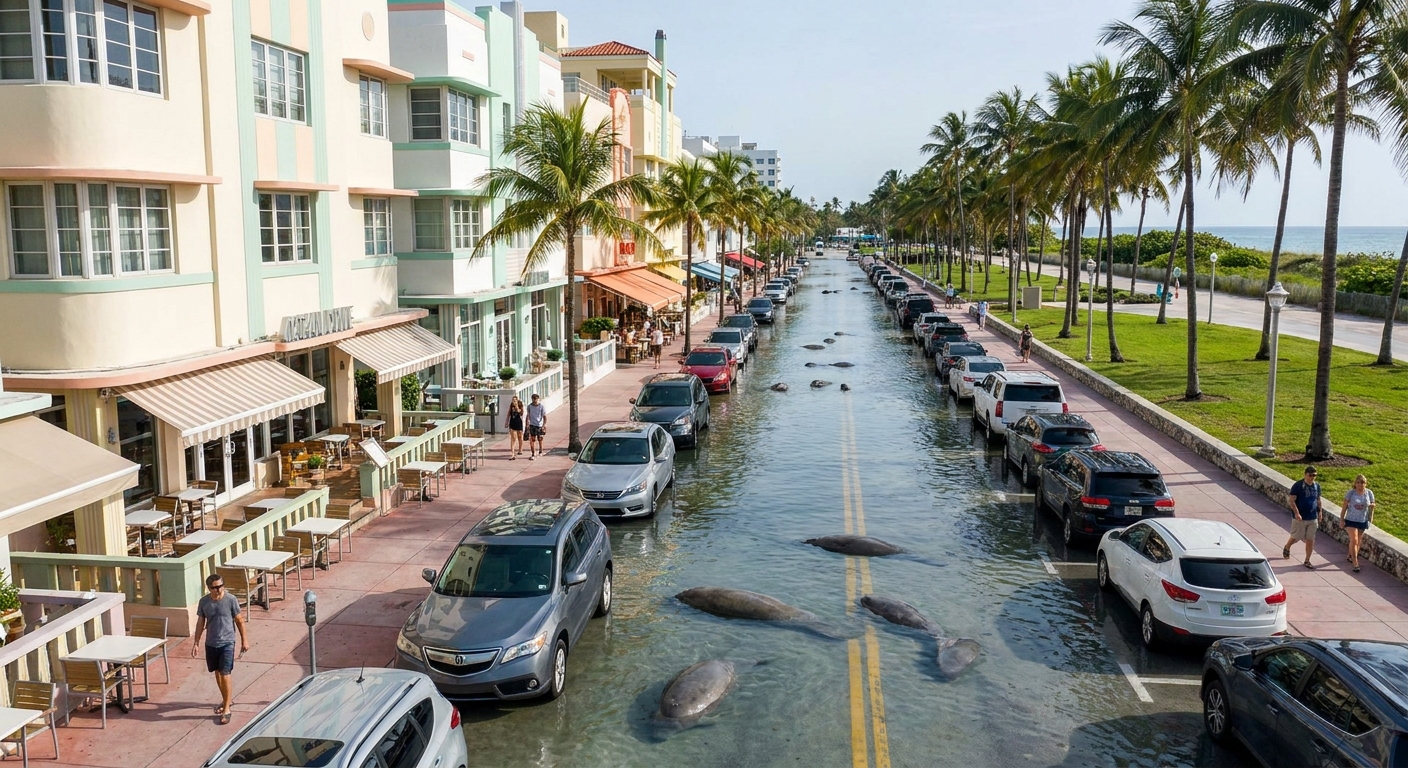
January gives the Everglades away. Falling dry-season water concentrates alligators and wading birds around whatever is left, which is why the Anhinga Trail in winter does the work a guide normally charges for. The same cooling pushes manatees into the interior springs, the subject of our manatee guide. And St. Augustine’s Spanish streets, unwalkable at an August noon, are a 65.5°F afternoon in a sweater.
Priced and timed: Everglades National Park charges $35 per private vehicle, valid seven days. Vizcaya Museum and Gardens, in north Coconut Grove inside the City of Miami, opens Wednesday to Monday from 9:30 a.m. with last admission at 4:30 p.m. and closes Tuesdays, at $20 for adults and $5 for ages 6 to 12 during restoration. The Pérez Art Museum Miami is free Thursdays 5 to 9 p.m. The Miami Beach trolley runs free, 8 a.m. to 11 p.m., about every 20 minutes.
Where to go in Florida in January
Southeast Florida takes the month on the figures. Fort Lauderdale and Miami hold afternoons at 75.6 and 76.2°F, nights above 60, fewer than four days of measurable rain, and water at 77°F. That is a beach vacation with no asterisk in the middle of winter, and it is the case the Miami guide builds around. Add the Everglades an hour west and the state’s two strongest January cards sit inside one drive.
The northeast loses the month, and loses it for exactly one traveler: the one who came for the sea. Water at 62.6°F, 42.9°F nights, 6.2 freezing nights on the gauge and 5.2 rain days is a beach week nobody enjoys. For a walker, those same numbers read as ideal, which is why St. Augustine is a January town rather than a January beach.
The Keys follow neither the north nor the middle. Key West’s 75.8°F high sits a half-degree below Miami’s, while its 65.5°F low is the warmest night on the list, its 3.3 wet days the fewest, and its 10 hours 49 minutes of daylight the longest in the state. The water holds 76.5°F. The price of all that is 113 miles of two-lane highway, a full day each way if you stop properly, as the road trip guide insists you should.
One line, if that is all you take: south of Fort Lauderdale the sea is in play, north of Orlando it is not, and the middle of the state offers a 71°F afternoon with a cold night attached to it.
Florida in January vs December and February
| Month | Season | Crowd shape | Figures we hold |
|---|---|---|---|
| December | Dry, Nov to Apr | Holiday weeks are the annual spike | Miami around 76°F by day, from the reanalysis series used in the state guide |
| January | Dry, Nov to Apr | The plateau after the holidays | Miami 76.2°F / 61.0°F, 1.83 in, sea 77.0°F |
| February | Dry, Nov to Apr | Opening of the February to April rate peak | No station normals served here, see the best-time guide |
On temperature the three months barely argue. Miami’s December daily figure of about 76°F comes from a reanalysis series rather than the station file, and it lands within a rounding error of January’s 76.2°F NOAA normal, so read them as the same afternoon rather than as a difference. On rain, January’s 1.83 inches at Miami International is the driest end of the dry season. On water, 77.0°F off Miami is the warm point of the American winter. All three months sit outside hurricane season.
Move four weeks back and you buy the holiday weeks, with the crowds and the rates that come with them. Move four weeks forward and you enter the February to April stretch that market data flags as the year’s most expensive, and you edge toward March, when Miami Beach converts its four Art Deco District garages to flat rates of $40 to $100 and sets non-resident towing at $548 (those were the 2026 measures, reissued each winter). January carries none of that apparatus.
By profile: families locked to a school calendar take late December and pay the peak knowingly. Couples and wildlife travelers with a free week take mid-January, once the causeway traffic thins. Anyone whose trip is really about the Keys takes January too, for the 3.3 wet days. Only travelers who want spring break rather than shelter from it should be looking at March.
Is January a good time to visit Florida?
Yes, for the traveler heading to the bottom third of the state: 76°F afternoons, 77°F water, under four days of rain, the Everglades at its most generous, and a month outside hurricane season by two clear weeks in either direction. No, for anyone booking a beach week north of Cape Canaveral, where the water is 62.6°F. No, too, for anyone hoping to have the place to themselves, because January sits inside Florida’s crowded half.
When the answer is no, the usual fix is a different latitude rather than a different month. If the month itself has to move, November opens the dry season with the same rain pattern and none of the holiday load, and April closes it before the switch. The other half of the year is a genuinely different trip: 10.51 inches at Miami International in June, and hurricane season from the first of that month, as the year-round view lays out.
The last word
Choose the latitude first and the week second. Everything else in a Florida January follows from how far south the bed is, because those 10.7 degrees between the Jacksonville gauge and Miami International are the difference between swimming and walking. And if you land in Miami and skip the rental car, the Metromover through Downtown and Brickell costs nothing and comes every 90 seconds at rush hour, which is the best deal in a state that spends the whole month charging for parking.
Sources & data for this guide
- January normals for six cities, highs, lows, precipitation, wet days and freezing nights · NOAA NCEI monthly normals 1991-2020, stations USW00012839 Miami International, USW00012836 Key West International, USW00012815 Orlando International, USW00012842 Tampa International, USW00012849 Fort Lauderdale-Hollywood, USW00013889 Jacksonville International (used for St. Augustine) · checked Sep 10, 2026
- Sea surface temperatures, averages of daily maxima 2015-2024 · Open-Meteo Marine API · checked Sep 10, 2026
- Daylight, sunrise and sunset for January 15, converted to America/New_York · sunrise-sunset.org · checked Sep 10, 2026
- Hurricane season dates and the September 10 peak · NOAA National Hurricane Center · checked Sep 10, 2026
- Dry season November to April and wet season May to October · our Florida best-time guide · checked Sep 10, 2026
- Fees and hours: Everglades entrance $35 per vehicle (National Park Service), Vizcaya hours and admission (vizcaya.org), PAMM free Thursdays (pamm.org), free Miami Beach trolley (City of Miami Beach) · checked Sep 10, 2026
- Spring-break garage rates of $40 to $100 and the $548 non-resident towing fee are the measures announced by Miami Beach for 2026 and reissued each winter · checked Sep 10, 2026
- Editorial admission: we hold no monthly occupancy or price series for Florida. The February to April rate pattern is market trend data, not an official statistic, and December and February station normals are not served here.
- Miami’s December daily figure of about 76°F comes from a 1991-2020 reanalysis series, not the station file, and is quoted from our Florida orientation guide. Fees and hours change · confirm with operators when you book.