
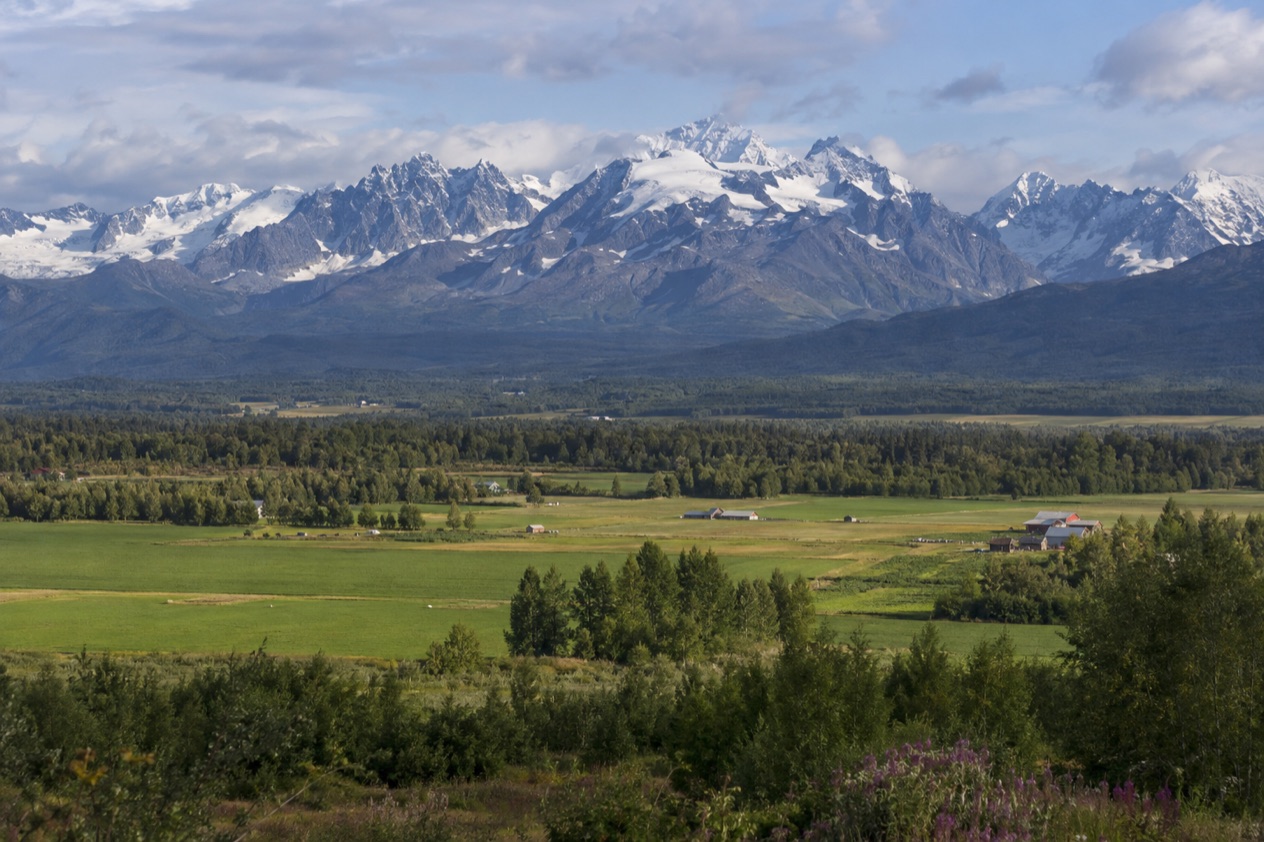
On a July evening in the Mat-Su Valley, the light stays long over the Chugach Mountains and gardeners are still out among their rows of cabbages. In February the same valley is quiet and blue, with woodsmoke, snow machines and mountains that look close enough to touch.
Wasilla and Palmer sit at the junction of the Parks and Glenn Highways, a farming valley with glaciers at its edges. Summer and early fall bring the most to do, while winter has its own pace.
When is the best time to visit Wasilla and Palmer?
The days are long, the air is mild enough for hiking in a light jacket, and the valley is at its greenest.
For sightseeing, June and July give the longest evenings, so a day can start late and still end with a walk. The highs stay in the 60s, and rain is light.
August brings a little more rain and noticeably shorter evenings, which suits a trip built around the fair and the first hints of fall color. Wasilla is also the last city of any size on the Parks Highway going north, so it works as a first night or a last night on the way to Denali or Fairbanks.
For wildlife and mountains, summer is when the hiking spots around Wasilla are open to walkers: Hatcher Pass, The Butte, Lazy Mountain, Crevasse Moraine and Matanuska Glacier. Animals are always a chance and never a promise, so go for the ridgelines and the views. Early September is a quieter, cooler stretch, when the days are still long enough for a full outing and the tundra on the higher slopes starts to turn.
The quiet seasons have their own appeal. Winter is cold and short on daylight, but it is the time for snow, sled dogs and a dark sky. Spring thaw is a shoulder season, with fast-growing daylight and muddy ground. Families with school-age children will find that late June through August gives the most hours outdoors, and the fair gives everyone something to do under a roof or in the open air.
Wasilla and Palmer weather by month
The year runs from deep cold in midwinter to mild summer afternoons, with daylight swinging from a few hours to most of a day.
| Month | Average high (°F) | Average low (°F) | Precipitation (in) | Days with precipitation | Daylight on the 15th |
|---|---|---|---|---|---|
| January | 22.4 | 8.3 | 0.65 | 2.1 | 6 h 13 min |
| February | 28.3 | 13.2 | 0.70 | 2.1 | 8 h 54 min |
| March | 33.9 | 17.2 | 0.47 | 1.8 | 11 h 38 min |
| April | 47.8 | 29.8 | 0.30 | 1.2 | 14 h 39 min |
| May | 59.1 | 38.8 | 0.62 | 1.8 | 17 h 29 min |
| June | 65.7 | 46.9 | 1.00 | 2.8 | 19 h 28 min |
| July | 67.6 | 50.7 | 1.60 | 5.1 | 18 h 41 min |
| August | 64.6 | 48.2 | 2.32 | 6.2 | 16 h 02 min |
| September | 55.8 | 40.8 | 2.08 | 6.0 | 13 h 04 min |
| October | 42.3 | 28.6 | 1.25 | 3.4 | 10 h 11 min |
| November | 28.9 | 15.6 | 0.66 | 1.8 | 7 h 17 min |
| December | 25.1 | 11.4 | 0.96 | 3.0 | 5 h 24 min |
Summer is the wetter part of the year here, and the rain tends to come on a handful of days, most often in late summer, so a light rain shell belongs in the bag from July through September.
From November to March the air stays below freezing on a typical day, and the little precipitation that falls is snow. Winter needs real layers, insulated boots and warm gloves.
Light matters as much as temperature. Around the longest days, evenings stretch so far that dinner can be followed by a hike, and a sleep mask helps at the hotel. In December the sun is up only briefly, so outdoor plans fit into the middle of the day. Spring and fall change fast: daylight is gained quickly in March and April and lost just as quickly in September and October.
What is there to do in Wasilla and Palmer in each season?
Summer: long days, mountains and the glacier
Summer is hiking season. Hatcher Pass rises above Palmer and Wasilla, and the road over it is unpaved and minimally maintained for much of its length, so the drive is part of the day. Up in the pass, Independence Mine State Historical Park sits among rugged peaks, a good place for wandering past old mining buildings with the mountains all around.
Matanuska Glacier is a valley glacier you can reach by car along the Glenn Highway, which makes it the largest of its kind reachable that way in the United States. Closer to town, The Butte, Lazy Mountain and Crevasse Moraine offer hikes with views over the farmland. The long evenings allow a second outing after dinner.
Fall: the fair, farm fields and changing color
The Alaska State Fair takes over Palmer for about twelve days in late August and early September, at the foot of the Chugach Mountains. Expect fair food, music, livestock barns and the garden displays.
After the fair the valley turns quieter. Days are still long enough for the hiking spots, the air cools, and a layer of fleece becomes the norm. October is the month when a summer trip becomes a fall one, with shorter days and the first real chill.
Winter and spring thaw: snow, sled dogs and quiet roads
Winter in the Mat-Su Valley is for people who like the cold. The Iditarod’s official restart is in Willow, the day after the ceremonial start in Anchorage, and the trail heads toward Nome through the Alaska Range.
Watching mushers and dog teams leave the start is a winter event in itself. Farther north on the Parks Highway the aurora season for Fairbanks runs from late August to late April, a reminder that a dark winter sky has its own draw, though that season is the Fairbanks one.
Spring thaw is the in-between time. Daylight returns fast, snow melts at lower elevations, and trails turn muddy. It is a time for quiet drives and for waiting, with the summer hiking spots not yet dependable.
When is Wasilla and Palmer cheapest and least crowded?
The quietest stretch is the cold half of the year, from October through March, when the valley belongs mostly to locals. Rooms are likely to be easier to find, restaurants have free tables, and the roads and trails are empty of summer traffic. That calm comes with short daylight and weather that limits what you can do outdoors.
The busiest weeks are the middle of summer and the days around the Alaska State Fair, when Palmer fills with visitors from across the region. Wasilla also sees travelers heading north, because of its place on the Parks Highway. If you want long days without the fair crowds, early June and early September are good choices.
Spring, in April and May, is another quiet window. The daylight is long, but the trails may still be muddy and some of the summer attractions are not yet in full swing. Tour operators and lodges can have fewer guests, and the valley feels slow and unhurried. Rates in the busy weeks usually reflect the demand, while the shoulder months feel more relaxed.
Which months should you avoid in Wasilla and Palmer?
No month is bad, but December and January are the hardest for a first visit, with the shortest daylight and the deepest cold. Plans that rely on hiking, glacier views and long drives suit the light months much better.
Long daylight runs from May through August, and the daylight is still generous in April and September. Between late April and late August the sky there does not get dark enough, so a northern trip for the aurora should avoid the summer weeks.
In winter, summer hiking is off the table, and the unpaved Hatcher Pass road is a place where conditions matter more. Late March and April can feel like a gap, with the cold gone but the green not yet back. If you want the full valley experience, choose June through September, when the hiking spots around Wasilla are the draw. If you want snow and dogs, choose the cold months and dress for it.
Festivals and events in Wasilla and Palmer through the year
Winter: the Iditarod and the dark months
The Iditarod Trail Sled Dog Race begins with a ceremonial start in downtown Anchorage, at Fourth Avenue and D Street. The next day, the official restart takes place in Willow, in the Mat-Su Valley, and the teams head out along a route that crosses Rainy Pass and ends in Nome. Towns such as Skwentna, McGrath and Unalakleet are checkpoints along the way.
Watching a restart is a day of snow, dog teams barking with excitement, and spectators bundled up on the sidelines. It suits anyone curious about Alaska’s winter traditions. Beyond the race, the winter holidays bring Christmas lights and the winter solstice, when the sun barely rises over the mountains.
Summer: the Fourth of July and the long evenings
Independence Day on July 4 is a fixed date, and in a valley with a long evening, a small-town celebration can stretch late. Parades, picnics and community gatherings are the typical shape of the day in towns like Palmer and Wasilla, and the long light means fireworks and bonfires wait for a late hour.
Summer is also the season of the farms. The Matanuska-Susitna Borough is one of the few agricultural areas in Alaska, and the long days help the gardens grow. Roadside stands and farm fields are part of the scenery, and they set the stage for the fair that follows.
Late summer and fall: the Alaska State Fair
The Alaska State Fair in Palmer runs for about twelve days in late August and early September, and it is the biggest event of the valley’s year. The fairgrounds sit below the Chugach Mountains, and the displays include giant vegetables and other produce grown in the Matanuska-Susitna Valley.
Families come for the rides and the animals, gardeners for the oversized produce, and anyone who wants a taste of the valley for the food stands and live music. The fair is also a good moment to see Palmer in full swing, before the fall chill and the shorter days arrive.
Sources
- NOAA NCEI, U.S. Climate Normals 1991-2020, monthly (https://www.ncei.noaa.gov/access/services/data/v1?dataset=normals-monthly-1991-2020&stations=USW00025331), station Palmer Muni Ap, elevation 230 feet, checked October 11, 2026
- Computed from the date and the latitude of the place (sunrise equation, solar elevation -0.833 degrees), October 11, 2026
- Wikivoyage, Wasilla (https://en.wikivoyage.org/wiki/Wasilla), checked October 11, 2026
- Wikipedia, Wasilla, Alaska (https://en.wikipedia.org/wiki/Wasilla,_Alaska), checked October 11, 2026
- Wikipedia, Palmer, Alaska (https://en.wikipedia.org/wiki/Palmer,_Alaska), checked October 11, 2026
- Wikipedia, Mat-Su Valley (https://en.wikipedia.org/wiki/Mat-Su_Valley), checked October 11, 2026
- Wikivoyage, Matanuska-Susitna Borough (https://en.wikivoyage.org/wiki/Matanuska-Susitna_Borough), checked October 11, 2026
- Wikipedia, Matanuska-Susitna Borough, Alaska (https://en.wikipedia.org/wiki/Matanuska-Susitna_Borough,_Alaska), checked October 11, 2026
- Wikipedia, Matanuska Glacier (https://en.wikipedia.org/wiki/Matanuska_Glacier), checked October 11, 2026
- Wikipedia, Hatcher Pass (https://en.wikipedia.org/wiki/Hatcher_Pass), checked October 11, 2026
- Alaska State Parks, Mat-Su region (https://dnr.alaska.gov/parks/aspunits/matsu/matsuindex.htm), checked October 11, 2026
- Wikipedia, Alaska State Fair (https://en.wikipedia.org/wiki/Alaska_State_Fair), checked October 11, 2026
- Wikipedia, Knik Glacier (https://en.wikipedia.org/wiki/Knik_Glacier), checked October 11, 2026
- Wikipedia, Iditarod Trail Sled Dog Race (https://en.wikipedia.org/wiki/Iditarod_Trail_Sled_Dog_Race), checked October 11, 2026
- Wikipedia, Climate of Alaska (https://en.wikipedia.org/wiki/Climate_of_Alaska), checked October 11, 2026
- University of Alaska Fairbanks Geophysical Institute, Aurora forecast (https://www.gi.alaska.edu/monitors/aurora-forecast), checked October 11, 2026
To plan your stay
- Things to Do in Wasilla and Palmer: Iditarod Country, Hatcher Pass, Glaciers and the Alaska State Fair
- Where to Stay in Wasilla and Palmer: Parks Highway Base, Farm Country and Valley Towns
- Wasilla and Palmer in January: Weather, Daylight, Northern Lights and Winter Outings
- Wasilla and Palmer in February: Weather, Northern Lights Chances and Things to Do