
Out on the edge of the Arctic Ocean, the wind sets the pace in Utqiagvik. In early summer the sun circles the sky without ever dipping below the horizon, bicycles roll down gravel streets at what feels like any hour, and the tundra behind town shifts from white to a patchwork of brown and green.
In winter the same streets lie under a long blue-black dusk, with snow squeaking underfoot and house lights the only warm color. This is the northernmost town in the United States, and its calendar is built around light far more than around temperature.
When is the best time to visit Utqiagvik?
The best time to visit Utqiagvik is May through July for travelers, when the sun stays up around the clock, with August and September as a gentler second choice for anyone who wants the sky to get dark again.
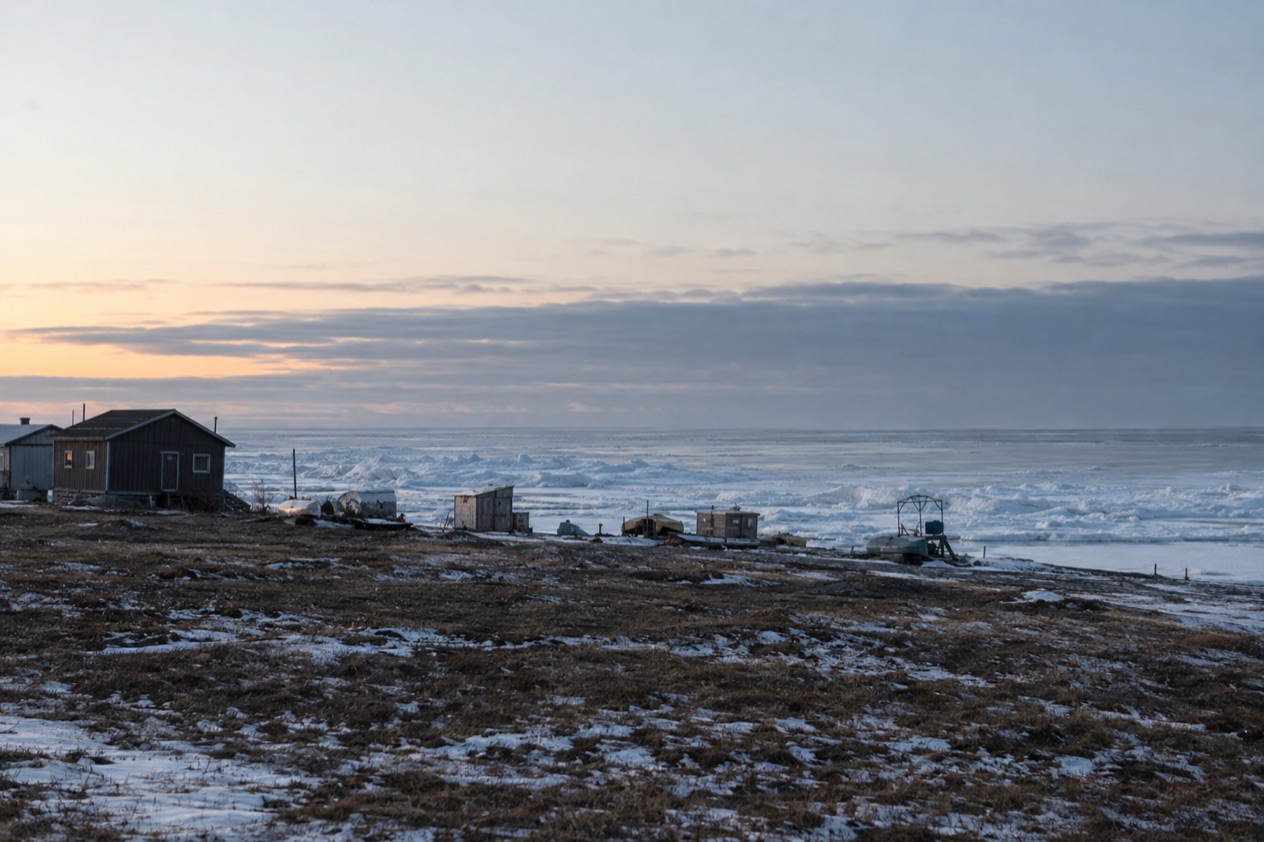
For sightseeing, the weeks of the midnight sun give you the most hours to use. You can walk the shore of the Arctic Ocean at ten at night in full daylight, wander the town, and look out over a tundra that is slowly thawing.
Even then the air is cool, with temperatures hovering around freezing in early summer and creeping only a little higher by midsummer. July and August are also the months with the most precipitation in the table, though the days with any at all remain few.
For wildlife and the wider landscape, think in terms of chances rather than promises.
Utqiagvik itself is a place to feel the scale of the Arctic coast, with open tundra, a wide horizon and a town that has been home to Iñupiat people for generations. Getting there is a matter of flying in, since no road or rail line reaches the town.
The quiet seasons have a character of their own. Late fall and winter bring the polar night, a stretch of about two months when the sun does not rise, and the town turns inward around school events, holidays and indoor gatherings. It suits travelers who are drawn to darkness, stars and deep cold, and who care less about sightseeing than about seeing how an Arctic community lives through its longest night.
For families, the long light of June and July is the easiest rhythm to live with, because bedtimes and mealtimes can follow the clock instead of the sky. Children who are sensitive to light may need a dark room to sleep, since the sun does not set. In the winter months the cold and the short or missing daylight shape every outing.
Utqiagvik weather by month
Utqiagvik is cold in every month, and the real swing of the year is in the light, which goes from no sun at all to no night at all.
| Month | Average high (°F) | Average low (°F) | Precipitation (in) | Days with precipitation | Daylight on the 15th |
|---|---|---|---|---|---|
| January | -5.2 | -17.8 | 0.14 | 0.2 | No daylight (polar night) |
| February | -5.5 | -18.3 | 0.21 | 0.3 | 6 h 46 min |
| March | -3.8 | -17.2 | 0.18 | 0.4 | 11 h 23 min |
| April | 10.6 | -2.5 | 0.18 | 0.4 | 16 h 21 min |
| May | 26.9 | 18.5 | 0.28 | 0.8 | 24 hours (midnight sun) |
| June | 40.9 | 31.1 | 0.43 | 1.4 | 24 hours (midnight sun) |
| July | 47.7 | 35.6 | 0.98 | 3.3 | 24 hours (midnight sun) |
| August | 44.5 | 35.1 | 1.09 | 3.8 | 19 h 04 min |
| September | 37.1 | 30.3 | 0.77 | 2.1 | 13 h 41 min |
| October | 25.6 | 16.8 | 0.54 | 1.2 | 9 h 01 min |
| November | 11.5 | -0.1 | 0.37 | 0.7 | 2 h 54 min |
| December | -0.4 | -12.2 | 0.22 | 0.4 | No daylight (polar night) |
The year has three moods. From December through March the air stays far below zero on most days, and what falls from the sky is light, dry snow rather than rain.
April and May are the thaw, when afternoons climb out of the deep freeze but nights still go below it.
For packing, that means warm layers and a windproof outer shell even in midsummer, and serious cold-weather gear from October onward. October is the snowiest month, with about 10 inches falling on average, and the snow cover that arrives then tends to stay through the winter. As for the light at both ends of the day, the hours of daylight in the table shrink fast from August to November, so a fall trip has real evenings and real darkness, while a trip in June has neither.
What is there to do in Utqiagvik in each season?
Summer: the long days of the midnight sun
Summer is the season for being outdoors at odd hours. In May, June and July the sun does not set, so a stroll along the Arctic Ocean shore or out toward the tundra is possible at any time of day. You see gravel beach edged with ice and driftwood, low wet tundra, and a town of houses on stilts and pilings, where everything is built around the frozen ground beneath.
This is also when you feel the Iñupiat character of the place most. Utqiagvik is home to a population of a bit more than 4,500 people, primarily of Iñupiat descent, and summer is when community gatherings spill outdoors. The main business of a visit in these months is simply to look, listen and take in a landscape that has no trees, no roads leading out and an open horizon in every direction.
Fall and winter: dusk, dark and snow
By September the daylight is back to something like a normal day, and by October the first real snow arrives. Fall is the time to see the town change fast, as the tundra whitens, the days shorten sharply and the first ice begins to form along the coast. It is a short season for travelers, but it is a quiet one for those who want to see the Arctic turn.
Winter is the polar night. The sun sets in mid-November and stays below the horizon until late January, and for part of that time even the midday sky stays dark. In the dark months the stars show clearly over a snowy town, and the aurora is a chance on clear nights. Activities are mostly indoors and in the community, and the cold is serious, with average highs below zero from December through March.
Spring: the light comes back
Spring begins in late January, when the sun returns, and the gain in daylight is dramatic. By March there are more than eleven hours of light, and by April the day is longer than it is in most of the country. Temperatures stay well below freezing in March, so this is still a winter landscape, but a bright one, with sunlit snow and sharp blue shadows.
April and May are the thaw, the time when ice, snow and sunlight all meet. May brings the first midnight sun. Spring is the season for travelers who want the Arctic at its starkest, with the light of summer and the temperatures of winter, and who are comfortable with real cold.
When is Utqiagvik cheapest and least crowded?
Utqiagvik is a town of fewer than five thousand people, reached only by air, so it never has the crowds of a cruise port or a road-trip stop. The stretch most tied to the travel calendar is the season of the midnight sun, from May through July, because the endless daylight is what draws people to the northernmost town in the country.
The months outside that stretch are the quieter ones. In fall, from September into October, the daylight shrinks toward the length of an ordinary day and the first snow arrives. From November to January the town is lived in by its residents, with the sun gone for the polar night. Those are the months when the place is least shaped by visitors, and the town feels most like itself.
What you can count on is the pattern of the light, which is what makes the first half of summer the natural high season and the dark months the natural quiet ones. Late winter and early spring, when the sun is back but the temperatures are still low, sit in between.
Which months should you avoid in Utqiagvik?
No month is one to avoid outright, but the deep winter, from December through February, asks the most of a visitor, with the polar night and the lowest temperatures of the year.
The months of long daylight run from April, with more than sixteen hours of light, through the midnight sun of May, June and July, and into August, when the day is still long. These are the months when the Arctic seems most open to a visitor. September and October bring the shorter days and the first heavy snow, and the daylight drops to a length travelers know from home.
In winter, much of the town’s life moves indoors. The polar night stretches from the middle of November to the end of January, and in the bleakest weeks the sun does not rise at all.
If you come then, come for the cold, the stars and the chance of the aurora, not for sightseeing. There is no road out of town, since the only way in or out is by plane, so the weather and the season shape every trip.
The aurora is a chance in the dark months, but no month is a promise, and the months when the sky is bright all night are not months for seeing it.
Festivals and events in Utqiagvik through the year
Spring and early summer: whaling and Nalukataq
The most important rhythm of the year in Utqiagvik is the whaling season. In spring, Iñupiat whaling crews go out onto the sea ice in pursuit of the bowhead whale, a tradition that is central to the community’s food, culture and identity. It is not a spectacle put on for visitors but a working season, and the town’s attention turns to the ice and the crews.
The celebration that follows is Nalukataq, the whaling festival, held in early summer. It is a community feast, with shared food from the hunt and the blanket toss, in which a person is tossed into the air from a large skin held by the crowd. If you are in town for it, you are a guest at a community event, and the right way to attend is with respect and an open mind.
The Fourth of July falls in the middle of the midnight sun, a fixed date that gives the town a reason to gather outdoors under a sun that never sets.
Fall: the return of the dark
Fall is a time of transition. The sun begins to set again after weeks without a sunset, and the whaling tradition has a fall season as well, as crews go out again before the ice sets in. The town’s attention turns to preparing for winter, with snow arriving in October and the days getting shorter fast.
Thanksgiving, on the fourth Thursday of November, falls just after the sun sets for the winter, on the 18th of the month, which gives the holiday a particular feel in a town where the daylight is by then only a few hours long. Gatherings are held indoors, and the long dusk outside is part of the setting.
Winter: holidays in the polar night
Christmas on December 25 and New Year’s Day fall in the middle of the polar night, when the sun does not rise at all. Homes and streets are lit, and the town celebrates indoors against the cold and dark. These are community holidays more than travel events, and visitors who come then see Utqiagvik at its most private.
The sun returns on January 23, after a polar night of about 66 days. It is a small first step into the light, with only a sliver of daylight at first, but the gain in the following weeks is fast, and by February there are nearly seven hours of daylight on the 15th. The return of the sun marks the turn of the year in a place where light is the main measure of time.
Sources
- NOAA NCEI, U.S. Climate Normals 1991-2020, monthly (https://www.ncei.noaa.gov/access/services/data/v1?dataset=normals-monthly-1991-2020&stations=USW00027502), station Barrow Post Rogers Ap, elevation 31 feet, checked October 11, 2026
- Computed from the date and the latitude of the place (sunrise equation, solar elevation -0.833 degrees), October 11, 2026
- Wikivoyage, Utqiagvik (https://en.wikivoyage.org/wiki/Utqiagvik), checked October 11, 2026
- Wikipedia, Utqiagvik, Alaska (https://en.wikipedia.org/wiki/Utqiagvik,_Alaska), checked October 11, 2026
- Wikipedia, Polar night (https://en.wikipedia.org/wiki/Polar_night), checked October 11, 2026
- Wikipedia, Midnight sun (https://en.wikipedia.org/wiki/Midnight_sun), checked October 11, 2026
- Wikipedia, Alaska North Slope (https://en.wikipedia.org/wiki/Alaska_North_Slope), checked October 11, 2026
- Wikipedia, Inupiat (https://en.wikipedia.org/wiki/Inupiat), checked October 11, 2026
- Wikipedia, Prudhoe Bay, Alaska (https://en.wikipedia.org/wiki/Prudhoe_Bay,_Alaska), checked October 11, 2026
- Wikipedia, Arctic Circle (https://en.wikipedia.org/wiki/Arctic_Circle), checked October 11, 2026
- Wikipedia, Polar bear (https://en.wikipedia.org/wiki/Polar_bear), checked October 11, 2026
- Wikipedia, Climate of Alaska (https://en.wikipedia.org/wiki/Climate_of_Alaska), checked October 11, 2026
- University of Alaska Fairbanks Geophysical Institute, Aurora forecast (https://www.gi.alaska.edu/monitors/aurora-forecast), checked October 11, 2026