
In December the lights of Utqiagvik burn through the middle of the day, and the sky above the frozen coast shifts from black to a deep, bruised blue and back again without the sun ever lifting over the edge. Snow squeaks underfoot, trucks idle outside the store with their engines running, and the town goes on with school, church and work in the dark. This is the northernmost city in the United States in the heart of its polar night, a month for travelers who want to see the Arctic winter as the people who live here do.
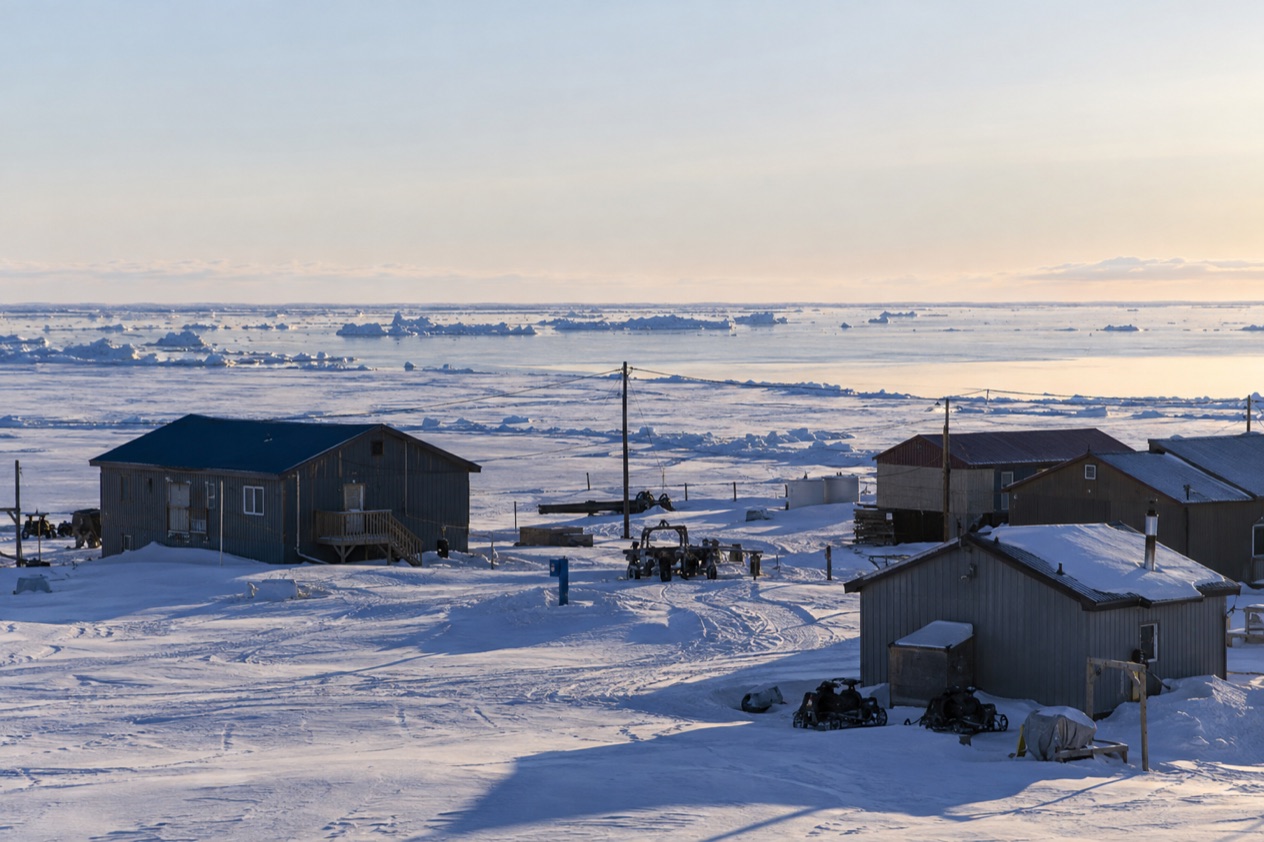
What is the weather like in Utqiagvik in December?
December in Utqiagvik is bitterly cold, dark all day, and very dry, with a little powdery snow instead of rain.
| Month | Average high (°F) | Average low (°F) | Precipitation (in) | Days with precipitation | Daylight on the 15th |
|---|---|---|---|---|---|
| November | 11.5 | -0.1 | 0.37 | 0.7 | 2 hours 54 minutes |
| December | -0.4 | -12.2 | 0.22 | 0.4 | No daylight (polar night) |
| January | -5.2 | -17.8 | 0.14 | 0.2 | No daylight (polar night) |
Afternoons hover around zero and nights drop well below it, so the cold is the first thing you meet when the airport door opens. Almost no precipitation falls in a typical December, and what does fall is snow, a few inches over the whole month. The snow you see underfoot is mostly older snow, and on a breezy day it can be pushed along the ground in low drifts that sting the face.
There is no sunrise and no sunset to plan around. Streetlights, headlights and the glow of windows carry the town through the hours that would be daytime elsewhere.
Dress for being outside in still, hard cold, in layers you can adjust when you step into a warm building. Insulated boots, thick mittens and a covering for your face matter far more than rain gear. If the wind picks up, the cold feels sharper, and your time outdoors shortens quickly.
What to do in Utqiagvik in December
What Utqiagvik offers in December is the Arctic night itself and the life of the town that carries on through it. This is not a month of boat trips, hikes or long days outdoors.
The polar night and the winter sky
The main event of the month is the darkness. Utqiagvik sits so far north that the sun stays below the horizon for a long stretch of winter, and in this part of Alaska the polar night lasts only a little over two months. December is the middle of it, so stepping outside at noon feels like stepping outside at midnight, apart from a faint paleness low in the sky.
With the dark comes a chance at the aurora. The Northern Lights oval covers most of Alaska, and the aurora can be seen from areas around the Arctic, so a clear night in Utqiagvik may bring green light moving across the sky. Cloud and weather decide, and nothing is guaranteed. On a clear night the stars also stand out sharply over the snow, with no summer twilight to wash them away.
Go out for a short time at first, with your hands covered and your face protected, and come back inside to warm up before a second try. People find the quiet the most striking part, since snow muffles the town and the cold air carries sound a long way.
The frozen coast and the whalebone arch
Utqiagvik faces the Arctic Ocean, and in December the water along the shore is locked under ice and snow. The coast is a place to see how the town sits at the top of the country, with open white ground running out to a dark horizon. The jawbones of bowhead whales stand along the shoreline as an arch, a reminder that whaling shapes the community’s year even when no whaler is on the ice.
A walk here is for a few minutes of looking, not a long outing. The wind off the ice can be fierce, and with no daylight to warm the ground, the cold settles into everything. Bring a camera that tolerates the cold and keep spare batteries in an inside pocket, since cold drains them fast.
Iñupiaq culture and the warm indoors
Utqiagvik is an Iñupiat community, and December is a good month to learn about that. The Iñupiat have lived on this coast for a very long time, and the town’s culture shows up in language, in whaling traditions and in the foods of the Iñupiat table, such as muktuk (whale skin and blubber), akutaq and caribou. Heritage displays and cultural programs are the kind of indoor stop that makes sense when the air outside is this cold.
Only a small share of Iñupiat today speak the Native language, and most of those are elderly, which gives the words you hear and see around town extra weight. Be respectful, ask before photographing people, and let conversations go where they go. Christmas falls in the middle of the dark, and community gatherings and church services bring neighbors together around it.
A café or restaurant is the other kind of warm indoors. Sitting down for a hot meal while the windows frost over is part of a December visit, and it is often where you will hear what the town is talking about that week.
A two-day itinerary for Utqiagvik in December
Day 1 starts slowly, since there is no sunrise to wake for. Have a late breakfast at a café and let the town come to life around you. At midday step outside to see the faint glow low in the sky, then walk the shoreline to see the frozen coast and the whalebone arch. Keep it short, and warm up indoors afterward.
In the afternoon visit a cultural center or a place that tells the story of the Iñupiat and the whale. It is the best use of the coldest hours, and the context makes the rest of the trip richer. In the evening have a long dinner at a local restaurant, then step out again if the sky is clear and look for the aurora, which is a chance and never a promise.
Day 2 follows the same rhythm with different stops. Spend the morning in the streets and shops, looking at how the town is built for winter: snow-packed roads, vehicles left running, and houses raised and heavily insulated. Stop at the general store, where you can see what a community at the edge of the road system stocks.
Spend the afternoon on a second cultural stop, a church or a community space if one is open to visitors, or on a drive around town if you can arrange one. If the weather turns and the wind makes the outdoors miserable, stay inside with a hot drink and use the time to rest. Finish with a simple supper and, if the sky is clear, a last look for the northern lights before your flight out.
Is Utqiagvik busy in December?
December is the deep of winter in Utqiagvik, and the town runs at the pace of its residents rather than at the pace of visitors.
The North Slope relies mostly on small airports and waterways to move people and goods, and the region is cut off from the rest of the state’s road system. In winter that isolation is part of the character of the place. Streets are quiet in the dark, and people move quickly between warm buildings.
Christmas shapes the middle and end of the month. Expect a holiday mood among residents, with gatherings and church services, and expect some places to keep different schedules around the day itself.
What to pack for Utqiagvik in December
Pack for standing outside in dry, deep cold and for stepping into very warm rooms. Everything should layer.
- Insulated, waterproof boots with room for thick socks, because the ground is frozen and snow-packed.
- A parka rated for extreme cold, since afternoon highs sit near zero.
- Thermal base layers and a fleece, so you can shed a layer indoors.
- Heavy mittens with liners, because fingers go numb quickly when you handle a camera.
- A face covering and a warm hat, for the wind that drives snow along the ground.
- A headlamp or flashlight, since there is no daylight to see by.
- Spare camera batteries, kept inside your coat, for night sky photos.
Good to know before you go
The main thing to plan around in December is the darkness. There is no daylight on the 15th, so errands, walks and photos all happen under streetlights or the night sky. Christmas Day is a public holiday, and some places may keep different schedules around it. Getting to Utqiagvik means flying, as the North Slope depends mostly on small airports and waterways, and weather on the day can shape flights.
Utqiagvik in December vs November and January
Moving the trip earlier to November brings a little daylight, about three hours on the 15th, so you get a short stretch of pale light for walking and photographs. It is also less cold, with a high above ten degrees, though a bit more snow falls. Anyone who wants some daytime to see the landscape should lean toward November.
January keeps the polar night but gets colder, with a high below zero and lows far below it. It is also the driest of the three months, with the fewest days of snow. You get the same dark sky and the same chance at the aurora, with sharper cold, so it suits travelers who are comfortable in deeper freeze.
If the polar night is the point, December and January deliver it fully. If you want a little light and a gentler cold, choose November. December sits in the middle: fully dark, cold but not at the extreme, and tied to Christmas, which gives the month a warm community side.
Is December a good time to visit Utqiagvik?
Yes, December is a good time for travelers who want the polar night and a quiet look at Arctic winter life, and a poor one for anyone who wants daylight, outdoor activities or mild weather.
You will love it if you are drawn to the northern sky, the stillness of a snowbound town and the chance to learn about Iñupiat life in its own setting. You should choose another month if you want long days, open water or easy time outdoors. People who dislike deep cold, or who need daylight to feel well, will find December hard.
On arrival, get warm first, then step out at midday to see the faint glow in the sky and get a feel for the cold. After that, spend your evenings watching for the aurora and your days among people and stories. What is special about December here is that you stand at the top of the country in the middle of its longest night, and the town keeps its lights on and its doors open.
Sources
- NOAA NCEI, U.S. Climate Normals 1991-2020, monthly (https://www.ncei.noaa.gov/access/services/data/v1?dataset=normals-monthly-1991-2020&stations=USW00027502), station Barrow Post Rogers Ap, elevation 31 feet, checked October 11, 2026
- Computed from the date and the latitude of the place (sunrise equation, solar elevation -0.833 degrees), October 11, 2026
- Wikipedia, Polar night (https://en.wikipedia.org/wiki/Polar_night), checked October 11, 2026
- University of Alaska Fairbanks Geophysical Institute, Aurora forecast (https://www.gi.alaska.edu/monitors/aurora-forecast), checked October 11, 2026
- Wikivoyage, Northern lights (https://en.wikivoyage.org/wiki/Northern_lights), checked October 11, 2026
- Wikipedia, Aurora (https://en.wikipedia.org/wiki/Aurora), checked October 11, 2026
- Visit Anchorage, northern lights viewing (https://www.anchorage.net/winter/things-to-do/northern-lights-viewing/), checked October 11, 2026
- Wikipedia, Polar bear (https://en.wikipedia.org/wiki/Polar_bear), checked October 11, 2026
- Wikipedia, Midnight sun (https://en.wikipedia.org/wiki/Midnight_sun), checked October 11, 2026
- Wikipedia, Alaska North Slope (https://en.wikipedia.org/wiki/Alaska_North_Slope), checked October 11, 2026
- Wikipedia, Inupiat (https://en.wikipedia.org/wiki/Inupiat), checked October 11, 2026
- Wikipedia, Climate of Alaska (https://en.wikipedia.org/wiki/Climate_of_Alaska), checked October 11, 2026