
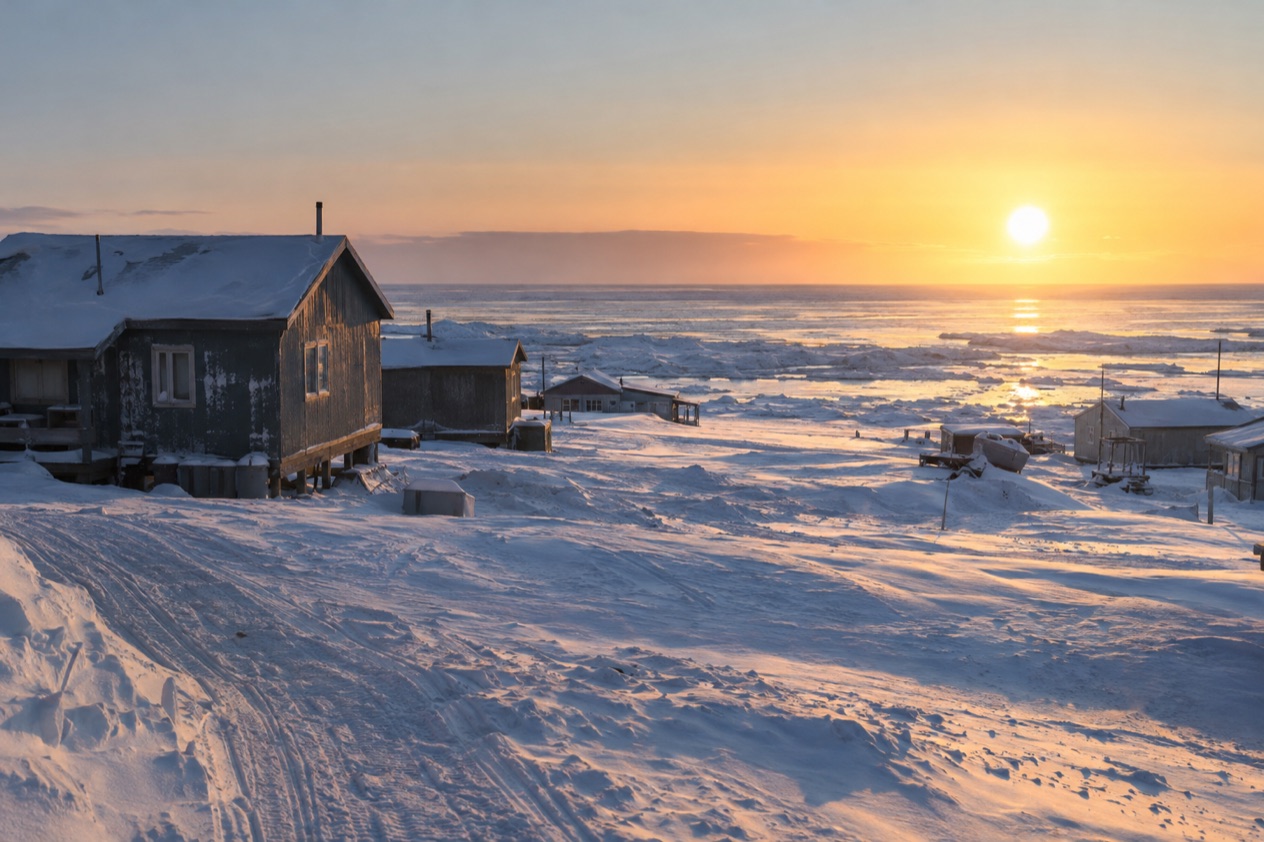
In March the sun is back over Utqiagvik for most of the day, and it throws a hard white light across a frozen sea and a town of snow-packed streets. Snow machines and pickups with exhaust trailing in the cold hurry between houses, and everything is far quieter than the postcard summer image of the Arctic. This is the northernmost city in the United States, and March is a month for travelers who want deep winter cold together with days that finally feel like days.
What is the weather like in Utqiagvik in March?
March in Utqiagvik is bitterly cold and very dry, with bright, long days and nights that still drop far below zero.
| Month | Average high (°F) | Average low (°F) | Precipitation (in) | Days with precipitation | Daylight on the 15th |
|---|---|---|---|---|---|
| February | -5.5 | -18.3 | 0.21 | 0.3 | 6 h 46 min |
| March | -3.8 | -17.2 | 0.18 | 0.4 | 11 h 23 min |
| April | 10.6 | -2.5 | 0.18 | 0.4 | 16 h 21 min |
The afternoon never really warms up. Even at the warmest hour of the day the air stays well below zero, so the walk from a car to a front door is something you feel in your face and fingers. Nights are colder still, and the difference between day and night is small enough that you dress the same way from morning to bedtime: heavy, windproof and layered.
Precipitation is rare, and what falls is snow, light and powdery. Days with any at all are few, though snow already on the ground can still blow around and cut visibility when the wind picks up. A sunny day here is not a warm one, and a gray day can feel as if the horizon has vanished, with sky and snow melting into the same pale tone.
The light is the real change of the month. After a February with short days, March gives you a long bright stretch in the middle of the day and a darkness that returns only at night. Mornings come with a low, pinkish sun, and the evenings linger in a way that invites an after-dinner walk. The sea is frozen white, and the town sits at its edge without a visible shoreline.
What to do in Utqiagvik in March
What you do here in March is mostly about taking in a place that exists at the edge of the map: the scale of the ice, the quiet, and the Iñupiat community that has lived on this coast for generations. With about 5,000 residents, Utqiagvik is the largest U.S. settlement north of the Arctic Circle, yet it feels like a small town where everyone knows the pickup in front of them.
The days are long enough to be out, and the cold is steady rather than stormy, so outings tend to be short and well planned. Many of the best moments are simple: standing on the edge of town with the ice running to the horizon, listening to how little there is to hear, and watching how the sky changes color as the sun swings low.
The town and its Iñupiat roots
Start with the people. Utqiagvik is an Iñupiat town, and the name itself is Iñupiaq, restored in place of the older Barrow. The Iñupiat Heritage Center is the natural place to understand the whaling culture, the skin boats, the clothing and the stories that tie the community to the sea ice. A morning there sets the rest of the visit in context.
Afterward, walk through the streets of town with that background in mind. You will notice whale bone arches, drying racks, sleds parked beside houses and the practical, weatherproof look of buildings made for this climate. It is a living town, not a museum, so a friendly nod to whoever passes goes a long way.
The Iñupiaq language is heard less than it once was, and community efforts to keep it alive are part of daily life in the Arctic. Visitors who listen more than they talk usually come away with the best impressions of the place.
Ice, light and the edge of the Arctic Ocean
At this time of year the light is clear and sharp, and the horizon often looks like a line drawn between pale blue and pale gray.
Stand there for a while, wrapped up, and let your eyes adjust. Pressure ridges, drifts shaped by wind and the soft color shifts of low sun are the show. Polar bears are an animal of this coast, and a rare chance sighting is possible, but never something to count on or to look for on your own.
A chance at the northern lights
With nights that are still long enough, March is a month when the aurora may appear. The northern lights oval covers most of Alaska, and activity tends to be stronger around the spring equinox than at midwinter or midsummer, which makes this time of year a decent bet.
It is a chance, though, not a promise. Clear skies matter, and so does patience. Step outside after dark, give your eyes time to adapt, and keep warm. Some nights bring a faint glow, others a moving curtain of green, and some bring nothing but stars over the snow.
Along the way, expect indoor time as well. Warm rooms, hot drinks and conversation in a small Arctic town are part of the experience, and a day in March usually balances a few short outings with long, cozy pauses between them.
A two-day itinerary for Utqiagvik in March
Day 1 is for getting your bearings. Take a slow morning with breakfast and a warm layer system, then step outside once the light is well up. A walk through town gives you the grid of streets, the whale bone arches and the feel of a community built around the cold. Keep it unhurried, because even short outdoor stretches in this air are tiring.
Around midday, head to the Iñupiat Heritage Center for its exhibits on whaling, clothing and traditions. It is the right place to be when the sun is highest and the air is at its mildest. Have lunch in a local restaurant afterward, then spend the afternoon walking to the shore to see the sea ice in strong light.
In the evening, eat a hot dinner in town and then step outside after dark. If the sky is clear, the aurora may put on a show. If clouds or blowing snow roll in, stay in, rest and warm up. The rain card here is really a snow card: when visibility drops, return to indoor stops and wait for it to clear.
Day 2 is for the quieter corners. Begin with a late breakfast and use the bright hours for a longer walk along the edge of town, where the ice and the horizon are best. The long afternoon light gives you time to take photos in layers, with spare gloves close at hand.
After a break indoors, spend the later afternoon at the town’s shops and community spots, where you can see what daily life looks like here. Arctic towns are generous when you are curious and respectful. Finish with dinner and another look at the night sky, and let the evening end on whatever the weather gives you.
Is Utqiagvik busy in March?
Utqiagvik is quiet in March, a working Arctic town of about the same size every month rather than a place with a visitor rush. The pace is set by residents going to work, school and community events, and the cold keeps the streets calm.
For a traveler, that means you are a guest in a small place rather than part of a crowd. Conversations come easily, and the streets and the shoreline feel like they belong to the town. Plan your days around the sun and the weather, because those matter far more here than any line or crowd.
What to pack for Utqiagvik in March
Bring clothing built for steady cold, because every outing here, even a short one, happens at well below zero.
- A heavy, windproof parka, because the air is far below freezing even at midday.
- Insulated boots with warm socks, since you will be standing on packed snow.
- Thin base layers and a fleece, to build warmth you can adjust indoors.
- Insulated mittens plus thin liner gloves, for photos without bare hands.
- A face covering and warm hat, for the cold on your cheeks and nose.
- Sunglasses, because the sun on snow is bright.
Good to know before you go
March gives you real daylight again, which is the best planning tool for the trip. Use the bright middle of the day for being outside and keep the evenings for warm rooms and, with luck, the sky. The cold is steady, so how you dress matters more than when you go out. This is a small town at the top of the country, and a relaxed pace suits both the place and the weather.
Utqiagvik in March vs February and April
Moving four weeks earlier brings you into a darker, shorter stretch. February has far less daylight, and the sun spends only a brief time above the horizon. It is a good month for the aurora but a tougher one for outdoor time, since the light is limited and the cold is just as deep.
Moving four weeks later changes the feel completely. April has long days, and the air is noticeably milder, though still below freezing. The sea remains ice, but the long light brings more time outdoors and a lighter mood in town. The darkness needed for the aurora is harder to find as the days stretch.
Choose February if the night sky is your priority and you can handle short days. Choose April if you want long light and slightly gentler cold. Stay with March if you want a balance: bright days, dark nights, and a deep-winter feel without the shortest days.
Is March a good time to visit Utqiagvik?
Yes, March is a good time for travelers who want the Arctic in winter without spending most of the day in the dark. Those who love stark landscapes, quiet towns and a real feeling of distance will find the month rewarding.
It is less suited to anyone who needs warmth, lots of activity or a packed schedule. The cold is serious, and the town is small. If that sounds like a fair trade for sea ice, big light and a chance at the northern lights, March delivers.
On arrival, give yourself a slow first day. Dress fully before stepping out, take a look at the town in daylight, and let your body adjust to the cold. March in Utqiagvik is the moment when the sun returns to the top of the country, and you get to watch it do so over a frozen ocean.
Sources
- NOAA NCEI, U.S. Climate Normals 1991-2020, monthly (https://www.ncei.noaa.gov/access/services/data/v1?dataset=normals-monthly-1991-2020&stations=USW00027502), station Barrow Post Rogers Ap, elevation 31 feet, checked October 11, 2026
- Computed from the date and the latitude of the place (sunrise equation, solar elevation -0.833 degrees), October 11, 2026
- University of Alaska Fairbanks Geophysical Institute, Aurora forecast (https://www.gi.alaska.edu/monitors/aurora-forecast), checked October 11, 2026
- Wikivoyage, Northern lights (https://en.wikivoyage.org/wiki/Northern_lights), checked October 11, 2026
- Wikipedia, Aurora (https://en.wikipedia.org/wiki/Aurora), checked October 11, 2026
- Visit Anchorage, northern lights viewing (https://www.anchorage.net/winter/things-to-do/northern-lights-viewing/), checked October 11, 2026
- Wikipedia, Inupiat (https://en.wikipedia.org/wiki/Inupiat), checked October 11, 2026
- Wikipedia, Prudhoe Bay, Alaska (https://en.wikipedia.org/wiki/Prudhoe_Bay,_Alaska), checked October 11, 2026
- Wikipedia, Arctic Circle (https://en.wikipedia.org/wiki/Arctic_Circle), checked October 11, 2026
- Wikipedia, Polar bear (https://en.wikipedia.org/wiki/Polar_bear), checked October 11, 2026
- Wikipedia, Polar night (https://en.wikipedia.org/wiki/Polar_night), checked October 11, 2026
- Wikipedia, Climate of Alaska (https://en.wikipedia.org/wiki/Climate_of_Alaska), checked October 11, 2026