
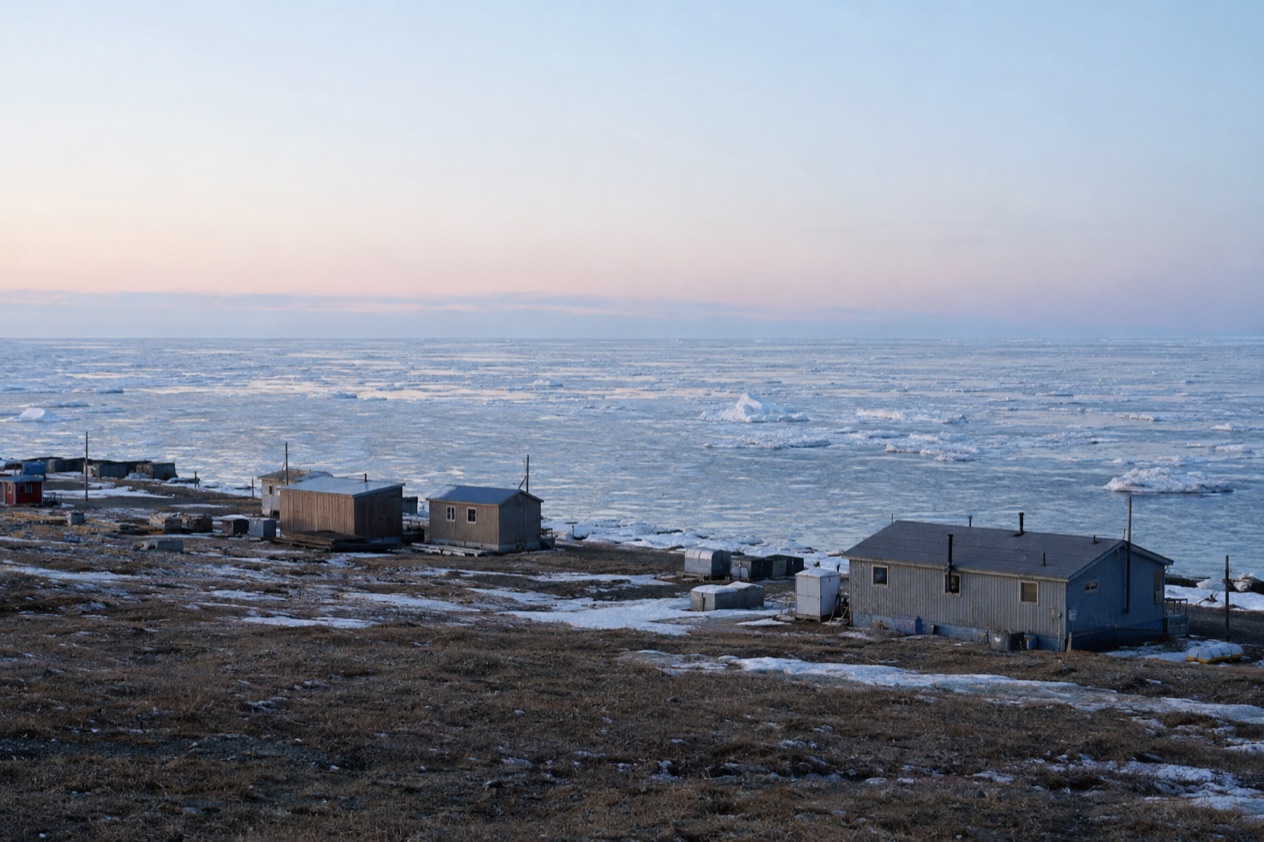
On a summer evening in Utqiagvik the sun slides along the horizon without ever setting, and the streets, the whale-bone arch and the tundra past the last houses all turn the same pale gold. Winter brings the opposite show, a long dark when window light glows against the snow and the Arctic Ocean goes quiet under ice. This is the northernmost town in the United States, a place of Iñupiat life, whaling tradition and sheer distance, made for travelers who want the top of the map rather than a resort.
Where is Utqiagvik and what is it like?
Utqiagvik sits on the shore of the Arctic Ocean in Arctic Alaska, 300 miles above the Arctic Circle, and it is the northernmost settlement in the United States and on the North American mainland. It belongs to the North Slope, the region that lies along the Chukchi Sea and the Beaufort Sea on the far side of the Brooks Range from the rest of the state. The town was long known as Barrow, and you will still see the old name on older maps and in older books.
With a population of 4,927 in the 2020 census, it is a real town rather than a village, the largest U.S. settlement north of the Arctic Circle. Most residents are Iñupiat, and the rhythm of the year follows the seasons of hunting and fishing as much as the calendar. Whales, seals, walrus and caribou are part of daily life here, and the town feels shaped by the land and the ice around it.
The pace is unhurried, and the place is plain in the best sense. You come for the horizon, the light, the people and the sense of standing at the edge of a continent, roughly 1,300 miles from the North Pole. Travelers who want restaurants, nightlife and a long list of sights may find it quiet.
It also helps to know that Utqiagvik is a damp town, which means the sale of alcohol is prohibited while bringing it in and drinking it are allowed. Beyond that, the character of the place comes from the Iñupiat community and from the Arctic itself, which sets the schedule for almost everything. For the right traveler, the lack of polish is exactly the appeal.
The North Slope around the town is a coastal plain with the densest concentration of birds in the Arctic, along with whales, walrus, seals, caribou and moose in the wider region. That is the setting you are stepping into: open, low and enormous, with weather and light doing most of the talking.
What is there to do in Utqiagvik?
The reasons to come are the light, the culture, the Arctic Ocean shoreline and the feeling of having reached the end of the road, even though no road leads here. What sets Utqiagvik apart from other Alaska destinations is that nothing is staged for you. You are visiting a working Iñupiat town at the edge of the Arctic Ocean.
Iñupiat culture and the whaling tradition
Iñupiat people still rely heavily on subsistence hunting and fishing, taking seal, walrus, caribou, fish and whales according to the season. When a whale is landed, it benefits the whole community, because the meat and blubber are shared out by a traditional formula. Behind the quiet streets there is a web of obligation and generosity that has lasted for generations.
Visitors can learn about the language too, which is spoken today by only a small share of Iñupiat, mostly elders. Listen with respect, ask before photographing people, and let the community set the terms of any encounter.
Midnight sun and polar night
Light is the headline attraction. In summer the sun stays above the horizon for 84 days, so evenings stretch into a soft, endless glow, and you can wander the shoreline at hours when other places are asleep. In winter the opposite happens, and the sun sets on November 18 and does not return until January 23.
Polar night is a mood as much as a phenomenon. Lit windows, snow and a cold clear sky make the town feel very small and very warm inside. You may see twilight glow at the edge of the day in the weeks around the dark, while the stars stay out for hours.
A guided tour of the tundra
Tundra Tours Inc. runs one tour a day during the summer season. It is the simplest way to see the land and the town through local eyes, with someone who knows the shoreline and the tundra around the settlement.
| Tour | Season | Time |
|---|---|---|
| Tundra Tours Inc. | Summer season | Starts 10:00 AM, ends around 2:30 PM |
The tour fills a good part of a day, so it pairs well with a slow afternoon of walking the town and the water’s edge. Expect to see open tundra, the Arctic Ocean and the low, wide landscape that defines the coastal plain.
Wildlife and the Arctic coast
The North Slope coastal plain is home to whales, walrus, seals, caribou and moose, and a huge number of birds. You may see some of them, but nothing here is guaranteed, and the Arctic keeps its own schedule. Even without a sighting, the shoreline, the ice and the sky are the point.
Polar bears are part of the wider story of the region. In the Chukchi and Beaufort seas, a share of the bears come onto land in summer when the sea ice disappears. Travelers who want to see them often look to Kaktovik, a separate community on Barter Island, rather than Utqiagvik itself.
How many days do you need in Utqiagvik?
A long weekend is enough to feel the place, and two or three days is a comfortable stay for travelers.
With a couple of days you can do the essentials. Spend one on the daily Tundra Tours outing in summer, with the rest of the day for walking the town and watching the light play along the water. Spend another learning about Iñupiat life, whaling and the language, at whatever pace the community allows.
With more time, the trip becomes about slowing down. You can return to the shore at different hours, which matters in a place where the sun may never set or never rise. A winter stay is a different kind of visit, built around dark days, cold air and the warmth of indoor gatherings.
If you want to stretch your journey across the North Slope, Alaska Airlines flights also connect Utqiagvik with Deadhorse. That is the gateway to Prudhoe Bay, where visitors come for the tundra, the Arctic Ocean and the midnight sun. Combining the two gives you two very different Arctic outposts, one a long-established Iñupiat town and the other an oil-field settlement with lodgings assembled from modular buildings. Anchorage and Fairbanks, the two cities with flights north, make natural stops before or after, and they bring a very different Alaska into the same trip.
Where to stay in Utqiagvik
You stay in the town itself, because Utqiagvik is the only settlement of its size for a very long way in any direction. There is no resort district to choose from and no neighboring beach town, so your base is simply the community. That has a charm of its own, because you wake up in the place you came to see.
Think about what you want from the stay rather than which neighborhood to pick. If you come in summer, you will want to be close to the shoreline and the tundra edge, where the light at the end of the evening is the show. If you come in winter, you will want a warm, comfortable base, since you will spend long hours indoors while the dark settles over town.
A stay here suits travelers who value a real encounter with a community over amenities. It is less suited to anyone who wants a long list of dining options or a busy street scene. The town’s damp law is worth knowing too, because alcohol cannot be bought locally, although visitors may bring it in and drink it.
For a different flavor of Arctic lodging, Prudhoe Bay and Deadhorse offer rooms in modular buildings, set up mainly for the oil field and for the visitors who come to see the tundra and the midnight sun. It is a worksite settlement rather than a town, and it makes a contrast with the lived-in character of Utqiagvik. Travelers also overnight in Anchorage or Fairbanks on the way in or out, using those cities as the start and end of the journey.
How do you get to Utqiagvik and get around?
You get to Utqiagvik by plane, because there are no roads or rails into town. Alaska Airlines offers several daily flights from Anchorage, Deadhorse and Fairbanks to Wiley Post–Will Rogers Memorial Airport, the airport code of which is BRW.
The lack of a road is part of the experience. The North Slope is cut off from the rest of the state by the Brooks Range, and the region relies mostly on waterways and small airports. The only highway connecting the area to the rest of Alaska is the Dalton Highway, which runs between Fairbanks and Prudhoe Bay, 495 miles to the south of Deadhorse’s far end.
That highway does not reach Utqiagvik, so a traveler who drives it must still fly the rest of the way north. Tour buses make the Dalton Highway trip from Fairbanks as a two-day journey with an overnight stop in Coldfoot. From Deadhorse, the flight connects you to Utqiagvik.
Once you are in town, the same isolation shapes how people live. Because nothing connects Utqiagvik to a wider road network, everything arrives by air or by water, and the town’s world is the town itself. Plan your days around where you are staying and what you came to see, and let local people guide you on the rest.
When is the best time to visit Utqiagvik?
Air temperatures stay cool, with highs only in the upper 40s, so the warm season here is a relative idea.
| Month | Average high (°F) | Average low (°F) | Precipitation (inches) | Days with precipitation | Snowfall (inches) |
|---|---|---|---|---|---|
| January | -5.2 | -17.8 | 0.14 | 0.2 | 3.5 |
| July | 47.7 | 35.6 | 0.98 | 3.3 | 0.2 |
Winter is a completely different trip. January is brutally cold, well below zero even in the afternoon, and the sun is gone from November 18 to January 23. It is dry, with very little precipitation falling as light snow, and the air is crisp. Visiting then is for travelers who specifically want polar night and are ready for the cold.
Since it is October now, the sun is already shortening its days, and the long dark is on its way. The autumn months are a time of transition, in between the midnight sun and the polar night, with the seasons turning quickly. Early summer brings the celebrations that follow the spring whale hunt, a good moment for anyone interested in Iñupiat culture, though dates vary from year to year.
Good to know before you go
Utqiagvik is a damp town, so alcohol cannot be bought there, though you may bring it in and drink it. Daylight shapes everything. In winter the sun is below the horizon from November 18 to January 23, and in summer it stays up for weeks. Respect the community, ask before photographing people, and remember that you are visiting a home, not a theme park.
Sources
- Wikivoyage, Utqiagvik (https://en.wikivoyage.org/wiki/Utqiagvik), checked October 11, 2026
- Wikipedia, Utqiagvik, Alaska (https://en.wikipedia.org/wiki/Utqiagvik,_Alaska), checked October 11, 2026
- Wikipedia, Polar night (https://en.wikipedia.org/wiki/Polar_night), checked October 11, 2026
- Wikipedia, Midnight sun (https://en.wikipedia.org/wiki/Midnight_sun), checked October 11, 2026
- Wikipedia, Alaska North Slope (https://en.wikipedia.org/wiki/Alaska_North_Slope), checked October 11, 2026
- Wikipedia, Inupiat (https://en.wikipedia.org/wiki/Inupiat), checked October 11, 2026
- Wikipedia, Prudhoe Bay, Alaska (https://en.wikipedia.org/wiki/Prudhoe_Bay,_Alaska), checked October 11, 2026
- Wikipedia, Arctic Circle (https://en.wikipedia.org/wiki/Arctic_Circle), checked October 11, 2026
- Wikipedia, Polar bear (https://en.wikipedia.org/wiki/Polar_bear), checked October 11, 2026
- Wikipedia, Climate of Alaska (https://en.wikipedia.org/wiki/Climate_of_Alaska), checked October 11, 2026
- NOAA NCEI, U.S. Climate Normals 1991-2020, monthly (https://www.ncei.noaa.gov/access/services/data/v1?dataset=normals-monthly-1991-2020&stations=USW00027502), station Barrow Post Rogers Ap, elevation 31 feet, checked October 11, 2026
All our pages
When to go
- Best Time to Visit Utqiagvik: Midnight Sun, Polar Night and Weather by Month
- Utqiagvik in January: Polar Night, Deep Cold and the Northern Lights
- Utqiagvik in February: Returning Daylight, Deep Cold and What to Do
- Utqiagvik in March: Weather, Daylight, Aurora Chances and What to Do
- Utqiagvik in April: Weather, Growing Daylight and What to Do
- Utqiagvik in May: Midnight Sun, Spring Whaling Season and What to Pack
- Utqiagvik in June: Midnight Sun, Nalukataq and Tundra Weather
- Utqiagvik in July: Midnight Sun, Tundra Weather and What to Do
- Utqiagvik in August: Weather, Long Evenings and What to Do
- Utqiagvik in September: Weather, Daylight, Fall Light and What to Do
- Utqiagvik in October: Weather, Shrinking Daylight and Life at the Top of the Country
- Utqiagvik in November: Fading Daylight, Deep Cold and What to Do
- Utqiagvik in December: Polar Night, Weather and What to Do