
NEGRIL · THE 12-MONTH VERDICT · 18.27° N
Negril sits on Jamaica’s western tip, seven miles of sand on one side of town and limestone cliffs on the other, and it has the enviable problem of being pleasant in all twelve months. Average highs move only 4.7°F across the year, from 82.0°F in January to 86.7°F in July. The sea never drops below the low eighties. What changes, and changes hard, is the rain.
That gap is the whole decision. January averages 0.63 inches of rain across 1.4 days wet enough to record 0.10 inch. September averages 4.43 inches across 11.8 such days, and it carries the statistical peak of the Atlantic hurricane season on September 10. Choose your week from the rain column rather than the temperature column, because the temperature column barely moves.
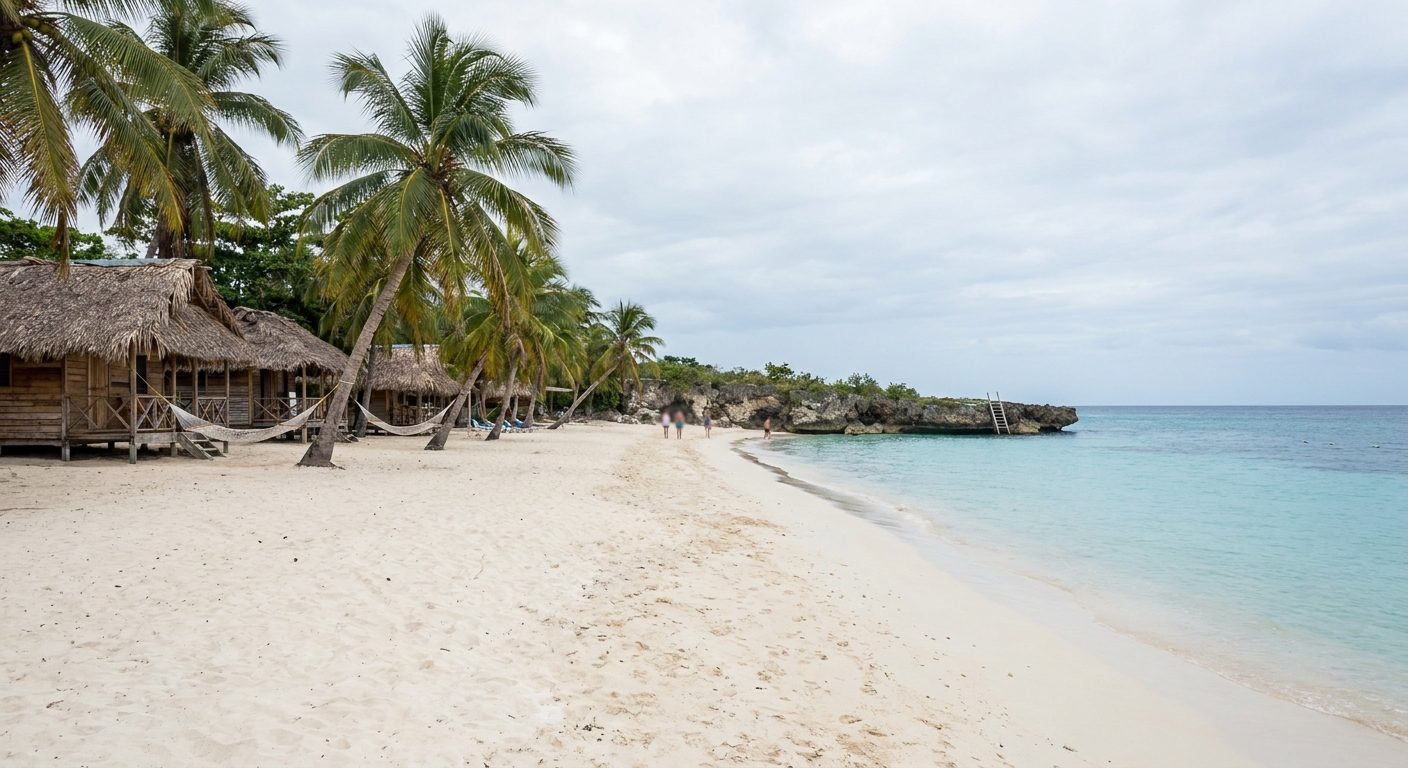
THE YEAR AT A GLANCE · NEGRIL
Come between January and April: March gives 83.3°F days, 0.95 inches of rain over about two wet days and a sea averaging 82.6°F, with the storm months safely behind and ahead of it.
BEST WINDOW: JAN–APR · DRIEST: JANUARY, 0.63 IN · WETTEST: SEPTEMBER, 4.43 IN · SEA 81.7°F TO 88.9°F
Go for: dry-season beach days between 82°F and 85°F, water above 81°F in every month of the calendar, and the sunset ritual off the West End cliffs.
Think twice before: booking September or October non-refundable: those two months average 11.8 and 11.9 days of measurable rain, inside the season’s most active stretch.
Normals: Open-Meteo / ERA5 grid cell · Sea: Open-Meteo Marine · Storms: NOAA NHC · full sources at the end
On this page
- Negril month-by-month weather tableHighs, lows, rain days and sea
- The best month to visit NegrilMarch, with the numbers
- Sea temperature for swimming81.7°F in February, 88.9°F in September
- The quiet months in NegrilLate August through October
- The month to avoidSeptember, 11.8 wet days
- Hurricane season dates for JamaicaJune 1 to November 30, and the booking rules
- When to visit Jamaica overallThe island-wide calendar
- Is the shoulder season worth it in Negril?The months either side of high season, in figures
Negril faces west, which is why its evenings sell postcards, and it sits low and flat compared with the north coast resorts. Nothing in the figures below is dramatic: no cold snap, no monsoon wall. The year turns on wet days, on how warm the water gets, and on whether your dates fall inside the storm window.
Negril weather month by month: highs, lows, rain and sea
| Month | Avg high | Avg low | Rain | Days ≥ 0.10 in | Sea |
|---|---|---|---|---|---|
| January | 82.0°F | 73.9°F | 0.63 in | 1.4 | 82.7°F |
| February | 82.6°F | 73.6°F | 0.75 in | 1.3 | 81.7°F |
| March | 83.3°F | 74.0°F | 0.95 in | 1.9 | 82.6°F |
| April | 84.7°F | 75.5°F | 1.33 in | 3.0 | 84.7°F |
| May | 85.0°F | 76.9°F | 3.92 in | 10.3 | 86.2°F |
| June | 86.0°F | 78.3°F | 2.80 in | 7.7 | 86.3°F |
| July | 86.7°F | 78.7°F | 2.60 in | 7.8 | 87.5°F |
| August | 86.6°F | 78.9°F | 3.37 in | 10.2 | 88.7°F |
| September | 85.8°F | 78.7°F | 4.43 in | 11.8 | 88.9°F |
| October | 84.2°F | 77.8°F | 4.39 in | 11.9 | 88.4°F |
| November | 83.3°F | 76.6°F | 2.02 in | 4.4 | 86.3°F |
| December | 82.6°F | 75.2°F | 0.90 in | 1.7 | 84.3°F |
The table splits the year cleanly in two. From December through April, monthly rain stays between 0.63 and 1.33 inches and wet days stay under three. From May through October, every month except June and July logs ten or more days with at least 0.10 inch, while the daytime high never varies by more than a degree and a half across that entire stretch.
Two hinges do all the work. April to May is the first: 1.33 inches over 3.0 wet days becomes 3.92 inches over 10.3, so the rain nearly triples and the wet-day count more than triples in four weeks. October to November is the second, running the other way: November keeps barely a third of October’s wet days, 4.4 against 11.9, and drops the rain total from 4.39 inches to 2.02.
September is the year’s most awkward month, and it is awkward for a specific traveler: the one with fixed dates, a single week and a non-refundable booking. It averages 4.43 inches over 11.8 wet days, and September 10 is the climatological peak of the Atlantic hurricane season, with most activity falling between mid-August and mid-October. A flexible traveler with a rebookable fare experiences the same month very differently.
One caveat matters before you plan around any of it. Every figure here for air temperature and rain comes from a 1991 to 2020 model reanalysis of the grid cell at 18.2683° N, 78.3475° W, not from an airport station on the ground, so treat it as the shape of the local climate rather than a reading taken in Negril. Days with an inch or more of rain never reach a full day in any month, October’s 0.5 being the annual maximum. Sea figures come from a separate marine dataset.
When is the best time to visit Negril?
March. Days average 83.3°F with nights at 74.0°F, rain totals 0.95 inches spread over 1.9 days wet enough to measure, the sea averages 82.6°F, and mid-month gives 12 hours 5 minutes of daylight. It also sits a long way from both ends of the hurricane season, which does not open until June 1 and closes on November 30.
Its neighbors each lose something. April warms the water usefully, to 84.7°F, but brings 3.0 wet days and 1.33 inches, half again as much rain as March. February is drier still, at 1.3 wet days, and yet it holds the coolest sea of the year at 81.7°F and 11 hours 35 minutes of daylight, a full half hour less than March. March takes the middle of that trade.
For the rest of the country, where the Blue Mountains and the north coast follow different rules, start with the island-wide calendar. If your dates land between June and November, the hurricane season guide carries the booking and insurance questions, and our post-Melissa update tracks what reopened. Packing for a wet-season week differs from packing for a dry one, which the packing list covers.
When can you swim in Negril? Sea temperature month by month
No month falls below the line most swimmers care about. February is the coolest at 81.7°F, January reads 82.7°F and March 82.6°F. From June through October the water sits at 86.3°F or above, peaking at 88.9°F in September, 88.7°F in August and 88.4°F in October. The full annual spread is 7.2°F, which means the difference between a winter swim and a late-summer one is real but never a question of whether you go in.
Read those numbers as afternoon values. Each one is the mean of daily maxima over 2015 to 2024, so it describes the warmest point of a typical day rather than a 24-hour average, and it runs a shade above what a round-the-clock mean would show. A 7am swim off the West End in February will feel a touch below 81.7°F. By four in the afternoon it will not.
When is Negril quietest?
The calendar answers this better than any price table. Jamaica’s resort coasts run their busy block from mid-December through mid-April, the same window as the dry months, and the beach empties in the long stretch from late August into October. That quiet period sits on top of the hurricane season’s most active weeks, mid-August to mid-October. We carry no price series for Negril, so this is a statement about the calendar and nothing more.
What you gain in those weeks is measurable. The sea is at its annual warmest, 88.9°F in September and 88.4°F in October. Daylight runs longer than in the winter peak: 12 hours 16 minutes in mid-September against 11 hours 11 minutes in mid-January, better than an hour of extra evening. Seven Mile Beach at that point belongs mostly to whoever is standing on it.
What you give up is rain and certainty. September averages 11.8 wet days, October 11.9, roughly nine times February’s 1.3. Both months fall inside the storm window, which forces refundable fares, travel insurance and a willingness to lose an afternoon. Anyone building a fixed budget around those weeks should read what a Jamaica trip costs with cancellation in mind.
Which month should you avoid in Negril?
September, and only for a certain traveler. If you have one week, fixed school dates and flights you cannot move, this is the month that can take your trip apart: 4.43 inches of rain across 11.8 wet days, the season’s peak on September 10, and a coast that watches the tropics for the whole month. Nobody avoids Negril in the absolute. People avoid September’s odds.
It redeems itself in two ways. Spread 4.43 inches across 11.8 wet days and the average wet day carries under half an inch, with days of an inch or more averaging just 0.3 for the whole month, so this is bursts of rain rather than gray weeks. And the water is at 88.9°F, the warmest reading of the year. Travelers with rebookable fares and loose plans get the emptiest beach in the calendar.
Negril shoulder season: months, rain and sea temperature
Two months sit on the edges of the dry block. April averages 84.7°F days, 1.33 inches of rain over 3.0 wet days, with the sea at 84.7°F. November averages 83.3°F, 2.02 inches over 4.4 wet days, sea at 86.3°F. Measured against March, the peak of the good weather at 1.9 wet days, both are wetter, and neither by an amount that reshapes a week.
The shoulder buys warmer water and longer evenings than the winter block delivers. November’s 86.3°F sea runs 3.7°F above March’s 82.6°F, and April’s 84.7°F is 2.1°F above it. Mid-April gives 12 hours 36 minutes of daylight, some 85 minutes more than mid-January. The beach in both months carries neither the holiday crush nor the empty-hotel feeling of October.
The cost is rain and one open question. November’s 4.4 wet days are more than double March’s 1.9, roughly two and a half extra wet days across a month, and the hurricane season stays technically open until November 30. April is clear of storms but still logs 3.0 wet days against March’s 1.9. May is not shoulder at all: 10.3 wet days and 3.92 inches put it firmly on the wet side.
Our call: take April if you want the dry-season guarantee with warmer water attached, and take the second half of November if the sea at 86.3°F matters more to you than two extra wet days. If you are still weighing Negril against the north coast for those dates, Negril versus Ocho Rios and Montego Bay versus Negril compare them directly.
The last word
Pick the dry block if you have any freedom at all, and pick March inside it. Then plan your evenings, because Jamaica keeps one clock all year with no daylight saving to shift it: the sun leaves the West End cliffs at 5:37pm in mid-November and at 6:54pm in mid-July, an hour and seventeen minutes of difference between the two versions of the same drink. Book the cliff bar accordingly.
Sources & data for this guide
- Monthly normals 1991-2020 for Negril: highs, lows, precipitation, days at 0.10 inch or more and days at an inch or more · Open-Meteo / ECMWF ERA5, model reanalysis for the grid cell at 18.2683° N, 78.3475° W, not an airport station reading · checked Sep 10, 2026
- Sea surface temperature off Negril, mean of DAILY MAXIMA over 2015-2024 · Open-Meteo Marine API · checked Sep 10, 2026
- Daylight, sunrise and sunset on the 15th of each month, converted to America/Jamaica · sunrise-sunset.org · checked Sep 10, 2026
- Atlantic hurricane season dates, the September 10 peak and the mid-August to mid-October active stretch · NOAA National Hurricane Center · checked Sep 10, 2026
- Editorial note: high and low season here are calendar statements, not price quotes. We hold no price series for Negril, so no month on this guide is ranked by cost.