
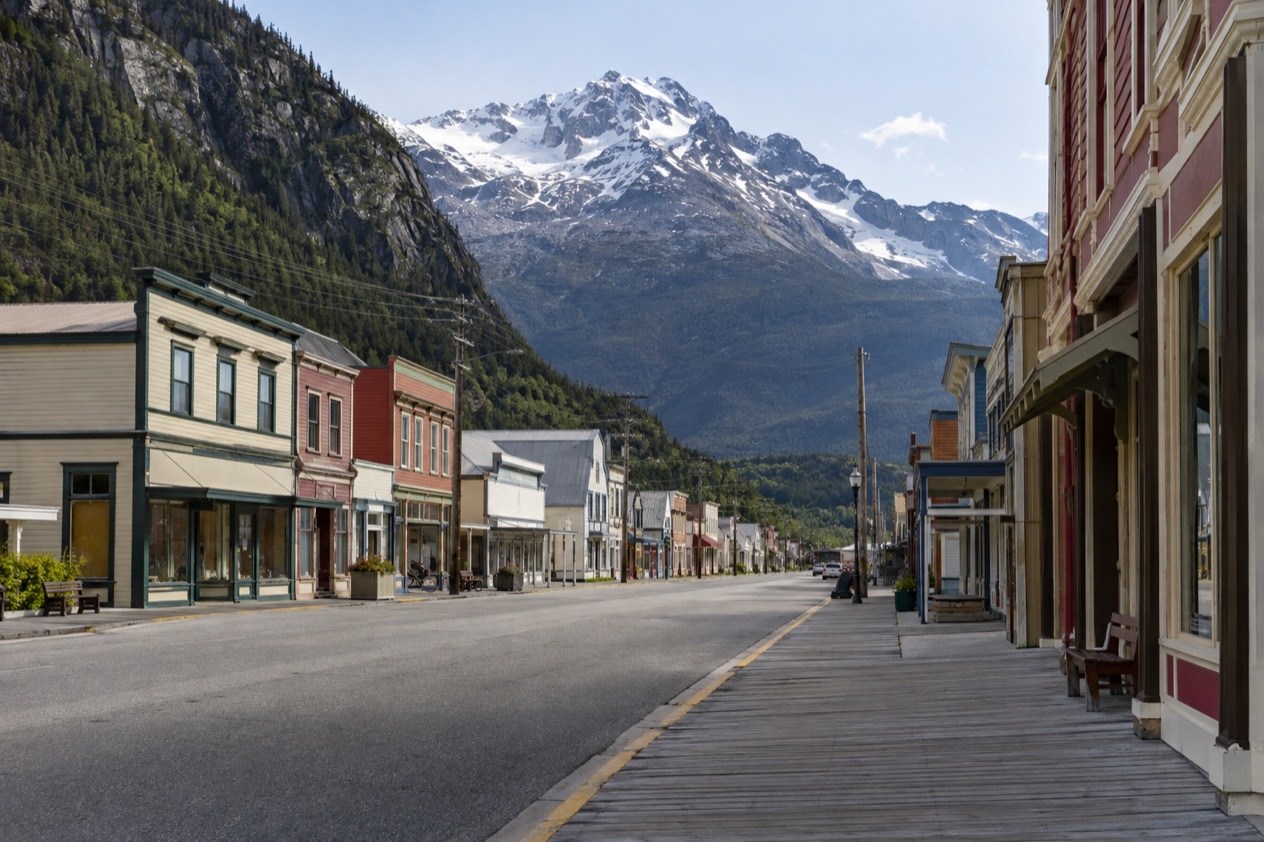
Early in the day, Skagway’s Broadway is a quiet street of false-front buildings and wooden boardwalks, with the old rail depot catching the first light. By midday the town can feel like a different place, with trains leaving the port and visitors drifting between shops and museums. The choice in a town this small is less about which neighborhood than about how close you want to be to the history, the tracks and the road out.
What is the best area to stay in Skagway?
For a first visit, stay around Broadway and the visitor center, because the gold rush story is right outside the door. If you are in town mostly to ride the White Pass and Yukon Route railroad or to catch the Alaska Marine Highway ferry, the port side of town makes the mornings simpler. If you are driving Highway 98 toward Whitehorse, a place that sits toward the road makes departures feel unhurried.
Families and travelers who want to explore on their own will like being close to the National Park Visitor Center, in the restored 1898 rail depot at 2nd and Broadway. Skagway has self-guided options and commercial tours alike, and a base near the center lets you mix the two without planning around a vehicle. Budget-minded travelers should think about the same question from the other direction: how much of the town you want at your front door against how much quiet you want at night.
Skagway is a town in Southeastern Alaska with a population of less than a thousand, so the areas here are not separate districts the way they are in a big city. They are three overlapping ways of being in the same small place.
One is the historic core around Broadway. Another is the working edge by the port, where the railroad starts and the ferry network ends. The third is the stretch tied to the one road out of town.
What changes from one to the next is mostly the mood. Near Broadway, the town feels like a preserved gold rush stage set that people actually live in. Near the port, you notice the machinery of getting people in and out: ships, a narrow gauge railroad, the northern end of the ferry line. Toward the highway, the outside world comes back into view, with the mountains and the long road to Yukon.
The season shapes all of it. The population of Skagway doubles in the summer tourist season, and the White Pass and Yukon Route runs purely for the tourist trade during the summer months.
Skagway is also a popular stop for cruise ships, and tourism is a big part of its business. Whatever your area, the town you meet depends on the month, and the quiet streets of the off-season are a different experience from the busy ones of high summer.
A last point on choosing: in a place with only one road to the rest of the continent, where you sleep matters less for sightseeing than for the way you arrive and leave. Think first about whether you come by ferry, by train from the port, or by Highway 98, and let the area follow from that. The sections that follow describe each area and how it fits those arrivals.
The best areas to stay in Skagway
Broadway and the historic center
This is the Skagway of postcards: the main street of a gold rush boomtown, lined with old wooden storefronts, saloon-style facades and the occasional costumed character. The anchor is the National Park Visitor Center in the restored 1898 rail depot at 2nd and Broadway. Staying near it means the park’s programs, tours and film are your neighbors, and the evening street, once the day visitors thin out, has a quiet old-town feel.
Lodging here tends toward historic-style small hotels, inns and guesthouses rather than large resorts, which suits the scale of the town. It is a good fit for first-time visitors, history lovers and couples who like to step out for dinner and come back without thinking about transport. Families can use the visitor center as a daily starting point, since ranger chats are offered daily on varying topics.
A practical tip: begin at the visitor center, as the park itself suggests. You will learn what is on that day, and the film Gold Fever: Race to the Klondike, shown in the theater there and lasting 24 minutes, sets up everything else you will see on the street outside. Light sleepers should ask about room placement, since a main street in a busy town has its own rhythm.
Near the port, the ferry and the train
The port is where Skagway’s story starts and, for many, where a visit begins. The White Pass and Yukon Route narrow gauge railroad starts at the port, and Skagway is the northern terminus of the Alaska Marine Highway System ferry network. The area carries the feel of arrivals and departures, with the mountains behind the harbor and the sound of the working waterfront.
It suits travelers whose trip is built around the railroad or the ferry, and anyone who likes to wake up and see the harbor. Because Skagway is a popular stop for cruise ships, this side of town is where the summer bustle gathers, so it is livelier than the rest and less of a hush.
A tip is to plan your railroad day with the departure point in mind. The train runs during the summer months only, so a stay near the port makes the most sense in that season. Outside it, the area is quieter, and the draw shifts to the ferry and the town’s history instead.
The Highway 98 side of town
Highway 98 is the only road access from Skagway to the rest of the continent. It leads to Whitehorse, Yukon, by way of Carcross, Yukon. A stay on this side of town suits travelers who are arriving or leaving by road, or who want a bit of distance from the main street and its summer crowds.
Here the feel is of a gateway rather than a set piece. You get the sense of a mountain town at the end of a long road, with the pass and the border country that gave the gold rush its drama. It is a sensible choice for road-trippers who want an early start, and for anyone who finds the center busier than they would like.
The tip here is about borders. Driving toward Whitehorse means crossing into Canada, so your documents matter on that leg of the trip. For the Skagway end, think of this area as the place to sleep, and the center as the place to spend the day, since the town is small enough that you are never far from either.
Skagway areas compared
| Area | Best for | Feel | Getting around |
|---|---|---|---|
| Broadway and the historic center | First visit, history, families | Gold rush main street, old-town evenings | Visitor center at 2nd and Broadway |
| Port, ferry and train | Railroad riders, ferry travelers, cruise visitors | Working waterfront, arrivals and departures | White Pass and Yukon Route starts at the port |
| Highway 98 side | Road-trippers heading to Whitehorse | Gateway to the pass, more room | Highway 98 via Carcross to Whitehorse |
The main trade-off in Skagway is between being in the middle of the story and being a step apart from it. Staying on Broadway puts the park, the shops and the old facades at your door, but it also puts you where the summer crowds pass. The edges of town give you a little more calm, at the cost of having to make a deliberate trip to the center.
Near the dock and the depot, the morning is the main event. Trains leave from the port, and the area is busy when ships are in. If you like watching a town work, you will enjoy it. If you want silence, you may prefer a place further from the harbor.
With a population of less than a thousand, Skagway does not offer the sprawl of choices of a larger resort town, so the decision is simpler than it looks. Choose the center for atmosphere, the port for the train and ferry, and the Highway 98 side for the road. None of these choices cuts you off from the others, because the whole town is small.
Seasons matter more than neighborhoods. The same street feels very different when the town’s population has doubled for the summer than it does in the months between October and May, when the national park asks winter visitors to read its separate guidance. Think about the version of Skagway you want to meet, then let the area follow.
How to choose your hotel in Skagway
Start with how you arrive. Skagway is the northern terminus of the Alaska Marine Highway System ferry network, the railroad starts at the port, and Highway 98 is the only road out. If you come by ferry, the port area spares you any extra step on arrival day. If you come by road, the Highway 98 side or the center both work, depending on how much quiet you want.
Next, think about what you want your days to be. If you plan to follow the park’s programs, sleep close to the visitor center and its ranger chats. If your day is the White Pass and Yukon Route, remember that the railroad operates purely for tourists during the summer months, so a stay timed to that season gives the trip its full shape.
Lodging in a town this size is mostly small-scale: historic-style hotels, inns, guesthouses and similar places rather than large resorts. Each property has its own character, so read its own description closely for rooms and amenities.
Families will find the center the most straightforward base, with the visitor center, the park film and the daily ranger chats all in the same place. Visitors who want to explore without a guide can do so, and those who prefer a structured day can use the commercial tours Skagway offers. M & M Tours is the only tour brokerage contracted by the Municipality of Skagway, which tells you something about how organized the town’s visitor trade is.
For travelers who value quiet, the question is the season. In summer, when the town’s population doubles and cruise ships call, expect a livelier street. Between October and May, the national park points visitors to its winter planning information, and the town takes on a calmer, more private character.
If mobility is a concern, ask each property about its entrance, floors and room layout directly, as an old-style building can differ from one to the next. Choosing the area nearest the visitor center keeps the day’s main stops close together.
Finally, match the stay to your route. A road-tripper heading for Whitehorse might choose the highway side, a railroad fan the port, and a history lover Broadway. Pick the one that matches the part of Skagway you came for, and the rest of the town will still be there when you step outside.
Good to know before you go
Skagway is reached by the Alaska Marine Highway System ferry, which ends here, or by Highway 98, the only road connection to the rest of the continent. The Skagway Convention and Visitors Bureau is the official visitor department and the place to start for local information. Once you arrive, the National Park Visitor Center at 2nd and Broadway is a good first stop for programs, tours and the park film.
Sources
- Skagway Convention and Visitors Bureau (https://www.skagway.com/), checked October 11, 2026
- Skagway, things to do (https://www.skagway.com/things-to-do), checked October 11, 2026
- Wikivoyage, Skagway (https://en.wikivoyage.org/wiki/Skagway), checked October 11, 2026
- Wikipedia, Skagway, Alaska (https://en.wikipedia.org/wiki/Skagway,_Alaska), checked October 11, 2026
- National Park Service, Klondike Gold Rush National Historical Park (Skagway), plan your visit (https://www.nps.gov/klgo/planyourvisit/index.htm), checked October 11, 2026
To plan your stay
- Best Time to Visit Skagway: Summer Trains, Chilkoot Trail Season, Weather and Quiet Months
- Things to Do in Skagway: Gold Rush History, the White Pass Railway and Dyea
- Skagway from Juneau: The Ferry Route, Highway 98 and a Day in Town
- Know Before You Go to Skagway: Ferry and Highway Access, Klondike Park, Weather and Bears